
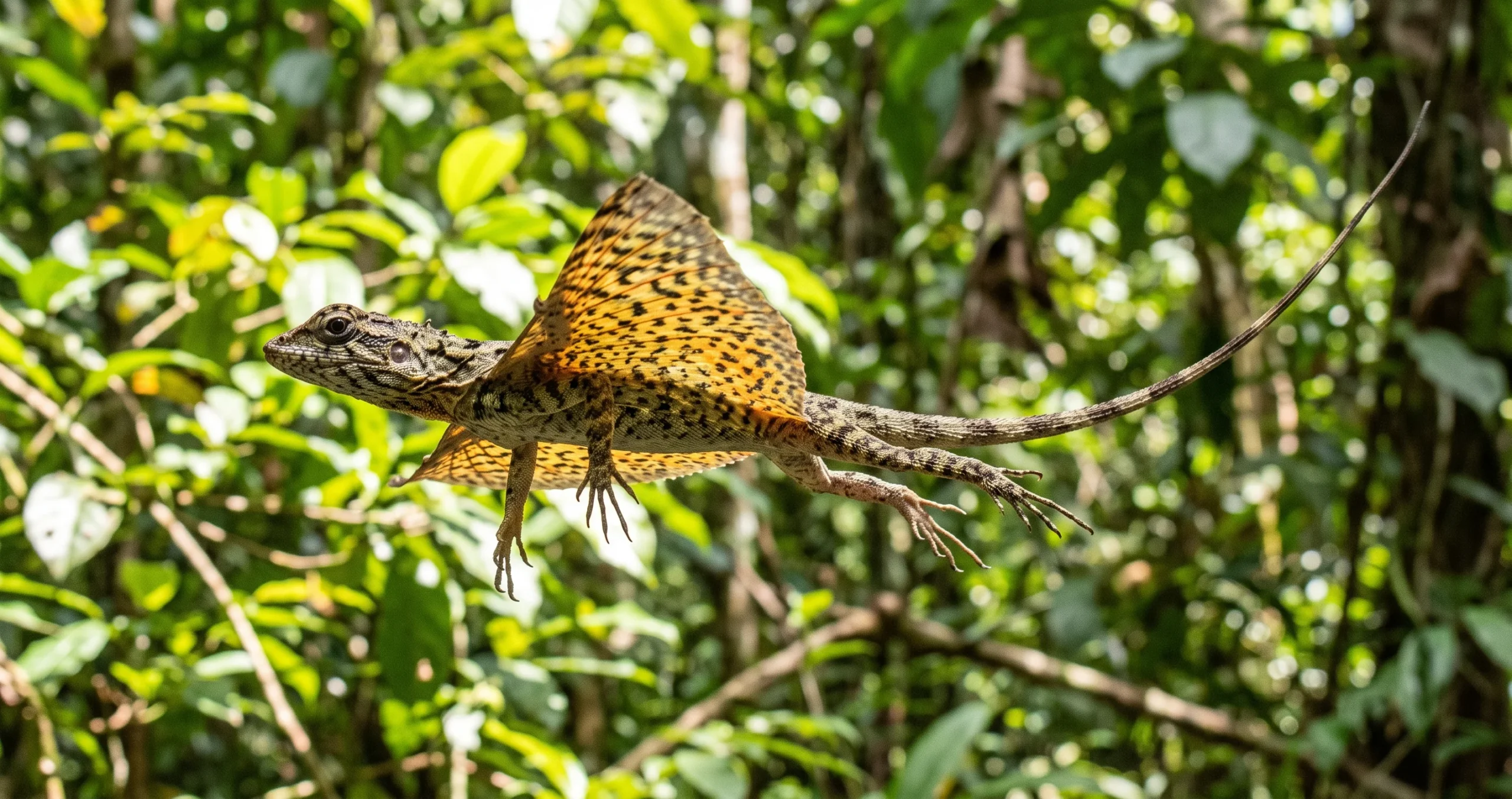
The tropical forests of Asia are home to a lizard that can launch from a tree and travel through the air using a structure unlike the wings of birds or bats. The secret behind Draco lizard gliding ribs is an expandable membrane called the patagium, supported by unusually elongated ribs extending from the sides of the body.
Draco lizards do not truly fly because they cannot generate powered flight by flapping wings. Instead, they convert height into forward movement. They leap from a tree, spread their rib-supported membranes, control their body in the air, and steer toward another trunk.
Even more remarkable, research has revealed that the lizard’s forelimbs actively help form and control this unusual wing.
Table of Contents
- What Is a Draco Lizard?
- Draco Lizard Gliding Ribs and the Patagium
- How the Rib-Supported Wing Opens
- The Surprising Role of the Forelimbs
- How a Draco Lizard Glides
- How Far Can Draco Lizards Glide?
- How Draco Controls Direction and Landing
- Why Gliding Evolved in Draco Lizards
- Does Body Size Affect Gliding?
- Draco vs. Other Gliding Animals
- Why Draco’s Wing Is So Unusual
- FAQ
- Conclusion
What Is a Draco Lizard?
Draco is a genus of arboreal agamid lizards native to parts of South and Southeast Asia.
They are commonly called flying lizards or flying dragons, although neither name is technically describing powered flight.
These reptiles spend much of their lives associated with trees. Instead of repeatedly climbing down to the forest floor and traveling between trunks, they can move through the air.
That lifestyle has produced one of the most specialized gliding systems among living reptiles.
The defining feature is the patagium: a broad membrane extending from each side of the body.
At rest, it folds against the lizard.
During a glide, it expands dramatically and becomes an aerodynamic surface capable of producing lift.
The unusual part is what holds that membrane open.
It is not primarily supported by elongated fingers, arms, or legs.
It is supported by the lizard’s ribs.
Draco Lizard Gliding Ribs and the Patagium
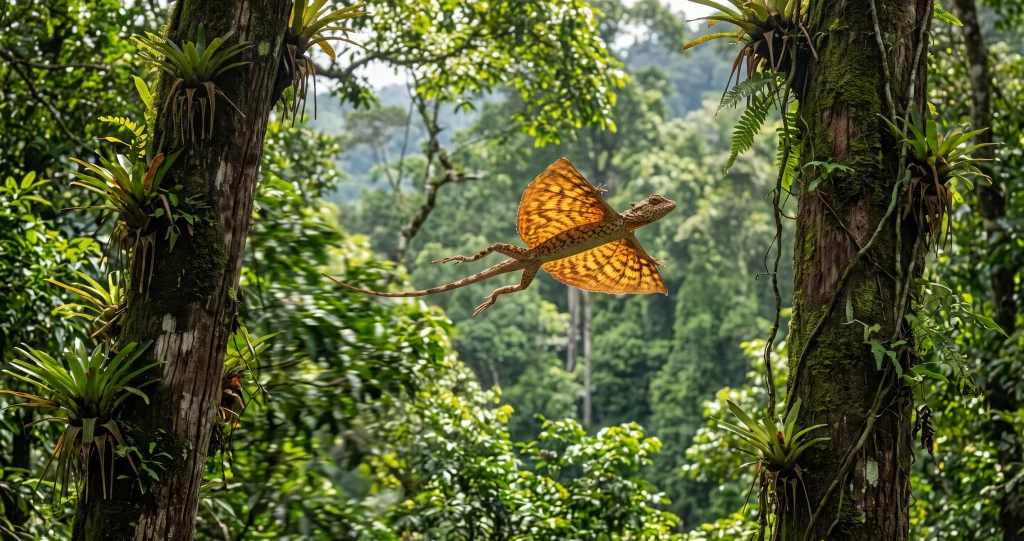
The anatomy behind Draco lizard gliding ribs is one of the most remarkable examples of skeletal specialization among living reptiles.
Draco’s patagium is supported by approximately five to seven greatly elongated thoracic ribs.
In an ordinary lizard, ribs mainly help support and protect the trunk. In Draco, several ribs have effectively acquired a second job.
They extend far outward from the body.
Skin stretched across these elongated structures creates a broad aerodynamic surface on each side of the lizard.
When folded, the membranes lie alongside the body and allow the animal to climb normally.
When the ribs spread outward, the patagium unfolds.
The result resembles a pair of wings extending laterally from the torso.
Research describing Draco’s flight anatomy identifies specialized intercostal and iliocostalis muscles associated with spreading these elongated ribs.
However, the ribs are only part of the story.
The lizard also uses its limbs to transform the expanded membrane into a controllable aerodynamic surface.
How the Rib-Supported Wing Opens
A glide begins while the lizard is still attached to a tree.
Once it commits to moving to another trunk, Draco launches itself outward.
Immediately after takeoff, its body accelerates forward and downward.
The elongated ribs then rotate outward, expanding the patagium.
The change is dramatic.
A relatively narrow climbing lizard suddenly has a much larger surface area interacting with the surrounding air.
Air moving around the expanded patagium generates aerodynamic forces that reduce the rate at which the animal falls and allow it to travel horizontally.
This is why the term “flying dragon” can be misleading.
The lizard is not generating continuous thrust like a bird.
Gravity supplies the energy.
Draco starts from an elevated position and gradually loses altitude while moving forward.
The rib-supported patagium allows it to convert that vertical drop into a controlled glide.
The Surprising Role of Draco’s Forelimbs
For centuries, illustrations often portrayed flying lizards gliding with their forelimbs extended independently in front of their bodies.
High-speed photography and field observations revealed something much more interesting.
During flight, Draco brings its forelimbs backward and uses its hands to grasp the leading edges of the patagium.
This temporarily connects two anatomical systems.
The ribs provide the internal framework supporting the membrane, while the forelimbs help control its outer leading edge.
Researcher J. Maximilian Dehling described this arrangement as a previously unknown type of composite wing.
The forelimbs and patagium are physically separate when the lizard is climbing. During the glide, they function together as an aerodynamic structure.
This also gives Draco greater control over the shape and orientation of its gliding surface.
It is an important reminder that Draco lizard gliding ribs are not acting alone. Successful flight depends on coordinated movement of the ribs, membrane, limbs, body, and tail.
How a Draco Lizard Glides
A typical glide can be divided into several stages.
1. Takeoff
The lizard pushes away from the tree trunk.
Observations of Draco dussumieri measured initial forward takeoff speeds of approximately 2 meters per second.
2. Acceleration
Immediately after leaving the tree, the lizard moves forward while also accelerating downward.
Its patagium begins opening.
3. Wing Formation
The elongated ribs spread the membrane while the forelimbs move into position along its leading edges.
The expanded structure begins functioning as an aerodynamic surface.
The trajectory becomes more horizontal.
4. Controlled Glide
Once the patagium is fully deployed, Draco can travel considerable horizontal distances while gradually losing height.
The lizard does more than passively fall.
Its posture, limbs, wing shape, and tail contribute to stability and control.
5. Landing
As the target tree approaches, Draco changes its body and wing orientation.
The animal pitches upward, reducing forward speed before making contact with the trunk.
It then lands feet-first and quickly resumes climbing.
The entire sequence turns a potentially uncontrolled fall into precise arboreal transportation.
How Far Can Draco Lizards Glide?
Claims about Draco gliding distances vary widely, partly because performance changes with species, body size, starting height, target position, and environmental conditions.
Direct field observations provide a useful reference.
In a detailed study of Draco dussumieri, documented horizontal glides ranged from approximately 2.2 meters to 26 meters.
Researchers also measured glides of 8 and 12 meters in which lizards reached maximum speeds of approximately 6.8 meters per second.
Those numbers demonstrate why gliding is useful even without spectacular long-distance flights.
A lizard does not need to cross an entire forest.
Moving several meters through the air may be enough to reach the next suitable tree without descending to the ground.
Some individuals have even demonstrated impressive maneuverability. Observations have recorded lizards changing direction substantially during flight, including one that turned almost 180 degrees and returned toward its original tree.
Glide performance also differs among Draco species.
Research comparing 11 species found that smaller species generally performed better than larger ones because increasing body size changes wing loading.
How Draco Controls Direction and Landing
Draco lizard gliding ribs provide the main lifting surface, but the animal must still control where that surface takes it.
That requires continuous adjustments.
Research on naturally gliding lizards has shown that Draco can select flight paths that reduce encounters with obstacles.
They do not simply leap in a general direction and hope for the best.
Their takeoff orientation can direct them away from obstacles, while adjustments during flight allow them to steer toward a target tree.
Researchers have recorded midair turns producing accelerations of up to 0.5 g.
The tail may also contribute to control.
Biomechanical modeling suggests active tail movements can improve stability and potentially enhance glide distance, although researchers note that additional studies of living animals are needed to fully understand its contribution.
Landing presents another challenge.
Draco approaches the target tree and performs a pitch-up maneuver, reorienting its aerodynamic surface and reducing forward velocity.
Its body eventually becomes much more upright relative to the flight path.
The feet then make contact with the trunk.
This combination of visual guidance and aerodynamic control makes Draco far more than a passive parachutist.
Why Gliding Evolved in Canopy-Dwelling Draco Lizards
To understand this adaptation, consider life on a tree trunk.
For an arboreal lizard, another tree may be only several meters away horizontally but require a much longer journey if reached by climbing.
The animal would otherwise need to descend, travel across or near the forest floor, locate the next trunk, and climb upward again.
Gliding creates a shortcut.
From an elevated position, Draco can launch toward another tree and remain within its arboreal environment.
This form of locomotion can make movement between trees more efficient while reducing the need to descend to ground level.
Gliding is integrated into other aspects of Draco biology as well.
Movement through the canopy can help individuals travel within territories and access resources or mates.
Natural selection did not suddenly produce a complete wing. Evolution works through modifications of existing structures across generations.
In Draco’s lineage, ribs and associated tissues became increasingly specialized until they formed the remarkable gliding apparatus seen today.
Research examining the evolution of Draco describes the genus as one of the most successful radiations of gliding vertebrates.
Does Body Size Affect Draco Gliding?
Being larger does not necessarily make a better flying dragon.
Comparative research across 11 Draco species found a clear relationship between body size and gliding performance.
Larger species generally have higher wing loading.
Wing loading describes the relationship between body weight and the area of the aerodynamic surface supporting it.
As body size increases, maintaining the same gliding performance becomes more difficult unless wing area or other characteristics compensate sufficiently.
Draco does not appear to fully compensate for this scaling problem.
Researchers found that larger Draco species generally lose more height during equivalent horizontal glides and perform less effectively than smaller species.
This relationship demonstrates that Draco lizard gliding ribs operate within the same fundamental aerodynamic constraints affecting other gliding animals.
Evolution can produce an extraordinary wing, but physics still sets the rules.
Draco Lizards vs. Other Gliding Animals
Gliding has evolved independently many times.
Flying squirrels, sugar gliders, colugos, gliding frogs, snakes, and other animals have all evolved ways to increase aerodynamic surface area or manipulate their bodies to travel through the air.
Yet they do not all use the same anatomical solution.
Flying Squirrels
Flying squirrels have a membrane stretching largely between their limbs.
Their elongated limbs help spread the patagium into a broad surface.
Draco takes a fundamentally different approach.
Its primary membrane projects from the sides of the torso and is supported by elongated ribs.
Gliding Snakes
Some snakes glide without a patagium at all.
They alter the cross-sectional shape of their bodies and use aerial undulation to generate aerodynamic forces.
Draco instead deploys a distinct winglike surface.
Gliding Frogs
Certain tree frogs use extensive webbing between their toes and flattened body postures to increase surface area and control their descent.
Again, no elongated rib-supported wing is involved.
Colugos
Colugos possess an enormous membrane connecting the neck, limbs, fingers, toes, and tail.
They achieve exceptional gliding ability through a very different anatomical arrangement.
Draco therefore represents a powerful example of convergent evolution.
Different animal lineages have faced a similar challenge—moving between elevated surfaces without powered flight—and evolved very different solutions.
Why Draco’s Wing Is So Unusual
Among living vertebrate gliders, Draco’s use of elongated ribs makes its aerodynamic system especially distinctive.
Even more interesting is the combination of those ribs with temporary forelimb control.
The wing does not correspond directly to a bird wing, bat wing, or flying squirrel membrane.
Research into Draco aerodynamics has found that its posture and three-dimensional wing shape can generate efficient aerodynamic performance.
Studies comparing aerodynamic models have even found that Draco can achieve favorable lift-to-drag performance under certain conditions compared with modeled gliding squirrels and gliding snakes.
The structure is therefore not merely a loose piece of skin slowing a fall.
It is a specialized aerodynamic system.
The fossil record also shows that rib-supported gliding structures are not unique to modern Draco in the history of vertebrates.
Several extinct reptilian lineages independently evolved membranes supported by elongated ribs or rib-like structures.
That repeated evolutionary pattern suggests that modifying the ribs can provide one viable route toward aerial locomotion for small arboreal reptiles.
For more wildlife adaptations and natural-history stories, visit Secrets of the Green Garden.
FAQ About Draco Lizard Gliding
Can Draco Lizards Really Fly?
Not in the same sense as birds, bats, or insects.
Draco lizards perform controlled gliding flight. They gain horizontal distance while gradually losing altitude rather than generating sustained powered flight through flapping wings.
How Do Draco Lizards Use Their Ribs to Glide?
Several elongated thoracic ribs extend outward and support a membrane called the patagium.
When these ribs spread, the membrane becomes a broad aerodynamic surface that generates lift during a glide.
How Many Ribs Support the Draco Patagium?
Research describes the patagium as being supported by approximately five to seven greatly elongated thoracic ribs.
The precise anatomy varies among species.
How Far Can a Draco Lizard Glide?
Performance varies by species and conditions.
One detailed field study of Draco dussumieri documented glides ranging from about 2.2 to 26 meters horizontally.
Do Draco Lizards Flap Their Patagia?
No.
The patagium functions as a gliding surface rather than a flapping wing used to generate powered flight.
The lizard spreads and controls the membrane while gravity provides the energy for forward descent.
Do Draco Lizards Use Their Arms During Gliding?
Yes.
Observations revealed that Draco moves its forelimbs backward and grasps the leading edges of the patagium during flight.
This creates a temporary composite wing in which the forelimbs help control the rib-supported membrane.
Why Did Draco Lizards Evolve Gliding?
Gliding is highly useful in an arboreal environment.
It allows a lizard to move between trees without repeatedly descending to the forest floor and climbing another trunk.
Are Draco Lizards the Only Animals With Patagia?
No.
Many gliding mammals and some other animals have membranes commonly called patagia.
What makes Draco unusual is that its primary gliding membrane is supported by elongated ribs rather than primarily being stretched between elongated limbs.
Conclusion
The anatomy behind Draco lizard gliding ribs demonstrates how evolution can transform an ordinary skeletal structure into an entirely new locomotor system.
Five to seven elongated thoracic ribs support the patagium, creating a broad aerodynamic surface when the lizard launches from a tree. The forelimbs then grasp and help control the leading edges of this membrane, while body posture and the tail contribute to maneuvering and stability.
Draco does not truly fly. Instead, it uses gravity, lift, careful steering, and a controlled landing maneuver to travel from tree to tree.
Documented glides reaching roughly 26 meters show how effective this strategy can be in an arboreal environment.
Flying squirrels stretch membranes between their limbs. Gliding snakes reshape their bodies. Frogs rely partly on enlarged webbed feet. Draco evolved another solution entirely: turning its own ribs into the framework for a deployable wing.
That unusual combination makes the flying dragon one of the most specialized and fascinating vertebrate gliders alive today.