
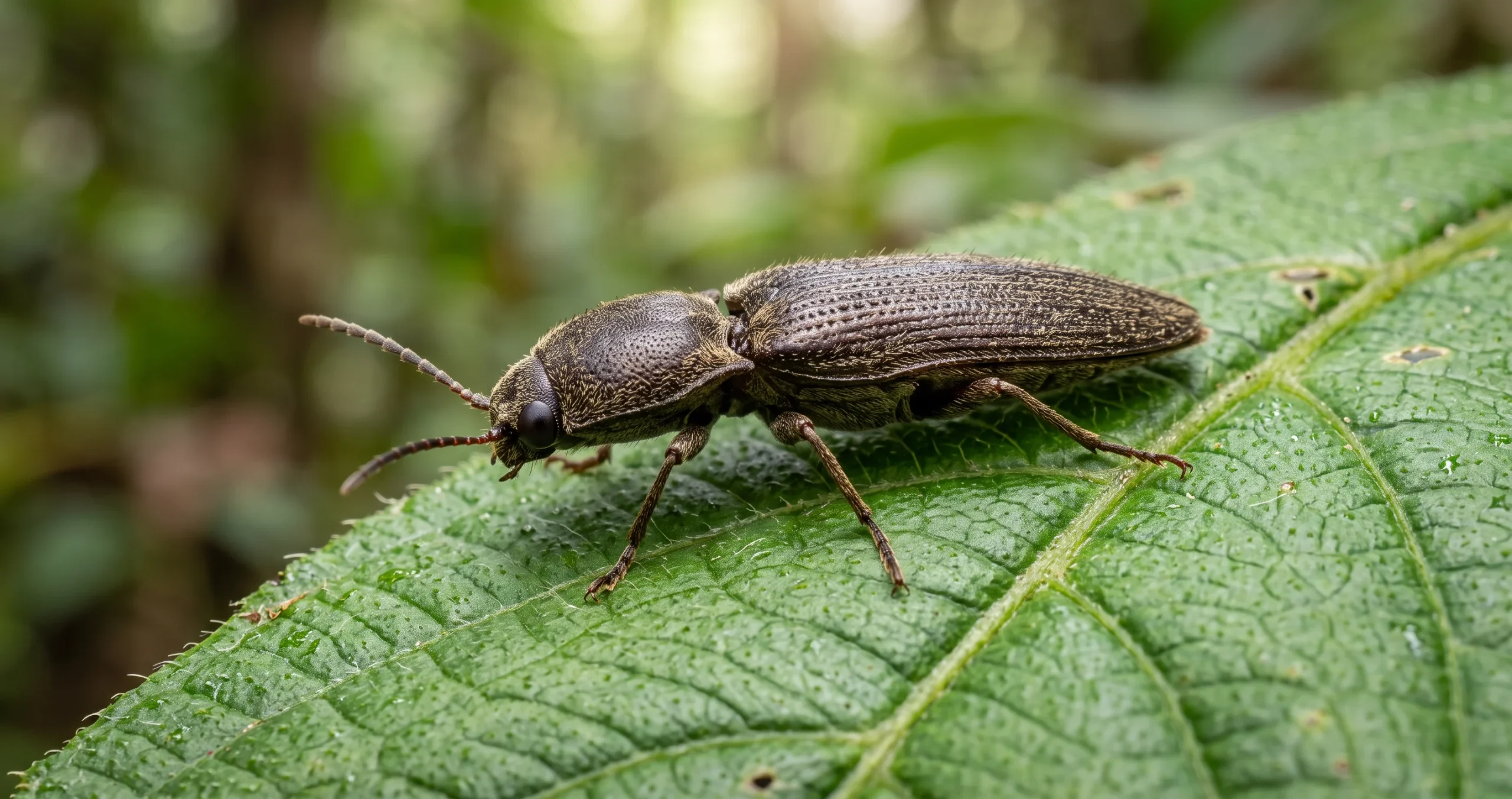
A click beetle stranded on its back does something extraordinary: instead of pushing against the ground with its legs, it bends its body, stores energy inside its thorax, and releases it in an explosive snap. The resulting click beetle self-righting jump can launch the insect into the air with accelerations hundreds of times greater than gravity.
The familiar “click” is therefore much more than a sound. It comes from an intricate biological system involving a thoracic hinge, a mechanical latch, muscles, elastic cuticle, and springlike structures that store energy before releasing it in milliseconds.
This remarkable mechanism has also attracted engineers searching for ways to make tiny robots jump without bulky motors or complicated legs.
Table of Contents
- What Is a Click Beetle?
- Why Click Beetles Need to Self-Right
- Click Beetle Self-Righting Jump Anatomy
- How the Thoracic Hinge Works
- How a Click Beetle Stores Energy
- The Millisecond Snap That Launches the Beetle
- How Fast Is a Click Beetle Jump?
- Click Beetles vs. Other Fast-Jumping Animals
- How the Beetle Lands Upright
- Why the Clicking Mechanism Evolved
- How Engineers Study Click Beetles
- Click Beetle-Inspired Jumping Robots
- FAQ
- Conclusion
What Is a Click Beetle?
Click beetles belong to the family Elateridae, a diverse group containing thousands of species distributed around the world.
They are generally elongated insects with relatively hard bodies. Many look unremarkable until they are placed on their backs.
Most beetles can use their legs to maneuver back onto their feet. Click beetles have another option.
They bend their bodies at a specialized hinge in the thorax, hold themselves under tension, and suddenly release that stored energy.
The insect snaps.
An audible click accompanies the movement, and when the beetle is resting against a surface, the rapid body motion can launch it upward.
Virginia Tech Extension describes the mechanism as a thoracic projection or peg interacting with another structure beneath the beetle. The resulting snap can propel the animal several inches into the air.
The maneuver is unusual because the legs are not responsible for powering the launch.
Why Click Beetles Need to Self-Right
Being upside down can create serious problems for a terrestrial insect.
A beetle unable to recover quickly may struggle to move normally and may become more vulnerable to predators and environmental hazards.
The click beetle self-righting jump provides an unusual solution.
Rather than requiring precise leg movements to roll over, the beetle throws its entire body into the air.
Once airborne, the insect rotates. It may land on its feet, or it may land on its back and repeat the process.
Research on the mechanics of click beetle jumping supports self-righting as an important function of the behavior.
One study found that the morphology produces relatively steep jumps. If the mechanism had primarily evolved to move away from predators, a shallower trajectory could provide greater horizontal distance.
Instead, the steep trajectory provides height and therefore time for body rotation before the beetle returns to the ground.
Clicking may have other benefits, including startling predators or helping the insect escape constraints, but researchers continue investigating the evolutionary history and functions of the behavior.
Click Beetle Self-Righting Jump Anatomy
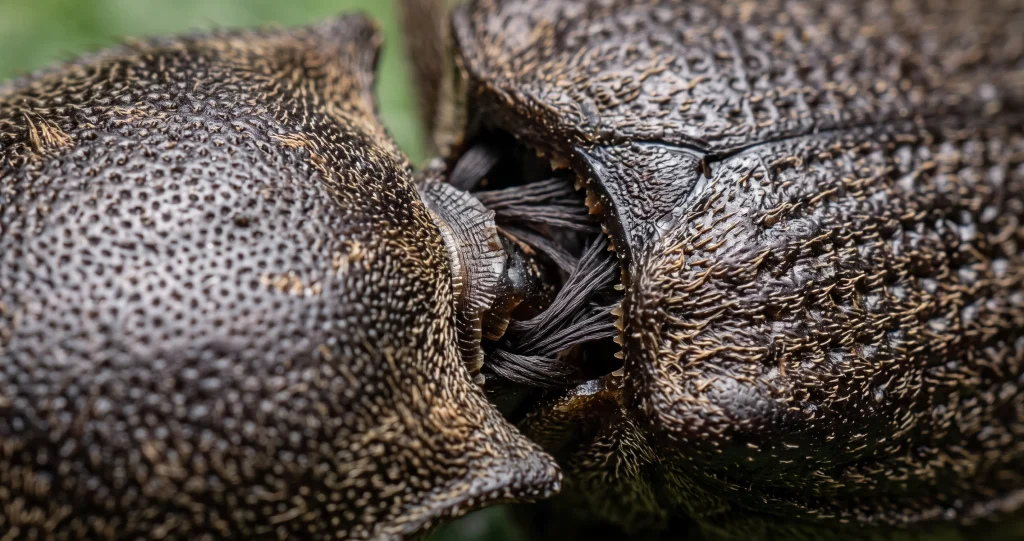
The secret of the click beetle self-righting jump lies between major sections of its body.
The beetle can be mechanically simplified into two large units connected by a flexible thoracic hinge.
One unit includes the head and prothorax. The other includes the remaining thoracic sections and abdomen.
This arrangement allows the beetle to bend and rapidly straighten its body.
The internal system is considerably more sophisticated than a simple hinge.
Important components include the prosternal process, often described as a peg, and structures associated with the mesothorax that interact with it.
Researchers studying several click beetle species have found that the peg and corresponding lip create a geometric latch capable of maintaining the beetle in a braced position while elastic energy accumulates.
In Campsosternus auratus, researchers have also identified the mesonotum as a highly specialized, saddle-shaped biological spring.
Muscles provide the initial input, but the final explosive motion comes from energy accumulated in elastic structures.
How the Thoracic Hinge Works
The click can be divided into several stages.
Stage 1: Latching
When lying on its back, the beetle first arches its body.
Movement around the thoracic hinge places the clicking apparatus into its latched configuration.
The prosternal process and associated structures interact to hold the system in place.
Think of drawing back a bow.
The archer does not release the arrow immediately. The system must first reach a loaded state.
Stage 2: Loading
Muscles continue contracting while the latch prevents the body from immediately returning to its relaxed position.
This is critical.
Muscle contraction alone cannot directly produce some of the extreme speeds observed during the click. Instead, muscular work performed over a relatively long period is stored as elastic potential energy.
Elastic structures within the thorax deform under this load.
Stage 3: Release
Eventually, the latch can no longer maintain the loaded configuration.
It releases.
Stored elastic energy is converted extremely rapidly into movement.
The front portion of the beetle rotates around the hinge, the body snaps, and the interaction with the ground launches the insect upward.
This type of biological system is known as latch-mediated spring actuation, or LaMSA.
It allows an animal to separate energy production from energy release.
That distinction is the key to the beetle’s extraordinary performance.
How a Click Beetle Stores Energy
Muscles have limits.
They can generate considerable force, but extremely rapid movements demand mechanical power that muscle tissue cannot always provide directly.
Spring-powered animals solve this problem by accumulating energy first.
The principle is similar to using a bow.
A person slowly performs work while drawing the bowstring. That energy becomes stored in the bent bow. Releasing the string allows the stored energy to leave far faster than the muscles originally supplied it.
The click beetle self-righting jump follows the same broad principle.
The beetle’s muscles deform elastic structures in its thorax while the latch prevents premature movement.
High-speed synchrotron X-ray research has shown that soft cuticle associated with the hinge contributes to the spring system. Researchers identified nonlinear elasticity, snap-through buckling, and damping as important features of the ultrafast release.
Other anatomical work has identified the mesonotum as an important saddle-shaped spring structure.
Rather than one simple spring, the beetle uses a distributed biological system in which multiple structures contribute to storing and releasing energy.
The Millisecond Snap That Launches the Beetle
Loading is relatively slow.
Release is extraordinarily fast.
Once the latch gives way, elastic recoil drives rapid rotation around the thoracic hinge.
The front portion of the beetle snaps toward the ground.
When this happens while the beetle is lying on a solid surface, the collision and body motion generate the forces needed for takeoff.
The beetle is thrown upward without using its legs for propulsion.
This distinction is important because “clicking” and “jumping” are not completely identical behaviors.
A beetle can operate the clicking mechanism when it is constrained or held, producing the characteristic rapid body movement.
A jump occurs when the click interacts appropriately with a surface and launches the animal.
The audible sound that gives click beetles their name accompanies this ultrafast mechanical event.
How Fast Is a Click Beetle Jump?
The numbers behind the click beetle self-righting jump are remarkable.
Classic measurements of click beetle jumping reported takeoff speeds around 2.4 meters per second, achieved in approximately 0.64 milliseconds during the propulsive phase.
That corresponds to an acceleration of roughly 3,800 meters per second squared, or about 380 times Earth’s gravitational acceleration.
More recent investigations of the internal clicking mechanism have also demonstrated extreme acceleration.
High-speed synchrotron X-ray imaging has allowed researchers to observe structures hidden inside the thorax during the latch, loading, and release sequence. This work has helped establish how nonlinear elasticity and rapid recoil create the extraordinary motion.
These values vary among species, individuals, experimental methods, and the particular phase being measured.
The important point is not one universal number.
It is the scale of the acceleration.
A tiny insect is briefly experiencing mechanical accelerations measured in hundreds of g.
Click Beetles vs. Other Fast Animal Movements
Click beetles are not alone in using springs to overcome the power limitations of muscle.
Fleas use elastic energy to power impressive jumps.
Froghoppers also use catapult-like mechanisms and can generate accelerations measured in hundreds of g.
A comparative review reported approximately 98 g for fleas, around 550 g for froghoppers, and roughly 380 g for click beetles, although values depend heavily on species and measurement methods.
Other ultrafast biological systems include trap-jaw ants and mantis shrimp.
What makes the click beetle particularly unusual is not simply its acceleration.
It is how the acceleration is generated.
Most familiar jumping insects launch by extending their legs.
Click beetles do not.
Their body itself becomes part of the launching mechanism.
The thorax functions as a combination of actuator, spring, latch, hinge, and structural frame.
That makes the beetle especially interesting to engineers.
How Does the Beetle Land Upright?
The phrase “self-righting” can create the impression that the beetle performs a perfectly controlled aerial maneuver and lands neatly on its feet every time.
The reality is more chaotic.
The beetle is launched upward and rotates while airborne.
Its steep trajectory gives it time and height to rotate, but the animal does not necessarily execute a precisely controlled half-turn.
Classic observations found that click beetles can rotate multiple times during a jump.
Sometimes the beetle lands correctly.
Sometimes it does not.
If it lands upside down again, it can repeat the click.
This seemingly imprecise strategy still works because the mechanism is repeatable.
Rather than requiring complicated aerial control, the beetle can simply launch again until it achieves the desired orientation.
For a small animal, mechanical simplicity can be highly effective.
Why Did the Click Beetle Self-Righting Jump Evolve?
Scientists have considered several possible benefits of clicking.
Self-righting is one of the strongest explanations for the characteristic jumping behavior.
Biomechanical modeling has shown that the beetle’s anatomy favors steep takeoff trajectories. Researchers argued that this makes sense for righting because height provides additional time for rotation.
A primarily escape-oriented jumper might benefit more from horizontal distance.
Still, clicking can have additional functions.
The sudden movement and sound may startle a predator. Virginia Tech Extension notes that the snap probably helps deter potential predators when the beetle is vulnerable.
Researchers have also proposed that clicking could help beetles free themselves from confined spaces or other physical constraints. The precise evolutionary history remains an active research topic rather than a completely settled question.
The mechanism is therefore best viewed as a versatile adaptation rather than a device with only one possible use.
Why Engineers Study the Click Beetle
Small robots face an engineering problem similar to that faced by small animals.
Making a tiny machine is relatively straightforward.
Making a tiny machine capable of producing a sudden burst of mechanical power is much harder.
Motors and actuators become constrained as devices shrink. A miniature actuator may generate movement, but directly producing an explosive jump can require more instantaneous power than it can deliver.
The click beetle provides another strategy.
Instead of demanding that an actuator produce all the power at once, the machine can slowly store energy and then release it rapidly.
That is exactly what the beetle does.
Researchers have developed mathematical and physical models of the click beetle self-righting jump specifically with small robotic systems in mind.
Early biomimetic studies showed that the single-hinge approach is especially useful for steep self-righting jumps, even though it is less suitable for long-distance horizontal jumping.
That tradeoff is valuable information for robot designers.
Click Beetle-Inspired Jumping Robots
Modern researchers have gone beyond modeling the insect.
They have built robots inspired by it.
One approach replaces the beetle’s complex biological spring-and-latch system with engineered elastic structures that slowly accumulate energy.
A rapid instability called snap buckling then releases that energy.
Researchers have demonstrated insect-scale robots in which small actuators gradually compress an elastic beam. Once a critical point is reached, the structure changes shape rapidly and strikes the ground, launching the machine.
The engineering principle is powerful because the actuator itself does not have to move at the final jumping speed.
It only needs to load the spring.
The spring does the fast work.
Potential applications include tiny robots capable of moving through confined environments, inspecting machinery, navigating rough terrain, or operating in agricultural settings. The U.S. National Science Foundation has highlighted possibilities including inspection inside turbines and jet engines as well as insect-scale agricultural robots.
More recent engineering work continues exploring click-beetle-inspired structures, including jumping robots and systems that use similar elastic principles for other mechanical purposes.
The beetle’s biological design offers engineers an elegant lesson: sometimes the best way to create an extremely fast machine is to load it slowly.
For more fascinating examples of wildlife anatomy, behavior, and natural engineering, visit Secrets of the Green Garden.
FAQ About the Click Beetle Self-Righting Jump
Do Click Beetles Jump With Their Legs?
No.
The characteristic clicking jump does not depend on the legs for propulsion.
Instead, the beetle bends and rapidly straightens its body around a specialized thoracic hinge.
What Makes the Clicking Sound?
The audible click is associated with the rapid release of the thoracic latch-and-spring mechanism as the beetle snaps its body.
The same ultrafast movement can launch the beetle when performed against a surface.
How Much Acceleration Can a Click Beetle Produce?
Measurements vary among species and methods.
Classic click beetle jumping measurements reported approximately 3,800 m/s², equivalent to about 380 g, while research on the internal click mechanism has demonstrated similarly extreme acceleration produced through rapid elastic recoil.
Why Doesn’t the Beetle Use Its Legs to Turn Over?
The specialized clicking mechanism provides a powerful alternative.
The beetle can launch its entire body upward without relying on a conventional leg-powered jump, allowing it to attempt self-righting even from a difficult upside-down position.
Does a Click Beetle Always Land on Its Feet?
No.
The animal may rotate several times in the air and does not always land upright.
If it lands on its back again, it can repeat the maneuver.
Is the Thoracic Hinge a Spring?
The system is more complicated than a single spring.
The hinge contains interacting latch structures, while elastic cuticle and specialized thoracic structures store energy. Research has identified the mesonotum as a saddle-shaped biological spring contributing to the mechanism.
Why Is the Click Beetle Jump So Powerful?
The beetle separates energy storage from energy release.
Its muscles load elastic structures relatively slowly. The latch holds that stored energy until it is released over an extremely short period.
This produces much greater instantaneous mechanical power than direct muscle contraction alone could achieve.
Have Scientists Built Robots Based on Click Beetles?
Yes.
Researchers have developed several click-beetle-inspired robotic concepts, including legless jumping devices and insect-scale robots using elastic energy storage and snap buckling.
Conclusion
The click beetle self-righting jump is an extraordinary example of biological power amplification.
Instead of relying on its legs, the beetle uses muscles to load elastic structures around a specialized thoracic hinge. A mechanical latch holds the body in its strained position until the system releases.
Then everything happens extremely quickly.
Elastic energy drives the body through a violent snap, producing the characteristic click and accelerating the beetle away from the ground. Measurements reaching hundreds of times Earth’s gravitational acceleration place the maneuver among the fastest mechanical movements found in small animals.
Its likely importance for self-righting also shows that an effective biological solution does not have to be perfectly controlled. The beetle can launch, rotate, land, and simply repeat the maneuver when necessary.
For engineers, the lesson extends beyond insects.
The same basic principle—store energy slowly, release it quickly—can allow small robots with relatively slow actuators to perform powerful jumps.
A mechanism that helps a beetle recover after falling onto its back is now helping researchers rethink how tiny machines could navigate environments where wheels, legs, and conventional motors struggle.