
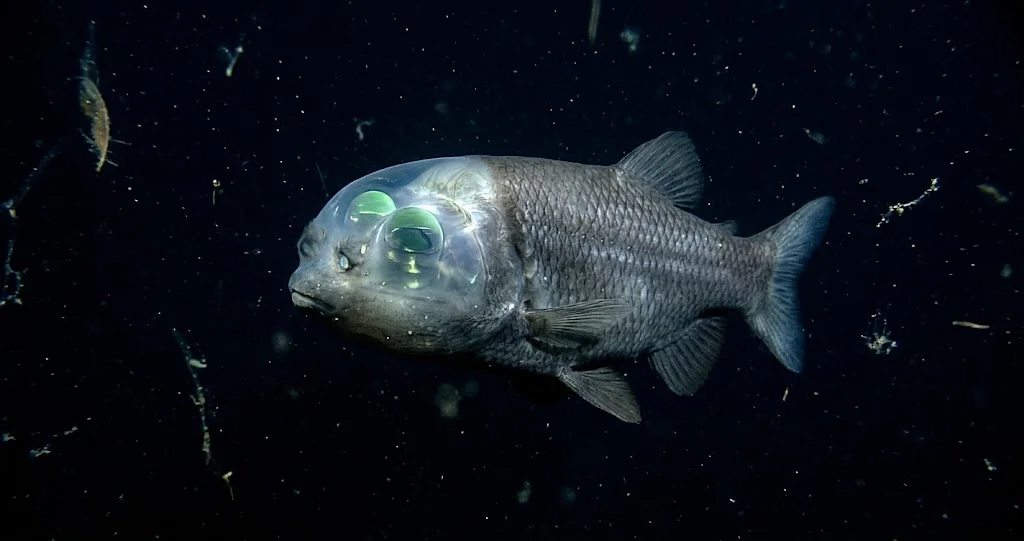
At first glance, the barreleye fish seems to have a fairly ordinary deep-sea face. Two small dark spots sit above its mouth, looking exactly where eyes ought to be. But those spots are not its eyes at all. The real eyes are much stranger: large, green, tubular organs positioned inside a transparent, fluid-filled shield covering the top of its head.
This extraordinary anatomy has made Macropinna microstoma one of the most recognizable fishes of the deep sea. The barreleye fish transparent head is not simply a bizarre visual feature. It forms part of a specialized sensory system adapted to the dim environment of the ocean’s mesopelagic, or twilight, zone.
For decades, scientists knew the species mainly from specimens brought to the surface in nets. These preserved fish revealed the strange tubular eyes, but their delicate transparent head covering was often damaged during collection. Observations of living animals eventually revealed what the intact fish really looks like—and showed that its remarkable eyes can rotate.
Table of Contents
- Meet Macropinna microstoma
- Barreleye Fish Transparent Head: What Is It?
- Those Small Spots Near the Mouth Are Not Its Eyes
- Why Are the Barreleye’s Eyes Green?
- Scientists Once Thought the Eyes Could Only Look Upward
- Preserved Specimens Hid the Barreleye’s Most Important Feature
- How Rotating Tubular Eyes May Help the Barreleye Find Food
- Life in the Mesopelagic Zone
- A Fish That Changed How Scientists Study the Deep Sea
- FAQ About the Barreleye Fish
- Conclusion
Meet Macropinna microstoma
Macropinna microstoma belongs to the family Opisthoproctidae, a group of deep-sea fishes commonly known as barreleyes or spookfishes.
The species occurs in the North Pacific and inhabits deep waters where sunlight is greatly reduced. It is a relatively small fish, growing to roughly 15 centimeters in length.
Its body is dark, while its large, broad fins appear suited to slow, controlled movements. Rather than being built like a fast-swimming open-water predator, the barreleye can maintain its position and maneuver carefully through its dim environment.
Its most extraordinary adaptations, however, are concentrated in its head.
Instead of conventional outward-facing eyes, M. microstoma possesses elongated tubular eyes. In living individuals, these organs can appear bright green and are visible through the transparent tissue covering the upper part of the head.
The arrangement seems extraordinary from a human perspective, but it becomes much more understandable when considered in the environment where the barreleye lives.
Barreleye Fish Transparent Head: What Is It?
The famous transparent portion of the barreleye is often described simply as a “transparent head.” That description is convenient, but it can create the mistaken impression that the fish’s entire skull is clear.
It is not.
The upper head includes a delicate, transparent, fluid-filled shield or dome. Through this covering, the internal tubular eyes can receive light.
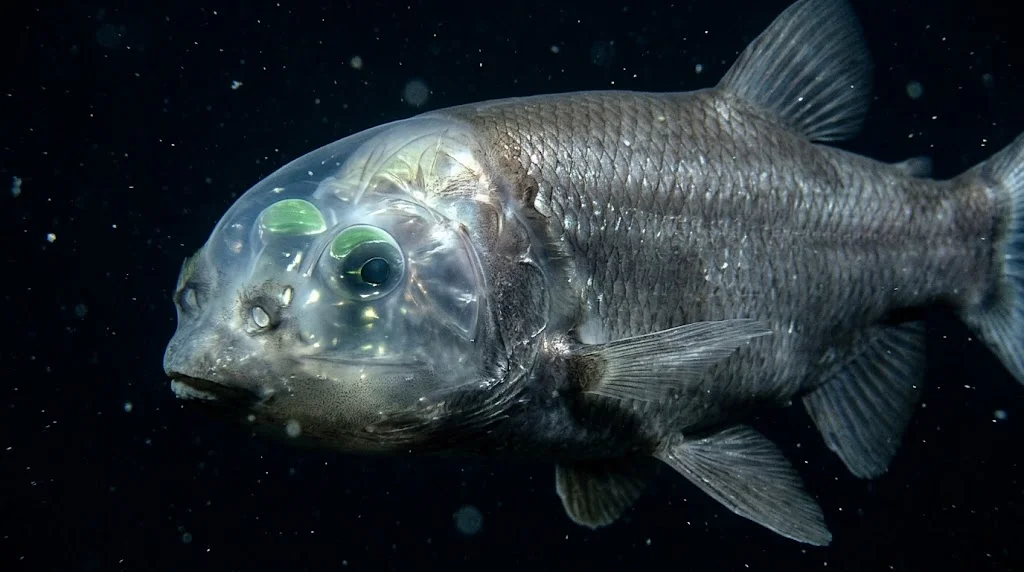
In images of living Macropinna microstoma, the shield is clear enough for the green eyes and some structures inside the head to be visible from outside.
The arrangement creates an unusual visual system. Instead of having the eyes exposed directly on the exterior surface of the head, the barreleye’s major visual organs are enclosed beneath transparent tissue.
The shield may do more than allow light to pass through.
Researchers Bruce Robison and Kim Reisenbichler of the Monterey Bay Aquarium Research Institute (MBARI) have suggested that it may also help protect the sensitive eyes, particularly if the fish obtains food around siphonophores.
Siphonophores are colonial marine organisms that can possess long tentacles armed with stinging cells. A protective transparent covering could therefore be useful for a fish maneuvering near them.
This proposed function is scientifically plausible and connected to observations of the fish, but it should not be treated as proof that protection from siphonophores is the shield’s sole evolutionary purpose.
Those Small Spots Near the Mouth Are Not Its Eyes
One of the most widespread misconceptions about the barreleye fish comes from its unusual face.
Look at a photograph and two small dark structures appear near the front of the head, immediately above the mouth.
They look exactly where most people expect eyes to be.
They are not eyes.
These small structures are olfactory organs associated with the fish’s sense of smell—functionally comparable to nostrils.
The real eyes are the much larger green tubular structures positioned farther back inside the transparent shield.
Once this distinction is understood, photographs of Macropinna microstoma suddenly look completely different.
The fish does not have tiny conventional eyes on its face. Its major visual organs are hidden inside its head and look upward through the transparent covering.
This is also why identifying the species from photographs can initially be confusing. Humans naturally interpret two symmetrical dark structures above a mouth as eyes, producing the illusion of a familiar vertebrate face where the true anatomy is far stranger.
Why Are the Barreleye’s Eyes Green?
The barreleye’s tubular eyes can appear strikingly green in photographs of living specimens.
Their coloration is associated with pigments in the visual system that may filter incoming light.
Such filtering could be particularly valuable in the mesopelagic zone.
At these depths, sunlight has been dramatically reduced. Much of the remaining downwelling light is concentrated in blue wavelengths. At the same time, many deep-sea organisms produce their own light through bioluminescence.
The barreleye therefore lives in a visual environment composed of extremely faint natural illumination, silhouettes and biological light sources.
Its tubular eyes provide a highly directional visual system capable of looking toward the faint light above.
Researchers have proposed that pigmentation in the eyes may help filter downwelling sunlight and potentially improve the detection of bioluminescent prey or other visual signals.
However, the precise performance of this filtering system in wild barreleyes remains difficult to test directly.
This distinction matters. Deep-sea species are notoriously difficult to observe for extended periods, so scientists often combine direct observations with anatomical evidence when interpreting how a structure functions.
Scientists Once Thought the Eyes Could Only Look Upward
The tubular eyes presented researchers with an apparent biological puzzle.
Early anatomical studies indicated that the eyes pointed upward.
This orientation made sense for finding prey.
A barreleye positioned below another animal could detect its silhouette against the faint light filtering downward from the ocean surface.
But a problem remained.
If the eyes were permanently fixed upward, how could the fish accurately guide its small mouth toward food positioned directly in front of it?
The answer became clearer when researchers were finally able to observe living barreleyes.
MBARI scientists used remotely operated vehicles to study Macropinna microstoma in its natural deep-sea environment. They also examined a living specimen brought to the surface in good condition.
Those observations showed that the tubular eyes were not permanently locked into an upward-facing position.
They could rotate.
When the fish was horizontal, its eyes could look upward through the transparent shield. When it changed orientation or focused on food, the eyes could rotate toward the front.
That discovery resolved one of the major mysteries surrounding the species.
The barreleye could search above itself for potential food and then shift its visual field forward while positioning its mouth toward the target.
Preserved Specimens Hid the Barreleye’s Most Important Feature
The scientific history of Macropinna microstoma demonstrates one of the biggest difficulties of studying deep-sea animals.
The species was scientifically described in 1939, decades before modern remotely operated vehicles could routinely explore deep ocean environments.
Researchers therefore depended heavily on specimens collected in nets.
For sturdy animals, this method can preserve important anatomical information. For delicate deep-sea organisms, however, the journey to the surface can be destructive.
A specimen may be dragged through hundreds of meters of water, compressed against other organisms inside a net and subjected to dramatic environmental changes.
The transparent shield of Macropinna microstoma is particularly delicate.
In collected specimens, this structure was often damaged or lost. Scientists could examine the fish’s tubular eyes, but they did not necessarily see the complete transparent dome surrounding them in an intact living individual.
Modern underwater observations changed that.
High-resolution cameras mounted on remotely operated vehicles allowed researchers to encounter barreleyes alive and relatively undisturbed.
Instead of reconstructing the animal entirely from preserved specimens, scientists could finally see its anatomy functioning in its natural orientation.
How Rotating Tubular Eyes May Help the Barreleye Find Food
The barreleye’s visual system appears especially suited to detecting relatively small targets under extremely low-light conditions.
Imagine the fish suspended almost motionless several hundred meters beneath the surface.
Above it lies the faintest remaining sunlight.
Its tubular eyes point toward that light.
A crustacean or other small animal moving overhead could interrupt the downwelling illumination and become visible as a silhouette.
Tubular eyes sacrifice some of the broad field of view associated with more conventional eye shapes in exchange for highly directional sensitivity.
Once a potential food item is located, the barreleye can reposition itself. Its ability to rotate the eyes forward could help maintain visual contact as the fish approaches and feeds.
Researchers have also observed barreleyes around siphonophores and have proposed that the fish may sometimes obtain small animals trapped among their tentacles.
This possibility is particularly interesting because it could connect several of the fish’s unusual adaptations.
Its broad fins provide controlled maneuverability. Its sensitive eyes can locate small food items in extremely dim conditions. Its transparent head shield may offer protection while the fish moves near potentially dangerous stinging tentacles.
The hypothesis is compelling, but the complete feeding ecology of Macropinna microstoma is still not known.
Life in the Mesopelagic Zone
The mesopelagic zone generally extends from approximately 200 to 1,000 meters beneath the ocean surface.
It is often called the twilight zone.
Sunlight reaches this region, but it becomes progressively weaker with depth. There is generally too little light for photosynthesis, yet enough residual illumination remains in parts of the zone to influence animal vision and behavior.
The mesopelagic ecosystem contains fishes, squid, crustaceans, gelatinous animals and many organisms capable of bioluminescence.
Some species remain at depth throughout the day. Others participate in enormous daily vertical migrations, moving toward shallower waters at night and descending again during daylight.
For a predator living here, vision presents an unusual challenge.
There may be just enough light to detect a silhouette but nowhere near enough illumination to see the environment as a surface fish would.
The barreleye’s anatomy is well matched to these conditions.
Its large tubular eyes emphasize sensitivity and directional viewing.
Their upward orientation allows the fish to exploit faint downwelling light.
Their ability to rotate gives the animal greater flexibility when approaching food.
The transparent shield allows light to reach eyes positioned inside the head while potentially giving those delicate organs additional physical protection.
Its broad fins also support controlled movement and stable positioning.
Together, these traits create an animal specialized not for bright daylight or high-speed pursuit, but for detecting subtle visual signals in one of Earth’s darkest inhabited environments.
A Fish That Changed How Scientists Study the Deep Sea
The barreleye is scientifically fascinating for more than its appearance.
Its history illustrates how technology can change our understanding of animals that are difficult to study.
A preserved specimen can reveal bones, muscles, digestive structures and many other anatomical features.
But preservation also has limitations.
Fragile tissue can collapse or disappear. Natural coloration can change. Soft structures may become distorted. Behavior cannot be reconstructed directly from a dead specimen.
The barreleye demonstrates these limitations dramatically.
For decades, scientists knew that Macropinna microstoma had strange tubular eyes.
But observations of intact living individuals revealed two crucial pieces of information: the eyes sit beneath a transparent shield, and they are capable of rotating.
Neither detail is merely cosmetic.
Together, they change the biological interpretation of the fish’s visual system.
The discovery also reinforces the importance of observing deep-sea organisms in their natural habitat whenever possible.
Some adaptations only make complete sense when the animal is alive, intact and interacting with the environment that shaped its evolution.
FAQ About the Barreleye Fish
Is the barreleye fish’s entire head transparent?
No. The upper portion of the head includes a transparent, fluid-filled shield. The entire skull and head are not completely transparent.
Are the two dark spots on its face its eyes?
No. The small structures near the mouth are olfactory organs associated with smell. The true eyes are the large green tubular structures visible inside the transparent shield.
Can the barreleye fish move its eyes?
Yes. Observations of living Macropinna microstoma showed that its tubular eyes can rotate from an upward-looking position toward the front.
Why does the barreleye look upward?
Looking upward can help the fish detect animals silhouetted against faint downwelling light in the mesopelagic zone.
Where does Macropinna microstoma live?
It inhabits deep waters of the North Pacific, including the mesopelagic or twilight zone.
How deep does the barreleye fish live?
The species is associated with mesopelagic depths, a broad ocean zone extending roughly from 200 to 1,000 meters below the surface. Individual observations occur within portions of this range rather than implying that the species is equally distributed throughout it.
Why are its eyes green?
Pigments in the eyes appear to filter light. Researchers have proposed that this could improve visual performance under mesopelagic lighting conditions, potentially helping distinguish biologically important light signals from downwelling illumination.
What does the barreleye fish eat?
Available evidence indicates that it consumes small animals, including crustaceans. Researchers have proposed that it may sometimes take prey associated with siphonophores, although its complete diet and feeding behavior remain incompletely documented.
Why did scientists misunderstand its transparent head for so long?
Traditional net collection frequently damaged the delicate transparent shield. Observing living animals with remotely operated vehicles allowed scientists to see the intact structure and understand the eye movements much more clearly.
Conclusion
The barreleye fish transparent head is far more than one of the deep ocean’s strangest visual spectacles. It is part of an integrated sensory system adapted to an environment where detecting tiny amounts of light can determine whether an animal finds food.
The familiar-looking face of Macropinna microstoma is deceptive. The two small dark structures near its mouth are not eyes but olfactory organs. Its real eyes are the prominent green tubes visible inside the transparent, fluid-filled shield above them.
Living observations also overturned the idea that these tubular eyes were permanently fixed upward. They can rotate, allowing the fish to scan the water above and shift its visual field as it changes orientation or approaches food.
Its transparent shield, sensitive tubular eyes, controlled swimming and unusual visual strategy all reflect the demands of life in the mesopelagic zone.
The barreleye also carries a broader scientific lesson. Deep-sea animals can look very different when encountered alive than when reconstructed from damaged specimens brought to the surface. Modern underwater vehicles have given researchers the opportunity to observe these creatures where their extraordinary adaptations actually function—and Macropinna microstoma remains one of the clearest examples of how much that perspective can reveal.
External sources:
- MBARI research on the barreleye fish: MBARI barreleye fish researc.