
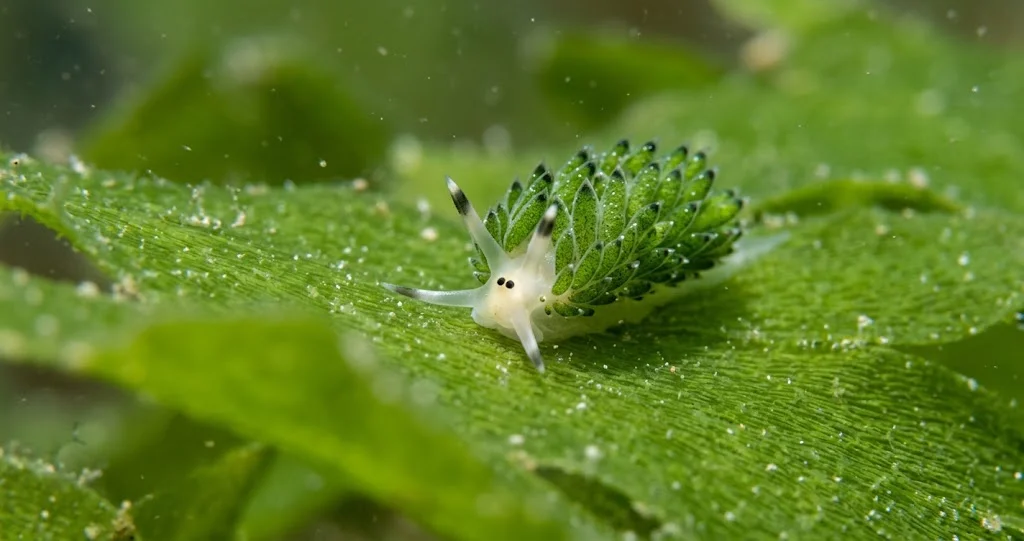
A tiny sea slug bites into an alga, sucks out its cellular contents and digests much of what it consumes. But some of the algal chloroplasts escape immediate destruction. Instead, the slug incorporates these structures into cells lining its digestive system, where some can continue capturing light and performing photosynthesis.
This remarkable process is known as kleptoplasty, literally involving “stolen plastids.” The phenomenon behind sea slug stolen chloroplasts has made certain sacoglossan sea slugs famous as “solar-powered slugs.” That description contains a grain of truth, but it can also exaggerate what is actually happening.
Species such as Costasiella kuroshimae, popularly called the leaf sheep, have helped bring attention to these unusual animals. However, kleptoplasty is not unique to one photogenic species. It occurs across multiple sacoglossan sea slugs, and the duration and importance of chloroplast retention vary considerably between species.
Table of Contents
- What Are Sacoglossan Sea Slugs?
- Sea Slug Stolen Chloroplasts: What Is Kleptoplasty?
- How Sea Slugs Steal Chloroplasts From Algae
- Where Are the Stolen Chloroplasts Stored?
- How Long Can Stolen Chloroplasts Keep Working?
- What Does Photosynthesis Give the Sea Slug?
- Are These Sea Slugs Really “Solar-Powered”?
- Costasiella kuroshimae: The Famous Leaf Sheep
- Why Kleptoplasty Is Such a Biological Puzzle
- FAQ About Sea Slugs and Stolen Chloroplasts
- Conclusion
What Are Sacoglossan Sea Slugs?
Sacoglossans are small marine gastropod molluscs with an unusual feeding specialization. Many feed on algae using a specialized radula adapted to pierce algal cells and extract their contents.
This feeding behavior has earned them descriptions such as “sap-sucking sea slugs.”
For most animals, eating algae means breaking down their cells and using the resulting nutrients. Some sacoglossans do something considerably more unusual.
They selectively retain chloroplasts from their food.
Chloroplasts are the cellular structures in algae and plants where photosynthesis takes place. Normally, they function as components of the cells that produced them. But in kleptoplastic sea slugs, chloroplasts taken from algae can remain structurally intact inside animal cells.
Some even continue photosynthesizing.
The ability varies dramatically across Sacoglossa. Some species do not retain functional chloroplasts, others retain photosynthetically active plastids for only a short period, and a smaller number can maintain functional kleptoplasts for weeks or even months.
Sea Slug Stolen Chloroplasts: What Is Kleptoplasty?
The biological term for the sea slug stolen chloroplasts phenomenon is kleptoplasty.
The word describes the sequestration of plastids—particularly chloroplasts—from another organism.
Unlike conventional symbiosis involving an intact photosynthetic partner, the slug does not normally keep the whole algal cell alive inside its body. Instead, it retains the chloroplast itself after consuming the alga.
The retained chloroplast becomes known as a kleptoplast.
Kleptoplasty is not exclusive to animals. It also occurs in several groups of single-celled eukaryotes, including some dinoflagellates, ciliates and foraminiferans. Long-term retention of photosynthetically active chloroplasts among animals, however, is particularly associated with a small number of sacoglossan sea slugs.
This distinction is important because popular descriptions can make it sound as though sea slugs somehow grow their own chloroplasts.
They do not.
The chloroplasts originate in algae and must first be acquired through feeding.
How Sea Slugs Steal Chloroplasts From Algae
The process begins with a meal.
Sacoglossan sea slugs use their specialized feeding apparatus to puncture algal cells. They then suck out cellular material.
Most of that material can be digested normally. In kleptoplastic species, however, some chloroplasts remain intact rather than being immediately broken down.
These chloroplasts are incorporated into the slug’s own cells.
That is already extraordinary because a chloroplast is not an independent organism. It evolved to operate as part of a photosynthetic eukaryotic cell and normally depends on numerous proteins associated with the algal nuclear genome.
Yet some stolen chloroplasts continue functioning after being separated from the algal cells that produced them.
This creates one of the central mysteries of kleptoplasty: how can an organelle remain photosynthetically competent for such a long time inside the cells of an entirely different organism?
Researchers once considered extensive horizontal transfer of algal genes into the slug genome as a possible explanation. However, genomic and transcriptomic evidence has not supported the idea that widespread transfer of algal nuclear genes into the slug genome explains long-term kleptoplast maintenance. Other mechanisms, including characteristics intrinsic to particular chloroplasts and host-mediated protection, are therefore important areas of research.
Where Are the Stolen Chloroplasts Stored?
Once acquired, kleptoplasts are retained intracellularly in cells associated with the sea slug’s digestive system.
More specifically, they occur in cells of the digestive tubules or digestive gland.
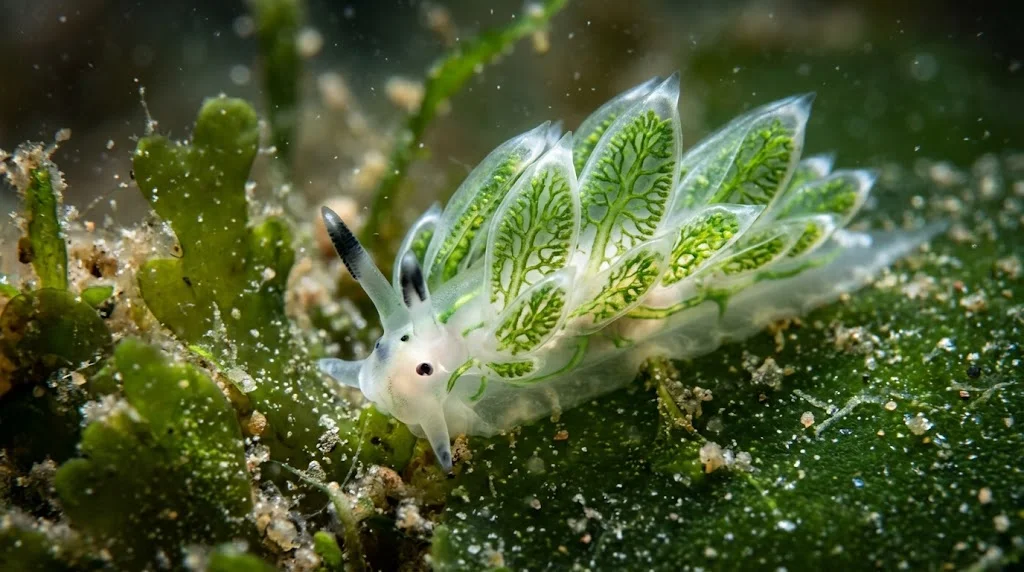
These digestive structures can branch extensively through the slug’s body. As a result, retained chloroplasts can become distributed across large areas of its tissues.
This helps explain the intense green coloration seen in many kleptoplastic species.
The color is not necessarily produced by the animal itself. A significant part can come from chlorophyll contained within the stolen algal chloroplasts.
The arrangement is particularly striking because the plastids are genuinely located within animal cells rather than merely sitting undigested inside the digestive tract. Scientific studies describe macroalgal chloroplasts being phagocytosed and retained by cells of the digestive tubules.
The slug therefore becomes a biological mosaic: an animal containing functioning cellular machinery acquired from its algal food.
How Long Can Stolen Chloroplasts Keep Working?
There is no single answer because kleptoplast retention varies greatly among sacoglossan species.
Some sea slugs retain chloroplasts only briefly. In certain cases, plastids persist for a few days or roughly a week and may provide little or no sustained photosynthetic function.
Other species achieve intermediate retention.
A relatively small group can maintain photosynthetically active kleptoplasts for several weeks to months. Research has identified particularly successful long-term associations in species such as Elysia chlorotica, Elysia timida and Plakobranchus ocellatus.
This variation is essential when discussing kleptoplasty.
It would be inaccurate to claim that every green sacoglossan sea slug can photosynthesize efficiently for months. The duration depends on both the slug species and the chloroplasts obtained from particular algal food sources.
Some algal chloroplasts appear intrinsically better suited to surviving outside their original cells than others.
Researchers continue investigating the molecular and physiological mechanisms that allow the most persistent kleptoplasts to remain functional despite being separated from the algal nucleus.
What Does Photosynthesis Give the Sea Slug?
Photosynthesis allows kleptoplasts to fix carbon using light energy, and experiments have demonstrated that photosynthetically derived compounds can become available to host tissues.
Research on species such as Elysia viridis has provided evidence for light-dependent incorporation of carbon and nitrogen associated with functional kleptoplasts. Photosynthetically derived metabolites can move beyond chloroplast-bearing digestive tissues into other areas of the animal.
Other research has connected kleptoplast photosynthesis with reproductive investment. Studies using stable-isotope tracing have shown photosynthetically fixed carbon reaching reproductive tissues and contributing to compounds associated with reproduction.
Photosynthesis may therefore provide supplementary nutritional resources rather than simply making the animal green.
Evidence from several species also indicates that active kleptoplasts can reduce the effects of food shortage. Under starvation, photosynthetic products may help some slugs maintain body condition or survive longer.
In Elysia crispata, researchers have additionally found evidence that photosynthesis supports mucus production, illustrating that fixed carbon can contribute to physiological functions beyond simple energy storage.
The benefit is therefore real—but describing the animal as surviving entirely on sunlight oversimplifies the biology.
Are These Sea Slugs Really “Solar-Powered”?
“Solar-powered sea slug” is memorable, but it should not be interpreted literally.
These animals are still heterotrophic animals.
They must feed to acquire their chloroplasts in the first place, and photosynthesis does not simply transform them into plants.
Experiments and reviews have also produced a more nuanced picture of how much kleptoplast photosynthesis contributes to survival. Evidence supports nutritional benefits in several species, including translocation of photosynthetically derived compounds, improved performance during food limitation and contributions to reproduction.
At the same time, the relative importance of photosynthesis varies among species and experimental conditions. Research has challenged overly simple claims that kleptoplast-bearing slugs survive prolonged starvation solely because sunlight replaces feeding.
There is another possibility during prolonged food deprivation: kleptoplasts themselves can eventually become nutritional resources when they are degraded.
The most accurate description is therefore that certain sacoglossan sea slugs can supplement their animal metabolism with products generated by stolen photosynthetic machinery.
They do not become fully photoautotrophic animals.
Their biology is more interesting than the slogan.
Costasiella kuroshimae: The Famous Leaf Sheep
Few sacoglossans have attracted as much public attention as Costasiella kuroshimae.
Its compact body, green coloration and projecting rhinophores have given it the popular nickname leaf sheep. Photographs of the tiny animal frequently circulate online alongside claims that it is a miniature animal powered by photosynthesis.
The association with kleptoplasty is legitimate: Costasiella belongs to Sacoglossa, and members of this lineage are known for retaining algal plastids.
But C. kuroshimae should not be treated as though it represents every aspect of kleptoplasty or as the sole example of the phenomenon.
The best-understood long-term kleptoplastic systems include other sacoglossans, particularly species of Elysia and Plakobranchus. Scientific work across Sacoglossa demonstrates substantial variation in how effectively different species retain chloroplasts and how long those chloroplasts remain photosynthetically active.
That broader context makes the leaf sheep more scientifically interesting.
It belongs to an evolutionary lineage in which feeding has developed into something far more complex than simple digestion: parts of the food’s cellular machinery can temporarily become functional components of the predator’s own tissues.
Why Kleptoplasty Is Such a Biological Puzzle
The extraordinary part of kleptoplasty is not simply that the chloroplasts enter an animal.
It is that some remain functional.
In algae and plants, chloroplasts do not normally operate in complete independence. Many proteins required for their maintenance and photosynthetic machinery are encoded by genes in the host cell’s nucleus.
A stolen chloroplast has lost that original nuclear environment.
Yet certain kleptoplasts remain photosynthetically competent for remarkably long periods inside sea slug cells.
Researchers have investigated several possible explanations.
Some chloroplasts appear naturally robust. Certain plastid genomes may retain useful genetic capabilities that help maintain photosynthetic machinery. The animal host may also reduce damage through behavior and physiology.
For example, several long-term kleptoplast-retaining sea slugs can regulate their exposure to intense light. Species with parapodia—wing-like lateral extensions—can alter how much light reaches their tissues by changing their body configuration. Protective compounds may further reduce damage from excessive or ultraviolet radiation.
The relationship therefore cannot be reduced to “an animal eats a plant and becomes photosynthetic.”
It is a sophisticated interaction between algal organelles and animal cells that researchers are still working to understand.
FAQ About Sea Slugs and Stolen Chloroplasts
What is kleptoplasty?
Kleptoplasty is the sequestration and retention of plastids obtained from another organism. In sacoglossan sea slugs, chloroplasts are taken from consumed algae and retained inside cells associated with the digestive system.
Do sea slugs really steal chloroplasts?
Yes. Certain sacoglossans ingest algal cellular material while retaining intact chloroplasts. These retained chloroplasts are called kleptoplasts.
Where do sea slugs keep the stolen chloroplasts?
They are retained inside cells lining the digestive tubules or digestive gland, structures that can branch extensively through the slug’s body.
Can the chloroplasts still perform photosynthesis?
In some species, yes. Functional kleptoplasts can continue photosynthetic activity after being incorporated into animal cells. Retention time varies greatly among species.
How long do stolen chloroplasts survive?
Some are retained for only days, while long-term kleptoplastic species can maintain photosynthetically active chloroplasts for weeks or months. Exceptional systems have been reported with still longer retention.
Does photosynthesis feed the sea slug?
It can contribute nutritionally. Experiments demonstrate that photosynthesis-derived carbon and other metabolites can reach slug tissues, and photosynthesis can contribute to processes such as survival during food limitation and reproduction in studied species.
Can a kleptoplastic sea slug survive only on sunlight?
Calling these animals completely solar-powered is misleading. They remain heterotrophic animals, acquire chloroplasts through feeding and differ greatly in their dependence on photosynthetic products.
Is Costasiella kuroshimae the only photosynthetic sea slug?
No. Kleptoplasty occurs in multiple sacoglossan species. Some of the best-studied examples belong to Elysia and Plakobranchus.
Do the slugs pass stolen chloroplasts to their offspring?
The remarkable association depends on chloroplast acquisition through feeding rather than the slug simply producing chloroplasts as inherited animal organelles. Juveniles of studied kleptoplastic species acquire functional plastids after beginning to feed on appropriate algae.
Conclusion
The story of sea slug stolen chloroplasts is more remarkable than the familiar phrase “solar-powered slug” suggests.
Certain sacoglossan sea slugs pierce algal cells, consume their contents and selectively retain chloroplasts inside cells of their digestive system. Instead of being immediately digested, some of these stolen organelles continue performing photosynthesis.
Depending on the species and algal source, functional kleptoplasts may persist from relatively short periods to weeks or months. Photosynthetically derived compounds can enter animal tissues and contribute to nutrition, starvation tolerance, reproduction and other physiological processes documented in particular species.
Yet these sea slugs are not plants in disguise.
They remain animals that must acquire chloroplasts by eating algae, and the contribution of photosynthesis differs substantially among species. Costasiella kuroshimae, the famous leaf sheep, is an eye-catching representative of this biology, but it belongs to a much broader and scientifically diverse story of kleptoplasty across Sacoglossa.
Perhaps the most fascinating part is that scientists still do not have every answer. Keeping an isolated chloroplast functional inside an animal cell presents substantial biochemical challenges.
For these tiny sea slugs, eating an alga can therefore accomplish something extraordinary: part of the meal continues working long after it has been swallowed.
External sources:
- A strong external source is the peer-reviewed open-access review by Sónia Cruz and Paulo Cartaxana in PLOS Biology, which examines what is known—and still unresolved—about kleptoplasty and long-term functional chloroplast retention. PLOS Biology/PMC — Kleptoplasty: Getting away with stolen chloroplasts.