
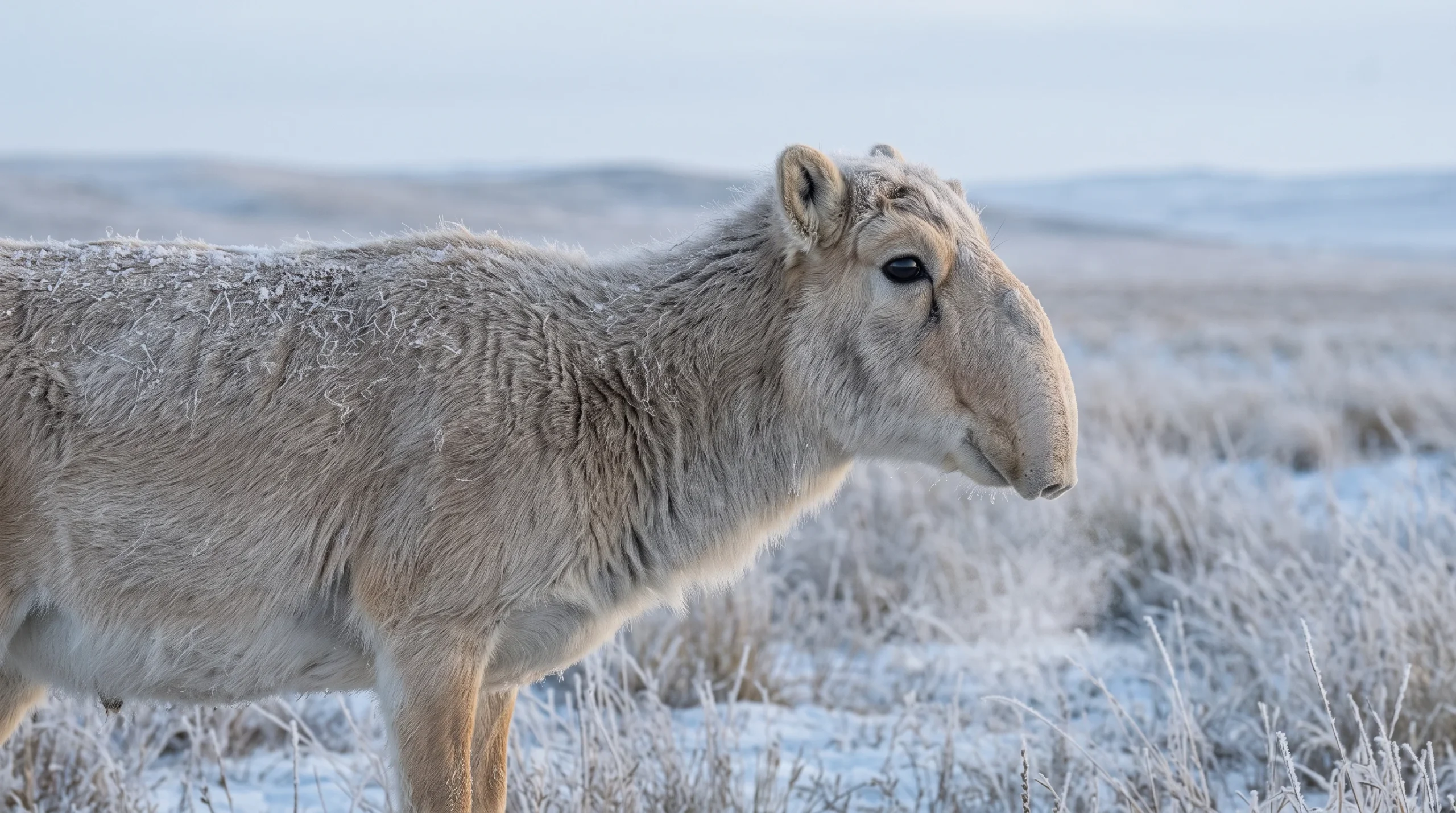
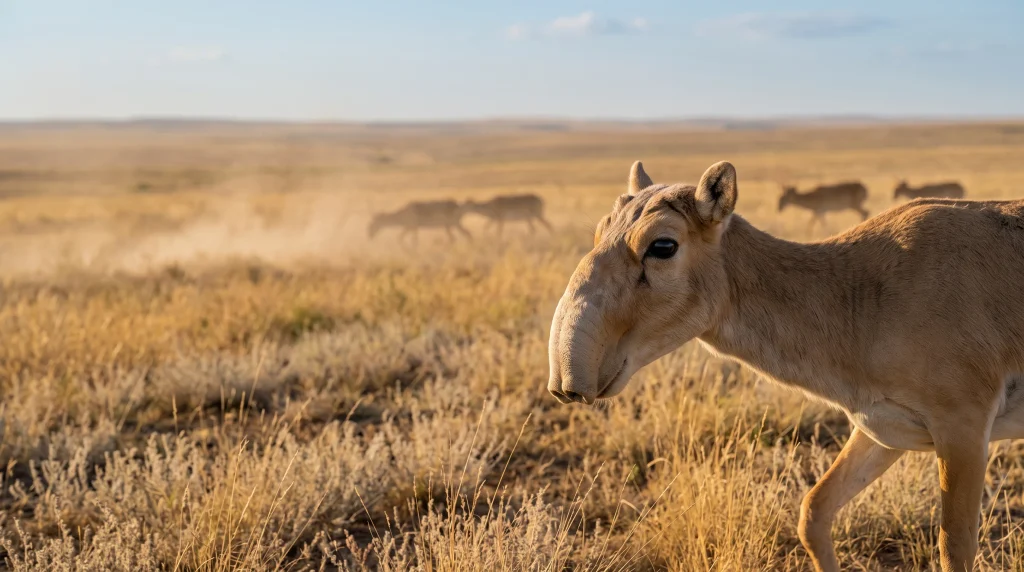
Few mammals have a face quite like the saiga antelope. Hanging over its mouth is a large, flexible, downward-facing nose that can look almost trunk-like when viewed from the side.
But the saiga antelope nose is not an ornamental oddity. It is a specialized structure associated with life on the open landscapes of Central Asia, where huge seasonal changes expose saigas to dusty conditions in warmer months and intensely cold air during winter.
Inside that unusual nose is an enlarged nasal chamber containing structures that interact with every breath the animal takes. Research indicates that the system helps filter airborne particles and can condition cold incoming air before it reaches deeper parts of the respiratory tract.
Once the saiga’s environment is understood, its strange face begins to make much more sense.
Table of Contents
- The Strange Anatomy of the Saiga Antelope Nose
- A Natural Dust Filter on the Steppe
- How the Saiga Antelope Nose Handles Freezing Air
- One Nose, Two Extreme Seasons
- Life on the Central Asian Steppe
- The Science Inside the Saiga’s Unusual Face
- More Than a Strange Nose
- An Ancient-Looking Survivor
- Frequently Asked Questions
- Conclusion
The Strange Anatomy of the Saiga Antelope Nose
The first thing most people notice about a saiga (Saiga tatarica) is the shape of its muzzle.
Instead of the relatively compact nose seen in many antelopes, the saiga has an enlarged, bulbous nasal region that projects downward over the mouth. The nostrils sit near the end of this flexible structure.
Its unusual external appearance reflects equally unusual anatomy inside.
The nasal cavity is large and contains complex internal surfaces rather than functioning as a simple open tube from nostrils to lungs. These internal structures increase the area over which inhaled air can interact with the tissues lining the nasal passages.
That matters because a mammalian nose does more than detect smells.
It is also the first major part of the respiratory system encountered by incoming air. Depending on the animal and environment, nasal structures can help filter particles and alter the temperature and moisture of inhaled air.
In the saiga, these functions are especially important because the animal lives in an environment that can be both dusty and extremely cold.
The unusual nose is therefore best understood as part of a respiratory system shaped by life on the Eurasian steppe.
A Natural Dust Filter on the Steppe
Imagine a large herd of hoofed animals moving rapidly across dry ground.
Every hoof striking loose soil can send particles into the air. Wind can add even more dust, particularly across exposed steppe and semi-desert landscapes where vegetation may be sparse.
For an animal traveling within a herd, that means breathing while surrounded by airborne particles.
This is where the saiga antelope nose becomes particularly useful.
The nasal cavity is lined with mucous membranes. Mucus helps capture particles entering with inhaled air, while the complex surfaces inside the nose increase contact between that air and the nasal lining.
Rather than allowing all airborne material to continue directly toward more sensitive respiratory regions, some of those particles can be intercepted within the nose.
Conservation organizations describing saiga biology have long highlighted this filtration role. The Convention on Migratory Species notes the species’ distinctive enlarged nose among its adaptations to its environment, while conservation accounts describe its usefulness in filtering dust associated with dry landscapes and herd movement.
It is important, however, not to imagine the nose as a perfect mechanical filter.
A saiga is not carrying a biological version of an industrial air purifier.
Instead, its enlarged nasal passages, internal structures, and mucus provide a first line of respiratory conditioning. Together, they can reduce the amount of particulate material traveling farther into the respiratory system.
That can be especially valuable during movement through dusty terrain.
How the Saiga Antelope Nose Handles Freezing Air
Dust explains only part of the story.
The same animal that experiences dry, dusty conditions during warmer periods must also survive winters on open landscapes where temperatures can fall far below freezing.
Breathing extremely cold air presents a physiological challenge.
Before outside air reaches the lungs, warming and humidifying it can help protect respiratory tissues and maintain suitable conditions for gas exchange.
The saiga’s enlarged nasal passages provide considerable internal surface area where incoming air can interact with warmer tissues.
As cold air moves through the nose, heat can be transferred to it before it travels deeper into the respiratory system.
This makes the saiga winter adaptation especially interesting because the same conspicuous nasal structure associated with dust filtration also participates in thermal conditioning.
Scientists have investigated the anatomy of this unusual system rather than simply assuming its purpose from appearance.
Research into saiga nasal morphology has found extensive nasal structures consistent with important respiratory heat-exchange and air-conditioning functions.
The safest scientific interpretation is therefore not that the nose works like a literal heater. Instead, its anatomy facilitates heat exchange between inhaled air and nasal tissues.
That distinction matters.
The saiga is using ordinary mammalian respiratory principles in an unusually specialized anatomical package.
One Nose, Two Extreme Seasons
The easiest way to understand the saiga nose is to compare the challenges it faces during different parts of the year.
Summer: Dust Management
Dry landscape → herd movement → airborne dust → nasal filtration
As saigas travel through dry steppe and semi-desert environments, wind and moving animals can lift fine particles from the ground.
Incoming air enters the enlarged nose, where mucus and internal nasal surfaces help intercept particles before air moves farther into the respiratory tract.
Winter: Cold-Air Conditioning
Freezing air → enlarged nasal passages → heat exchange → respiratory system
During winter, extremely cold outside air enters those same passages.
Contact with the nasal lining helps warm and condition the air before it travels toward the lungs.
The two functions are not contradictory.
They demonstrate how one anatomical structure can provide benefits under very different environmental conditions.
A saiga antelope adaptation does not necessarily need to solve only one problem. Natural selection can favor structures that perform several useful functions, particularly when those functions matter repeatedly throughout an animal’s life.
For a migratory mammal inhabiting an exposed continental environment, both dust and cold are recurring challenges.
Life on the Central Asian Steppe
The saiga’s face makes much more sense when placed back into its habitat.
Saigas inhabit open steppe, grassland, and semi-desert landscapes in Central Asia. Important populations occur primarily in Kazakhstan, with saigas also associated with parts of Russia and Mongolia depending on the population and taxonomic treatment.
These are landscapes of enormous horizons.
There may be relatively little shelter from strong winds, intense sun, snow, or sudden weather changes. Seasonal conditions can shift dramatically.
Saigas respond partly through movement.
They are highly mobile ungulates capable of seasonal migrations as they seek suitable forage, water, breeding areas, and conditions across broad landscapes.
Migration also allows animals to respond to environments where resources are not distributed evenly throughout the year.
But movement creates its own challenges.
Traveling across dry ground can expose animals to dust. Moving in large aggregations can increase the amount of disturbed soil. Winter travel exposes the respiratory system to repeated breaths of frigid air.
The Central Asian saiga is therefore not simply an antelope that happens to possess an unusual nose.
Its nasal anatomy belongs within a larger package of traits associated with surviving in open, highly seasonal landscapes.
The Science Inside the Saiga’s Unusual Face
The saiga’s nose has attracted scientific attention precisely because its shape is so different from that of many other living bovids.
Anatomical researchers have examined the nasal cavity and associated structures to understand how this unusual morphology might affect respiration.
One particularly relevant peer-reviewed study is Clifford and Witmer’s investigation of saiga nasal anatomy and its relationship to respiratory function. The researchers used anatomical evidence to examine the enlarged nasal region and the structures contained within it.
Their findings support an important point: the visible, hanging nose is only the external portion of a much more elaborate respiratory structure.
The internal anatomy creates extensive surfaces that can interact with moving air.
That supports physiological roles in conditioning inhaled air, including warming cold air and filtering material entering the respiratory passages.
However, there is an important difference between identifying what a structure can do and reconstructing exactly why it evolved.
Scientists can examine living saigas, measure anatomy, compare structures, and test biomechanical or physiological predictions. Determining every historical selective pressure that produced the modern nose is more difficult.
It is therefore reasonable to say that filtration and respiratory air conditioning are supported functions of the saiga nasal system.
It is more cautious to describe the exact evolutionary sequence that produced the nose as an interpretation based on anatomy, ecology, comparative biology, and the environmental challenges saigas experience.
Good natural-history explanations should preserve that distinction.
More Than a Strange Nose
The nose gets most of the attention, but it is only one part of the saiga’s adaptation to the steppe.
A Seasonal Coat
Saigas experience major seasonal changes in their fur.
Their winter coat becomes much thicker and paler than their summer coat, providing insulation during cold conditions. In warmer periods, the coat is shorter and typically more yellowish or sandy in appearance.
This seasonal transformation complements the respiratory advantages provided by the nose.
Long-Distance Movement
Saigas are built for movement across open country.
Rather than defending tiny territories year-round, populations can travel substantial distances as seasonal conditions change.
Migration helps connect the animals with changing food resources, breeding areas, and seasonal habitat.
Steppe Vegetation
Saigas are herbivores.
Their diet includes a variety of grasses, herbs, shrubs, and other steppe plants. What is available changes with location and season, giving mobility an important role in feeding ecology.
Herd Living
Saigas are social animals and can form groups that vary greatly in size depending on season and circumstances.
Large aggregations can provide benefits, but moving animals also disturb dry soil—which brings the story back to the saiga dust filter represented by the specialized nasal system.
These traits work together.
A warm winter coat would not replace the need to condition freezing inhaled air. A specialized nose would not eliminate the need to move in search of food.
Survival comes from an entire suite of anatomical and behavioral characteristics.
An Ancient-Looking Survivor
The saiga is frequently described in popular media as an “Ice Age antelope.”
There is a genuine historical reason for the association, but the phrase can be misleading if taken too literally.
Saigas had a much broader distribution during the Pleistocene than they do today. Fossil evidence indicates that saiga populations once occurred across extensive areas of Eurasia, and their former range reached considerably farther west than their modern Central Asian strongholds.
They lived alongside the broader cold-adapted fauna associated with Pleistocene steppe environments.
That does not mean today’s saiga should be portrayed as an animal that remained completely unchanged since the Ice Age.
Living species and populations continue experiencing evolution, demographic changes, shifting environments, and changes in geographic distribution.
The modern saiga is better understood as the surviving representative of a lineage with a deep history in open Eurasian environments.
Its distinctive face is particularly meaningful in that context.
The large nose illustrates extreme specialization for exposed habitats where seasonal temperatures, airborne particles, long-distance movement, and respiratory demands all matter.
The animal may look strange to human eyes, but evolution does not design faces according to human expectations.
Function matters more than appearance.
Frequently Asked Questions
Why does the saiga antelope have such a large nose?
The enlarged nose contains specialized internal nasal structures that help condition inhaled air. Important functions include filtering airborne particles and warming very cold incoming air before it travels deeper into the respiratory system.
Does the saiga’s nose filter dust?
Yes. The internal nasal passages and mucus can trap airborne particles entering with inhaled air. This is particularly useful in the dry, dusty environments saigas inhabit and during herd movement across loose ground.
How does a saiga survive freezing winters?
Several adaptations work together. Saigas develop a dense winter coat, remain mobile across their landscape, and possess enlarged nasal passages that help warm cold incoming air. Their behavior and seasonal movements also help them respond to changing environmental conditions.
Where do saiga antelopes live?
Most saigas live in Central Asia, particularly Kazakhstan. Populations also occur in Russia and Mongolia, although the Mongolian saiga is geographically and taxonomically distinct from the main populations farther west.
They generally occupy open steppe, grassland, and semi-desert environments.
What does a saiga eat?
Saigas are herbivores that consume grasses, herbs, shrubs, and other available steppe vegetation. Their diet changes according to location and season.
Do male and female saigas have large noses?
Yes. Both sexes possess the characteristic enlarged nose. Adult males are distinguished by other traits as well, most notably their horns; females normally lack horns.
Why do saigas migrate?
Migration allows saigas to track seasonal resources and environmental conditions across highly variable steppe landscapes. Movement can help them reach suitable feeding, breeding, and seasonal habitat as conditions change.
Conclusion
At first glance, the saiga antelope nose can seem almost comically oversized.
Put the animal back into its environment, however, and the shape becomes far more logical.
A saiga lives on vast open landscapes where wind and moving herds can fill dry air with dust. Months later, that same animal may face bitter winter conditions and repeatedly inhale air far below freezing.
Its enlarged nasal system helps address both challenges.
Mucus and complex internal passages help trap particles. Extensive nasal surfaces help condition and warm cold incoming air. Meanwhile, a seasonal coat, migratory behavior, herd living, and a flexible herbivorous diet help the animal cope with the broader demands of life on the Central Asian steppe.
The saiga’s face is therefore an excellent reminder that an animal adaptation cannot be fully understood by appearance alone.
What seems bizarre in isolation can become remarkably practical when viewed through ecology, anatomy, and evolution.
The saiga antelope nose looks strange because the environment that shaped it is demanding—and the unusual structure helps its owner breathe through dust, cold, and life on the move.