
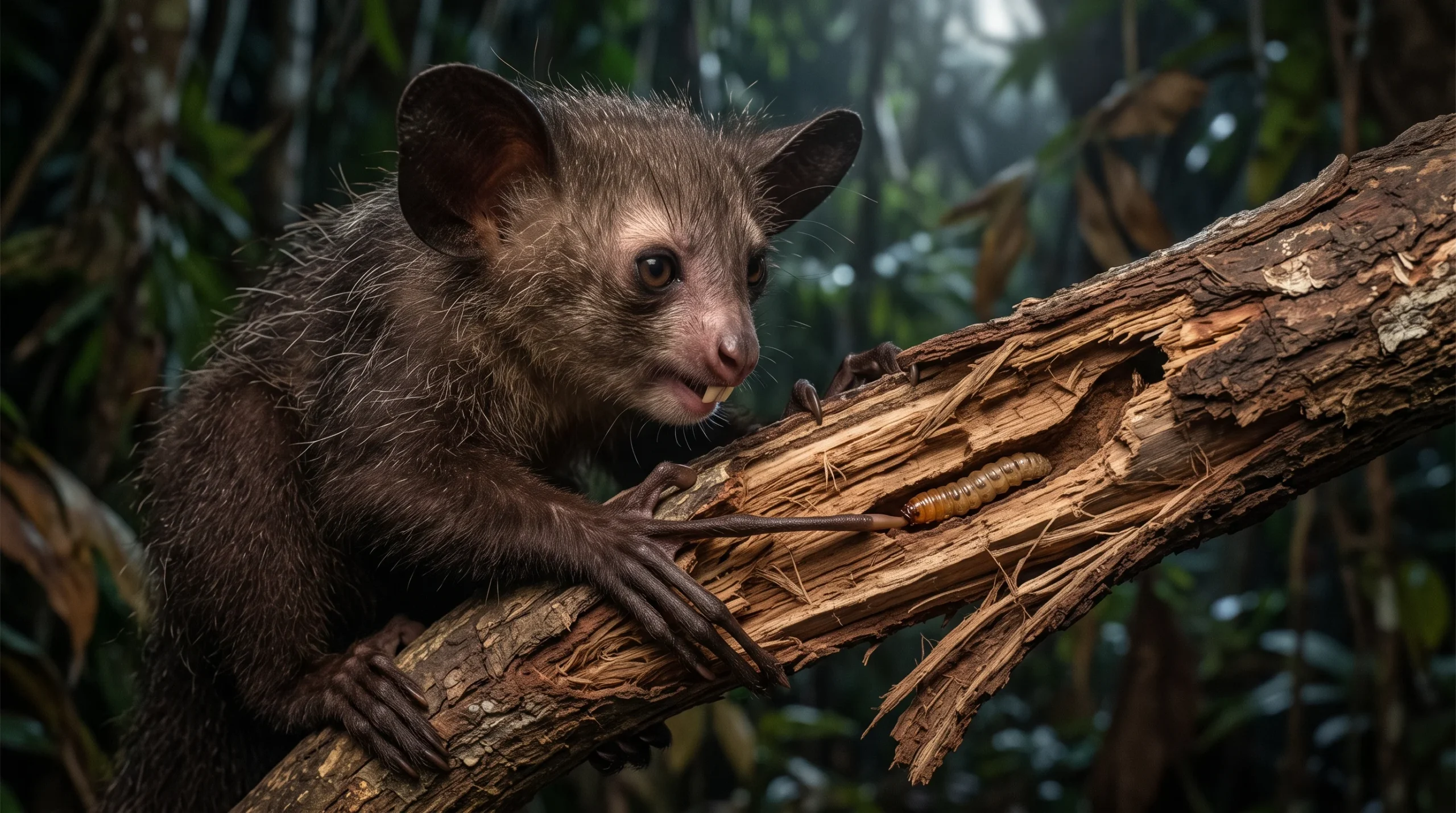
The aye-aye middle finger is one of the strangest feeding adaptations among primates. Extremely thin, long, and unusually mobile, this specialized finger helps the aye-aye locate and extract food hidden beneath bark and inside wood.
Native to Madagascar, the aye-aye (Daubentonia madagascariensis) uses a remarkable technique called percussive foraging, or tap-scanning. It rapidly taps wood, listens for differences that may indicate cavities, gnaws an opening with its powerful incisors, and inserts its slender middle finger to reach insect larvae.
The finger works together with the aye-aye’s large ears, specialized teeth, and sensitive hearing. What looks bizarre is actually part of an efficient feeding system designed for finding food that cannot be seen from the surface.
Table of Contents
- What Makes the Aye-Aye’s Hand So Unusual?
- How the Aye-Aye Middle Finger Finds Hidden Food
- Tap, Listen, Gnaw, Extract
- Why Aye-Ayes Have Such Large Ears
- Why the Middle Finger Is So Specialized
- Finding Beetle Larvae Inside Wood
- More Than a Strange-Looking Lemur
- Why This Adaptation Matters
- FAQ
- Conclusion
What Makes the Aye-Aye’s Hand So Unusual?
An aye-aye’s hand looks very different from the hand of most familiar primates.
Its fingers are long and narrow, but the third digit is particularly unusual. This is the specialized aye-aye middle finger, which is noticeably thinner than the surrounding fingers and capable of precise movements.
Its unusual proportions are directly connected to feeding.
The aye-aye uses the finger when investigating wood and later when probing small openings. Its slender shape allows it to reach into narrow spaces that thicker fingers could not easily enter.
This gives the animal a useful tool for obtaining concealed food.
Instead of relying only on sight or smell to find something edible, the aye-aye can investigate what is happening underneath the surface of a branch.
According to the Duke Lemur Center’s aye-aye profile, the animal’s specialized third finger plays an important role in finding and extracting food.
How the Aye-Aye Middle Finger Finds Hidden Food
One of the aye-aye’s most remarkable behaviors is called percussive foraging.
It is also commonly described as tap-scanning.
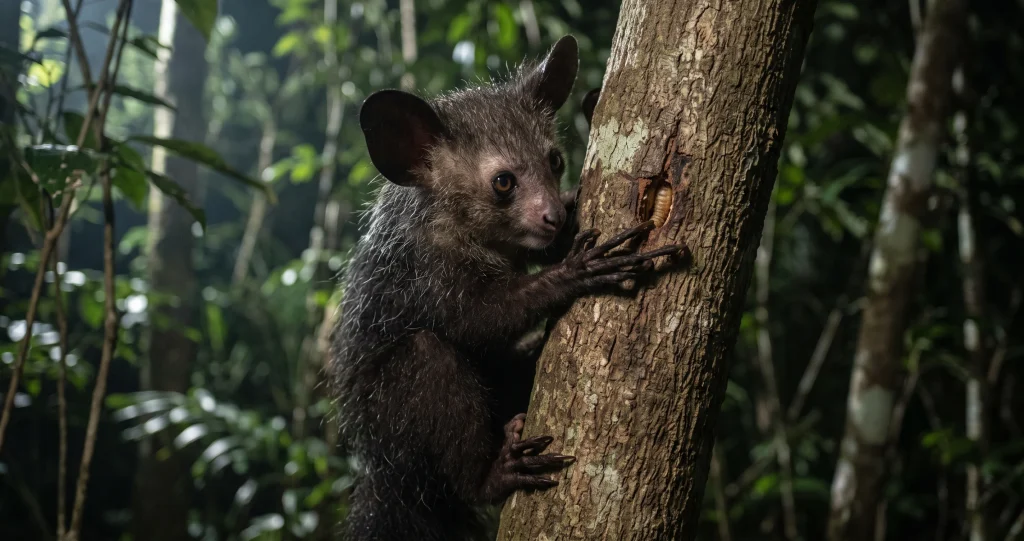
The animal moves along a branch while rapidly tapping the wood with its specialized finger. Those taps create sounds and vibrations that vary depending on the structure beneath the surface.
Solid wood does not necessarily produce the same acoustic information as an area containing a cavity or insect tunnel.
The aye-aye can use these differences to identify locations worth investigating.
Scientific studies support an important role for sound in this process. Research into aye-aye hearing has found a relationship between frequencies generated during tapping and the animal’s auditory sensitivity.
However, the process should not be oversimplified.
Researchers continue to investigate exactly how aye-ayes combine acoustic and tactile information while tap-scanning.
Does the Aye-Aye Use Echolocation?
The aye-aye is sometimes said to use echolocation like a bat.
That comparison is not entirely accurate.
Bats produce specialized vocalizations and analyze returning echoes. Aye-ayes physically strike a surface and obtain information from the resulting sounds and vibrations.
It is therefore more accurate to describe aye-aye tapping as specialized percussive foraging rather than ordinary bat-like echolocation.
The distinction is important because scientists have evidence that acoustic information matters, but the complete sensory process remains an active subject of research.
Tap, Listen, Gnaw, Extract
The feeding sequence becomes much easier to understand when divided into four stages:
Tap the wood → locate a promising cavity → gnaw an opening → insert the finger and extract food.
1. Tap
The aye-aye rapidly taps the surface of a branch or trunk.
Its specialized middle finger allows it to perform these movements quickly and precisely.
2. Listen
The animal evaluates sensory information generated by tapping.
Differences in the wood can help reveal promising subsurface areas, including cavities and tunnels.
Its large ears and sensitive auditory system are particularly useful because the food is hidden from view.
3. Gnaw
Once the aye-aye identifies a promising location, another unusual adaptation takes over.
The animal possesses powerful incisors that grow continuously.
It gnaws through the wood to create an opening into the cavity.
4. Extract
The aye-aye middle finger then becomes a precision probe.
Its thin shape allows the animal to insert it through the opening and explore narrow tunnels. The aye-aye can manipulate or hook food and pull it toward its mouth.
This sequence demonstrates why focusing on the finger alone tells only part of the story.
The finger, ears, incisors, and behavior work together.
Why Aye-Ayes Have Such Large Ears
Another striking feature of an aye-aye is its enormous ears.
For a nocturnal animal searching for hidden food, sensitive hearing can be extremely valuable.
An insect larva buried inside wood cannot simply be spotted with the eyes. Instead, the aye-aye needs information about structures underneath the surface.
Sound helps provide that information.
Studies of aye-aye acoustic ecology have examined how tapping sounds relate to the animal’s hearing abilities. The results support the idea that its auditory system is well suited to obtaining useful information during percussive foraging.
The ears are also highly mobile.
Research using models of aye-aye ears has investigated how ear position may affect the reception of sounds generated during tap-scanning.
This does not mean the ears function as a perfect biological scanner.
Rather, current evidence indicates that hearing is an important component of a broader sensory system used while searching for hidden food.
Why the Aye-Aye Middle Finger Is So Specialized
The unusual shape of the aye-aye middle finger becomes particularly useful after the animal opens a cavity.
Wood-boring insects do not create perfectly straight tunnels.
Their galleries can curve and change direction inside branches.
A thick or rigid finger would have difficulty reaching into these narrow spaces.
The aye-aye’s third digit is extremely slender and highly mobile, allowing much more precise probing.
Anatomical research has revealed unusual joint specialization associated with this mobility. The finger can move with remarkable freedom compared with what people normally expect from a primate digit.
That gives the aye-aye an effective biological probe.
Its teeth perform the heavy work of opening wood, while the finger performs the delicate work of investigating what lies inside.
This division of labor is central to the animal’s feeding strategy.
Finding Beetle Larvae Inside Wood
Wood-boring insect larvae are among the most interesting foods targeted by aye-ayes.
Certain beetle larvae spend part of their development concealed inside wood. As they feed, they create tunnels beneath the surface.
For many predators, the surrounding wood provides excellent protection.
The aye-aye has evolved a way around that defense.
Research examining aye-aye feeding sites in Madagascar has documented the importance of mines associated with wood-boring beetle larvae. Researchers have investigated how the physical characteristics of those tunnels may provide useful information during tap-scanning.
Once a promising tunnel has been identified, the aye-aye can gnaw through the wood and probe the cavity.
The aye-aye finger can then reach places that the mouth cannot.
This behavior gives the animal access to a food resource that is difficult for many other mammals to exploit.
More Than a Strange-Looking Lemur
The aye-aye is not simply a specialist insect hunter.
It is a nocturnal lemur found naturally in Madagascar.
Aye-ayes spend much of their active period moving through trees and searching for food. Their diet includes insect larvae but also various plant foods.
Fruits, seeds, nuts, and other resources can contribute to their diet.
Their incisors are another distinctive adaptation. Unlike the teeth of most primates, the front teeth grow continuously, helping the animal gnaw through tough materials.
The unusual finger is also more versatile than its reputation suggests.
It can be used to manipulate foods and retrieve material from narrow spaces, not only to remove insects from wood.
These adaptations make the aye-aye one of Madagascar’s most distinctive primates.
Why This Adaptation Matters
Specialized anatomy can allow an animal to exploit resources that competitors cannot easily reach.
The aye-aye provides an excellent example.
A branch may look empty from the outside while containing nutritious insect larvae beneath its surface.
Accessing that food creates several problems.
The animal must detect the hidden cavity, determine where to open the wood, penetrate the surface, and finally remove the prey from a narrow tunnel.
The aye-aye has adaptations for every stage.
Its finger produces rapid taps.
Its auditory system helps collect information from those taps.
Its incisors create an opening.
Its specialized third digit then probes the cavity.
The result is an unusual but highly coordinated feeding strategy.
Rather than competing only for visible food, the aye-aye can exploit resources hidden inside wood.
Aye-Aye Adaptations Work as a System
It is tempting to focus entirely on the bizarre appearance of the aye-aye middle finger, but evolution rarely works through one feature in isolation.
The effectiveness of the finger depends on other adaptations.
Without strong incisors, accessing deep cavities would be difficult.
Without sensitive hearing, locating promising areas beneath the wood would be less effective.
Without precise finger mobility, retrieving food from narrow tunnels would become harder.
Behavior connects all of these anatomical features.
This combination makes the aye-aye a particularly interesting example of evolutionary specialization.
Its strange appearance reflects the unusual ecological problems it has become equipped to solve.
FAQ
What Is Special About the Aye-Aye Middle Finger?
The aye-aye middle finger is extremely thin, elongated, and mobile. It is used during tap-scanning and can later be inserted into narrow cavities to manipulate and extract hidden food.
Why Do Aye-Ayes Tap on Trees?
Aye-ayes tap wood to obtain sensory information about what lies beneath the surface. Differences associated with cavities or tunnels can help them identify promising places to investigate.
Do Aye-Ayes Use Echolocation?
Not in the conventional bat-like sense. Aye-ayes create sounds by physically tapping wood and use acoustic information during percussive foraging. Scientists continue studying exactly how acoustic and tactile cues are combined.
What Do Aye-Ayes Find Inside Wood?
Wood-boring insect larvae are important targets. These larvae create tunnels inside branches and other woody material that aye-ayes can investigate and excavate.
Why Are Aye-Ayes’ Ears So Large?
Their large, sensitive ears are useful for detecting sounds during nocturnal activity and tap-scanning. Research supports an important role for hearing during percussive foraging.
Where Do Aye-Ayes Live?
Aye-ayes are native to Madagascar. They inhabit several types of forest and spend much of their active time moving and feeding in trees.
Is the Aye-Aye’s Finger Used Only for Finding Insects?
No. The specialized digit can also help manipulate other foods and retrieve material from narrow spaces. Extracting insects from wood is simply its most famous use.
Conclusion
The aye-aye middle finger is strange in appearance but remarkably practical in function.
An aye-aye taps wood with its slender finger and uses sensory information to identify promising hidden cavities. Its large ears contribute to detecting useful acoustic information. Powerful incisors then open the wood, allowing the specialized finger to probe inside and retrieve food.
Each adaptation supports the others.
The finger alone does not explain the aye-aye’s success. Neither do its ears or teeth. Together with specialized behavior, they form an integrated feeding system that allows this Madagascar lemur to reach resources hidden from view.
The aye-aye middle finger is therefore more than one of the strangest hands in the primate world. It is a precision tool at the center of an extraordinary strategy for finding and extracting food.