
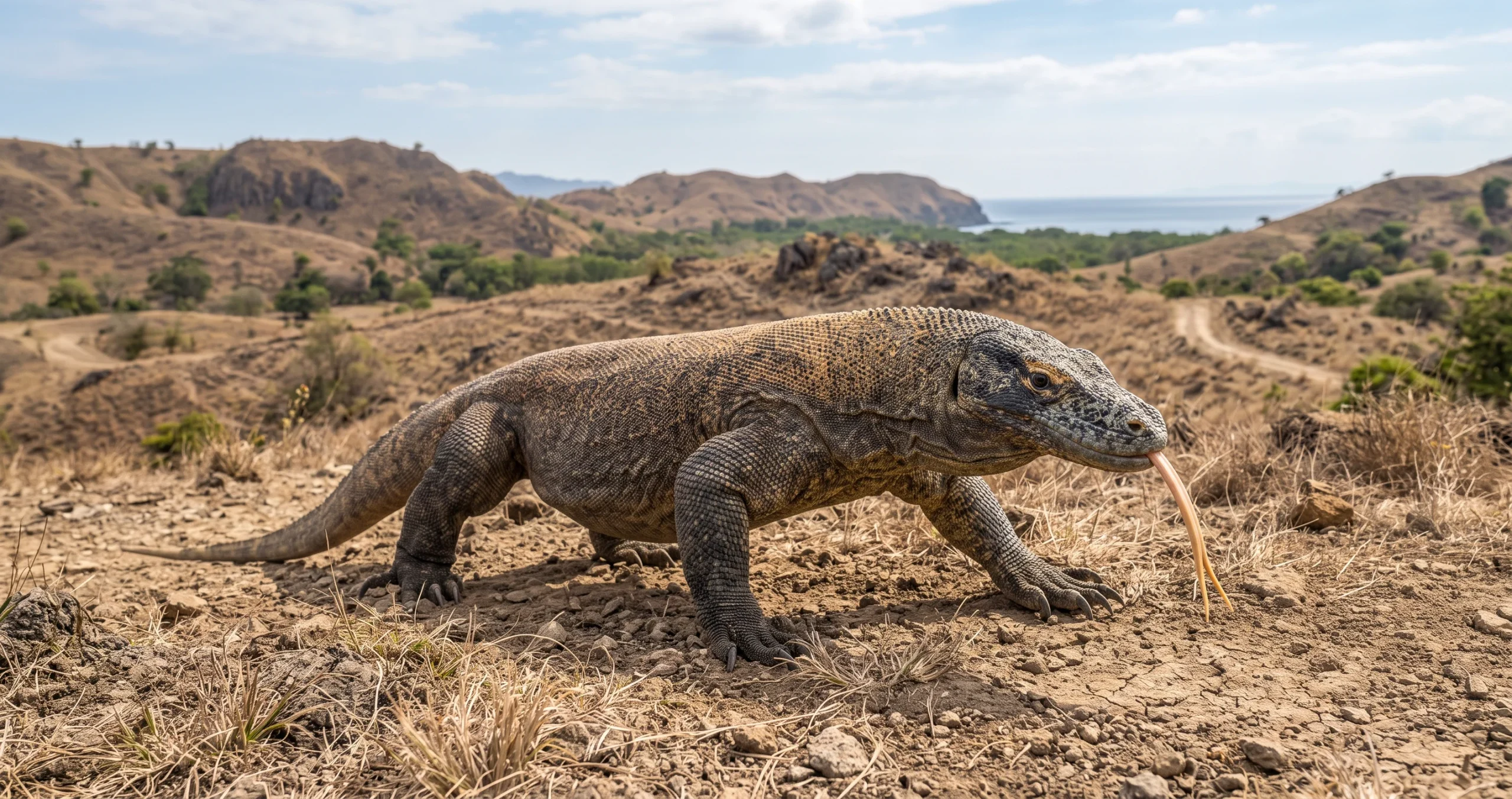
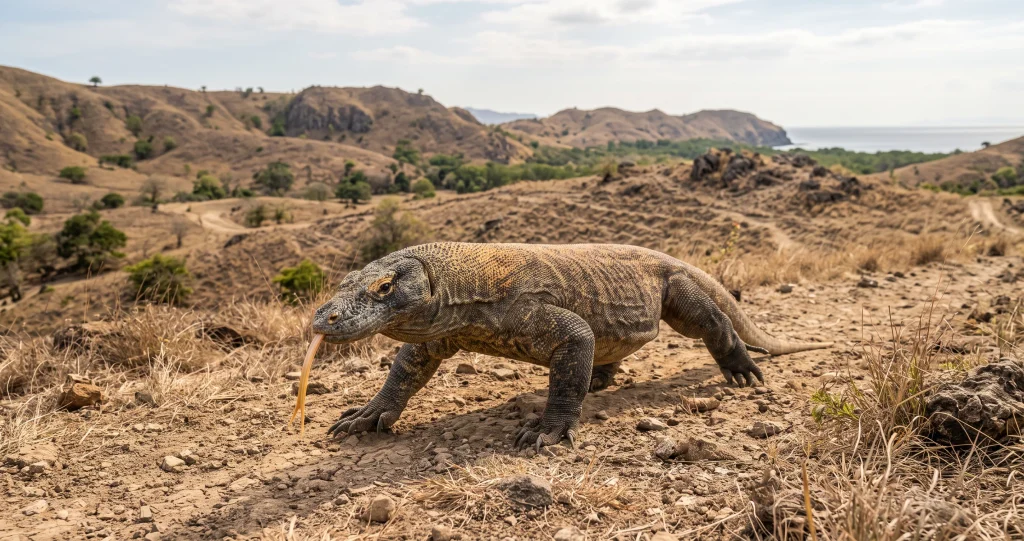
A Komodo dragon walking across a dry Indonesian landscape repeatedly does something that looks almost snake-like. Its long yellow tongue shoots from its mouth, splits into two narrow tips, then disappears again.
That flicking tongue is doing far more than tasting the ground. The unusual Komodo dragon tongue smell system allows the world’s largest living lizard to collect chemical traces from its surroundings and deliver them to specialized sensory organs inside its mouth. Under favorable conditions, those chemical clues can help a dragon locate carrion from surprisingly far away.
The popular version of the story says a Komodo dragon can simply “smell prey from miles away.” The real biology is stranger—and more precise.
Its forked tongue functions partly as a chemical sampling device. The two tips can collect information from slightly different locations, while head and body movements help the animal determine which direction is worth investigating.
It is less like having an extraordinarily powerful human nose and more like carrying a mobile chemical tracking system.
Table of Contents
- Komodo Dragons Do Not Smell Like We Do
- How the Jacobson’s Organ Works
- Why the Komodo Dragon Has a Forked Tongue
- How Two Tongue Tips Reveal Direction
- Can a Komodo Dragon Really Detect Carrion Miles Away?
- Wind Can Make or Break the Trail
- How Chemical Tracking Fits Into the Hunt
- Komodo Dragons Use More Than One Sense
- Common Myths About Komodo Dragon Smell
- Frequently Asked Questions
- Conclusion
Komodo Dragons Do Not Smell Like We Do
Humans usually think of smell as air entering the nostrils and odor molecules interacting with receptors in the nasal cavity.
Komodo dragons have a more unusual chemical-sampling system.
Like other monitor lizards, they repeatedly extend and retract their forked tongues while investigating their environment. The tongue collects chemical particles and brings those samples back into the mouth.
The information can then be analyzed by the vomeronasal organs, commonly called Jacobson’s organs.
The Smithsonian’s National Zoo describes the Komodo dragon’s sense of smell as its primary food-detection system and explains that the animal transfers chemical information gathered by its tongue to the Jacobson’s organs in the roof of the mouth.
This distinction matters.
When people say a Komodo dragon “smells with its tongue,” the phrase is a useful shortcut—but the tongue itself is not doing all of the sensory analysis.
It is collecting and delivering the evidence.
How the Jacobson’s Organ Works
The vomeronasal system is a specialized chemical-sensing system found in many vertebrates and particularly important in snakes and many lizards.
When a Komodo dragon flicks its tongue, chemical molecules from the environment can adhere to the tongue surface.
The tongue is then withdrawn.
Inside the mouth, the collected chemical information is transferred toward openings associated with the vomeronasal organs.
Specialized sensory cells respond to chemical compounds in those samples, allowing the nervous system to extract useful information from the environment.
For a predator and scavenger, that information can be enormously valuable.
A carcass releases chemical compounds as decomposition proceeds. An injured animal can leave chemical traces as it moves. Other Komodo dragons also produce chemical information that may be biologically relevant.
The tongue therefore gives the dragon access to an invisible landscape.
To us, an apparently empty patch of savanna may contain little obvious information.
To a tongue-flicking monitor lizard, the same place can contain chemical clues worth following.
How the Komodo Dragon Tongue Smell System Works
The strangest feature is visible every time the tongue appears.
It is deeply forked.
A forked tongue is not merely a dramatic reptilian ornament. Separating the tongue into two tips allows chemical samples to be collected at two slightly different positions.
That difference can provide directional information.
Imagine an odor source somewhere to the dragon’s left.
If chemical cues associated with that source are stronger on one side than the other, comparing the samples can help the animal determine where the chemical trail becomes stronger.
The Smithsonian describes this process specifically for Komodo dragons: differences in chemical concentration detected between the two tongue tips can provide information about the direction of a potential food source.
The animal can then move, sample again, and update its course.
This happens repeatedly.
Tongue out.
Sample.
Tongue in.
Analyze.
Move.
Sample again.
The result is not a single magical detection followed by a perfectly straight walk toward dinner.
It is active chemical navigation.
Why Two Tongue Tips Are Better Than One
Directional chemical sensing becomes easier to understand if you compare it with locating a sound.
Two ears receive slightly different information depending on where a sound originates. The nervous system can use those differences to help determine direction.
A forked tongue provides a roughly comparable principle for chemical sampling, although the sensory mechanism is entirely different.
The left and right tongue tips collect samples from separate points in space.
This is sometimes called stereo chemoreception.
Research on forked tongues in squamate reptiles has shown that tongue-forking can contribute to directional chemical sensing. Komodo dragons add another behavior to this system: they can move their heads from side to side while investigating chemical information.
The Smithsonian notes that their undulating walk and side-to-side head movements work with tongue sampling to help establish the direction of food.
This creates something more sophisticated than simply detecting that food exists.
The dragon needs to answer another question:
Which way should I go?
That is where the fork becomes particularly useful.
Can a Komodo Dragon Really Detect Carrion Miles Away?
This is where a spectacular animal fact needs some caution.
A widely repeated claim says Komodo dragons can detect carrion from several miles away.
There is support from major zoological institutions for a substantial detection range. The Smithsonian National Zoo states that Komodo dragons can at times detect carrion from as far as about 2.5 miles, or 4 kilometers, away. San Diego Zoo Wildlife Alliance has likewise published an estimated carrion-detection distance of 2.5 miles.
That does not mean every carcass is detectable from exactly 2.5 miles.
It certainly does not mean a dragon exists inside a perfect circular “smell radar” with a fixed 2.5-mile radius.
Chemical detection depends on the cue actually reaching the animal.
A large decomposing carcass releasing abundant volatile compounds under favorable wind conditions is very different from a small, fresh food source separated from the dragon by unfavorable airflow and complicated terrain.
The famous distance is therefore better treated as an estimate of what may be possible under favorable circumstances, not a guaranteed detection specification.
Wind Can Make or Break the Trail
Chemical tracking outdoors is shaped by physics.
Odor molecules do not spread evenly in every direction.
Air currents transport them.
Wind can create an irregular plume extending away from a carcass. Within that plume, concentrations fluctuate as moving air mixes and disperses the chemicals.
A dragon positioned downwind may encounter useful chemical information.
A dragon at a similar distance but in the wrong direction may receive far less.
Terrain can complicate the picture further.
Komodo dragons inhabit landscapes containing open savanna, scrub, forested areas, ridges, valleys, and coastal environments. Vegetation and landforms influence airflow and how odor plumes move.
Temperature and atmospheric conditions can also affect the dispersal of volatile compounds.
This is why “it can smell meat from 2.5 miles away” is less informative than it initially appears.
The animal is not measuring distance.
It is encountering chemical information carried through a constantly changing environment and then attempting to navigate toward its source.
How Chemical Tracking Fits Into the Hunt
Komodo dragons are both predators and scavengers.
Carrion can represent a valuable meal that does not require the energetic cost and physical danger of attacking large living prey. A sensory system capable of guiding the animal toward a distant carcass is therefore extremely useful.
But Komodo dragons also hunt.
Adults can prey on animals including deer, wild pigs, and other vertebrates, while younger dragons consume smaller prey.
Their hunting strategy combines patience, concealment, rapid short-range attack, powerful neck movements, serrated teeth, claws, and venom.
The Smithsonian describes Komodo dragons as opportunistic hunters that can wait along game trails for suitable prey while also scavenging carcasses.
Chemical tracking becomes particularly interesting when an injured animal moves away.
A dragon does not necessarily need to maintain visual contact with every potential food source. Chemical information can help it investigate where an animal or carcass has gone.
That ability complements rather than replaces its other senses.
For another example of an animal turning its tongue into a highly specialized feeding tool, see our article on the extraordinary pangolin tongue adaptation.
Komodo Dragons Use More Than One Sense
Calling the tongue the Komodo dragon’s chemical detector should not create another misconception: these animals are not navigating through a world defined exclusively by smell.
Vision matters.
The Smithsonian reports that Komodo dragons can detect objects at considerable distances and that their vision is particularly useful for detecting movement.
A moving deer, for example, provides visual information that a stationary carcass cannot.
The senses work together.
A dragon may visually detect movement, investigate chemical traces with tongue flicks, change direction as chemical concentrations change, and use its physical hunting adaptations once it reaches striking distance.
This sensory flexibility suits an opportunistic predator.
It can search.
It can wait.
It can scavenge.
And when a promising chemical trail appears, it can follow.
Common Myths About Komodo Dragon Smell
Myth 1: Komodo Dragons Literally Smell With Their Tongues
Not exactly.
The tongue is primarily a sampling and delivery tool in this system. Chemical information collected by tongue flicking is transferred to the vomeronasal organs, where specialized sensory receptors participate in detecting those compounds.
The shortcut “smelling with the tongue” describes the overall behavior but hides the more interesting anatomy.
Myth 2: The Forked Tongue Makes Smell Stronger
The fork is especially important for spatial information.
Because the two tips sample slightly different locations, differences between them can help indicate the direction of a chemical source.
The fork therefore helps the dragon determine where to investigate rather than simply functioning as a larger odor collector.
Myth 3: A Komodo Dragon Can Always Detect Meat From 2.5 Miles Away
No fixed distance works under every condition.
The roughly 2.5-mile figure is reported by authoritative zoo sources as a possible or estimated carrion-detection range.
Actual detection depends on variables including the odor source, wind direction, terrain, and environmental conditions.
Myth 4: Komodo Dragons Hunt Only by Smell
Chemical sensing is extremely important, but Komodo dragons also use vision, movement detection, stealth, ambush behavior, physical power, teeth, claws, and venom.
They are multisensory predators rather than walking noses.
Myth 5: The Tongue Detects Prey Like Radar
There is no invisible biological radar beam extending from a Komodo dragon.
The animal must encounter chemical cues.
Repeated tongue flicking and movement then allow it to sample its surroundings and adjust direction as new information arrives.
That process is impressive enough without turning it into a supernatural ability.
Frequently Asked Questions About Komodo Dragon Tongue Smell
How does a Komodo dragon smell with its tongue?
The dragon flicks its forked tongue into the environment and collects chemical samples. When the tongue returns to the mouth, those chemicals are delivered toward the vomeronasal, or Jacobson’s, organs for sensory analysis.
Why is a Komodo dragon’s tongue forked?
The separated tips allow chemical information to be sampled at two slightly different locations.
Differences between those samples can provide directional information, helping the animal determine which way a chemical source lies.
What is Jacobson’s organ?
Jacobson’s organ is another name for the vomeronasal organ, a specialized chemosensory structure found in many vertebrates.
In Komodo dragons, tongue flicking helps deliver environmental chemical samples to this sensory system.
How far away can a Komodo dragon smell prey?
The Smithsonian National Zoo states that Komodo dragons can sometimes detect carrion from up to approximately 2.5 miles (4 kilometers) away.
That figure should not be interpreted as a guaranteed range for every food source. Wind, terrain, decomposition, source size, and other environmental factors affect whether chemical cues reach the dragon.
Can Komodo dragons smell living prey?
Their chemosensory system is not limited to dead animals.
Komodo dragons can investigate chemical information associated with living animals and their surroundings, although carrion is especially relevant because decomposition can produce strong chemical cues.
Do Komodo dragons use their noses?
Komodo dragons possess conventional olfactory anatomy as reptiles, but tongue-flicking and the vomeronasal system play a particularly prominent role in their chemical investigation of food and surroundings.
Can they tell which direction an odor comes from?
Their forked tongue can contribute to directional chemical sensing because the two tips sample separate points.
Repeated tongue flicking, head movement, and locomotion allow the dragon to continually update its direction.
Do Komodo dragons track wounded prey for days?
Komodo dragons are capable of following chemical cues associated with potential food, and the Smithsonian describes them using smell to track wounded animals.
However, the old popular story that their hunting strategy depends mainly on biting an animal and then waiting days for mouth bacteria to kill it is an oversimplification. Komodo dragons possess venom, inflict severe mechanical wounds, and use multiple strategies when hunting.
Conclusion
A Komodo dragon’s flicking yellow tongue may be one of the most recognizable images in the reptile world, but the real sensory system behind it is even stranger than it looks.
The Komodo dragon tongue smell system begins when the forked tongue collects chemical information from the environment.
The tongue then returns those samples to the mouth, where the vomeronasal organs help analyze them.
Because the tongue has two separated tips, the dragon can gather chemical information from slightly different positions. Comparing those samples, combined with repeated tongue flicks and side-to-side movement, helps reveal the direction of a promising chemical source.
Under favorable circumstances, that system may help a Komodo dragon detect carrion from roughly 2.5 miles away, according to major zoological sources.
But there is no fixed “miles-away” guarantee.
Wind must transport the chemical cues. Terrain can alter their path. The strength and nature of the odor source matter.
That makes the truth more fascinating than the myth.
A Komodo dragon is not simply smelling farther than other animals.
It is repeatedly sampling an invisible chemical landscape, comparing information collected by two tongue tips, changing direction, sampling again, and gradually navigating toward food.
The tongue looks strange because it is built for a strange job.
It is part of a biological tracking system that allows the world’s largest living lizard to turn invisible molecules drifting through the landscape into directions it can follow.
Internal sources :
External Source :
- Smithsonian’s National Zoo — Komodo Dragon — authoritative overview of tongue flicking, Jacobson’s organs, directional chemical sensing, hunting behavior, and the reported 2.5-mile carrion-detection range.
- San Diego Zoo Wildlife Alliance — Komodo Dragon — authoritative zoological background on Komodo dragon anatomy, ecology, and behavior.
- San Diego Zoo Wildlife Alliance — Komodo Carrion Detection — specifically reports an estimated carrion-detection range of approximately 2.5 miles.