
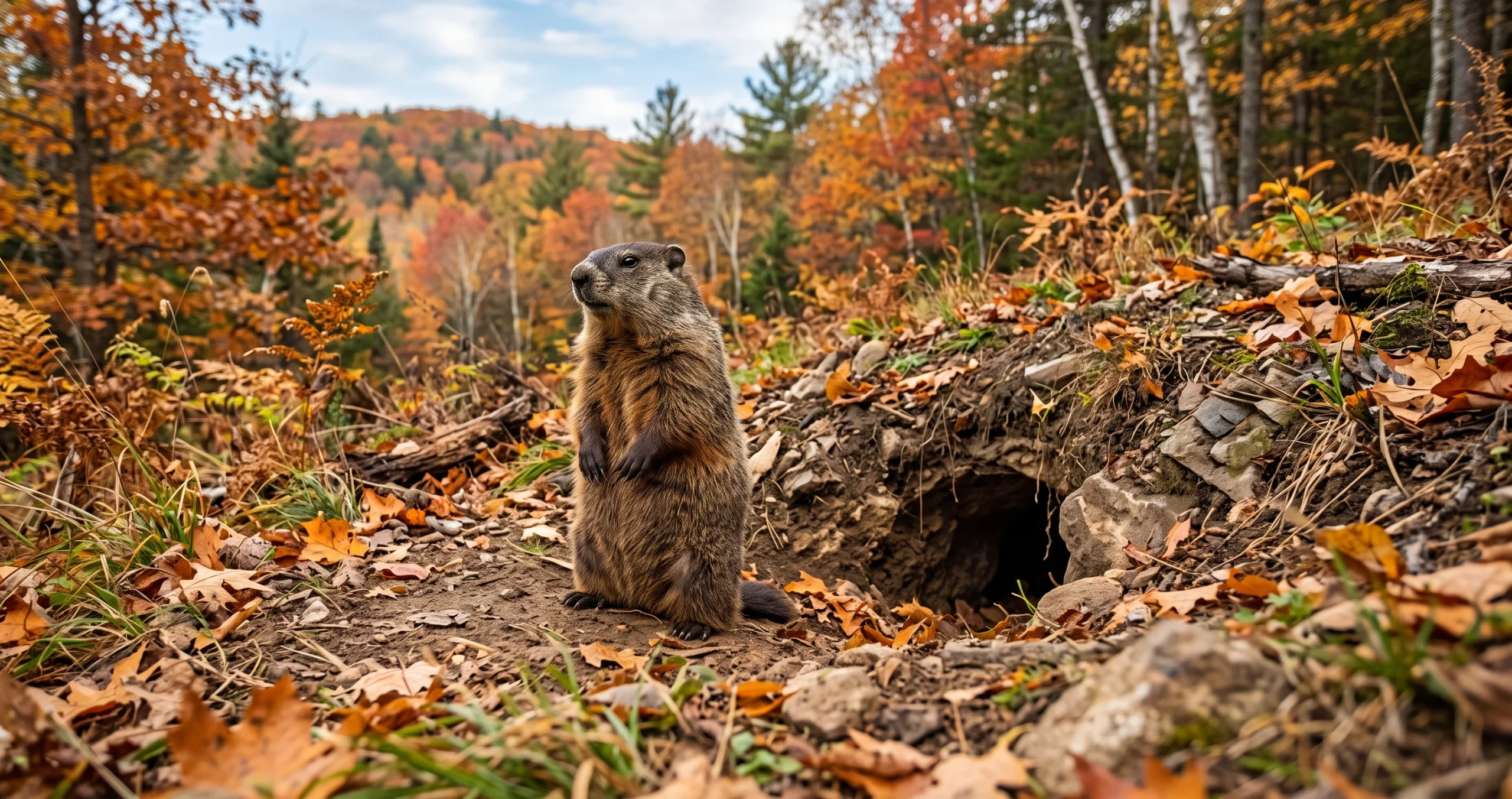
Every February, the groundhog becomes famous for supposedly predicting how much winter remains. Its real winter ability is far more remarkable. Groundhog true hibernation involves a profound, controlled reduction in body temperature, heart rate, breathing, and metabolism that allows this stocky North American rodent to survive months when fresh food is scarce.
Groundhogs, also called woodchucks (Marmota monax), belong to the marmot branch of the squirrel family. Unlike an animal that simply sleeps more during cold weather, a hibernating groundhog enters repeated periods of deep torpor in which its entire physiology operates at an extraordinarily low level. Researchers have studied this transformation for decades because it demonstrates how dramatically a mammalian body can reduce its energy requirements without suffering the damage such conditions would normally cause.
Table of Contents
- What Is a Groundhog?
- What “True Hibernation” Actually Means
- Groundhog True Hibernation: What Happens Inside the Body
- How Low Does a Groundhog’s Body Temperature Fall?
- What Happens to the Heart?
- Metabolism Falls Dramatically
- Hibernation Is Not One Continuous Sleep
- How Groundhogs Prepare During Fall
- Why Fat Is Essential for Winter Survival
- Groundhogs Versus Bears
- Why Groundhog Day Does Not Reflect the Real Biology
- Why Groundhogs Emerge
- Common Myths About Groundhog Hibernation
- Frequently Asked Questions
- Conclusion
What Is a Groundhog?
The groundhog is a large ground-dwelling squirrel native to much of eastern and central North America. “Groundhog” and “woodchuck” are two common names for the same species, Marmota monax.
Groundhogs spend much of the warmer part of the year feeding on vegetation and using extensive burrow systems for shelter, reproduction, and protection from predators. Pennsylvania State University notes that woodchucks are among the relatively few mammals that undergo true hibernation, with the timing varying geographically.
Although groundhogs look heavy and slow when feeding in a field, their seasonal biology is precisely adapted to a life in which food availability changes dramatically between summer and winter.
What “True Hibernation” Actually Means
Hibernation is more than prolonged sleep.
Sleep primarily involves changes in brain activity and responsiveness. True hibernation involves major physiological changes throughout the body, including substantial reductions in metabolic rate, heart rate, breathing, and body temperature.
The National Park Service describes three characteristics commonly associated with a true hibernator: reduced metabolism, a slower heart rate, and a lowered body temperature.
This deep energy-saving condition is called torpor.
A groundhog entering torpor does not simply become inactive. Its body actively transitions into an extraordinarily low-energy physiological state.
That distinction makes groundhog true hibernation very different from simply hiding underground and sleeping through bad weather.
Groundhog True Hibernation: What Happens Inside the Body
The transformation occurring during groundhog true hibernation affects nearly every major energy-consuming system.
Research on hibernating woodchucks has documented dramatic reductions in body temperature and heart rate. Other cardiovascular functions decline as the animal’s tissues require far less oxygen and energy.
In one research context, naturally hibernating woodchucks had an average body temperature of approximately 56°F (13°C) and a heart rate around 27 beats per minute. Different studies and environmental conditions can produce different values, so these numbers should not be treated as fixed for every individual.
Deep-hibernating mammals can suppress metabolic activity to a tiny fraction of normal levels. Research involving woodchucks describes deep torpor as a state in which metabolic rate may fall below 5% of the normal rate.
That enormous reduction in energy expenditure is the key to surviving winter on stored body fat.
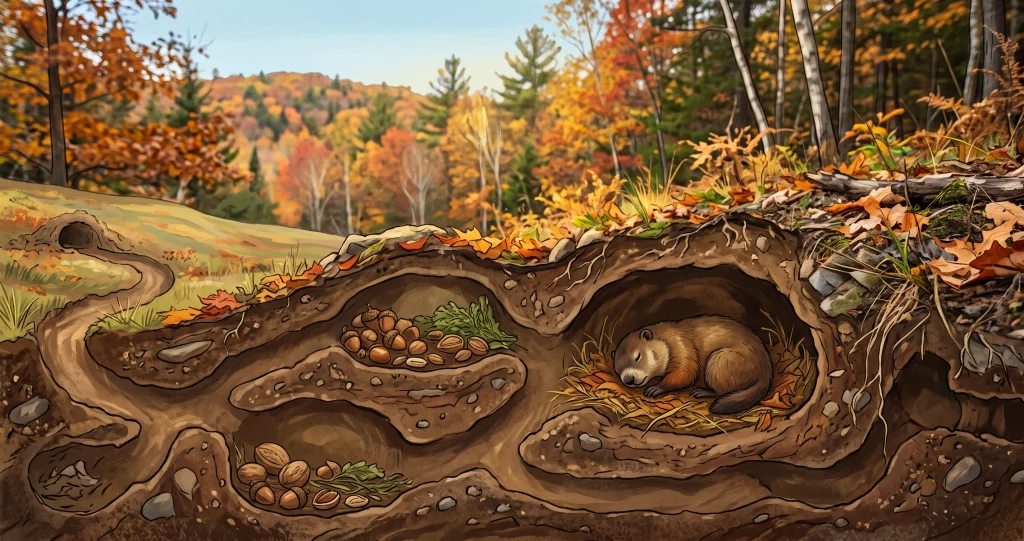
How Low Does a Groundhog’s Body Temperature Fall?
An active mammal normally maintains a relatively stable internal temperature regardless of moderate changes in its surroundings.
During deep hibernation, a groundhog temporarily relaxes much of that expensive temperature regulation.
Its body cools dramatically as it enters torpor.
Cornell University has described woodchuck body temperature during hibernation as dropping to around 39–40°F under some natural burrow conditions. Other research has recorded warmer values depending on the animal, hibernation stage, environmental temperature, and study conditions.
This variability is important.
There is no single temperature that every groundhog maintains throughout the entire winter. Hibernation is dynamic, and body temperature changes as the animal cycles between deep torpor and periods of arousal.
What Happens to the Heart?
One of the most striking aspects of groundhog true hibernation occurs in the cardiovascular system.
As the animal enters torpor, its heart slows dramatically.
The decline is not merely a passive consequence of becoming cold. Research on mammalian hibernation indicates that heart rate can begin falling before a noticeable decline in body temperature, showing that entry into hibernation involves active physiological regulation.
During deep hibernation, heart rate can fall from normal active levels to only a small fraction of its warm-season rate.
Researchers studying hibernating woodchucks have measured extremely low heart rates along with reduced blood pressure and cardiac workload. Remarkably, the heart continues functioning at temperatures that would create severe problems for most nonhibernating mammals.
That ability has made hibernating mammals interesting research models for scientists investigating cardiovascular physiology.
For a broader comparison of how dramatically heart rates differ across animals, see Secrets of the Green Garden’s guide to animal heart rates.
Metabolism Falls Dramatically
Reducing body temperature and heart rate would accomplish little if the rest of the body continued consuming energy normally.
It does not.
During deep torpor, metabolic activity is profoundly suppressed. Research on woodchucks describes metabolic rates during hibernation falling below 5% of normal levels.
Oxygen demand falls along with energy consumption.
This is what allows a groundhog to remain underground for extended periods without continuously searching for food.
Instead of supplying its body with newly eaten calories, the animal gradually draws energy from fat accumulated before entering hibernation.
Hibernation Is Not One Continuous Sleep
One common misconception is that a groundhog enters its burrow in fall, falls asleep, and remains continuously unconscious until spring.
Real hibernation is more complicated.
Groundhogs undergo bouts of torpor interrupted by periodic arousals. During these arousals, body temperature and metabolic activity rise substantially before the animal eventually returns to torpor.
Studies monitoring woodchuck body temperatures have documented these torpor and euthermic, or normal-temperature, periods throughout hibernation. Researchers have even found evidence that biological rhythms persist during these cycles.
Arousal is energetically expensive because warming the body requires substantial energy.
Scientists continue investigating why hibernators periodically return to high body temperatures despite that cost. Several physiological processes may benefit from these intervals, but hibernation should not be imagined as one uninterrupted state lasting all winter.
How Groundhogs Prepare During Fall
Groundhog true hibernation depends heavily on what happens before winter arrives.
During late summer and fall, groundhogs spend considerable time feeding and accumulating energy reserves.
Their seasonal weight gain is not simply incidental fattening. Stored fat becomes the primary energy source that supports the animal while it spends long periods underground without normal feeding.
Woodchucks mainly eat plant material, including grasses, legumes, and other vegetation.
As winter approaches, feeding opportunities eventually decline while the animal transitions toward its hibernating season.
The exact timing depends partly on geography. Groundhogs living at different latitudes do not necessarily spend identical amounts of time in torpor. Research comparing populations found substantial geographic differences in hibernation patterns.
Why Fat Is Essential for Winter Survival
Stored fat is essentially the groundhog’s winter fuel tank.
Even an animal with a drastically suppressed metabolism still requires energy. Cells must remain alive, organs must continue functioning at reduced levels, and periodic arousals require substantial fuel.
Body condition can therefore influence how an individual uses torpor.
A long-term study of free-ranging woodchucks found relationships between body mass, body temperature during torpor, and the proportion of the hibernation season spent torpid. Heavier animals tended to spend proportionally less time in torpor and maintained higher torpor body temperatures than lighter animals.
This finding reveals an important point: hibernation is not an identical program running in every groundhog.
Animals adjust their energy-saving strategy according to biological and environmental circumstances.
Groundhogs Versus Bears
Groundhogs provide a classic example of deep hibernation because their body temperature, heart rate, and metabolic rate all decline dramatically.
Bears present a more complicated comparison.
Some educational sources describe bears as entering torpor rather than “true hibernation” because their body temperature remains relatively high and they can become responsive much faster than small deep hibernators. For example, the National Park Service notes that bear body temperature falls much less dramatically than it does in many small mammalian hibernators.
Modern terminology is not completely uniform, however. Other researchers and wildlife agencies do call the bear’s winter state hibernation, emphasizing its profound metabolic suppression despite the comparatively modest temperature decrease. The National Park Service itself notes that the scientific view increasingly treats hibernation as a spectrum rather than a simple binary category.
The clearest comparison is therefore physiological rather than semantic.
A groundhog is a deep hibernator whose internal temperature can fall dramatically. A bear maintains a much warmer body and remains comparatively capable of responding to disturbance.
Why Groundhog Day Does Not Reflect the Real Biology
The most famous groundhog behavior has surprisingly little to do with meteorology.
Groundhog Day, celebrated on February 2, is a cultural tradition in which a groundhog’s supposed observation of its shadow is interpreted as predicting whether winter will continue.
A groundhog’s emergence cannot actually forecast six additional weeks of winter.
February 2 is a traditional cross-quarter date roughly midway between the winter solstice and spring equinox. It also happens to fall near the general period when some groundhogs begin transitioning toward the end of their hibernation season.
Their biological schedule is connected to seasonal rhythms, reproduction, geography, body condition, and environmental conditions—not an ability to predict future weather.
Why Groundhogs Emerge
Emergence from hibernation is biologically important because spring brings more than warmer weather.
It also brings the breeding season.
Penn State Extension reports that males generally emerge before females and that breeding occurs during March and April, although timing varies geographically.
This makes late-winter activity far more interesting biologically than the shadow tradition suggests.
A male emerging or becoming active around this period is participating in a seasonal reproductive cycle shaped by evolution, not delivering a meteorological forecast.
Common Myths About Groundhog Hibernation
Myth 1: Groundhogs Simply Sleep All Winter
Hibernation is physiologically different from ordinary sleep.
Groundhogs enter deep torpor characterized by extreme reductions in temperature, heart rate, and metabolism, with periodic arousals occurring during the hibernation season.
Myth 2: Their Body Completely Shuts Down
It does not.
The groundhog remains alive, and its nervous, cardiovascular, respiratory, and metabolic systems continue operating at greatly reduced levels.
Myth 3: Every Groundhog Hibernates Exactly the Same Way
Hibernation varies among individuals and populations.
Latitude, body condition, sex, environmental conditions, and other factors can influence the timing and duration of torpor.
Myth 4: Groundhogs Know When Spring Will Arrive
Groundhogs respond to biological rhythms and environmental conditions.
There is no biological mechanism by which seeing a shadow on February 2 could reveal weather conditions six weeks into the future.
Myth 5: Groundhogs Never Wake During Hibernation
True hibernators periodically arouse.
Woodchucks alternate between deep torpor and warmer periods rather than remaining continuously in one low-temperature state throughout winter.
Frequently Asked Questions
Are groundhogs true hibernators?
Yes. Groundhogs are classic mammalian hibernators that undergo deep seasonal torpor with major reductions in body temperature, heart rate, and metabolism.
Are groundhogs and woodchucks the same animal?
Yes. Both names refer to Marmota monax, a North American member of the squirrel family.
How low does a groundhog’s body temperature get?
It varies with environmental conditions and stage of hibernation. Measurements and field descriptions show that body temperature can fall from normal mammalian levels to roughly 40°F under deep-hibernation conditions, although higher temperatures also occur.
How slowly does a groundhog’s heart beat during hibernation?
Heart rate falls dramatically during deep torpor. One research dataset cited for naturally hibernating woodchucks recorded approximately 27 ± 8 beats per minute, while other hibernation research has documented still lower rates under different conditions.
Because measurements vary with temperature, individual condition, and torpor depth, a single number should not be presented as universal.
Do groundhogs eat during hibernation?
Their winter survival strategy primarily depends on energy stored as body fat before hibernation rather than regular winter feeding.
How long do groundhogs hibernate?
The duration varies by region. Penn State Extension notes that hibernation generally begins around late October or early November and can continue until late February or March, while research shows that latitude significantly affects time spent in torpor.
Are bears true hibernators?
Terminology varies. Bears clearly undergo major seasonal metabolic suppression, and many scientists describe their winter state as hibernation. However, compared with deep hibernators such as groundhogs, bears maintain much higher body temperatures and can become active more readily.
Does Groundhog Day have a scientific basis?
Not as a method of weather forecasting.
The date overlaps broadly with an important seasonal period in groundhog biology, but whether an individual sees its shadow cannot predict future winter weather.
Conclusion
The real story behind groundhog true hibernation is much more extraordinary than the folklore surrounding February 2.
A groundhog survives winter by temporarily transforming how its body uses energy. Its temperature falls dramatically, its heart slows, oxygen demand decreases, and its metabolism can decline to a tiny fraction of normal activity. Stored fat accumulated during the warmer months supplies the energy needed to maintain this carefully regulated state.
Yet hibernation is not simply months of uninterrupted sleep. Groundhogs move through cycles of deep torpor and arousal, and the duration and intensity of those cycles can vary according to body condition, sex, geography, and environmental conditions.
Groundhog Day turned Marmota monax into a symbol of approaching spring. Biology reveals something even more impressive: a mammal capable of slowing its body almost to a standstill and then restoring normal physiological function as the seasons change.
External Sources: