
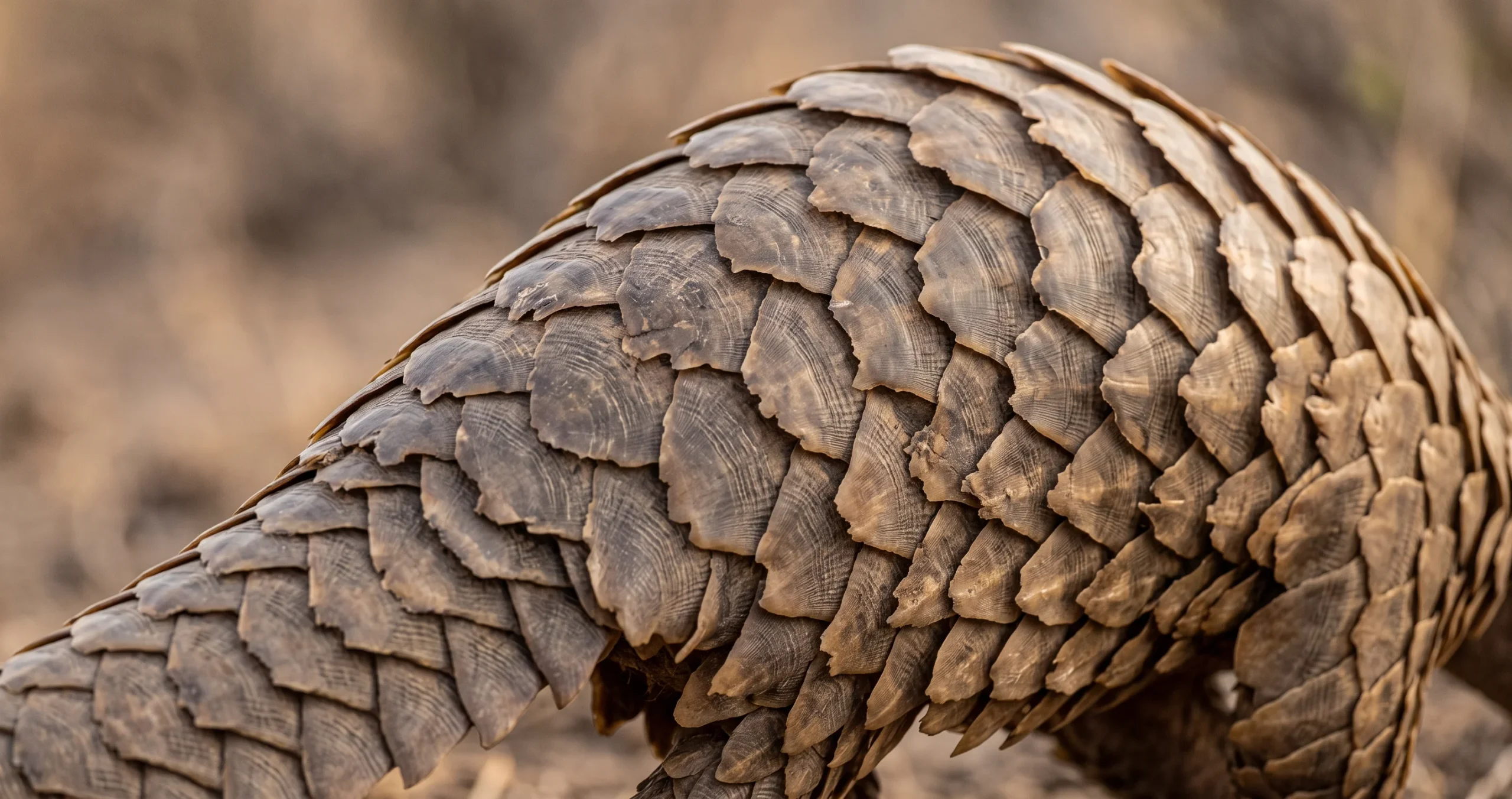
Pangolins look almost as if nature covered a small mammal in pinecone-like armor. Their unusual appearance comes from overlapping keratin scales, and the pangolin scale defense becomes especially impressive when the animal senses danger. Instead of confronting many predators directly, a pangolin can curl its body inward until vulnerable areas are hidden and its tougher scaled surface faces outward.
This behavior is one of the most distinctive defensive adaptations among mammals. But pangolin scales are not metal plates, and a curled pangolin is not literally impenetrable. The real mechanism is more interesting: tough biological material, overlapping scales, flexible movement, strong muscles, and body positioning all work together.
Table of Contents
- What Is a Pangolin?
- Why Pangolins Are Mammals
- What Pangolin Scales Are Made Of
- How the Pangolin Scale Defense Works
- Why Overlapping Scales Matter
- What Happens When a Pangolin Senses Danger?
- How the Head and Soft Underside Are Protected
- The Role of Strong Muscles
- How the Tail Helps
- How Curling Can Discourage Natural Predators
- Other Remarkable Pangolin Adaptations
- The Eight Living Pangolin Species
- Common Myths About Pangolin Defense
- Frequently Asked Questions
- Conclusion
What Is a Pangolin?
Pangolins are specialized insect-eating mammals belonging to the order Pholidota. There are eight recognized living species, with four native to Africa and four occurring in Asia.
Their habitats vary considerably. Depending on the species, pangolins can live in tropical forests, woodlands, savannas, grasslands, and other environments that provide suitable shelter and populations of ants and termites.
Some pangolins spend most of their time on the ground, while others are skilled climbers that regularly move through trees. There is no single lifestyle that describes all eight species.
Despite these differences, every living pangolin shares its most recognizable feature: much of the body is covered with large, overlapping scales.
Why Pangolins Are Mammals
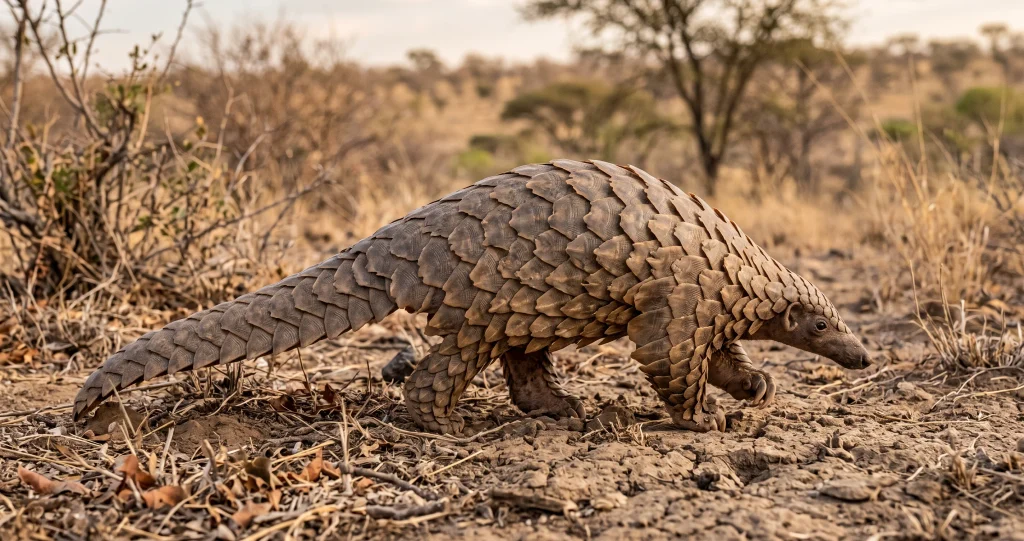
The combination of scales, an elongated body, and unusual movements can make a pangolin look more reptilian than mammalian at first glance.
Appearances are misleading.
Pangolins belong firmly within the class Mammalia. Females produce milk for their young, and areas of the body that are not covered with scales have hair. Mothers also provide care for their offspring.
Their scales therefore do not make pangolins reptiles. Instead, they represent an extraordinary specialization of structures produced by mammalian skin.
Pangolins are also sometimes called “scaly anteaters.” Although that nickname describes their appearance and diet reasonably well, pangolins are not true anteaters.
The similarities developed because both groups became highly specialized for feeding on ants and termites.
What Are Pangolin Scales Made Of?
Pangolin scales are made primarily of keratin, a tough structural protein.
Keratin itself is not unusual in the animal kingdom. Human hair and fingernails contain keratin, while other animals use keratin in structures such as claws, hooves, feathers, and horns.
What makes pangolins extraordinary is the extent to which keratinized scales cover their bodies.
The scales grow from their bases and are continually subjected to natural wear. They are attached to the skin rather than forming a solid external shell.
This distinction is important when describing pangolin protection.
Calling the scales “natural armor” is a useful comparison because they provide physical protection. However, they should not be imagined as metal plates or an indestructible shell.
Their effectiveness comes from their material, shape, arrangement, and the way a pangolin positions its body.
How the Pangolin Scale Defense Works
The pangolin scale defense depends on more than simply having tough scales.
When a pangolin is walking normally, several relatively vulnerable areas remain accessible. Its softer underside, portions of its face, and other less-protected areas do not have the same heavy scale covering as its back.
When the animal perceives a serious threat, it can dramatically change this arrangement.
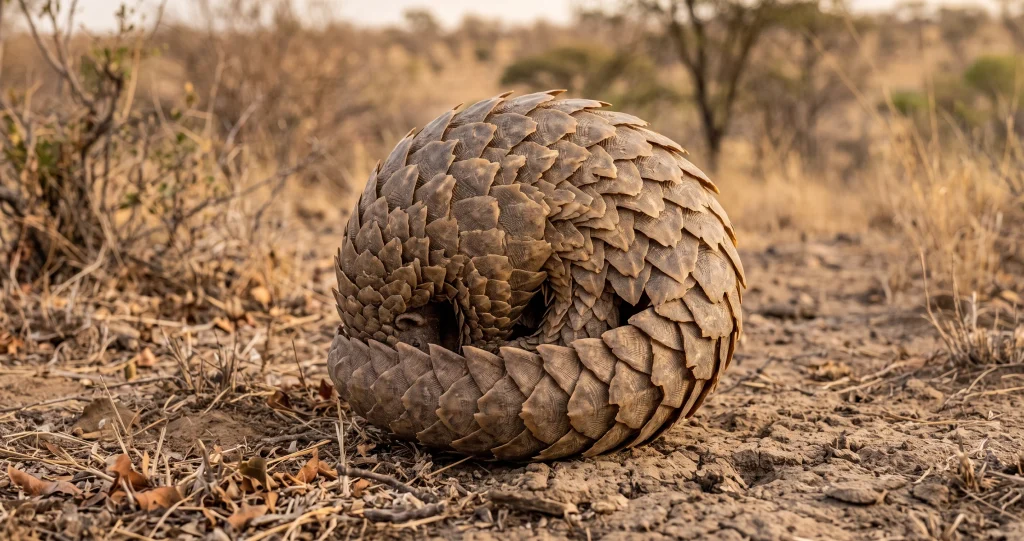
The head is tucked inward. The legs and softer underside are drawn toward the center, and the body bends into a compact shape.
As the curl tightens, the heavily scaled back and tail become the main surfaces facing outward.
The scales themselves do not suddenly become harder when danger appears. Instead, the pangolin changes which parts of its body are exposed.
That simple principle is at the heart of the defense:
Vulnerable structures move inward while tougher structures remain outside.
Why Overlapping Scales Matter
A single pangolin scale provides only part of the protection. The arrangement of hundreds of scales is equally important.
Pangolin scales overlap somewhat like roof tiles or shingles.
Instead of every scale standing independently with large gaps between them, each scale partially overlaps neighboring areas. This arrangement creates extensive coverage while still allowing the body to bend and move.
That flexibility becomes particularly important when the pangolin curls.
A completely rigid shell would make normal movement difficult. Pangolins instead combine individual tough structures with flexible skin and joints, allowing them to walk, climb, dig, and then curl when necessary.
The exposed edges of the scales can also be relatively sharp.
When the animal forms a tight ball, a predator encounters layers of tough scales rather than easy access to the softer belly, face, and limbs.
What Happens When a Pangolin Senses Danger?
Curling is a characteristic pangolin defense, but it should not be described as the animal’s only possible response.
Behavior depends on the species and circumstances.
A pangolin may attempt to move away from a disturbance or use other defensive behaviors before curling tightly. Pangolins also possess anal glands capable of producing a strong-smelling secretion.
When the animal commits to curling, however, its body undergoes an impressive transformation.
The head moves inward toward the chest and belly. The legs are drawn closer to the body, and the softer underside disappears toward the center.
The body continues bending until it forms a compact defensive shape dominated by overlapping scales.
How the Head and Soft Underside Are Protected
The easiest way to understand pangolin curling is to look at what disappears inside the ball.
The belly lacks the extensive heavy scale covering found across much of the back. Portions of the face and other areas are also more vulnerable.
Curling changes which parts of the animal a predator can reach.
The pangolin folds the softer underside toward the center while bringing its scaled back around the outside.
Its small head can also be tucked into the protected interior.
The result is a major change in the predator’s challenge. Instead of having easy access to the softer belly or head, it must interact primarily with a compact surface covered in tough scales.
Strong Muscles Hold the Defensive Ball
Scales cannot create this defense by themselves.
The pangolin must physically bend its body and maintain the curled position. Strong muscles allow it to contract tightly and resist being easily opened.
This muscular component is one reason the pangolin defense is better understood as a complete biological system rather than simply “armor.”
Several features work together:
Keratin provides tough material.
Overlapping scales provide extensive coverage.
A flexible body allows curling.
Strong muscles maintain the position.
The tail adds additional protection.
Each feature contributes something different to the final defensive posture.
How the Tail Helps
A pangolin’s tail is far more than a structure that simply trails behind its body.
During defensive curling, the tail can contribute to covering vulnerable areas. Because much of it is also protected by scales, it becomes another tough outer surface when the animal curls.
The tail serves additional functions during everyday life, and these functions vary among species.
Tree-dwelling pangolins have especially useful tails for climbing. Some can use their tails to grip branches or stabilize themselves as they move through vegetation.
Ground-dwelling species rely on their tails differently, including using them for balance during movement.
This diversity illustrates how the same basic body structure can become specialized for different lifestyles.
How Curling Can Discourage Natural Predators
Pangolins share their habitats with formidable predators.
Potential predators vary according to region and species, but they can include large cats, hyenas, and large snakes.
The curled posture changes the challenge facing an attacker.
A predator that might otherwise reach the pangolin’s softer underside instead encounters a compact object covered largely by tough, overlapping scales.
The head and limbs become much harder to access.
The pangolin’s protection should not be exaggerated, however. A curled pangolin is not literally invulnerable, and natural defenses rarely provide absolute protection.
A more accurate description is that curling reduces vulnerability.
For certain natural predators, the effort required to handle or penetrate the defensive posture may make the pangolin a much more difficult target.
Other Remarkable Pangolin Adaptations
The scales attract most of the attention, but pangolins possess an entire collection of adaptations for their specialized lifestyle.
Powerful Digging Claws
Pangolins have powerful claws that help them reach insects hidden inside soil, ant nests, termite structures, rotting wood, and other protected locations.
Those large claws can make ordinary walking somewhat awkward.
Ground pangolins may move with their front claws curled inward, helping protect the claws while traveling.
Their ability to dig is important not only for feeding. Some pangolin species also use burrows for shelter.
An Exceptionally Long Tongue
Once an insect colony has been opened, the pangolin uses another extraordinary adaptation.
Its long, sticky tongue can probe narrow spaces that would be inaccessible to an ordinary mammalian mouth.
Ants and termites stick to the tongue and are pulled into the mouth.
Pangolins do not depend on conventional chewing teeth to process their prey. Their feeding system is highly specialized for collecting large numbers of small insects.
Protection While Feeding
Breaking into an ant or termite colony creates an obvious problem: the insects defend themselves.
Pangolins possess adaptations that help protect sensitive areas while feeding.
Their nostrils and ears can be closed or protected, and sturdy eyelids help shield the eyes.
These features allow the animal to exploit food sources that would be uncomfortable or difficult for many other mammals to access.
The Eight Living Pangolin Species
There are eight recognized living pangolin species, divided evenly between Africa and Asia.
Although they share the characteristic scaled body, the species differ in size, habitat, scale characteristics, geographic distribution, and lifestyle.
Four Asian Pangolins
The four Asian species are:
- Chinese pangolin (Manis pentadactyla)
- Indian pangolin (Manis crassicaudata)
- Sunda pangolin (Manis javanica)
- Philippine pangolin (Manis culionensis)
These animals occupy different parts of Asia and use habitats ranging from forests to more open environments.
Their body proportions and scale characteristics also vary.
Four African Pangolins
Africa is home to:
- Giant pangolin (Smutsia gigantea)
- Temminck’s pangolin (Smutsia temminckii)
- White-bellied pangolin (Phataginus tricuspis)
- Black-bellied pangolin (Phataginus tetradactyla)
These species include both terrestrial and highly arboreal forms.
The black-bellied pangolin, for example, possesses an exceptionally long tail suited to an arboreal lifestyle.
Temminck’s pangolin, by contrast, is primarily terrestrial and spends much of its active time moving across the ground.
The giant pangolin is appropriately named, being considerably larger than some of its smaller tree-dwelling relatives.
These differences are important because statements about one pangolin species cannot automatically be applied to all eight.
Common Myths About Pangolin Scales and Defense
Myth 1: Pangolin Scales Are Like Metal Armor
They are not.
Pangolin scales are biological structures made primarily from keratin. Their toughness provides physical protection, but their effectiveness also depends on their overlapping arrangement and the pangolin’s curled posture.
Myth 2: Pangolins Are Reptiles
Pangolins are mammals.
Their unusual scales create a reptile-like appearance, but their reproduction, anatomy, evolutionary history, and other characteristics place them firmly within Mammalia.
Myth 3: A Curled Pangolin Is Completely Impenetrable
“Impenetrable” is too strong.
Curling provides impressive protection by hiding vulnerable areas and exposing tougher scaled surfaces, but it does not transform the animal into an indestructible object.
Myth 4: Curling Is the Pangolin’s Only Defense
Curling is its most recognizable defensive behavior, but pangolins can respond to threats in other ways depending on the circumstances.
Avoidance, movement away from danger, defensive tail movements, and strong-smelling secretions can also play roles.
Myth 5: All Pangolins Live the Same Way
The eight species have different lifestyles.
Some spend most of their time on the ground, while others are excellent climbers. Their size, habitat preferences, tail structure, and other characteristics also vary.
Why Pangolin Defense Is Such an Effective Biological Design
One of the most interesting aspects of pangolin protection is that nothing new has to appear when danger arrives.
The protective structures are already present.
The animal simply rearranges its body so that vulnerable structures move inward and tougher structures move outward.
In simple mechanical terms, the defense combines material properties with body geometry.
Keratin provides toughness.
Overlapping scales provide coverage.
Flexible joints and skin allow movement.
Strong muscles create and maintain the curl.
The tail contributes additional coverage.
This combination turns several relatively simple biological features into a sophisticated defensive system.
The scales are therefore only one component of the story.
Without the pangolin’s flexible body and muscular control, those scales would not provide the same protection. Without the overlapping arrangement, flexible movement would leave more vulnerable areas exposed.
The effectiveness comes from all of these adaptations working together.
Frequently Asked Questions
What are pangolin scales made of?
Pangolin scales are made primarily of keratin. This is the same broad structural protein found in human hair and fingernails and in many animal claws, hooves, feathers, and similar structures.
Why do pangolins curl into a ball?
Curling allows a pangolin to tuck vulnerable areas such as its head, limbs, and softer underside inward while exposing its tougher scale-covered surfaces.
Are pangolin scales impenetrable?
No. Pangolin scales provide substantial physical protection, especially when combined with the curled posture, but they are biological keratin structures rather than an indestructible shell.
What animals prey on pangolins?
Natural predators vary by region and pangolin species. Large cats, hyenas, and large snakes are among the predators capable of attacking pangolins.
What do pangolins eat?
Pangolins specialize primarily in ants and termites. Strong claws help expose insect colonies, while their exceptionally long, sticky tongues collect the insects.
Do all pangolins live on the ground?
No. Some pangolin species are predominantly terrestrial, while others are highly adapted to climbing and spend substantial amounts of time in trees.
How many pangolin species are there?
Eight living pangolin species are currently recognized. Four occur in Africa and four in Asia.
Conclusion
A pangolin’s curled defensive ball is far more sophisticated than simply hiding behind scales. Its protection comes from several adaptations working together: tough keratin scales, their overlapping arrangement, a flexible body, powerful muscles, and a strong tail.
When danger becomes serious, the pangolin can tuck its head, limbs, and softer underside inward while keeping its tougher scaled surfaces exposed. This pangolin scale defense can make the animal much more difficult for certain natural predators to attack.
The scales are not metal armor, and a curled pangolin is not literally impenetrable. Its remarkable protection instead comes from the way anatomy and behavior work together, turning an unusual covering of keratin scales into one of the most distinctive defensive systems found among mammals.