
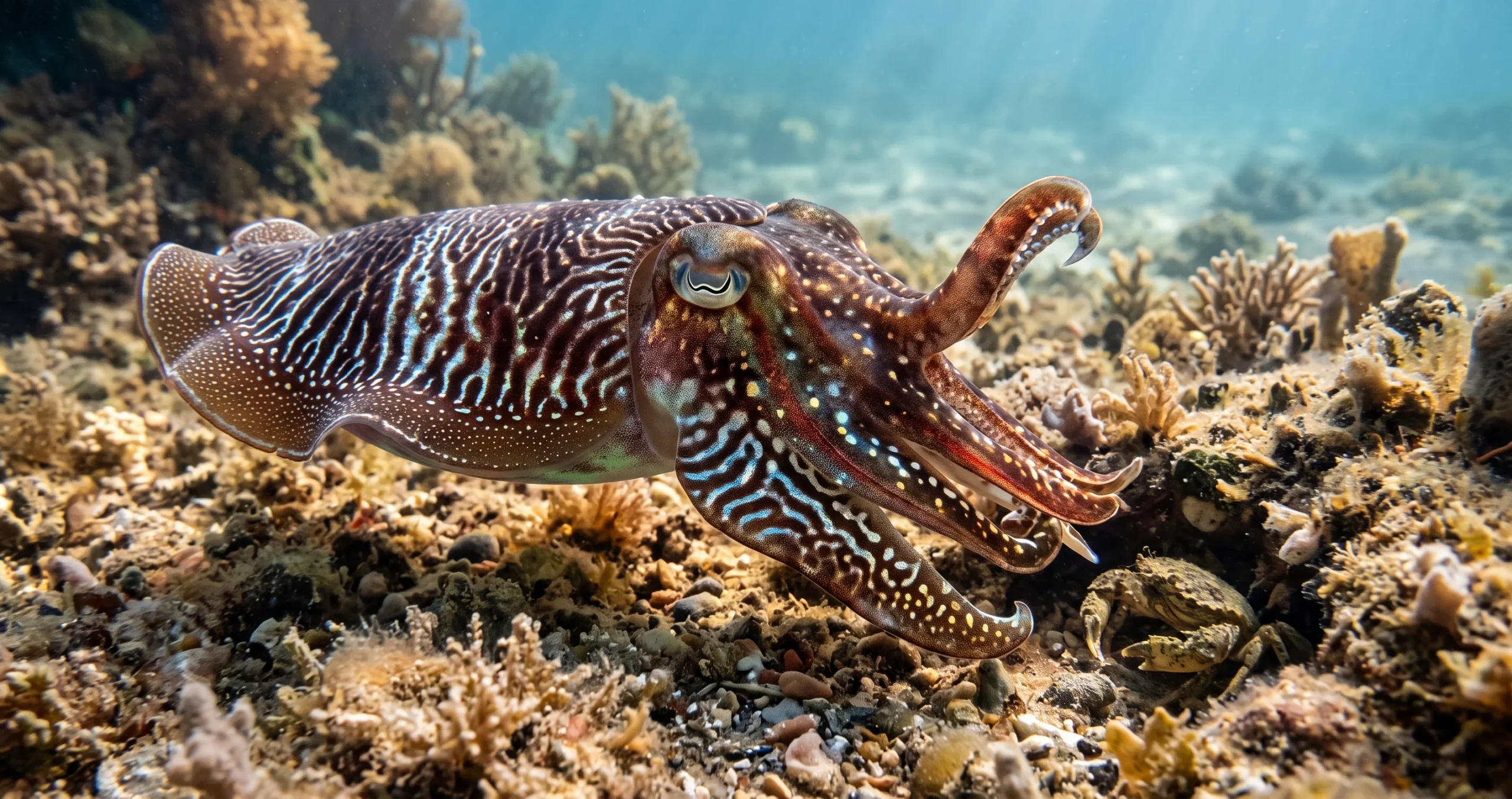
A cuttlefish closing in on a crab can suddenly transform into something that looks almost unreal. Dark bands appear to flow repeatedly across its pale head and arms while the predator continues creeping forward. This remarkable cuttlefish hypnotic hunting display is often described as “hypnotizing” prey, but recent research suggests something more precise may be happening: the moving pattern may interfere with the visual motion cues a crab normally uses to recognize an approaching predator.
The effect is created by rapidly controlled pigment organs in the skin, not by emitted light. And although “hypnosis” makes a memorable description, scientists have not shown that cuttlefish literally put prey into a hypnotic state.
Instead, the display may represent an extraordinary form of visual deception.
Table of Contents
- What Is the Cuttlefish “Hypnotic” Hunting Display?
- How Chromatophores Create the Moving Pattern
- Why the Display May Make Prey Hesitate
- How It Fits Into a Cuttlefish Hunt
- More Than One Hunting Disguise
- Cuttlefish vs. Octopus and Squid Color Change
- Common Myths
- FAQ
- Conclusion
What Is the Cuttlefish Hypnotic Hunting Display?
The dramatic behavior is especially well documented in the broadclub cuttlefish, Sepia latimanus, a large Indo-Pacific species.
As the animal approaches prey such as a crab, it can turn much of its head and arms pale while producing dark stripes that repeatedly move downward across them. Researchers call this behavior the “passing-stripe display.” Related moving skin patterns in cephalopods have historically been called “passing cloud,” “wandering cloud,” chromatic pulses, or rhythmic passing waves.
The terminology matters because not every moving cuttlefish pattern is identical or serves the same purpose.
A broad review of dynamic cephalopod skin patterns describes a “passing cloud” as a moving area of color generated through coordinated chromatophore activity. Researchers have increasingly preferred more descriptive terms such as “chromatic pulse” because calling it a cloud could incorrectly imply that its function is to imitate a passing shadow.
In broadclub cuttlefish, the hunting version is particularly striking.
The animal stretches several arms forward, spreads others laterally, becomes relatively pale, and sends dark bands downward across the front of its body. From the prey’s perspective, those bands create strong, continuous downward motion.
Documentaries and divers have understandably described the performance as mesmerizing or hypnotic.
Science now offers a more interesting explanation.
How Chromatophores Create the Moving Pattern
The cuttlefish hypnotic hunting display is sometimes described as a “light show,” but cuttlefish are not projecting flashing light onto their prey.
The visible waves are primarily changes in pigmentation.
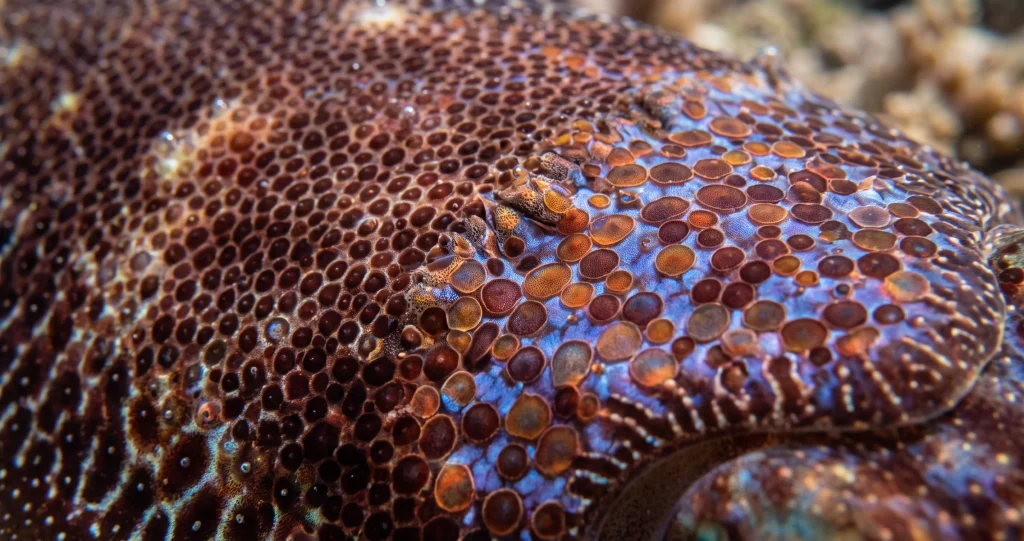
Cuttlefish skin contains thousands of chromatophores. Each chromatophore includes a pigment-containing sac controlled by muscles and nerves. When its surrounding muscles contract, the pigment sac expands and becomes much more visible; when they relax, it contracts again.
Coordinating huge numbers of these structures allows a cuttlefish to create spots, bands, mottles, and rapidly moving patterns.
The process is under direct neural control. This means changes can happen extremely quickly and can be coordinated across different parts of the body. Cephalopods can therefore produce waves in which bands seem to travel over the skin even though no physical band is moving across the animal.
Think of a stadium wave.
Individual spectators stand and sit in sequence, creating the illusion of a wave traveling around the stadium. In a cuttlefish, neighboring groups of chromatophores expand and contract in sequence, producing a moving visual pattern.
Other specialized skin structures add even more complexity. Many cephalopods possess iridophores, which create reflective or iridescent effects, and leucophores, which scatter ambient light. The Smithsonian provides a useful overview of how octopuses, squid, and cuttlefish change color.
This skin is effectively a biological display surface connected directly to the nervous system.
Does the Display Really Freeze the Prey?
For years, the spectacular appearance encouraged an appealing hypothesis: perhaps the cuttlefish overwhelms, confuses, or “hypnotizes” its victim.
That explanation was difficult to test.
A major advance came from research published in 2025 examining wild broadclub cuttlefish and experimental responses in shore crabs. Instead of finding evidence for literal hypnosis, the researchers found support for a form of motion camouflage.
The key is to consider the scene from the crab’s visual perspective.
As a predator moves directly toward an animal, its image expands across the prey’s visual field. This “looming” pattern is an important warning signal that can trigger escape behavior.
A cuttlefish cannot simply become invisible while swimming toward its target. No matter how closely its colors match the reef, its growing outline can reveal that something is approaching.
The passing stripes may help solve that problem.
In laboratory experiments, crabs were shown expanding visual stimuli representing an approaching predator. They were less likely to react when the expanding stimulus contained downward-moving stripes than when it had no stripes or stationary stripes.
Researchers proposed that the strong downward motion generated by the stripes may overwhelm or mask the weaker expanding motion associated with the predator’s approach.
In other words, the crab may see plenty of movement.
It may simply receive a less obvious “predator coming directly toward me” signal.
That distinction changes how we should describe the cuttlefish hypnotic hunting display. The prey is not necessarily transfixed by a beautiful pattern. Its visual motion-detection system may instead be receiving misleading information at exactly the moment when rapid escape matters most.
Earlier research had proposed several possibilities, including confusing prey, distracting it, or disguising the cuttlefish’s approach. The newer experimental evidence gives substantial support to the motion-camouflage explanation for the broadclub cuttlefish’s passing-stripe display.
How the Display Fits Into a Cuttlefish Hunt
The stripes are not the entire hunting strategy.
Broadclub cuttlefish first identify and approach potential prey before switching displays during the closer stages of the hunt. Field research involving 28 passing-stripe hunting events found that the stripes appeared during the final phase of the approach, beginning at an average distance of roughly one meter from the prey.
The cuttlefish also changes posture.
Several arms form a forward-pointing cone, while lateral arms spread outward. This posture presents a relatively flattened frontal profile to the crab and helps conceal movements of the mantle fins.
Both features could reduce recognizable looming signals.
The moving stripes then add a powerful downward-motion signal over that approaching shape.
Researchers also discovered that broadclub cuttlefish modify their stripe behavior according to their movement. Stripe frequency was related to approach speed, suggesting the display is actively coordinated with the predator’s hunting behavior rather than being a simple automatic flash.
Once within striking distance, the cuttlefish can rapidly extend its specialized feeding tentacles toward the prey.
The apparent “hypnosis” is therefore only one stage of a sophisticated sequence involving detection, stealth, body positioning, visual deception, and an explosive final strike.
Cuttlefish Have More Than One Hunting Disguise
The passing stripes are not even the broadclub cuttlefish’s only visual hunting tactic.
A 2025 field study analyzed 234 hunting displays from 98 wild broadclub cuttlefish in Indonesia. Researchers identified four major display types: passing-stripe, leaf, branching coral, and pulse displays. Individual cuttlefish sometimes switched between them during an approach.
The leaf display looks very different from the famous cuttlefish hypnotic hunting display.
A cuttlefish becomes olive-green to pale and approaches with a slow oscillating movement. Researchers proposed that this could resemble an innocuous leaf drifting in the current—a possible form of motion masquerade.
The branching-coral display uses raised arms and complex static coloration that may help conceal the predator against reef structures.
The pulse display produces slower-moving dark pulses combined with another distinctive arm posture. Its precise advantage remains less clear.
This diversity suggests cuttlefish hunting is not based on one universal visual trick.
Instead, these predators may choose among several combinations of color, movement, texture, and posture.
That flexibility is arguably more remarkable than the popular idea of simply “hypnotizing” prey.
Camouflage Is Part of the Same Visual Toolkit
A cuttlefish can go from conspicuous moving stripes to remarkably effective camouflage using essentially the same programmable skin.
Camouflage patterns can be adjusted to different backgrounds and situations. Research on European cuttlefish has shown that their body patterns are context-dependent and can change while animals move between different surroundings.
Color is only part of the transformation.
Cuttlefish can also manipulate skin texture using muscular structures called papillae. Combined with changes in body posture and pattern, this can make an animal resemble sand, rock, coral, or other parts of the environment.
Their skin therefore performs apparently contradictory jobs.
One moment, it suppresses visual information to conceal the animal.
The next, it produces powerful moving patterns.
Those displays can serve hunting, defense, courtship, or communication depending on the species and context.
How Cuttlefish Compare With Octopuses and Squid
Cuttlefish, octopuses, and squid are all cephalopods, and all three groups contain remarkable specialists in rapid appearance change.
They share the basic chromatophore system. Neural control allows pigment sacs to expand and contract rapidly, while reflective structures such as iridophores and leucophores can contribute additional optical effects in many species.
But each group uses that toolkit differently.
Octopuses are particularly famous for matching complex seafloor backgrounds. Many can combine dramatic color change with alterations in skin texture and body posture, sometimes becoming extraordinarily difficult to distinguish from rocks, algae, or coral.
Some octopuses take visual deception even further. The mimic octopus changes posture, coloration, and movement in ways that resemble other marine organisms.
Squid tend to live more extensively in open water, although their ecology varies enormously among species. Chromatophore displays can function in camouflage and communication, while some squid also use bioluminescent photophores—actual light-producing organs—for signaling or counterillumination.
Cuttlefish excel at combining background matching, texture, posture, signaling, and moving chromatophore patterns.
That makes the cuttlefish hypnotic hunting display part of a broader cephalopod story: skin has evolved from a passive body covering into an extraordinarily dynamic communication and camouflage system.
For another remarkable example of cephalopod visual biology, see our wildlife coverage of octopus camouflage and rapid color change on Secrets of the Green Garden.
Common Myths About the Cuttlefish “Hypnosis” Display
Myth: Cuttlefish literally hypnotize prey
There is no evidence that prey enter a neurological hypnotic state. For broadclub cuttlefish hunting crabs, recent experiments instead support the idea that downward-moving stripes interfere with the visual motion information used to detect an approaching predator.
Myth: The cuttlefish produces flashing light
The hunting stripes are created primarily through changing pigmentation, not by projecting light. Chromatophores expand and contract in coordinated sequences to create apparent motion across the skin.
Myth: Every cuttlefish uses the same display
Dynamic skin patterns vary among species and contexts. Even broadclub cuttlefish use multiple hunting displays rather than relying exclusively on passing stripes.
Myth: The display simply distracts prey
Distraction or confusion has been proposed, but the strongest recent experimental evidence for broadclub cuttlefish points toward motion camouflage. The downward stripes may conceal the more threatening expanding-motion signature of an approaching predator.
Myth: Cuttlefish only change color for camouflage
Their visual displays also participate in hunting, defense, social signaling, and courtship. Some patterns are deliberately conspicuous rather than cryptic.
FAQ
What is the cuttlefish hypnotic hunting display?
It is a popular description for dynamic skin patterns used by some cuttlefish while approaching prey. In broadclub cuttlefish, dark stripes repeatedly move downward across a pale head and arms during the final hunting approach.
Do cuttlefish really hypnotize crabs?
Literal hypnosis has not been demonstrated. Experimental evidence published in 2025 indicates that the broadclub cuttlefish’s passing stripes can reduce crab responses to an approaching visual stimulus, supporting a motion-camouflage explanation.
How does a cuttlefish make moving stripes?
Groups of pigment-containing chromatophores expand and contract under neural and muscular control. Coordinating them sequentially produces the appearance of a dark band moving across the body.
Is the cuttlefish creating its own light?
Not in the passing-stripe hunting display. The visual effect comes mainly from pigment changes and reflected ambient light. Some other cephalopods possess true bioluminescent organs, but that is a different mechanism.
Why does the prey appear to freeze?
The crab may fail to respond as strongly because the downward stripes interfere with visual cues that normally signal an approaching object. Experiments show reduced responses to expanding stimuli containing downward-moving stripes, although describing that response as “freezing” or “hypnosis” can oversimplify the mechanism.
Do cuttlefish use the display on every prey animal?
No. Field observations show broadclub cuttlefish using several different hunting displays, and researchers are still investigating what determines which strategy an individual uses.
Conclusion
The famous cuttlefish hypnotic hunting display looks almost supernatural when seen underwater, but its likely explanation is even more fascinating.
Cuttlefish create moving bands by precisely coordinating chromatophores across their skin. In broadclub cuttlefish, these stripes appear during the final approach toward prey and produce strong downward motion from the crab’s perspective.
Recent experiments indicate that this movement can reduce a crab’s response to the visual expansion normally associated with an approaching predator. Rather than literally hypnotizing its victim, the cuttlefish may be hiding one kind of movement beneath another—a remarkable form of motion camouflage.
The behavior also belongs to a much larger visual repertoire. Broadclub cuttlefish can use leaf-like movement, coral-like postures, pulses, camouflage, and passing stripes depending on the hunting situation.
Octopuses and squid share much of the same color-changing machinery, but cephalopod species have adapted it for different combinations of camouflage, communication, defense, and predation.
Calling the display “hypnosis” captures what it looks like to human observers.
Calling it visual deception comes closer to what the evidence currently shows.