
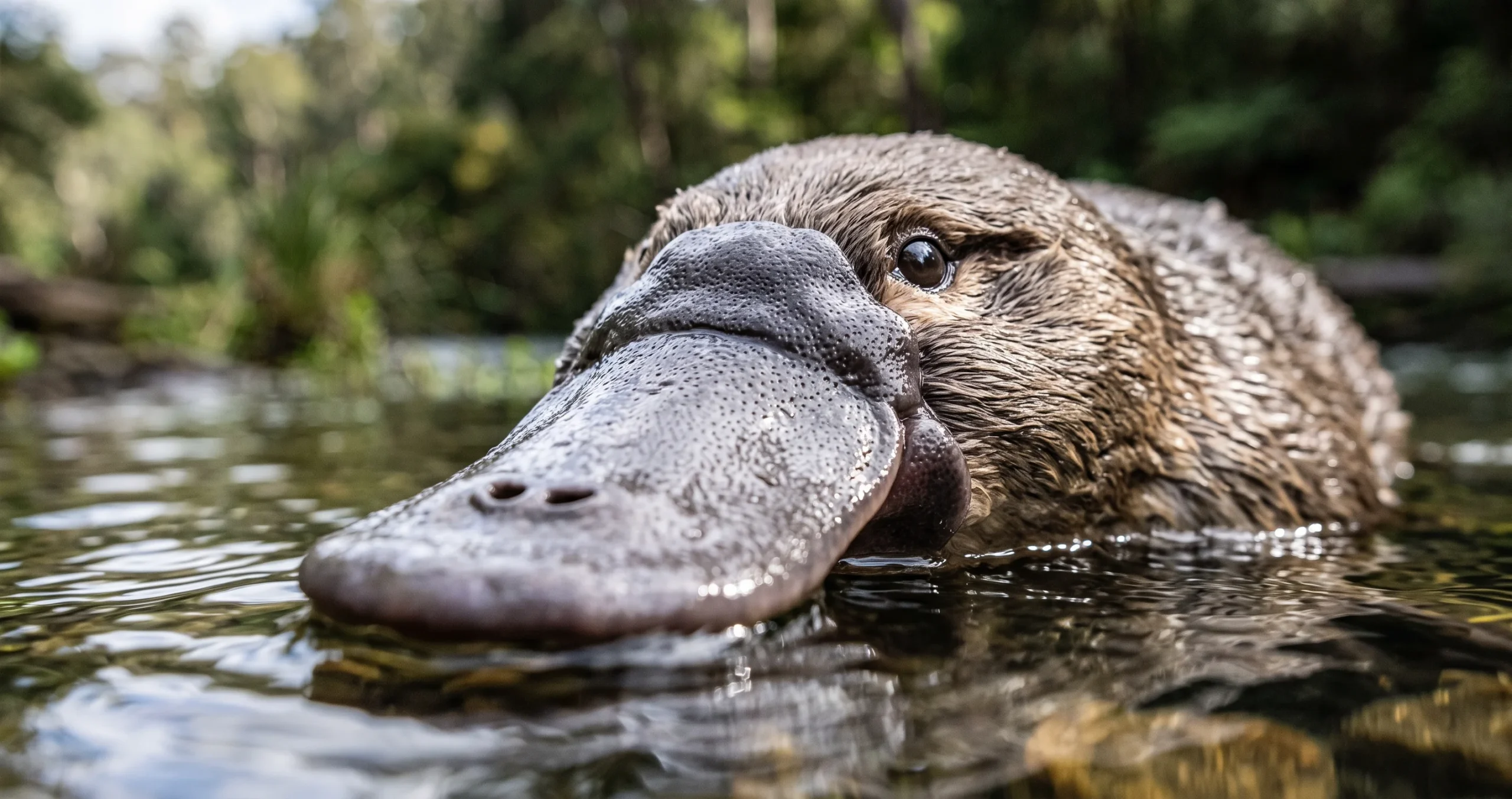
The platypus looks as if several unrelated animals were combined into one body: dense mammalian fur, a broad sensitive bill, webbed feet, a beaver-like tail, and an egg-laying reproductive system. Yet some of its strangest adaptations are invisible. The remarkable combination of platypus electroreception venom and unusual digestive biology makes this Australian mammal one of the most distinctive vertebrates alive.
None of these features makes the platypus “less mammalian.” It is a monotreme, an ancient branch of mammals that followed a different evolutionary path from marsupials and placental mammals. Understanding that path explains why the platypus seems to break so many familiar mammal rules.
Table of Contents
- What Makes a Platypus a Mammal?
- Platypus Electroreception Venom and an Extraordinary Sensory System
- Why Platypuses Hunt With Their Eyes Closed
- The Venomous Spur of the Male Platypus
- An Egg-Laying Mammal
- The Platypus Does Not Have a Conventional Stomach
- Why Early Naturalists Thought It Might Be Fake
- Other Strange Platypus Traits
- Common Platypus Myths
- FAQ
- Conclusion
What Makes a Platypus a Mammal?
A platypus (Ornithorhynchus anatinus) may not fit the popular image of a mammal, but biologically there is no doubt about its classification.
It has fur, is warm-blooded, and females produce milk for their young. These are fundamental mammalian characteristics. The major difference is that platypuses belong to the monotremes, the mammalian lineage that also includes echidnas.
Unlike marsupials and placental mammals, monotremes lay eggs. The Australian Museum notes that monotremes are mammals distinguished by egg laying and that females lack conventional teats; milk is delivered through specialized skin areas instead.
The platypus therefore is not an evolutionary mixture of bird, reptile, and mammal. It is a highly specialized mammal whose lineage preserves some ancient reproductive characteristics while possessing many adaptations of its own.
Platypus Electroreception Venom and an Extraordinary Sensory System
One of the most extraordinary aspects of platypus electroreception venom biology begins with the animal’s bill.
The bill is not simply a duck-like mouthpiece. Its skin contains a dense sensory system capable of detecting both mechanical disturbances and weak electrical signals in water.
Research has estimated roughly 40,000 specialized sensory mucous glands associated with electroreception across the upper and lower bill. Experiments have confirmed that receptors supplied by branches of the trigeminal nerve respond to weak electrical stimulation.
This matters because living animals produce tiny electrical signals. Muscle contractions and nerve activity involve movements of charged ions, and those biological processes can create weak electrical fields in conductive environments such as water.
A platypus searching along a streambed can detect electrical information associated with small prey such as aquatic insect larvae, worms, and crustaceans.
The system works alongside mechanoreception. Sensitive mechanical receptors in the bill respond to pressure, touch, and disturbances created by moving animals.
Research into the platypus sensory system suggests that its brain can integrate electrical and mechanical information, potentially helping the animal determine both the direction and distance of prey. For a detailed scientific overview, see research on the sensory world of the platypus published through the Royal Society and available via PubMed Central.
This is not biological “radar.” The platypus does not send out electromagnetic pulses and wait for them to bounce back. Instead, it detects weak electrical fields already present around living prey.
Why Platypuses Hunt With Their Eyes Closed
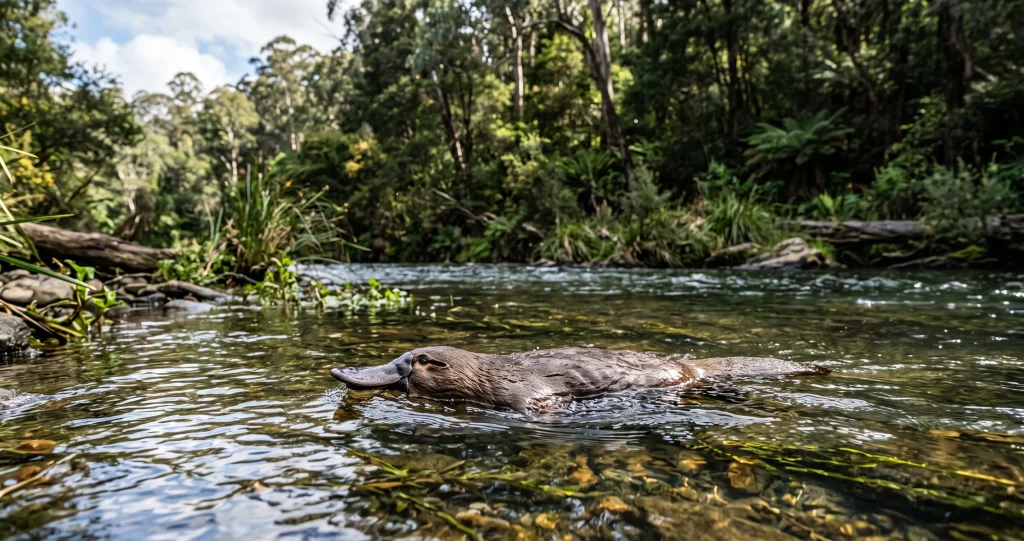
The electrical sense becomes even more impressive when the platypus dives.
While searching underwater, a platypus closes its eyes, ears, and nostrils. Instead of visually scanning the streambed, it relies heavily on information arriving through its bill.
This makes sense in its environment.
Platypuses often forage near the bottoms of rivers and streams, where disturbed sediment and low light can make vision unreliable. A sensory system that works without clear visibility allows them to locate hidden or moving prey under conditions in which eyesight may provide little useful information.
The animal sweeps its bill through the water and sediment while swimming. Electrical receptors detect weak biological signals, while mechanoreceptors register movement and physical disturbances.
Scientists have even investigated how differences in the arrival time of electrical and mechanical signals might help the brain estimate prey location.
For a related example of electrical sensing in another monotreme, see our article on how echidna electroreception works. Echidnas possess a much less elaborate electroreceptive system, illustrating how differently this unusual sense has developed within the monotreme lineage.
The Venomous Spur of the Male Platypus
Electroreception is only half of the platypus electroreception venom story.
Adult male platypuses carry a sharp spur on each hind leg connected to a venom-producing gland. The venom system becomes particularly active during the breeding season, when the glands enlarge and venom production increases.
That seasonal pattern provides an important clue about its function.
Evidence including increased male aggression, seasonal venom production, and spur wounds found on males supports the idea that the system is primarily involved in competition between males. Scientists remain appropriately cautious about assigning a single evolutionary function, but reproductive competition is strongly supported.
The venom is also capable of seriously affecting humans.
Documented envenomation can cause immediate, severe localized pain, swelling, nausea, sweating, and swollen lymph nodes. In some reported cases, pain has persisted for an extended period after the injury.
This does not mean platypuses routinely attack people. Envenomation is uncommon and is most likely to occur when a male is handled or restrained.
The platypus is therefore among the very small number of living mammals equipped with a functional venom-delivery system.
An Egg-Laying Mammal
Perhaps the most famous platypus characteristic is also one of the easiest to misunderstand.
Female platypuses lay eggs.
After mating, a female constructs a nesting burrow and gathers moist vegetation for nesting material. She lays small eggs and incubates them while curled around them, holding them against her abdomen with her tail.
Once the young hatch, another distinctly mammalian characteristic takes over: milk production.
Female platypuses do not have nipples like most familiar mammals. Milk is secreted onto specialized areas of the abdomen, where the young obtain it.
Egg laying therefore does not make the platypus partly reptilian. Monotremes represent a distinct surviving branch of mammals in which egg laying has been retained while defining mammalian traits such as hair and lactation are also present.
The Platypus Does Not Have a Conventional Stomach
Another popular claim says that platypuses have no stomach.
That statement is useful shorthand, but the reality is more precise.
The platypus has a small stomach-like region, yet it lacks the gastric glands responsible for the strongly acidic digestion found in the conventional stomachs of humans and many other mammals. Its digestive tract therefore does not perform typical acid-and-pepsin stomach digestion.
Genetic evidence makes the story even more interesting.
Researchers have found that several genes associated with gastric acid secretion and digestive enzymes have been lost or inactivated during monotreme evolution. Modern genomic research indicates that substantial loss of stomach-function genes is shared by platypuses and echidnas.
The platypus has not simply “forgotten” how to digest food. Digestion continues elsewhere in the gastrointestinal system, including through pancreatic and intestinal processes.
Its anatomy demonstrates an important evolutionary principle: structures that seem fundamental to one group of animals can be radically modified when other biological systems compensate.
Why Early Naturalists Thought It Might Be Fake
Imagine being a European naturalist near the end of the 18th century and receiving a preserved animal from Australia.
It has fur.
Then there is the broad bill.
Its feet are webbed.
Its tail looks unlike that of most familiar mammals.
The combination was so extraordinary that some Europeans initially suspected the specimen might be a taxidermy trick.
The Natural History Museum records that when an early skin and illustration reached Europe, suspicions arose that someone might have attached a duck-like bill to the body of another animal. British naturalist George Shaw examined the animal and accepted that it was genuine, although its anatomy remained astonishing.
The confusion did not disappear immediately.
Its reproductive biology created another puzzle. An animal with fur and milk production should, according to the familiar mammalian pattern, give birth to live young. Evidence that the platypus laid eggs challenged expectations about how mammals were supposed to reproduce.
Today, the platypus seems less like a biological contradiction and more like an important reminder that the traits seen in placental mammals represent only one part of mammalian evolutionary diversity.
Other Strange Platypus Traits
The surprises continue beyond platypus electroreception venom, egg laying, and unusual digestion.
Adult platypuses do not have conventional teeth. Young animals develop teeth, but adults instead process food using hardened keratinous structures inside the mouth. Genomic comparisons have found losses in genes associated with tooth development in monotremes.
Their webbed front feet are another specialized feature. On land, the webbing can fold back, allowing the claws to function more effectively. In water, the enlarged webbing turns the front feet into powerful paddles.
The broad tail also serves several functions. It contributes to the animal’s streamlined body shape and stores energy as fat.
Even the bill itself is misleading at first glance. It may resemble a duck’s bill from a distance, but structurally and functionally it is a sophisticated mammalian sensory surface rather than a bird beak.
Common Platypus Myths
Myth: The platypus is part duck.
It is not. Similar-looking structures can evolve independently in unrelated animals. The platypus is a monotreme mammal, not a mammal-bird hybrid.
Myth: Platypuses use electricity to stun prey.
They detect weak electrical fields; they do not generate powerful electrical discharges like an electric eel.
Myth: Every platypus is venomous.
The functional venom-delivery system is characteristic of adult males. Females do not retain the same functional adult spur-and-venom apparatus.
Myth: Platypuses are blind.
They have functional eyes. They simply close them while foraging underwater and rely strongly on bill-based sensory information.
Myth: The platypus literally has no digestive stomach region.
A more accurate statement is that its stomach is highly reduced and lacks the normal acid-secreting gastric glands and acid-pepsin digestion typical of many mammals.
FAQ
How does platypus electroreception work?
Specialized receptors concentrated in the bill respond to weak electrical fields in water. These fields can originate from biological activity such as muscle contractions in prey. Mechanical receptors in the bill provide additional information about movement and contact.
Why does a platypus close its eyes underwater?
When foraging underwater, platypuses close their eyes, ears, and nostrils and depend heavily on electroreception and mechanoreception through the bill. This system is particularly useful for locating prey in dark or sediment-filled water.
Are platypuses venomous?
Adult males possess hind-leg spurs connected to venom glands. Venom production becomes especially pronounced during the breeding season and appears strongly associated with male competition.
Can platypus venom kill a human?
Human envenomation is known for producing intense pain and other symptoms, but the scientific literature primarily emphasizes severe pain rather than human fatalities. Any platypus spur injury requires professional medical assessment.
Do platypuses really lay eggs?
Yes. Platypuses and echidnas are monotremes, the surviving egg-laying mammals. After hatching, platypus young are nourished with milk produced by their mother.
Does a platypus have a stomach?
It has a reduced stomach-like region, but it lacks the conventional gastric glands responsible for acid-pepsin digestion. Several genes involved in normal mammalian gastric function have also been lost or inactivated.
Conclusion
The platypus does not actually violate the rules of mammalian biology. It reveals that those rules are far broader than the familiar examples of dogs, whales, mice, and humans might suggest.
The combination of platypus electroreception venom, egg laying, milk production without conventional nipples, a highly reduced non-acidic stomach, webbed feet, tooth loss, and a remarkably sensitive bill reflects a long and independent evolutionary history.
Its electrical sense allows it to hunt underwater while its eyes, ears, and nostrils are closed. Male venom adds another rare mammalian adaptation, while its reproductive and digestive systems preserve or modify characteristics very different from those of placental mammals.
Early naturalists understandably struggled to fit the platypus into the categories they knew. Modern biology gives us a better interpretation: the platypus is not an evolutionary mistake or collection of mismatched animal parts.
It is an exceptionally specialized mammal—and one of the clearest demonstrations of how inventive mammalian evolution can be.
3 External Sources:
- Pettigrew, Manger & Fine — “The Sensory World of the Platypus,” Philosophical Transactions of the Royal Society B
PubMed Central — The Sensory World of the Platypus - Whittington et al. — research on platypus venom genes and envenomation biology
PubMed Central — Novel Venom Gene Discovery in the Platypus - Australian Museum — Platypus biology, reproduction, behavior and natural history
Australian Museum — Platypus