
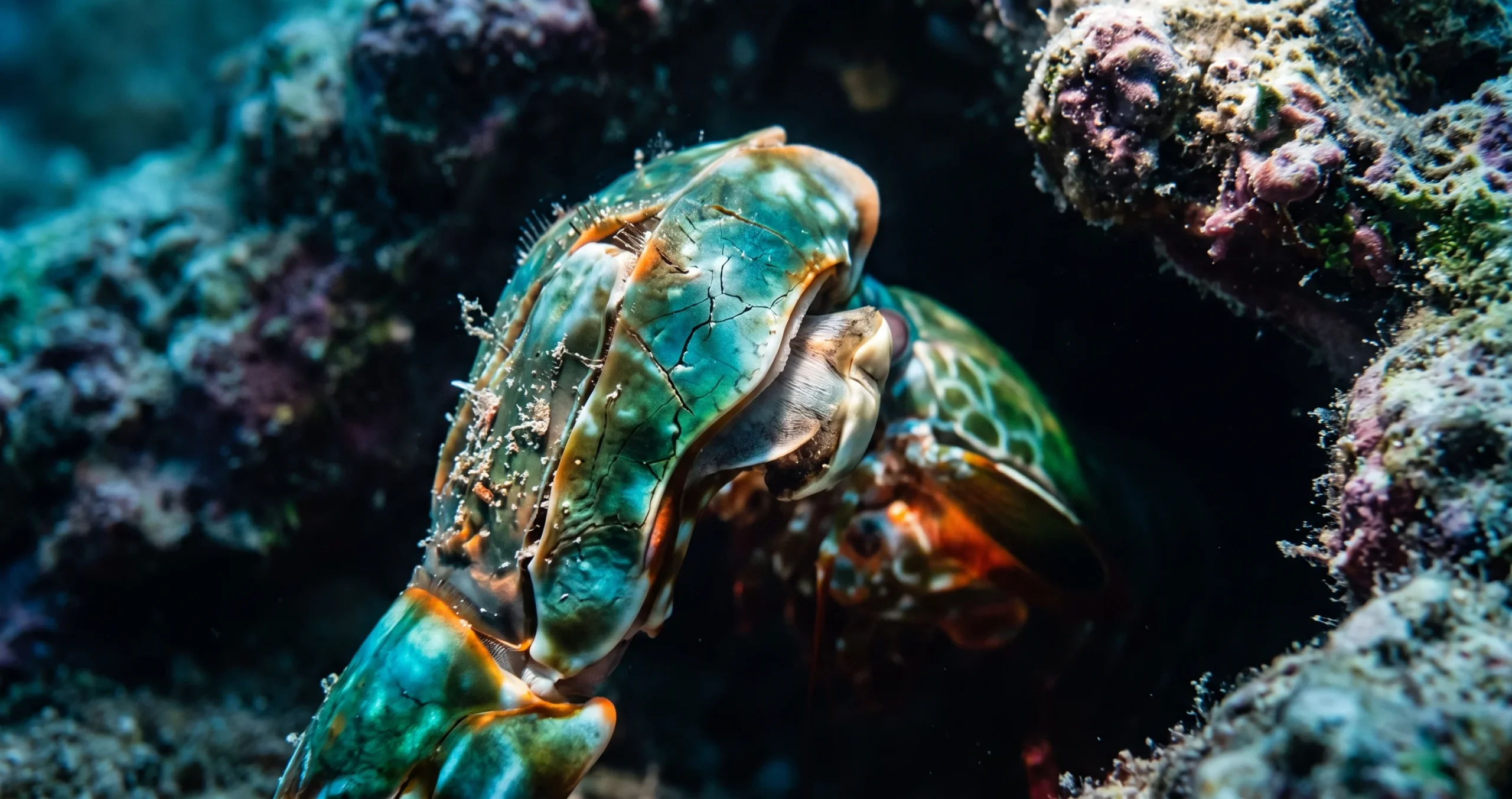
A mantis shrimp does not look like an animal capable of producing one of the fastest strikes in the ocean. Yet some “smasher” species accelerate a hammer-like appendage so rapidly that the blow can fracture hard shells—and the water itself contributes a second damaging event. The extraordinary mantis shrimp punch speed comes from a biological spring-and-latch system that stores energy before releasing it almost instantaneously.
Even more remarkable, the weapon survives thousands of impacts because its internal material is arranged to resist catastrophic cracking. Add an unusually complex visual system, and mantis shrimp become a striking example of how evolution can solve problems in mechanics, materials science, and sensory biology at the same time.
Table of Contents
- Meet the Mantis Shrimp
- Mantis Shrimp Punch Speed: Why Muscle Alone Is Not Enough
- The Spring-Loaded Raptorial Appendage
- How Fast Is the Strike?
- Cavitation: The Second Hit
- Why the Club Does Not Destroy Itself
- How Mantis Shrimp Eyes See the World
- What the Club Could Teach Materials Engineers
- Common Mantis Shrimp Myths
- Frequently Asked Questions
- Conclusion
Meet the Mantis Shrimp
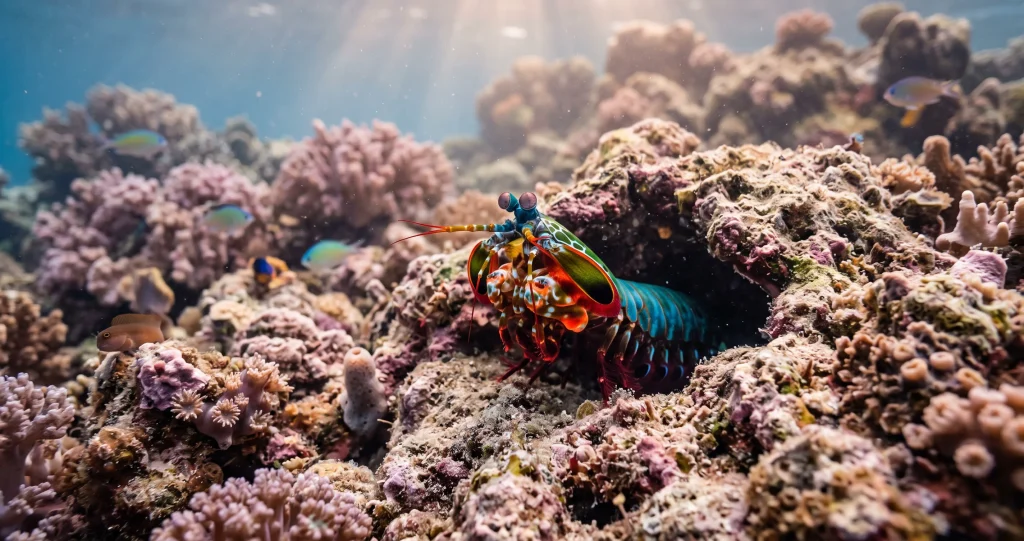
Despite their common name, mantis shrimp are not true shrimp. They are stomatopods, an ancient group of marine crustaceans found mainly in warm shallow seas.
Different species have evolved specialized raptorial appendages—the powerful limbs positioned near the front of the body. Broadly speaking, “spearers” use elongated, spiny appendages to seize softer prey, while “smashers” possess enlarged clubs capable of breaking hard structures.
The peacock mantis shrimp (Odontodactylus scyllarus) is one of the best-known smashers. Its club can hammer snails, crabs, and other hard-shelled prey.
Researchers became particularly interested in this animal because conventional muscle contraction alone could not explain the speed and acceleration of its attack. The solution turned out to be a mechanical energy-storage system built directly into the appendage.
Mantis Shrimp Punch Speed: Why Muscle Alone Is Not Enough
Muscles can generate substantial force, but they face physiological limits on how quickly they can contract.
The mantis shrimp gets around that limitation by separating energy production from energy release.
Instead of contracting its muscles and moving the club simultaneously, the animal slowly loads elastic structures within its raptorial appendage. Energy is stored first and then released over an extremely short period.
The basic principle resembles a bow and arrow.
An archer uses relatively slow muscle movement to bend the bow. The bow stores that energy elastically. Releasing the string converts the stored energy into the rapid acceleration of an arrow.
A mantis shrimp uses a much more sophisticated biological version of the same principle.
This type of system is often described as power amplification because the power released during the movement can exceed what the muscles could directly generate over such a short period.
The Spring-Loaded Raptorial Appendage
High-speed imaging and biomechanical studies have revealed several components working together during a mantis shrimp strike.
Muscles first contract to load elastic structures in the appendage. A latch prevents the striking limb from moving prematurely while that energy accumulates.
One particularly important component is a saddle-shaped structure in the exoskeleton.
Its geometry allows elastic deformation as the animal prepares its strike. When the latch releases, the stored energy is rapidly converted into movement, propelling the club toward the target.
The original biomechanical work published in Nature demonstrated that this energy-storage mechanism was necessary to explain the extraordinary acceleration of the strike. Researchers also recorded vapor bubbles forming near the point of impact.
Readers interested in the experimental biomechanics can explore the original Nature study on the mantis shrimp’s deadly strike mechanism.
The result is essentially a biological catapult.
Instead of relying on muscle to move the weapon at full speed, muscle loads the weapon and the spring system fires it.
How Fast Is the Strike?
Measurements vary among species and experimental conditions, but research on smashing mantis shrimp has recorded strikes reaching roughly 23 meters per second, or about 51 miles per hour, underwater.
The speed alone does not tell the whole story.
Reaching that velocity across a very short distance requires extreme acceleration. The shape of the club and the neighboring propodus also helps reduce hydrodynamic drag as the appendage travels through water.
This is an important point because water is much denser than air.
Swinging an appendage underwater at extraordinary speed means fighting substantial resistance. The mantis shrimp combines power amplification with a hydrodynamically favorable shape to produce its explosive movement.
The phrase “mantis shrimp punch speed” can therefore be slightly misleading. The animal is not simply throwing a miniature version of a human punch.
It is operating a specialized spring-powered hammer.
And impact is only the first part of the attack.
Cavitation: The Second Hit
One of the strangest consequences of the mantis shrimp strike occurs in the surrounding water.
When the club accelerates rapidly enough, pressure in the water immediately around it can fall dramatically. Under the right conditions, that pressure drop allows tiny vapor-filled cavities—or cavitation bubbles—to form.
Cavitation also occurs around rapidly moving boat propellers and other machinery.
The bubbles do not necessarily last long. As surrounding water pressure rises again, they collapse violently.
That collapse can release energy as pressure waves, sound, and localized physical stresses.
The Strike Creates Two Damaging Events
High-speed recordings of peacock mantis shrimp attacks revealed cavitation bubbles forming between the striking appendage and the prey. The bubbles then collapsed after the initial mechanical impact.
This means prey can experience two closely spaced events.
First comes direct contact from the club.
Then comes the collapse of the cavitation bubble, generating an additional pressure pulse or shock-like event.
Calling it a literal “second punch” is useful for visualization, but the mechanisms are different. The first comes from the solid club transferring momentum. The second comes from rapid bubble collapse in the surrounding water.
Cavitation helps explain why the mantis shrimp’s attack is so effective against hard biological materials such as mollusk shells.
It also illustrates something easy to overlook when thinking about underwater animals: at sufficiently high speeds, the physical properties of water become part of the weapon.
For another remarkable example of marine animals evolving unusual physical adaptations, read our article on why octopuses have three hearts and blue blood.
Why the Club Does Not Destroy Itself
Producing a devastating strike creates an obvious engineering problem.
If a hammer repeatedly hits hard shells with enormous acceleration, why does the hammer itself not fracture?
The answer is found in the architecture of the dactyl club.
Research at the University of California, Riverside and collaborating institutions has shown that the club is not made from one uniform material. Instead, it contains specialized regions with different mechanical roles.
The exterior impact region is highly mineralized and hard. This provides a durable surface capable of transferring momentum into prey.
Inside the club, however, the architecture changes.
Layers of chitin fibers are arranged in a helicoidal pattern—a rotating, spiral-like configuration sometimes compared with twisted plywood.
That organization changes how cracks propagate through the material.
Making Cracks Take the Long Way Around
In a simple brittle material, a crack can propagate relatively directly from its starting point, eventually causing catastrophic failure.
The mantis shrimp’s internal architecture makes that process more difficult.
Research examining this structure found that cracks twist as they travel through the helicoidal layers. Changing the crack’s direction requires additional energy, helping prevent damage from spreading directly through the club.
Another striated region contains aligned fibers wrapped around the club. Researchers have compared its function to the wraps boxers use around their hands: the architecture helps contain the structure and resist damaging expansion during impact.
The result combines hardness, toughness, energy dissipation, and crack control.
That combination has attracted considerable attention from engineers.
How Mantis Shrimp Eyes See the World
The animal carrying this extraordinary hammer also possesses one of the strangest visual systems known among animals.
Humans normally use three classes of cone photoreceptors for color vision. Some mantis shrimp possess around 12 spectral channels, in addition to sophisticated sensitivity to polarized light.
That fact has produced another popular myth: mantis shrimp must see colors far better than humans.
Experiments suggest the reality is considerably more interesting.
More Channels Do Not Mean Better Color Discrimination
Humans perceive color largely by comparing signals among our three cone classes. Our brains use those comparisons to distinguish an enormous range of colors.
Experiments with the mantis shrimp Haptosquilla trispinosa found that although it has 12 color channels, it performed worse than humans at distinguishing between closely neighboring colors.
Researchers concluded that mantis shrimp appear to process color differently.
Instead of extensively comparing receptor outputs in the same way humans do, their visual system may rapidly identify spectral information using a different neural strategy.
That distinction matters.
It is accurate to say that some mantis shrimp have far more spectral receptor channels than humans. It is not accurate to simply say they “see more colors than humans” if that implies superior fine color discrimination.
Their eyes also detect ultraviolet wavelengths and polarized light unavailable to unaided human vision, giving them access to categories of visual information that humans cannot naturally perceive.
For scientists, the fascinating part is not that their vision is universally “better.” It is that evolution produced a fundamentally different solution to visual processing.
What the Club Could Teach Materials Engineers
The mantis shrimp club has become a model for biomimicry—the practice of studying biological structures for engineering inspiration.
Engineers often face a difficult trade-off.
A protective material should be strong and resistant to impact, but increasing protection can also increase weight. That matters enormously in aircraft, vehicles, protective equipment, and body armor.
The mantis shrimp faces a comparable problem.
Its club needs to survive repeated high-energy impacts without becoming so massive that the animal cannot accelerate it effectively.
The helicoidal architecture offers one potential solution.
Researchers have used principles derived from the club to develop and investigate composite materials designed to redirect cracks and dissipate impact energy. Potential applications have included aerospace structures, vehicles, helmets, sports equipment, and protective armor.
This does not mean modern body armor is simply made from copied mantis shrimp shells.
Instead, engineers study the structural principles—the orientation of fibers, layering, gradients in material properties, and mechanisms that slow crack growth—and attempt to reproduce useful versions in synthetic composites.
That is one of the most valuable aspects of biological materials research.
Evolution does not manufacture steel, carbon fiber, or engineered ceramics. It organizes relatively ordinary biological ingredients into extraordinary structures.
The architecture can sometimes matter as much as the ingredients themselves.
Common Myths About Mantis Shrimp
Myth: A mantis shrimp literally breaks the laws of physics.
It does not. Its strike is extraordinary precisely because it exploits physics so effectively. Elastic energy storage, latching, hydrodynamics, and cavitation all operate according to well-understood physical principles.
Myth: The punch moves faster than a bullet.
This comparison is often oversimplified. Researchers have described the club’s acceleration as exceeding that of a .22-caliber bullet, while measured strike velocity can reach about 23 meters per second. Acceleration and speed are different quantities.
Myth: Cavitation means the shrimp punches twice with its club.
There is only one mechanical club strike. Cavitation bubble collapse creates a separate pressure event immediately around the impact.
Myth: Mantis shrimp see vastly more colors than humans.
Some species possess about 12 color channels compared with our three, but behavioral experiments found surprisingly poor discrimination between similar colors. Their visual system processes spectral information differently rather than simply providing “superhuman” color vision.
Myth: The club is simply an extremely hard shell.
Hardness is only part of its success. Its layered, helicoidal and fiber-reinforced architecture helps redirect cracks and prevent catastrophic failure.
Frequently Asked Questions
How fast can a mantis shrimp punch?
Research on smashing mantis shrimp has reported underwater strikes reaching approximately 23 meters per second, or roughly 51 mph. Exact performance varies with species, body size, and experimental circumstances.
Why is mantis shrimp punch speed so high?
The shrimp does not rely on direct muscle contraction alone. Muscles preload elastic structures while a latch temporarily holds the appendage in place. Releasing the latch allows stored elastic energy to accelerate the club extremely rapidly.
What is a cavitation bubble?
A cavitation bubble is a vapor-filled cavity that forms when local pressure in a liquid falls sufficiently. When pressure returns, the bubble can collapse rapidly and generate intense localized forces.
Does the mantis shrimp really create a shockwave?
The rapidly moving club can produce cavitation, and collapse of those bubbles produces an additional pressure event associated with the strike. Researchers documented cavitation accompanying attacks in the peacock mantis shrimp.
Can a mantis shrimp break aquarium glass?
Large smashing species are capable of producing powerful impacts, and stories about aquarium damage have contributed to their reputation. The more scientifically important point is that their clubs are adapted to repeatedly fracture hard biological materials such as mollusk shells.
Do mantis shrimp have 12-color vision?
Some mantis shrimp have 12 spectral receptor channels, compared with three cone classes used in normal human color vision. However, experiments show that more channels do not automatically produce finer color discrimination.
Why are engineers interested in the mantis shrimp club?
Its internal helicoidal and fiber-reinforced architecture combines impact resistance with relatively low weight. Researchers have investigated those structural principles as inspiration for tougher composites used in areas including protective equipment, transportation, aerospace, and sports.
Conclusion
The astonishing mantis shrimp punch speed is not the product of impossibly strong muscles. It comes from a beautifully coordinated mechanical system that stores muscular energy in elastic structures, holds it with a latch, and releases it in a fraction of a second.
The strike is fast enough to trigger cavitation, meaning the surrounding water contributes an additional damaging pressure event after the club hits its target.
Yet producing extreme power is only half of the evolutionary achievement.
The mantis shrimp also needs to survive its own weapon. Its mineralized impact surface, helicoidal internal layers, and reinforcing fibers provide a sophisticated system for resisting cracks and absorbing repeated impacts—one that materials scientists continue to study for engineering inspiration.
Its eyes tell a similarly surprising story. Having many more spectral channels than humans does not simply give it “better” color vision. Instead, mantis shrimp appear to process visual information in a fundamentally different way while also detecting ultraviolet and polarized light.
Nothing about the mantis shrimp actually violates the laws of physics.
The animal is remarkable because evolution has pushed those laws to extraordinary biological extremes—turning a small marine crustacean into a spring-powered hammer, a lesson in impact-resistant engineering, and one of the strangest visual systems in the sea.