
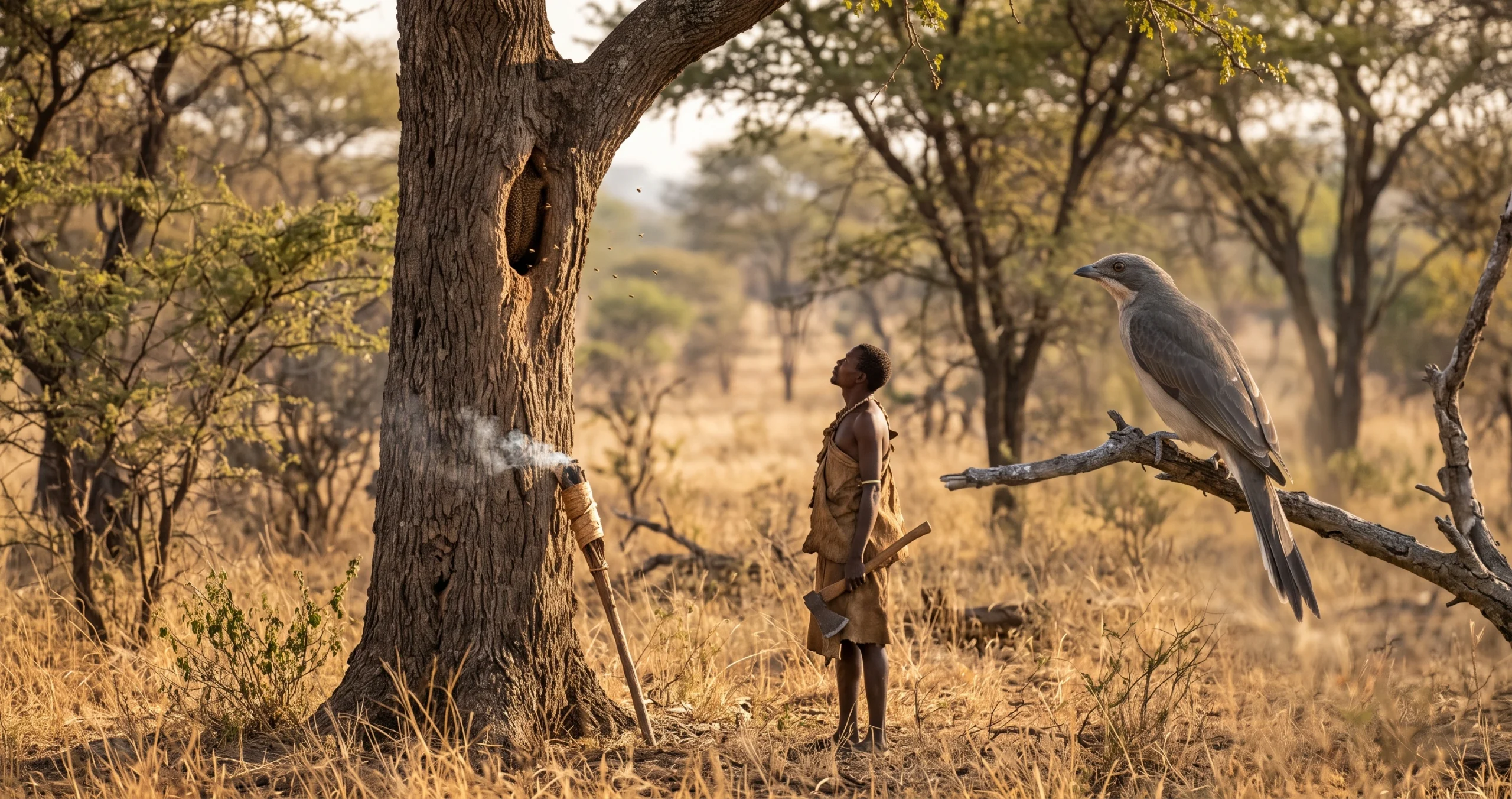
In a dry woodland in southeastern Africa, a honey hunter produces a distinctive rolling call. From somewhere among the trees, a greater honeyguide answers. The person calls again, the bird flies ahead, and a remarkable cooperative search begins—sometimes ending at a wild honeybee colony hidden inside a tree.
This greater honeyguide human cooperation is one of the best-documented examples of coordinated foraging between humans and a free-living wild animal. Yet there is no single universal version of the partnership. Human honey-hunting traditions differ across Africa, the calls people use differ culturally, and the behavior and benefits of the interaction vary among regions.
Table of Contents
- Meet the Greater Honeyguide
- A Remarkable Partnership Between Wild Birds and Humans
- Humans Can Call the Birds
- Honeyguides Respond to Human Signals
- The Bird Takes the Lead
- Signals During the Search
- Finding the Bees’ Nest
- What Humans Gain
- What the Honeyguide Gains
- Why Honeyguides Eat Wax
- Is This True Two-Way Communication?
- Different Human Communities, Different Calls
- A Relationship Shaped by Culture and Ecology
- Do Honeyguides Learn This From Their Parents?
- Honeyguides Have Another Extraordinary Lifestyle
- Not Every Human–Honeyguide Relationship Is Identical
- Why Scientists Study This Partnership
- Frequently Asked Questions
- Conclusion
Meet the Greater Honeyguide
The greater honeyguide (Indicator indicator) is a medium-sized bird found across much of sub-Saharan Africa.
Its appearance is relatively understated. Adults are generally brownish or gray-brown above, paler underneath, and possess distinctive white markings in the tail that can become conspicuous when the bird flies.
Greater honeyguides inhabit woodland, savanna, shrubland, forest edges, and other habitats where suitable food and host species occur.
Their ecology, however, is anything but ordinary.
Honeyguides consume insects and other animal material, but members of the honeyguide family are famous for their unusual ability to consume beeswax. Greater honeyguides also locate wild bee colonies—and in some regions, they interact with human honey hunters who possess the tools and knowledge needed to open them.
A Remarkable Partnership Between Wild Birds and Humans
A wild honeybee colony can contain valuable resources for both species.
Humans seek energy-rich honey and may also consume bee larvae, pupae, and other hive products. Honeyguides are strongly attracted to beeswax but can have difficulty accessing comb protected inside a tree cavity and surrounded by defensive bees.
This creates an opportunity for cooperation.
A greater honeyguide that knows the location of a colony can lead a human toward it. The honey hunter can use smoke, tools, climbing skills, and detailed ecological knowledge to subdue the bees and open the nest.
Afterward, wax exposed by the harvest can become accessible to the bird.
Both partners can therefore gain something that would otherwise be harder to obtain.
Scientists describe this as a facultative mutualism: the partnership can benefit both participants, but neither species depends absolutely on a single partner for survival.
The relationship is especially remarkable because greater honeyguides are wild.
They have not been domesticated or individually trained by honey hunters in the way that humans train hunting dogs or falcons.
Image 1 placement — 1200 × 630 px, photorealistic, no text or graphic overlays
Alt text: Greater honeyguide human cooperation during a search for wild honey
Humans Can Call the Birds
The interaction can begin with the human rather than the bird.
Among Yao honey hunters in Mozambique, people traditionally use a distinctive vocalization often transcribed as a loud trill followed by a grunt.
The sound is not simply a general shout made while walking through the woodland.
It is a culturally established signal associated with honey hunting.
Researchers led by Claire Spottiswoode tested whether this call actually changes honeyguide behavior.
In controlled field experiments, the traditional trill-grunt substantially increased the probability of being guided by a honeyguide compared with control sounds.
The experiments also showed that using the traditional call increased the overall probability of successfully finding a bees’ nest.
This provided unusually strong evidence that human vocal signals can actively influence the behavior of a free-living wild bird.
Honeyguides Respond to Human Signals
The birds are not merely reacting indiscriminately to human noise.
The 2016 experiments compared the Yao trill-grunt with other human and animal sounds. Honeyguides responded more strongly to the specialized honey-hunting signal.
The result suggested that the birds associate that particular human sound with an opportunity for cooperation.
Later experiments went even further.
Researchers compared honeyguide responses to culturally different honey-hunting signals used in Mozambique and Tanzania.
Honeyguides preferred the calls traditionally used by honey hunters in their own local region.
That discovery indicates that the communication system is not based solely on one genetically fixed human sound that all honeyguides across Africa automatically recognize.
Local experience matters.
The Bird Takes the Lead
Once cooperation begins, the honeyguide can guide the search.
A bird may call from a perch, attract the honey hunter’s attention, and then fly toward another tree.
The person follows.
The honeyguide lands again, calls, and eventually moves farther ahead. Through repeated flights and stops, bird and human progress through the landscape.
The interaction requires attention from both participants.
The bird must maintain contact with the human, while the honey hunter listens for calls, watches where the bird moves, and uses personal knowledge of bee ecology and the landscape.
Guiding does not necessarily follow an identical sequence every time.
Distance to the colony, vegetation, terrain, bird behavior, and the honey hunter’s experience can all affect the search.
Signals During the Search
Honeyguides provide behavioral cues while guiding.
Classic field research in Kenya found that characteristics of the bird’s guiding behavior changed as the pair approached a bees’ nest.
These changes can include aspects of calling, flight distance, and perching behavior.
Experienced honey hunters can use such information when interpreting where the bird is leading them.
It is tempting to call this a spoken “language,” but that description risks going beyond the evidence.
Researchers can demonstrate that particular signals influence behavior and provide information during a cooperative interaction. That does not establish that honeyguides possess a human-like symbolic language or consciously describe the location of a nest.
The scientifically important finding is already remarkable: behaviorally meaningful signals pass between two very different species during a shared search.
Finding the Bees’ Nest
Eventually, the honeyguide’s movements can bring the hunter close to a bee colony.
Wild African honeybees frequently establish colonies in cavities, including hollow sections of trees.
The nest may be difficult to detect from the ground.
Once nearby, the human must still locate the precise cavity entrance and determine how to reach the comb.
This is where human ecological knowledge becomes crucial.
The honey hunter may listen for bees, inspect tree cavities, watch flight paths, climb, or use other locally appropriate methods.
Smoke is commonly used in several honey-hunting traditions to help manage defensive bees.
The tree or cavity may then be opened sufficiently to reach the comb.
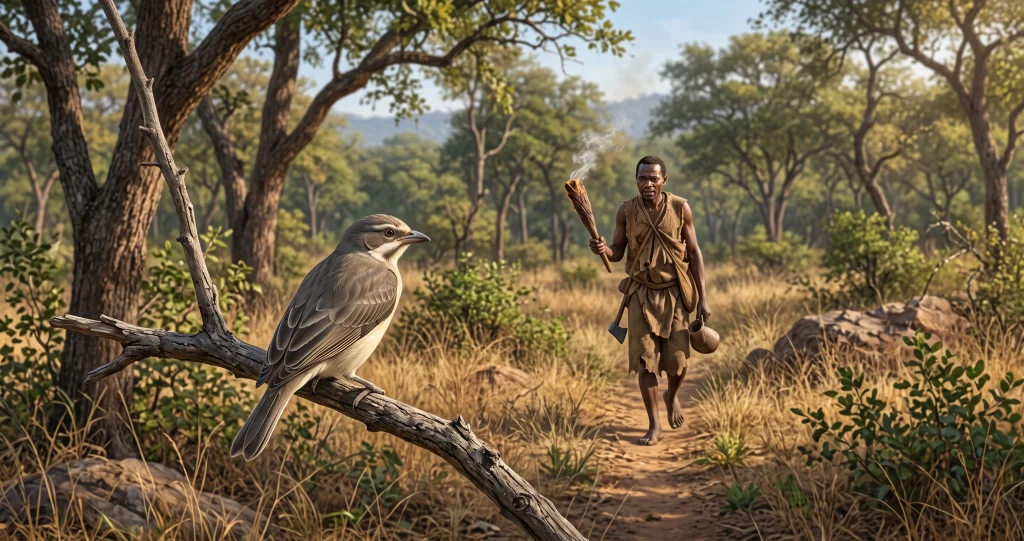
Image 2 placement — 1200 × 630 px, photorealistic, no text or graphic overlays
Alt text: Greater honeyguide and honey hunter locating a wild bees nest
What Humans Gain
The most obvious human reward is honey.
Honey is an exceptionally energy-rich food, making a successfully located wild colony potentially valuable.
The harvest can also provide bee brood—eggs, larvae, and pupae—which contains protein and fat.
Research among the Hadza of northern Tanzania demonstrated how substantial the honeyguide’s contribution can be.
A 2014 study found that honeyguides increased Hadza honey hunters’ rate of finding bee nests dramatically and guided them to higher-yielding colonies. Researchers estimated that foods obtained through honeyguide-assisted honey hunting contributed substantially to the diet during the study.
For humans searching large woodland landscapes, information about the location of hidden colonies can therefore have genuine nutritional value.
What the Honeyguide Gains
The bird gains access primarily to wax and associated hive material exposed by the human harvest.
Without human intervention, much of that resource can be difficult to reach.
Honeybees defend their nests, and comb may be concealed deep within cavities that a honeyguide cannot easily open.
Humans change that situation.
By opening the cavity and subduing the bees, honey hunters expose wax that birds can subsequently eat.
Recent camera-trap research in Mozambique confirms that greater honeyguides frequently arrive quickly at wax left after honey harvests. At monitored sites, they successfully fed at 23 of 26 wax locations.
But describing this as humans always “paying” the bird would be misleading.
Practices differ among communities.
In some traditions, honey hunters deliberately leave wax for honeyguides. In others, humans may not intentionally provide a reward, even though wax can still become accessible as a consequence of opening the nest.
Why Honeyguides Eat Wax
Beeswax is an unusual food.
It consists largely of lipids, including long-chain compounds that most vertebrates do not use extensively as a dietary resource.
Honeyguides are unusual in regularly consuming it.
Their ability to exploit wax gives them access to a resource avoided or poorly exploited by many other birds, although research has shown that they are not the only vertebrates willing to consume exposed wax.
Greater honeyguides also eat insects and other foods.
Wax should therefore not be imagined as their only source of nutrition.
Researchers continue to investigate the physiological and microbial mechanisms involved in wax digestion. Historical studies have suggested that specialized digestive processes allow honeyguides to obtain nutritional value from beeswax, but the precise contribution of the bird’s own digestive physiology and its microbiome has been an area of continuing scientific interest.
Is This True Two-Way Communication?
There is strong experimental evidence for reciprocal signaling.
Humans produce specialized calls that affect honeyguide behavior. Honeyguidides, in turn, produce calls and movements that humans use while following them.
The 2016 Science study described the interaction as reciprocal signaling.
That terminology is justified because signals from each species influence the behavior of the other in ways relevant to their cooperative goal.
This remains different from claiming that the participants understand each other’s intentions exactly as humans understand those of other people.
Behavioral experiments establish functional communication.
They do not require researchers to assume human-like mental representations in the bird.
The original peer-reviewed research, “Reciprocal Signaling in Honeyguide-Human Mutualism,” published in Science, provides the experimental foundation for this conclusion.
Different Human Communities, Different Calls
One of the most fascinating discoveries came from comparing honey-hunting cultures.
Yao honey hunters in northern Mozambique traditionally use the trill-grunt.
Hadza honey hunters in northern Tanzania use a very different signal—a melodic whistle.
Both are culturally established ways of attracting or communicating with honeyguides.
Researchers experimentally played these sounds to wild honeyguides in both regions.
Mozambican honeyguides responded more strongly to the Yao signal, while Tanzanian honeyguides responded more strongly to the Hadza signal.
The differences could not be adequately explained simply by how well the sounds traveled through the environment.
Instead, the evidence indicates that honeyguides learn which human sounds locally predict useful cooperative partners.
The 2023 Science study described this as a geographically varying mosaic of culturally determined interspecies communication.
A Relationship Shaped by Culture and Ecology
Humans bring cultural knowledge to the partnership.
Honey-hunting techniques, calls, methods for handling bees, and customs concerning what happens to wax after harvest can be transmitted within human communities.
Honeyguides bring their own behavioral flexibility.
The birds can learn associations between locally relevant human signals and profitable opportunities.
This creates an unusual intersection between human culture and wild-animal behavior.
It does not mean honeyguides have been domesticated.
They remain free-living birds that can choose whether to approach humans, guide them, feed at exposed wax, or forage independently.
Researchers have even found that individual honeyguides can switch between guiding humans and simply arriving later to scavenge exposed wax.
Do Honeyguides Learn This From Their Parents?
This question contains one of the biggest mysteries surrounding the partnership.
Greater honeyguides are brood parasites.
Females do not normally raise their own offspring. Instead, they lay eggs in the nests of other bird species.
Young honeyguides consequently grow up with foster parents belonging to another species.
They do not spend childhood following a biological mother or father on honey-hunting trips.
That makes simple parent-to-offspring instruction an unlikely explanation for how guiding behavior is transmitted.
Some components may have a genetic basis, while important details could be learned later through experience with humans or other honeyguides.
The 2023 experiments strongly suggest that recognition of locally appropriate human calls involves learning. Exactly how young honeyguides first develop guiding behavior and acquire all of the relevant information remains an active scientific question.
Honeyguides Have Another Extraordinary Lifestyle
The bird’s reproductive biology is dramatically different from its cooperative relationship with humans.
A female greater honeyguide places an egg in another bird’s nest rather than building a nest and raising chicks herself.
The young honeyguide hatches equipped with specialized hooks on its bill.
In some host nests, the newly hatched honeyguide uses these hooks to kill the host’s chicks, eliminating competitors for the food delivered by the foster parents.
The hooks disappear as the honeyguide develops.
This creates a remarkable biological contrast.
The same species involved in a mutually beneficial relationship with humans is an obligate reproductive parasite of other birds.
Cooperation and exploitation are therefore not fixed personality characteristics of a species. They are ecological relationships whose consequences depend on the participants and circumstances.
Not Every Human–Honeyguide Relationship Is Identical
Regional variation is essential to understanding the system accurately.
The Yao of Mozambique commonly cooperate with honeyguides using their characteristic trill-grunt, and wax exposed during harvesting can reward the bird.
Hadza practices in Tanzania differ.
Research has reported that Hadza honey hunters sometimes hide, burn, or bury wax rather than deliberately leaving it for honeyguides. One interpretation offered by hunters is that restricting the bird’s reward keeps it motivated to locate additional colonies.
Whatever the ultimate ecological consequences, this finding demonstrates why the partnership should not be reduced to a single story in which humans everywhere deliberately leave a standardized “payment.”
There can also be variation among individual birds.
Some honeyguides guide. Others may exploit wax opened through another bird’s cooperation. Individuals can switch between these tactics.
Environmental circumstances matter as well.
Bee abundance, habitat, competing wax consumers, human honey-hunting traditions, and opportunities for birds to encounter knowledgeable people can all influence the interaction.
Cooperation has also disappeared or become uncommon in parts of Africa where traditional honey hunting has declined.
Why Scientists Study This Partnership
The human–honeyguide system provides an unusual opportunity to study cooperation outside domestication.
Most familiar examples of humans working with animals involve species that people have bred, trained, or kept for generations.
Honeyguides are different.
A researcher can observe communication emerging between free-living wild birds and humans who possess culturally transmitted knowledge.
The system therefore raises questions spanning several fields.
Behavioral ecologists can study cooperation and mutualism. Ornithologists can investigate learning and communication. Anthropologists can examine culturally transmitted honey-hunting traditions.
Evolutionary researchers can ask how interactions remain stable when participants have opportunities to exploit one another.
The discovery of geographically distinct human calls recognized by local birds adds another dimension: cultural variation in one species can shape learned behavior in another.
Readers interested in another example of sophisticated avian learning can explore our article on how crows remember human faces.
Frequently Asked Questions
Do greater honeyguides really lead humans to honey?
Yes. Field observations and controlled experiments demonstrate that greater honeyguides can guide human honey hunters to wild bees’ nests in several African regions.
Can humans call honeyguides?
Yes, in some honey-hunting cultures. Yao hunters in Mozambique use a characteristic trill-grunt, while Hadza hunters in Tanzania use a different whistle-like signal.
Do honeyguides understand those calls?
Experiments show that honeyguides respond selectively to locally relevant honey-hunting calls. This demonstrates learned, behaviorally meaningful recognition, but it does not establish human-like understanding of the signal.
What does the honeyguide get from helping people?
The bird can gain access to beeswax and associated hive material exposed when humans open a bee colony. Without humans opening the nest and subduing defensive bees, much of this wax would be difficult for the bird to reach.
Do humans always leave wax as a reward?
No. Practices differ geographically and culturally. Some honey hunters deliberately leave wax, while research among the Hadza has documented practices that deliberately restrict honeyguides’ access to comb.
How do young honeyguides learn to guide people?
The complete developmental process remains unresolved. Greater honeyguides are brood parasites and are raised by other bird species, making direct parental teaching unlikely. Experimental evidence indicates that at least some locally relevant human signals are learned.
Are honeyguides domesticated?
No. Greater honeyguides participating in this partnership are free-living wild birds. They are not owned, bred, or individually trained by the humans with whom they cooperate.
Conclusion
A greater honeyguide calling from an African woodland and a honey hunter answering it represent something exceptionally rare in nature.
Each participant possesses information or abilities valuable to the other.
The bird can locate hidden bee colonies and guide through the landscape. The human possesses cultural knowledge, tools, and techniques capable of opening protected nests and making valuable hive resources accessible.
Communication helps bring those abilities together.
Experiments demonstrate that humans can increase their chances of attracting cooperative honeyguides with specialized calls and that honeyguides distinguish locally appropriate signals from less relevant sounds. The birds then use calls, flights, and perching behavior during the search.
The relationship is not uniform across Africa.
Different communities possess different calls and customs, individual honeyguides can behave differently, and even the way wax is shared varies among honey-hunting traditions.
Those differences make greater honeyguide human cooperation more scientifically interesting, not less.
It is a partnership shaped simultaneously by ecology, animal learning, and human culture—a system in which a free-living bird and a human can exchange useful signals, travel through the landscape together, and sometimes reach a resource that becomes more accessible because both participated in the search.