
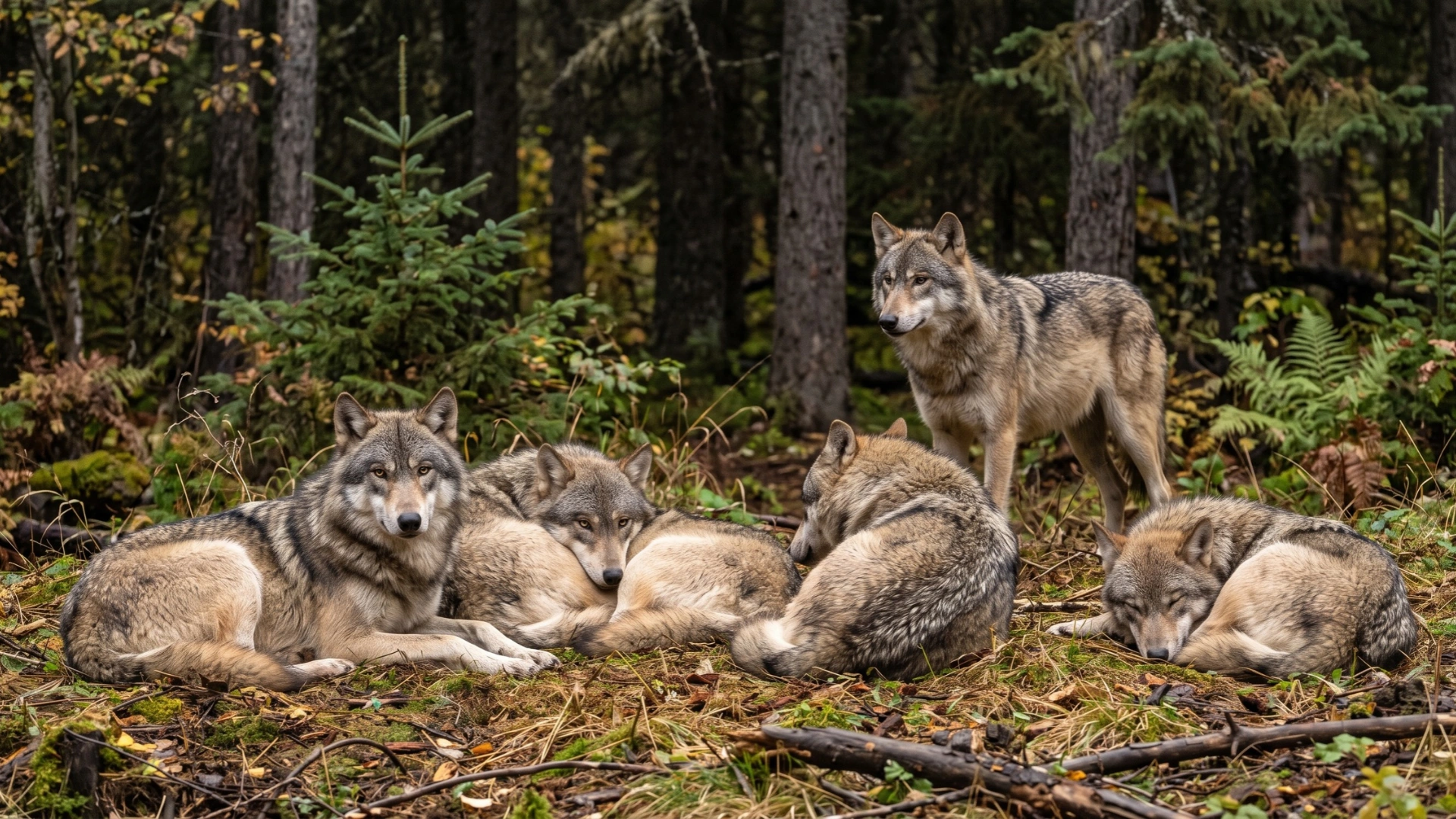
For decades, wolves have been portrayed as locked in a constant struggle for status. According to the familiar story, every pack has a powerful “alpha male” who fights his way to the top, dominates weaker wolves, and maintains control through intimidation.
Modern field research paints a very different picture. The alpha wolf myth grew largely from observations of unrelated wolves living together in captivity—not from the everyday lives of typical wild wolf families. Studies of free-ranging wolves show that a pack is usually much closer to a family than a ruthless hierarchy.
The wolves at the front are generally there for a simple reason: they are the parents.
Understanding that distinction changes almost everything about how we interpret wolf behavior, from hunting and pup-rearing to dominance displays and even the way wolf research has influenced dog-training advice.
Table of Contents
- Where the Alpha Wolf Idea Came From
- Why Captive Wolves Gave Researchers a Misleading Picture
- How the Alpha Wolf Myth Changed
- What a Wild Wolf Pack Is Really Like
- Leadership Without a Constant Power Struggle
- Cooperation Is at the Heart of Wolf Society
- Dominance Behavior Still Exists
- How the Alpha Idea Entered Popular Culture
- Why Wolf Dominance Theory Became Dog-Training Advice
- What Accurate Wolf Social Behavior Looks Like
- Common Wolf Pack Myths
- Frequently Asked Questions
- Conclusion
Where Did the Alpha Wolf Idea Come From?
The alpha-wolf concept did not appear out of nowhere. Early researchers studying captive wolves observed social conflicts, dominance displays, submission, and apparent rank relationships among animals sharing an enclosure.
The problem was the environment.
Many captive groups were composed of unrelated wolves brought together artificially. They could not simply disperse across a vast landscape when social tension developed.
Researchers therefore witnessed interactions that could be much more competitive than those normally occurring within a wild family group.
This helped produce the familiar hierarchy of “alpha,” “beta,” and lower-ranking wolves.
The terminology eventually became deeply embedded in both scientific and popular descriptions of wolves.
One of the researchers most closely associated with changing this interpretation was wildlife biologist L. David Mech. In a landmark 1999 paper based partly on years of observations of free-ranging wolves on Ellesmere Island, Mech explained that much of the traditional picture of pack social dynamics had come from studies involving unnatural assortments of captive wolves.
His field observations pointed toward a much more natural explanation.
A typical pack was a family.
Why Captive Wolves Gave Researchers a Misleading Picture
Imagine placing several unrelated adult humans together in a confined space where leaving is difficult. Their social relationships might look very different from those of parents living naturally with their children.
Something similar can happen with wolves.
In nature, young wolves eventually have an important option unavailable to many captive animals: dispersal.
As wolves mature, some leave their birth pack and travel in search of territory and potential mates. Yellowstone data, for example, show dispersal occurring in both sexes, with considerable variation in the age at which individuals leave.
Captive wolves living in artificial groups cannot reproduce this natural social system perfectly.
That does not make captive-wolf observations useless. They have contributed enormously to our knowledge of wolf communication and behavior.
But scientists must be cautious about assuming that behavior produced under one set of conditions describes what normally happens under another.
That distinction became crucial to understanding the alpha wolf myth.
How the Alpha Wolf Myth Changed
The scientific understanding of wolves evolved as researchers accumulated more observations of animals living under natural conditions.
Mech’s 1999 paper, available through the U.S. Geological Survey, describes the typical wild wolf pack as a family in which adult parents guide group activities.
Rather than unrelated adults continuously competing for the highest position, the basic relationship resembles parents and their offspring.
That is why wolf organizations increasingly favor terms such as breeding male, breeding female, breeding pair, or simply parents.
The International Wolf Center notes that “alpha” has largely been superseded by terminology emphasizing the breeding parents because free-ranging packs generally consist of those parents and their offspring.
This does not mean every older observation involving dominance was false.
It means the interpretation was incomplete.
![“Wild wolf family demonstrating why the alpha wolf myth misrepresents normal pack structure.”]](https://secretsofthegreengarden.com/wp-content/uploads/2026/09/manar-web-4-1024x576.webp)
What Is a Wild Wolf Pack Really Like?
A typical wild wolf pack begins with two wolves.
A male and female form a pair, establish or occupy a territory, reproduce, and raise pups. If offspring remain with their parents after their first year, the group expands.
The next litter adds another generation.
Soon the “pack” may include the breeding parents, pups of the current year, yearlings, and older offspring that have not yet dispersed.
The International Wolf Center describes a pack as a cohesive family unit commonly consisting of adult parents and their offspring from the current year and sometimes previous years. Unrelated animals can occasionally join, so the family model should not be treated as an absolute rule.
Yellowstone provides excellent examples of how variable packs can become.
The National Park Service reports that wolf pack size depends partly on prey availability and prey size. Yellowstone has even recorded unusually large packs containing dozens of animals, although such enormous groups are exceptional.
So there is no single perfect wolf-pack structure.
The family unit is simply the best starting point for understanding the typical pattern.
Leadership Without a Constant Power Struggle
Once a pack is understood as a family, the behavior of the adults becomes easier to interpret.
Parents naturally have influence over their offspring.
A wolf father does not necessarily need to defeat his sons in dramatic battles to establish that relationship any more than a human parent needs to win a wrestling tournament to become the parent of the household.
Mech described wild packs as having a division of labor, with adult parents guiding group activities. His observations found the female particularly important in pup care and defense, while the male often played a major role in foraging, provisioning, and associated travel.
Actual behavior varies among packs and individuals.
Wolf leadership is therefore more flexible and context-dependent than the simplified image of one permanently commanding animal.
Cooperation Is at the Heart of Wolf Society
Competition certainly exists among wolves, but cooperation is fundamental to their survival.
Wolves cooperate when hunting prey that can greatly outweigh an individual wolf. They defend territories, protect carcasses, communicate with pack members, and help raise pups.
Yellowstone researchers describe wolves as cooperative breeders. Both parents and other pack members can participate in caring for offspring.
Social living can provide other benefits as well.
National Park Service research highlights cooperative hunting, offspring care, territorial defense, carcass defense, and even potential survival benefits for impaired pack members.
Wolf society is consequently better understood through a mixture of kinship, cooperation, individual relationships, communication, reproduction, and competition rather than through a single dominance ladder.
For another look at the complex behavior of wild animals, explore the wildlife section at Secrets of the Green Garden, including articles examining animal communication, cognition, and survival strategies.
Does Dominance Exist in Wolves?
Yes.
Correcting the alpha wolf myth does not mean pretending wolves have no dominance relationships.
Wolves use body posture, facial expressions, tail position, vocalizations, muzzle licking, crouching, and other signals during social interactions. The International Wolf Center describes both dominant and submissive displays as part of wolf communication.
Conflict can also be serious.
Competition between neighboring packs can become violent or fatal. Yellowstone research has documented intense territorial conflict between packs, demonstrating that wolves are certainly capable of aggression.
The important distinction is between acknowledging dominance behavior and imagining the typical pack as a collection of unrelated adults constantly fighting for an “alpha” throne.
Those are not the same claim.
How the Alpha Idea Entered Popular Culture
The phrase “alpha wolf” was almost irresistible outside biology.
It was simple, dramatic, and easy to apply to human behavior.
Books, movies, television programs, motivational speakers, online personalities, and popular psychology adopted “alpha” as shorthand for the strongest or most assertive individual in a group.
Eventually, the concept became detached from the complicated biology that originally inspired it.
People began speaking casually about alpha personalities, alpha leaders, alpha males, and alpha behavior.
Meanwhile, wolf biology itself was moving toward a more nuanced understanding.
This created a strange situation: the simplified version of wolf behavior became increasingly popular just as wolf researchers were emphasizing its limitations.
How the Alpha Wolf Myth Influenced Dog Training
Perhaps the most consequential extension of the idea involved domestic dogs.
Some dog-training philosophies suggested that unwanted behaviors happened because dogs were attempting to increase their social rank over humans.
Owners were therefore encouraged to establish themselves as the “alpha.”
Various techniques were promoted under this logic, including forcing dogs onto their backs in so-called alpha rolls, controlling access to resources, walking through doors first, or interpreting everyday behavior as a challenge for leadership.
There are two major problems with this reasoning.
First, the traditional interpretation of wolf packs on which it was based was oversimplified.
Second, domestic dogs are not simply wolves living in human houses.
The American Veterinary Society of Animal Behavior warns against applying simplistic wolf-dominance ideas to dogs and recommends evidence-based, reward-based approaches to training. Its dominance guidance also notes that higher-ranking wolves do not normally force lower-ranking animals onto their backs in the manner implied by the traditional “alpha roll.”
That distinction matters because misunderstanding an animal’s motivation can lead people to respond in ways that increase fear, stress, or defensive aggression.
What Accurate Wolf Social Behavior Looks Like
Real wolf behavior is more interesting than the stereotype.
Wolves form long-lasting social relationships. They play, rest together, communicate through scent and vocalizations, care for young, cooperate while hunting, and defend territories.
Howling is especially important.
It can help wolves communicate within a pack, advertise territorial occupancy, and coordinate social activity.
Pup-rearing demonstrates the cooperative nature of the pack particularly clearly.
Young wolves initially depend heavily on adults. After weaning, adults can bring food back and regurgitate it for pups. As youngsters grow, they become increasingly involved in pack movements and eventually hunting.
Some will remain with their parents for a time.
Others will disperse.
A dispersing wolf may travel away from its birth family, find a mate, establish territory, and begin another family.
In that sense, one of the most revealing ways for a young wolf to become what people once called an “alpha” is not necessarily to defeat the existing leader.
It is to leave home and become a parent.
Common Myths About Wolf Packs
Myth 1: Every Pack Has an Alpha Male Who Fought His Way to the Top
In a typical wild pack, the leading adult male is commonly the father of the younger wolves rather than an unrelated fighter who defeated everyone else for control.
Myth 2: Wolves Are Constantly Fighting for Rank
Wolves can compete, display dominance, and fight.
However, everyday pack survival depends heavily on cooperation among related animals.
Myth 3: There Is No Dominance Behavior in Wolves
This goes too far in the opposite direction.
Dominant and submissive interactions do occur. The mistake is treating those interactions as proof that every pack operates as a rigid ladder maintained through continuous violence.
Myth 4: Every Wolf Pack Has Exactly One Breeding Pair
A breeding pair is typical, but nature produces exceptions.
Yellowstone research has documented packs containing multiple breeding animals, and the National Park Service reports that roughly a quarter of Yellowstone packs can have multiple breeding pairs under polygymous mating arrangements.
Myth 5: Dogs Need Humans to Behave Like Alpha Wolves
Domestic dogs have their own evolutionary and behavioral history.
Professional veterinary behavior guidance does not support basing dog training on simplistic “alpha wolf” assumptions.
FAQ About the Alpha Wolf Myth
Are alpha wolves real?
“Alpha” can describe a socially dominant individual, and the term still appears in some scientific, educational, and management contexts.
However, researchers increasingly use terms such as breeding male, breeding female, breeding pair, or parents when describing typical wild packs because those terms better represent the family relationships involved.
Who leads a wolf pack?
The adult breeding wolves—usually the parents—have substantial influence over pack activities.
Leadership can vary according to circumstances rather than functioning as one individual issuing commands at all times.
Do wolves fight for dominance?
Dominance interactions and conflicts occur, but the idea that members of a normal wild family continually battle for the top position exaggerates their importance.
Territorial conflict between separate packs can actually be much more intense than everyday competition within a family pack.
Why did scientists once believe in alpha wolves?
Much early research on wolf social structure involved captive groups that could contain unrelated animals living together under artificial conditions.
Those groups did not always reproduce the family structure normally seen in free-ranging wolf packs.
Did the scientist who created the alpha idea later reject it?
The history is more complicated than that popular claim suggests.
The terminology developed across earlier captive-wolf research and was later used by influential wolf researchers, including L. David Mech. As evidence from wild wolves accumulated, Mech became a prominent advocate for moving away from “alpha” terminology when describing typical natural packs. His 1999 paper clearly explains why the family model is more accurate.
Are wolf packs always families?
Not always.
The typical pack is centered on a breeding pair and offspring, but unrelated wolves can occasionally join, and some populations produce more complicated arrangements.
Should people use wolf behavior to train dogs?
Comparisons can generate interesting research questions, but domestic dogs should be understood primarily through research on domestic dogs.
Veterinary behavior specialists recommend science-based training rather than methods built around proving human “alpha” status.
Conclusion
The alpha wolf myth survives because it tells an appealingly simple story: one powerful animal defeats its rivals and rules the pack.
Wild wolf society is far more interesting.
Most packs are families. Breeding parents raise offspring with help from other members, relatives cooperate to hunt and defend territory, young wolves mature and disperse, and new packs form.
Dominance and aggression have not disappeared from the scientific picture. Wolves still compete, signal status, defend resources, and sometimes engage in lethal conflicts.
What changed was the framework used to interpret those behaviors.
Instead of seeing every interaction as part of a relentless struggle for the top rank, researchers studying free-ranging wolves revealed a social system built substantially around family relationships, reproduction, cooperation, communication, and shared survival.
The stereotypical alpha standing above a pack of defeated rivals makes a memorable image.
A pair of parents traveling across the landscape with their offspring is much closer to the everyday reality of wild wolves.
3 External Sources:
- U.S. Geological Survey — L. David Mech, Alpha Status, Dominance, Leadership, and Division of Labor in Wolf Packs
USGS wolf-pack research - National Park Service — Yellowstone Wolf Ecology
Yellowstone National Park wolf ecology - International Wolf Center — Wolf FAQs and pack structure
International Wolf Center wolf information