
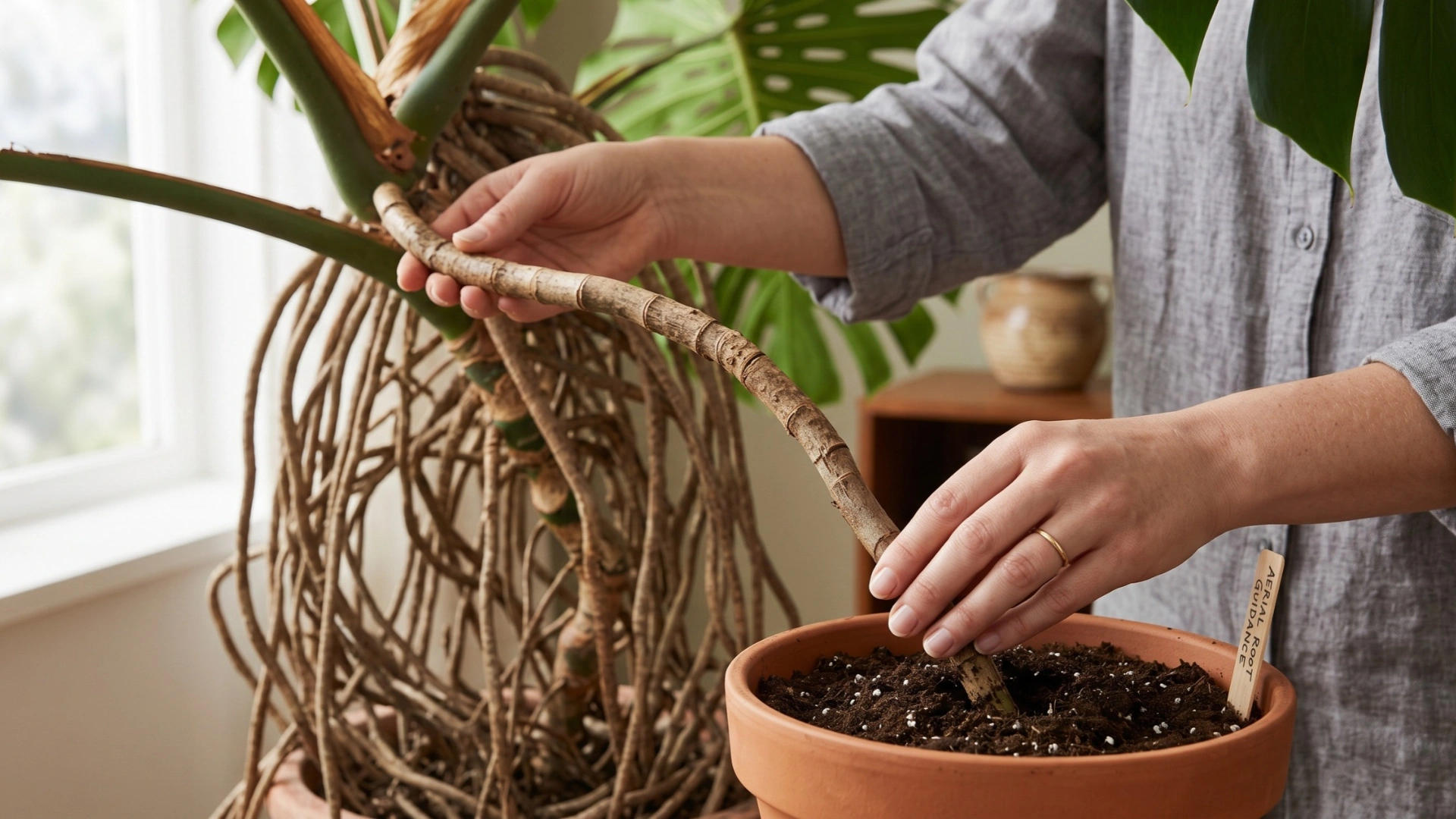
If your Monstera has started producing long brown or greenish roots from its stem, there is usually no reason to worry. These strange-looking growths are monstera aerial roots, a normal part of the plant’s climbing strategy rather than a sign that something has gone wrong.
In nature, these roots help Monstera plants attach themselves to trees and other surfaces as they climb toward brighter conditions. Indoors, they may hang over the edge of the pot, reach toward a wall, wrap around a support, or eventually grow into the potting mix.
Understanding what aerial roots actually do makes it much easier to decide whether to leave them alone, train them onto a support, direct them into the soil, or trim them when necessary.
Table of Contents
- What Are Monstera Aerial Roots?
- What Aerial Roots Do in the Wild
- Do Aerial Roots Absorb Water?
- Why Indoor Monsteras Produce Aerial Roots
- Should You Cut Monstera Aerial Roots?
- How to Guide Aerial Roots Into the Soil
- How to Train Aerial Roots Onto a Moss Pole
- Healthy vs. Struggling Monstera Roots
- Common Myths About Aerial Roots
- FAQ
- Conclusion
What Are Monstera Aerial Roots?
Aerial roots are roots that develop above the soil rather than beginning underground. On a mature Monstera deliciosa, they normally emerge from nodes along the main stem.
They can initially appear as small green, cream, or brown bumps. As they develop, they may become long, firm, cord-like structures that extend several feet on a large plant.
Their appearance sometimes causes confusion because older aerial roots can look woody, rough, or dark brown even when they are perfectly healthy.
This growth pattern is normal for Monstera. The Royal Horticultural Society describes Monstera species as evergreen climbing plants with aerial roots, while University of Wisconsin horticulture specialists note that Monstera deliciosa produces numerous long aerial roots as it climbs.
What Monstera Aerial Roots Actually Do in the Wild
To understand these roots, it helps to picture a Monstera growing in a tropical forest rather than in a decorative pot beside a window.
They Help the Plant Climb
One of the most important functions of monstera aerial roots is mechanical support.
Wild Monsteras are climbing vines. Rather than building a thick, self-supporting trunk like a tree, the plant takes advantage of existing structures.
Its aerial roots can attach to tree trunks and other surfaces, helping stabilize the increasingly heavy vine as it grows upward. Penn State Extension notes that Monsteras naturally use aerial roots around the bases of their leaves to attach themselves to rainforest trees.
This climbing habit gives the plant access to progressively brighter conditions without requiring it to invest enormous amounts of energy in a massive woody trunk.
The University of Minnesota similarly describes Monstera deliciosa as a vining plant that attaches to trees and trunks with aerial roots.
They Can Eventually Reach the Ground
Some aerial roots continue growing downward until they encounter soil.
Once they reach a suitable growing medium, their behavior and anatomy can change. Botanical research has distinguished between true aerial roots and aerial roots that subsequently enter the soil and become aerial-subterranean roots.
That explains something houseplant owners frequently observe: an aerial root that finds its way into the pot may eventually behave much more like part of the plant’s underground root system.
They Can Help With Moisture and Nutrient Acquisition
Aerial roots are not merely decorative anchors.
When they encounter moist organic material, soil, or a damp support, they can contribute to the plant’s access to water and nutrients. University of Wisconsin Extension specifically recommends a moss-covered support and notes that keeping it moist allows aerial roots to obtain water and nutrients.
However, this does not mean a few aerial roots dangling in dry household air replace the underground root system.
The roots growing in your pot remain crucial for supplying the plant with water and mineral nutrients.
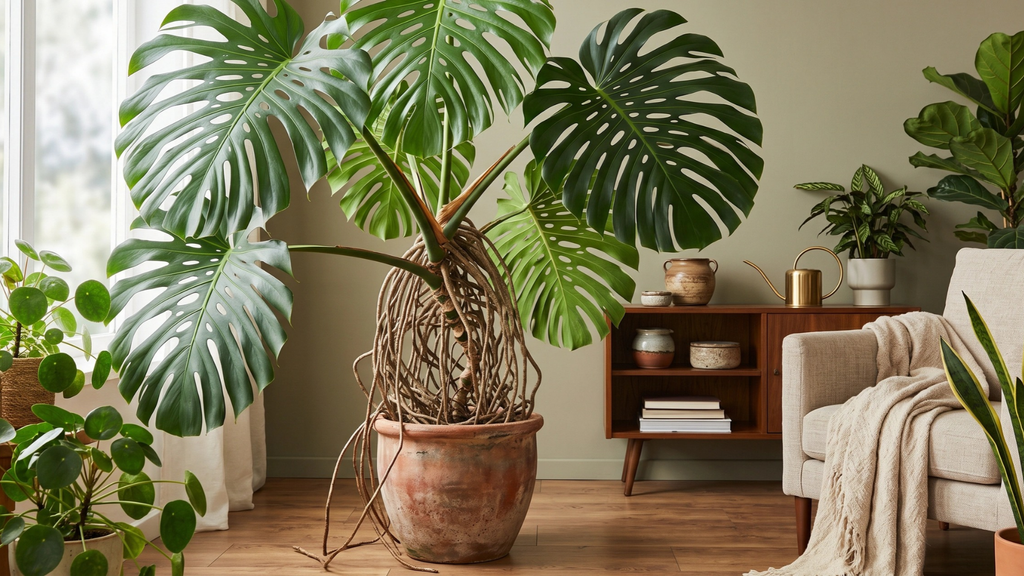
Why Indoor Monsteras Produce Aerial Roots
Aerial roots sometimes surprise houseplant owners because the plant has no rainforest tree to climb.
But indoor cultivation does not erase the plant’s natural growth habit.
Producing aerial roots is genetically normal for a climbing Monstera. As the plant matures and its stems become longer and heavier, aerial roots often become increasingly noticeable.
They may grow toward the floor, nearby furniture, walls, the pot, or whatever support happens to be available.
A plant producing several aerial roots is therefore not automatically root-bound, thirsty, or asking for a larger pot.
In many cases, it is simply behaving like a Monstera.
Should You Cut Monstera Aerial Roots?
This is where houseplant advice often becomes unnecessarily dramatic.
In general, you do not need to cut aerial roots. Leaving healthy aerial roots intact allows the plant to use them for their natural climbing and supporting functions.
However, removing an occasional aerial root for practical reasons is unlikely to seriously harm an otherwise healthy, established Monstera.
The important distinction is between pruning a few inconvenient aerial roots and repeatedly removing large amounts of active root tissue.
When Trimming May Be Reasonable
Aerial roots can become surprisingly long indoors. Some may stretch across floors, disappear behind furniture, or grow into places where they are difficult to manage.
In those situations, trimming selected roots can make the plant easier to maintain.
Use clean, sharp pruning shears and make a clean cut rather than tearing or snapping the root.
Avoid unnecessarily cutting roots that are already firmly established in the potting mix or deeply integrated into a support.
Those roots may be actively contributing more to the plant than a dry aerial root hanging freely in the air.
Cutting Aerial Roots Does Not Control the Plant Permanently
Another important point is that pruning aerial roots does not change the Monstera’s fundamental growth habit.
New aerial roots can develop from other nodes as the vine continues growing.
If the real problem is that your plant is becoming tall, sprawling, and difficult to manage, giving it an appropriate climbing structure is usually more effective than continuously removing every new root.
How to Guide Monstera Aerial Roots Into the Soil
If an aerial root is already growing downward toward the pot, you can gently guide it into the potting mix.
Do not sharply bend a stiff root. Older roots can crack when forced into an unnatural position.
Instead, redirect flexible young roots gradually.
Once an aerial root enters the growing medium, it may develop into part of the plant’s soil-based root system. Research into Monstera deliciosa root development confirms that aerial roots can transition into aerial-subterranean roots after entering soil.
You should not, however, repot a plant simply to bury every aerial root.
A well-established Monstera can have numerous aerial roots, and trying to force all of them into one container can create an unnecessarily tangled arrangement.
How to Train Monstera Aerial Roots Onto a Moss Pole
Providing support is often the most natural solution for an indoor Monstera.
A moss pole, coir pole, wooden plank, or sturdy trellis can give the climbing stem somewhere to grow.
Position the support close to the main stem and secure the stem loosely with soft plant ties if necessary. Never tightly tie the petioles—the stalks connecting individual leaves to the stem—as these need room to move.
Guide flexible aerial roots toward the support rather than forcing them around it.
The University of Wisconsin Horticulture’s Monstera guide recommends providing a tree-bark or moss-covered support for aerial roots to attach to. It also explains that a moist moss-covered support can provide aerial roots with access to moisture and nutrients.
If you’re using a moss pole designed to stay moist, remember that “moist” does not mean permanently waterlogged.
Good airflow still matters.
A dry decorative coir pole can provide physical support, but it does not function exactly like a consistently moist moss-based rooting surface.
Signs of a Healthy vs. Struggling Root System
Aerial roots alone cannot tell you whether the entire root system is healthy.
Look at the whole plant.
Signs of Healthy Roots and Growth
Healthy Monsteras typically produce firm new growth, maintain sturdy stems, and develop leaves appropriate for their age and growing conditions.
New aerial roots may appear firm and lighter in color before becoming darker and more corky with age.
Roots growing inside the pot should generally feel firm rather than soft or slimy.
Strong new leaves are another encouraging sign. With sufficient light and appropriate climbing support, mature Monsteras may gradually produce larger, increasingly fenestrated foliage.
Signs the Plant May Be Struggling
Persistent yellowing, wilting despite wet soil, stalled growth during the growing season, and soft or foul-smelling underground roots deserve attention.
These symptoms may indicate excessive moisture or root problems rather than anything specifically wrong with the aerial roots.
Monsteras require drainage and should not remain continually saturated. The Royal Horticultural Society warns that prolonged overwatering or leaving containers standing in water can cause root rot.
Conversely, a severely dry root ball can cause wilting, crispy foliage, and slowed growth.
Light matters too. Penn State Extension notes that Monsteras can become leggy under insufficient light and recommends bright light without harsh direct exposure.
For more indoor-growing guidance, see our houseplant articles at Secrets of the Green Garden, where we cover practical care strategies for keeping indoor plants vigorous without relying on unnecessary gardening myths.
Common Myths About Monstera Aerial Roots
Myth 1: Aerial Roots Mean the Plant Needs Water
Not necessarily.
Aerial roots are part of the plant’s natural climbing habit and can develop even when watering is perfectly adequate.
Check the moisture level of the potting mix rather than using aerial-root production as a watering signal.
Myth 2: Every Aerial Root Should Be Put in Water
Placing individual aerial roots permanently into jars or glasses of water is unnecessary.
The plant already has an underground root system designed to supply water. Constantly keeping random aerial roots submerged can also make the setup harder to maintain.
If you want an aerial root to contribute more directly to the root system, guiding it into an appropriate growing medium is generally more practical.
Myth 3: Cutting One Aerial Root Will Kill the Monstera
A healthy established plant is not normally dependent on one individual aerial root.
Removing an inconvenient aerial root is very different from damaging the plant’s main underground root system.
Still, there is no reason to routinely remove healthy aerial roots simply because they look unusual.
Myth 4: More Aerial Roots Always Mean a Healthier Plant
Root production is not a simple health score.
A large mature climbing plant may naturally produce many aerial roots, while a smaller Monstera may produce fewer.
Judge plant health by multiple factors including foliage, new growth, stem condition, soil moisture, light exposure, pests, and the condition of the underground roots.
Myth 5: Aerial Roots Are the Same as Underground Roots
They are related, but not identical in every situation.
A botanical study of Monstera deliciosa identified anatomical and developmental differences among aerial roots, aerial roots that had entered soil, and lateral subterranean roots.
Their environment influences how these roots develop and function.
FAQ About Monstera Aerial Roots
Can I cut Monstera aerial roots?
Yes, individual aerial roots can generally be trimmed from a healthy, established Monstera when they become inconvenient. Use clean, sharp tools and avoid unnecessary removal of roots that have already established themselves in soil or a support.
Will aerial roots grow back?
A cut root will not necessarily regenerate from the exact cut end, but the plant can continue producing new aerial roots from nodes as it grows.
Aerial-root production is part of the Monstera’s natural growth pattern.
Should I put Monstera aerial roots in soil?
You can gently direct suitable aerial roots into the potting mix.
If they enter soil, they may develop into roots that contribute to the underground root system. Never force a stiff root sharply downward just to get it into the pot.
Should aerial roots go into a moss pole?
They can.
Aerial roots naturally help Monsteras attach to climbing surfaces, making moss poles and similar supports useful for recreating part of their natural growth habit.
Can Monstera aerial roots absorb water?
They can participate in moisture and nutrient acquisition when they encounter suitable moist material.
University of Wisconsin Extension specifically notes that aerial roots attached to a moist moss-covered support can obtain water and nutrients.
That does not mean exposed aerial roots should replace normal watering of the potting medium.
Why are my Monstera’s aerial roots brown?
Brown does not automatically mean dead.
Older aerial roots commonly become darker and more woody-looking as they mature. A root that is firm may still be functional.
Soft, mushy, foul-smelling tissue is more concerning and may indicate decay.
Do aerial roots mean my Monstera needs repotting?
No.
Aerial roots are normal climbing structures and are not reliable evidence that a Monstera is root-bound.
Instead, inspect the container’s underground root system and consider factors such as roots densely filling the pot, unusually rapid drying, reduced growth, and difficulty maintaining appropriate moisture.
Can I use an aerial root to propagate Monstera?
An aerial root alone is generally not what you need for successful propagation.
A Monstera cutting should contain appropriate stem tissue and a node because the node contains the structures necessary to produce new growth. University of Minnesota Extension describes propagation using stem cuttings containing a node rather than detached aerial roots alone.
Conclusion
Monstera aerial roots look unusual indoors because we normally expect roots to stay hidden beneath the soil. For a Monstera, however, growing roots above ground is completely natural.
In the wild, these roots help the vine anchor itself to trees and other supports as it climbs. Some eventually reach soil, while roots contacting moist organic material can also contribute to water and nutrient uptake.
Indoors, you have several reasonable options. You can leave aerial roots alone, gently guide flexible ones into the potting mix, encourage them to attach to a moss pole or other climbing structure, or selectively trim roots that have become genuinely inconvenient.
The important thing is not to interpret every aerial root as a problem that needs fixing.
In most cases, those strange brown cords emerging from your Monstera are simply evidence that the plant is doing what its ancestors evolved to do: search for support, anchor itself, and keep climbing.
External Sources:
- University of Wisconsin–Madison Extension — Swiss-Cheese Plant, Monstera deliciosa:
University of Wisconsin Horticulture - Penn State Extension — Monstera as a Houseplant:
Penn State Extension - University of Minnesota Extension — Monstera deliciosa:
University of Minnesota Extension