
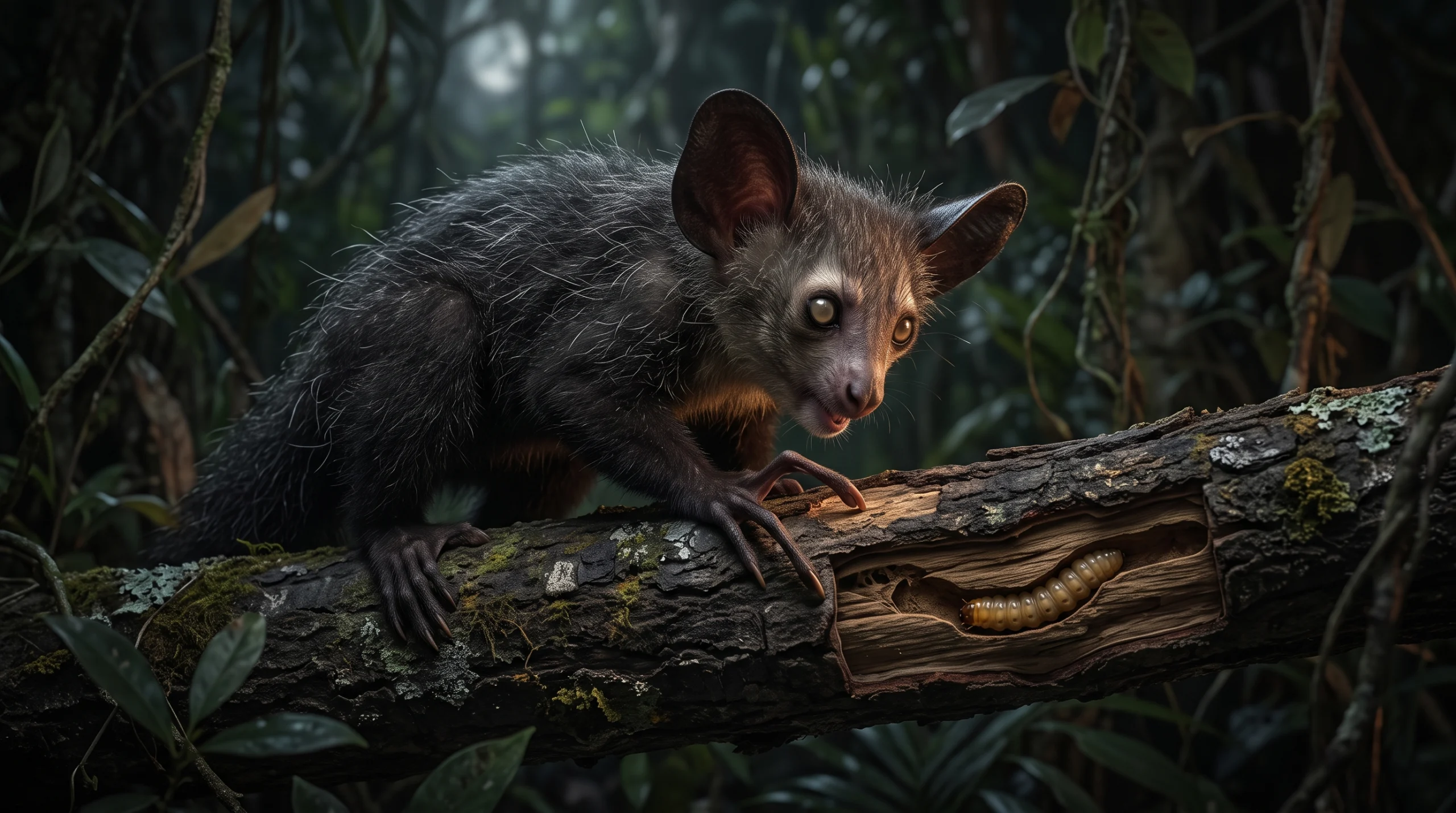
In a Madagascar forest after dark, an aye-aye moves deliberately along a branch. Its large ears stand forward while its hands explore the wood. Then one remarkably thin finger begins striking the surface in a rapid series of taps.
The animal pauses, shifts a short distance, and taps again. The sounds produced by those impacts contain information about what lies beneath the surface. A solid section of wood does not respond exactly like one containing a cavity or insect gallery. By repeatedly sampling the branch, the aye-aye can concentrate its investigation on promising locations.
Finding the right spot is only the beginning.
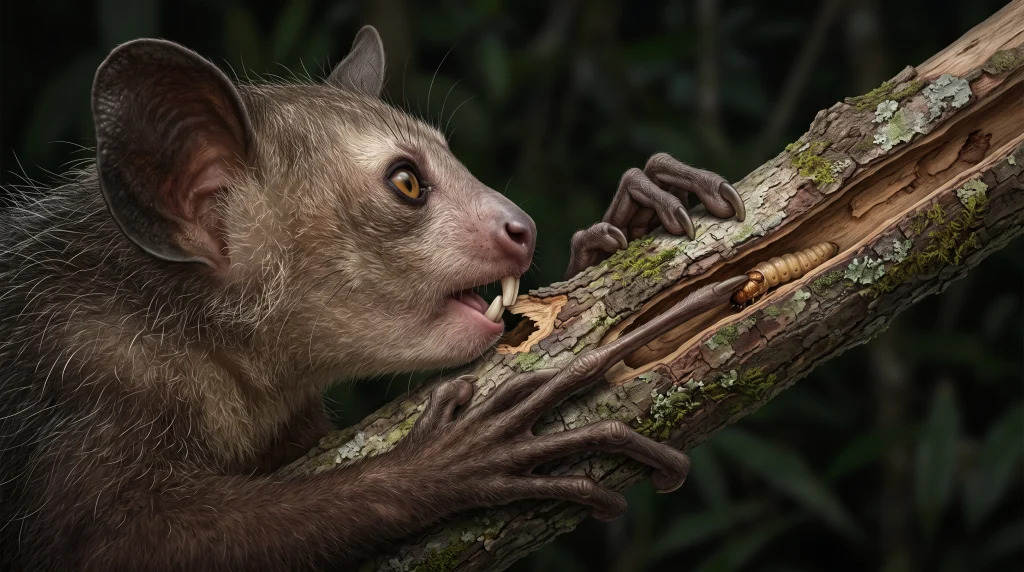
Powerful, continuously growing incisors can gnaw through wood to create an opening. The same extraordinarily slender middle finger can then enter narrow spaces, probing and manipulating concealed food such as wood-boring insect larvae.
This behavior, known as percussive foraging or tap-scanning, is one of the most specialized feeding systems known among living primates. It is not simply the work of a strange finger. Hearing, teeth, hand anatomy, touch, and carefully sequenced behavior function together.
Summary of Article
- The aye-aye (Daubentonia madagascariensis) is a nocturnal lemur found only in Madagascar.
- It uses percussive foraging to investigate woody substrates for concealed resources.
- Tapping produces acoustic information that can help reveal cavities and other structural differences inside wood.
- Its unusually large ears contribute to this acoustic investigation.
- Continuously growing incisors allow aye-ayes to gnaw openings into hard substrates.
- A highly specialized middle finger can probe narrow cavities and help extract concealed food.
- Wood-boring insect larvae are important prey, but aye-ayes also consume other documented foods.
What Exactly Is an Aye-Aye?
The aye-aye, Daubentonia madagascariensis, is a lemur and therefore a primate.
It belongs to Madagascar’s extraordinary endemic lemur fauna and represents a particularly distinctive evolutionary lineage. Aye-ayes are nocturnal and largely arboreal, although they can also travel on the ground. They occur across forested parts of Madagascar rather than being restricted to a single small forest type. Duke Lemur Center describes them as widely but sparsely distributed in eastern and western forests.
Their appearance has historically caused taxonomic confusion. Their large incisors and gnawing behavior can appear superficially rodent-like, but an aye-aye is not a rodent.
Its unusual anatomy includes large mobile ears, elongated fingers, an exceptionally modified third digit, and incisors unlike those of typical lemurs.
A Hand Unlike That of Other Primates
The aye-aye’s hand is extraordinarily specialized.
An anatomical study of its forelimb described a combination of features including an unusually large hand and a highly modified middle, or third, finger. The specialized digit is not simply a scaled-down version of the other fingers; its musculature and anatomy permit exceptional speed and mobility.
The Extraordinary Middle Finger
The third digit is long, extremely slender, and capable of movements important to several stages of feeding.
During percussive foraging, it participates in tapping woody surfaces. Once an opening has been made, the digit can also be inserted into narrow cavities and manipulated to obtain food.
That dual role is important.
Popular descriptions sometimes portray the finger as if it independently detects, spears, and removes an insect. In reality, the feeding system involves several anatomical and sensory components working in sequence.
What Is Percussive Foraging?
Percussive foraging is a method in which an animal mechanically strikes a substrate and obtains information from the resulting response.
For the aye-aye, wood becomes something that can effectively be sampled acoustically.
Research on feeding sites has shown that aye-ayes target subsurface cavities, including extensive mines made by wood-boring beetle larvae. Those internal spaces alter the physical structure of the wood and provide potential acoustic cues during tapping.
First Step: Tapping the Wood
As an aye-aye moves across a branch or other woody substrate, it taps at multiple locations.
This is active investigation rather than random knocking.
Each impact introduces mechanical energy into the substrate. The resulting sound and vibration depend partly on the material beneath and around the tapping location.
Second Step: Listening to the Wood
Solid wood and wood containing cavities or galleries can produce different acoustic responses.
The aye-aye’s auditory system is highly specialized. Research into its acoustic ecology has found particular auditory sensitivity associated with frequencies important to tap-scanning, while experimental work using a biomimetic tapping system has investigated how the animal’s external ears may influence near-field acoustic sensing.
This does not mean the aye-aye simply “hears a grub through the tree.”
A more careful description is that tapping helps it identify structural differences that deserve further investigation.
This Is Not True Echolocation
Percussive foraging should not be confused with biological echolocation.
Echolocating bats and toothed whales actively produce acoustic signals and analyze returning echoes to obtain information about objects in their surroundings.
An aye-aye instead creates impacts against a physical substrate and evaluates information associated with the substrate’s response.
Scientists have investigated similarities between aye-aye auditory specialization and echolocating mammals, but genetic research found no significant evidence of the same auditory-processing molecular convergence between aye-ayes and echolocating bats and dolphins.
Calling the process “sonar” can therefore work only as a loose analogy. Scientifically, percussive foraging or tap-scanning is more accurate.
Third Step: Locating a Promising Cavity
One tap does not necessarily identify a larva.
Instead, repeated sampling allows the aye-aye to compare neighboring areas and focus attention where acoustic or structural information is promising.
Research on naturally foraged trees found that large cerambycid beetle larvae produce extended mines within wood. Such galleries may provide an acoustic trail that an investigating aye-aye can follow.
The distinction matters: detecting an internal cavity is not identical to proving that prey is present inside it.
Powerful Incisors Open the Way
Locating a concealed resource would accomplish little without a way to reach it.
Here the aye-aye’s teeth become essential.
Its incisors grow continuously, an exceptional feature among primates. Anatomical research shows that its masticatory system is highly specialized for powerful gouging and gnawing associated with extractive feeding.
Once the aye-aye identifies a promising area, it can use those incisors to remove material and create an opening.
The functional resemblance to rodent gnawing is striking, but it represents a similarity in feeding mechanics, not evidence that aye-ayes are rodents.
The Long Finger Goes Inside
After an opening exists, the third finger assumes another role.
Its narrow dimensions and extraordinary mobility allow it to enter spaces inaccessible to a typical primate finger. The animal can probe and manipulate the interior of cavities while extracting concealed resources.
Anatomical research specifically connects the modified third digit with investigating, locating, and extracting wood-boring larvae and other foods.
It is better imagined as a highly mobile probe and manipulation tool than as a simple spear.
Why Wood-Boring Larvae Are Valuable Food
Wood-boring larvae spend part of their development inside woody plant tissue.
That location provides protection from many predators. A food resource sealed behind bark and wood is inaccessible to an animal that lacks the sensory equipment to locate it or the anatomy needed to expose it.
Aye-ayes possess both.
Research on feeding sites identified large cerambycid beetle larvae and organisms associated with their mines as important targets of extractive foraging.
Their feeding method effectively turns an otherwise difficult-to-reach resource into available prey.
The Aye-Aye Eats More Than Insect Larvae
The familiar image of an aye-aye extracting a grub is accurate but incomplete.
Wild aye-ayes have a broader diet. Documented foods include fruits, nuts and seeds, nectar and other plant resources in addition to invertebrates. Duke Lemur Center notes insect larvae, nuts, seeds and fruits among their foods, while historical field research has also identified nectar and fungi.
Their specialized finger can also assist with foods other than insects.
This broader diet helps explain why describing the aye-aye as simply an insect specialist misses important aspects of its feeding ecology.
Four Adaptations Working as One System
The aye-aye’s feeding success comes from integration.
The tapping digit generates mechanical impacts. Its auditory system helps assess the response. Repeated investigation narrows the search. Continuously growing incisors create access. The slender third finger then probes the exposed space.
The sequence can be summarized as:
TAP → LISTEN AND ASSESS → LOCATE → GNAW → PROBE AND EXTRACT
No individual feature performs every stage.
This is why focusing only on the long finger understates the animal’s biological specialization.
A Primate Filling a Woodpecker-Like Niche
Aye-ayes are sometimes compared ecologically with woodpeckers.
The comparison is useful when kept narrow. Both can exploit food concealed inside woody substrates, but they belong to completely different vertebrate lineages and use very different anatomy.
A genome-resource paper on the aye-aye noted the absence of woodpeckers in Madagascar in the context of this extractive-foraging niche.
This provides an example of how unrelated animals can exploit similar ecological resources through different evolutionary solutions.
Life in Madagascar’s Forests
Aye-ayes are native only to Madagascar.
They are primarily nocturnal and spend much of their active time moving and feeding in trees. Their distribution is broad for a lemur, but their populations can occur at low densities.
Madagascar should not be imagined as one continuous uniform rainforest. The island contains multiple forest types and environmental conditions, and aye-ayes have been recorded across a wider ecological range than early researchers once understood.
Their combination of nocturnal activity and arboreal foraging places special importance on sensory systems capable of gathering useful information when visibility is limited.
Why Such Extreme Specialization Evolved
The aye-aye’s anatomy did not appear because the animal consciously “needed” a better way to find larvae.
Evolution works through inherited variation and differential reproductive success across generations.
Features that improved access to useful resources could be favored when they contributed to survival and reproduction. Over evolutionary time, selection acting on anatomy, sensory systems, and behavior can produce extreme specialization.
The aye-aye represents the outcome of that process, not a deliberately designed biological tool.
The Aye-Aye’s Role in the Forest
Aye-ayes participate in Madagascar’s forest food webs as consumers of both animal and plant resources.
They prey on invertebrates and consume fruits, seeds, nectar, and other foods. Their ecological relationships therefore extend beyond their famous larva-extraction behavior.
Claims that they provide broad “pest control” or function as major ecosystem engineers require evidence and should not simply be assumed from their insect-eating habits.
Conservation of the Aye-Aye
The aye-aye is currently listed as Endangered according to the conservation status reported by Duke Lemur Center.
Major documented pressures include habitat loss and hunting or persecution. In some agricultural settings, aye-ayes may be killed because they are regarded as crop pests.
Cultural beliefs can also influence persecution in certain places, but they require careful treatment. Madagascar contains considerable cultural diversity, and taboos or beliefs concerning aye-ayes are not universal across Malagasy communities. Duke Lemur Center explicitly notes this variation when discussing fady, or cultural taboos.
Conservation therefore involves both protecting habitat and understanding local human-wildlife relationships without reducing diverse communities to a stereotype.
Common Mistakes When Talking About Aye-Ayes
Calling the Aye-Aye a Rodent
It has rodent-like incisors and gnaws wood, but the aye-aye is a lemur and a primate.
Saying It Uses Echolocation
The correct term is percussive foraging or tap-scanning. It obtains information by tapping a substrate and assessing the resulting acoustic response.
Saying the Long Finger Does Everything
The finger is important, but successful feeding also depends on hearing, repeated sensory investigation, powerful incisors, and coordinated behavior.
Saying It Eats Only Wood-Boring Larvae
Larvae are important prey, but aye-ayes consume a broader range of animal and plant foods.
Treating Its Appearance as Functionless Weirdness
Many of the aye-aye’s unusual features make biological sense when viewed in the context of its highly specialized feeding ecology.
Frequently Asked Questions
Why does the aye-aye tap wood?
Tapping helps it investigate internal differences in woody substrates that may indicate cavities or galleries worth examining.
How does an aye-aye find food inside wood?
It combines tapping and acoustic assessment with repeated investigation, then uses its incisors to open promising locations and its specialized finger to probe them.
Does an aye-aye use echolocation?
No. Its behavior is classified as percussive foraging, not biological echolocation.
Why is its middle finger so thin?
Its specialized proportions and exceptional mobility allow it to tap surfaces and probe narrow spaces that ordinary primate fingers cannot access as effectively.
Why does the aye-aye have continuously growing incisors?
Its incisors are strongly associated with a feeding ecology involving repeated gnawing and gouging of hard substrates.
Does the aye-aye eat only insect larvae?
No. Its documented diet also includes plant foods such as fruits, nuts or seeds, and nectar.
Is the aye-aye a rodent?
No. Daubentonia madagascariensis is a lemur and therefore a primate.
Is the aye-aye endangered?
Yes. It is currently classified as Endangered, with habitat loss and hunting among documented threats.
Conclusion
The aye-aye is much more than a primate with an unusually thin finger.
Its remarkable feeding method depends on a complete biological sequence:
TAPPING → ACOUSTIC ASSESSMENT → LOCATION → GNAWING → PROBING AND EXTRACTION
The middle finger helps generate information and later explore narrow spaces. Large ears and specialized auditory capabilities contribute to acoustic investigation. Continuously growing incisors open the wood. Precise movements bring these components together in the correct order.
Percussive foraging demonstrates how anatomy, sensory biology, and behavior can become tightly integrated around a difficult ecological problem: obtaining food that is physically hidden from view and protected inside wood.
Among Madagascar’s exceptional evolutionary lineages, the aye-aye is a particularly vivid example of specialization—not because one feature is strange in isolation, but because so many features operate together as a coherent feeding system.
Internal Linking
Only links that could be independently verified on Secrets of the Green Garden are included.
Natural anchor: For another example of an unusual mammal whose extreme anatomy supports a highly specialized way of moving and feeding in trees, explore our guide to the colugo and its extraordinary gliding membrane.
The Colugo: The Mammal With the Most Extreme Gliding Membrane
Natural anchor: Large ears can perform several biological functions in mammals; our guide to the fennec fox explains how hearing, nocturnal behavior, and desert ecology interact in another highly specialized species.
Why the Fennec Fox’s Ears Are So Disproportionately Large
I could not reliably verify three to five closely relevant existing articles on the site from the available search results, so additional URLs have not been invented.
Authoritative External Sources
Erickson, C. J. — “Feeding sites for extractive foraging by the aye-aye, Daubentonia madagascariensis.”
Supports the description of subsurface cavities, cerambycid beetle larvae, feeding sites, and the possible acoustic importance of larval mines.
PubMed — Erickson aye-aye feeding-site study
Soligo, C. — “Anatomy of the hand and arm in Daubentonia madagascariensis: a functional and phylogenetic outlook.”
Supports the anatomy, exceptional mobility, and functional specialization of the third digit.
PubMed — Aye-aye hand and arm anatomy
Ramsier, M. A. & Dominy, N. J. — “Receiver bias and the acoustic ecology of aye-ayes.”
Supports the specialized auditory biology associated with tap-scanning and percussive foraging.
PubMed — Acoustic ecology of aye-ayes
Dickinson, E. et al. — “DiceCT Analysis of the Extreme Gouging Adaptations Within the Masticatory Apparatus of the Aye-Aye.”
Supports the unusual dentition and masticatory adaptations associated with gouging and extractive foraging.
PubMed — Aye-aye masticatory adaptations
Testing Convergent Evolution in Auditory Processing Genes between Echolocating Mammals and the Aye-Aye.
Provides evidence relevant to distinguishing aye-aye tap-foraging adaptations from true mammalian echolocation.
PubMed — Aye-aye and echolocation convergence study
Duke Lemur Center — Aye-Aye.
Supports species natural history, distribution, diet, conservation status, threats, and general biology.
Duke Lemur Center — Aye-Aye species profile