
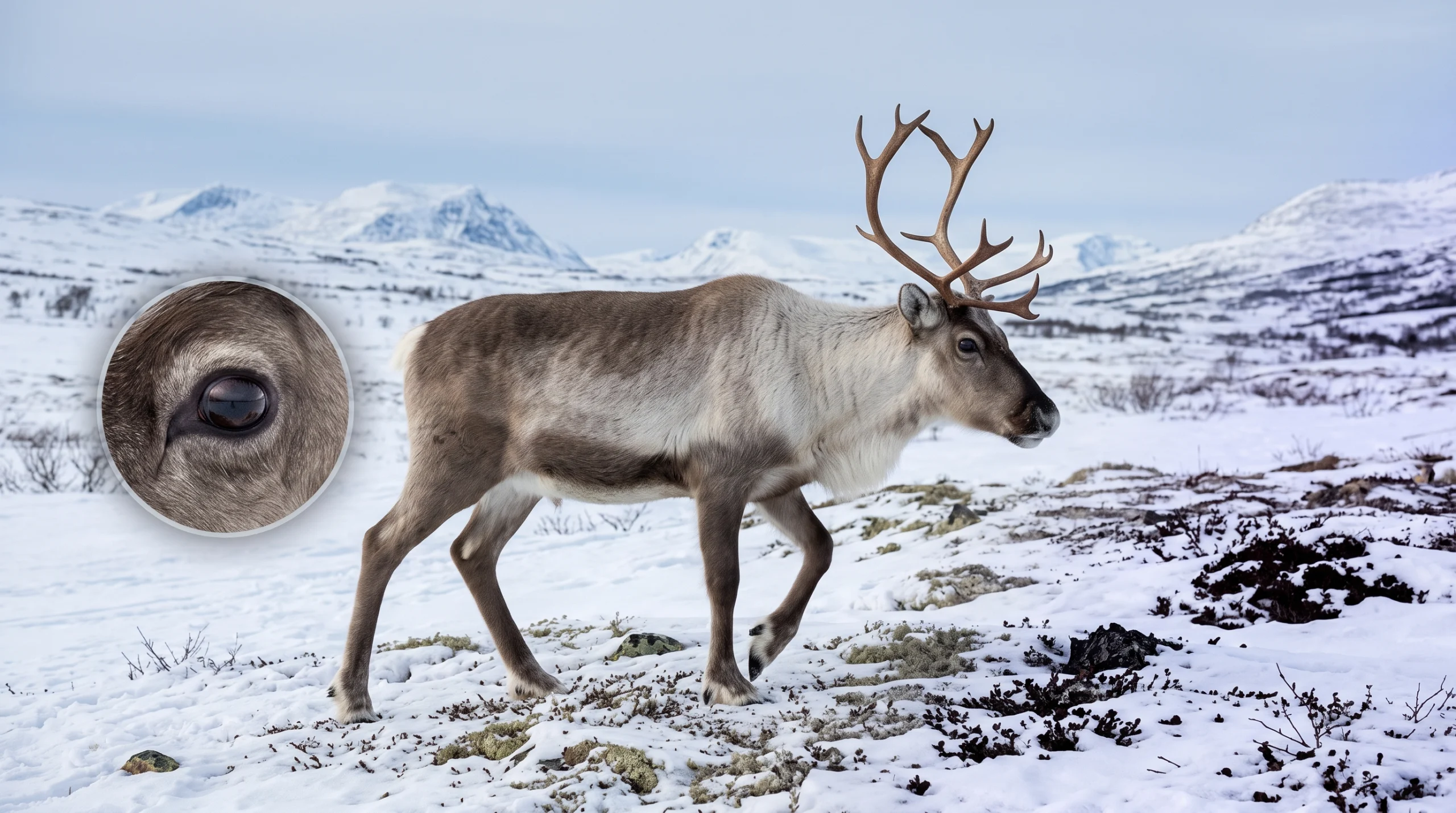
Across an Arctic winter landscape, snow can dominate almost everything the human eye sees. Hills, frozen ground, and wind-shaped drifts merge into a bright environment where objects may appear to offer relatively little contrast.
A reindeer moving through that same landscape receives visual information unavailable to us.
Research has demonstrated that reindeer (Rangifer tarandus) can detect near-ultraviolet wavelengths that normal human vision cannot. Their corneas and lenses transmit wavelengths that human ocular structures largely prevent from reaching the retina, and their retinas respond to this ultraviolet light.
That does not mean reindeer walk through a purple-tinted Arctic.
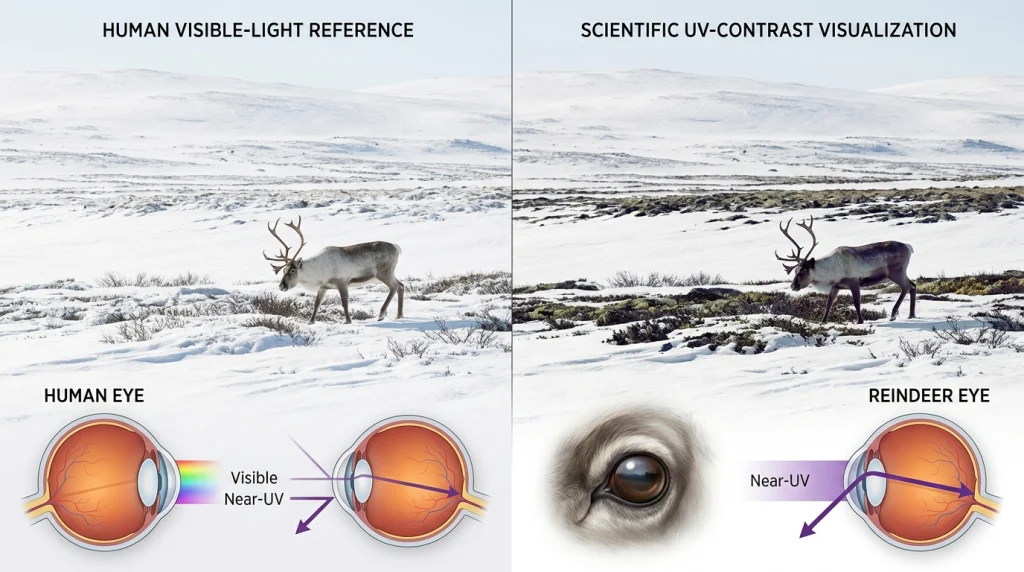
The important difference is contrast. Snow reflects substantial short-wavelength and ultraviolet radiation, while some other materials absorb more of it. A surface that does not stand out dramatically to human eyes can therefore potentially become more conspicuous to an animal whose visual sensitivity extends farther into the ultraviolet.
Reindeer vision offers a remarkable example of how the same physical landscape can contain different visual information for different species.
Summary of Article
- Reindeer can detect near-ultraviolet wavelengths outside normal human vision.
- Their cornea and lens allow useful near-UV radiation to reach the retina.
- Snow and ice can create a relatively UV-rich Arctic visual environment.
- Vegetation can produce stronger contrast against snow in UV wavelengths.
- UV sensitivity may therefore provide useful information when reindeer forage in winter.
- Proposed advantages involving predators or other biological objects require more caution than the experimentally demonstrated visual sensitivity itself.
- Reindeer eyes also undergo remarkable seasonal changes associated with the enormous annual variation in Arctic light.
Table of Contents
- Reindeer See Beyond the Human Visible Range
- How Scientists Discovered Reindeer UV Sensitivity
- Why Humans Cannot See the Same Light
- Snow Reflects Ultraviolet Light
- Biological Materials and UV Contrast
- Could UV Vision Help Reindeer Find Food?
- Predator Detection May Also Benefit
- UV Sensitivity Does Not Mean a Purple Arctic
- Reindeer Eyes Change With the Arctic Seasons
- Vision at the Extremes of Light
- Common Mistakes When Talking About Reindeer Vision
- Frequently Asked Questions
- Conclusion
Reindeer See Beyond the Human Visible Range
Visible light is the portion of electromagnetic radiation detected by an animal’s visual system.
For humans, vision is usually described as covering approximately 400 to 700 nanometers, although the boundaries are not perfectly sharp. Sensitivity falls progressively near the edges rather than ending at an absolute line.
Ultraviolet radiation occupies wavelengths shorter than the violet end of conventional human vision.
Reindeer push their functional sensitivity farther into this short-wavelength region.
In a landmark 2011 study in The Journal of Experimental Biology, Christopher Hogg and colleagues examined Arctic reindeer eyes and found that the cornea and lens did not block all ultraviolet radiation. Electrophysiological measurements also demonstrated retinal responses to UV wavelengths.
The discovery did not show that reindeer can see every form of ultraviolet radiation.
Instead, their visual sensitivity extends into the near-UV portion immediately beyond the range normally available to humans.
How Scientists Discovered Reindeer UV Sensitivity
Establishing ultraviolet vision requires more evidence than simply observing an animal living in a UV-rich environment.
Researchers first needed to determine whether ultraviolet wavelengths could physically enter the eye.
Measurements showed that the reindeer cornea and lens transmit near-UV radiation rather than eliminating it before it reaches the retina.
The researchers then tested retinal responses electrophysiologically. In simplified terms, they measured whether retinal tissue responded when stimulated with different wavelengths.
It did.
Both rod and cone photoreceptors responded to UV under low-intensity stimulation. Further investigation of retinal RNA and opsin expression indicated that this response was not produced by a separate, dedicated UV-specific photoreceptor mechanism.
That combination of evidence was important.
Ultraviolet radiation could enter the eye, and the retina could respond to it.
The study therefore demonstrated a sensory capability rather than merely proposing one from ecological circumstances.
Why Humans Cannot See the Same Light
Light must pass through several structures before reaching the human retina.
The cornea and especially the crystalline lens influence which wavelengths successfully reach our photoreceptors. These ocular media substantially limit ultraviolet transmission.
Consequently, normal human vision has little access to the near-UV information that can reach a reindeer’s retina.
This is biologically important because ultraviolet radiation can damage ocular tissue. Blocking much of it before it reaches the retina provides protection.
The Reindeer Eye Lets More UV Through
The reindeer situation is different, but it should not be simplified into the claim that humans possess a “UV filter” while reindeer have none.
Reindeer still have corneas, lenses, and other ocular tissues interacting with incoming radiation.
The difference is in spectral transmission.
Hogg and colleagues demonstrated that reindeer ocular media transmit substantially shorter wavelengths than human eyes normally do. Their retinal photoreceptors can consequently receive information from part of the near-ultraviolet spectrum.
The original researchers also highlighted an interesting biological problem: ultraviolet radiation can damage mammalian retinas, yet obvious UV-related retinal damage was not apparent in the animals they studied.
Exactly how reindeer manage the risks associated with this unusual visual environment remains an important aspect of their ocular biology.
Snow Reflects Ultraviolet Light
Ultraviolet sensitivity becomes particularly interesting when considered in the environment where reindeer live.
Snow is an efficient reflector and scatterer of short-wavelength radiation. The Arctic environment can therefore be proportionally rich in UV, particularly because shorter wavelengths are scattered through the atmosphere and reflected by snow and ice.
This changes the visual problem.
Imagine a bright background that reflects substantial ultraviolet radiation. Now place an object on that background that absorbs much more UV.
To an animal sensitive to those wavelengths, the difference can create additional contrast.
Dark Against a UV-Bright Background
The crucial concept is spectral contrast.
An object does not need to emit ultraviolet radiation to become conspicuous in UV-sensitive vision.
Suppose snow returns substantial UV toward the observer while an exposed piece of vegetation absorbs much of that same radiation. In the ultraviolet portion of the spectrum, the vegetation can become relatively dark against the brighter snow.
Researchers directly tested this idea in northern Norway.
They photographed vegetation on snow-covered pasture under natural winter illumination using different spectral conditions. Plants at the snow surface showed high achromatic contrast in UV-only images, and the contrast was substantially greater than in corresponding images where UV was blocked.
That is much stronger evidence than simply assuming that vegetation “must” stand out in ultraviolet.
Biological Materials Can Look More Contrasting in UV
Organic materials frequently absorb ultraviolet radiation, but their exact spectral properties vary.
The clearest ecologically relevant evidence for reindeer concerns vegetation.
The 2014 study by Nicholas Tyler, Glen Jeffery, Christopher Hogg, and Karl-Arne Stokkan demonstrated under natural winter conditions that plants exposed at the snow surface could produce strong UV contrast against the snowy background.
Two claims need to remain separate.
Measured physical property: vegetation can produce enhanced achromatic contrast against snow at wavelengths within the UV range available to reindeer.
Ecological interpretation: reindeer may exploit this extra contrast when locating forage.
The first was experimentally measured.
The second is a biologically plausible interpretation supported by those measurements, but the visual contrast experiment itself does not prove the complete evolutionary history of reindeer UV sensitivity.
Similar caution is necessary when discussing other biological materials.
A material can absorb UV without demonstrating that reindeer actively use that property in a particular behavior.
Could UV Vision Help Reindeer Find Food?
Winter feeding creates a formidable visual challenge.
Reindeer and caribou depend on plant material, including lichens in many populations and seasons, while living in landscapes where snow may conceal much of the available forage.
Anything that makes exposed vegetation more visually distinct could potentially improve detection.
The 2014 Arctic study provides unusually relevant evidence because researchers did not merely measure plant material in an artificial laboratory setting. They recorded vegetation on snow-covered pasture under natural winter luminance.
Vegetation became strongly conspicuous in UV-only imagery.
The researchers concluded that plants are visually salient at UV wavelengths to which Rangifer is sensitive and argued that this sensitivity is likely to improve discrimination of forage against snow, particularly under low, relatively UV-enriched twilight illumination.
That is a reasonable evidence-based ecological interpretation.
It is still more precise than saying that reindeer “evolved UV vision to find lichens.”
Natural selection does not necessarily produce a sensory system for one exclusive purpose, and demonstrating present-day usefulness is not the same as reconstructing the exact selective history responsible for a trait.
Predator Detection May Also Benefit
Predator detection is another proposed benefit of short-wavelength sensitivity.
In principle, an animal or its fur could become more conspicuous against UV-reflective snow if it absorbs substantially more ultraviolet radiation than the surrounding surface.
That creates optical plausibility for enhanced detection.
But optical plausibility and demonstrated predator-detection behavior are different levels of evidence.
The best-established findings concern reindeer ocular transmission, retinal responses, and enhanced contrast of vegetation against snow. Claims that UV vision specifically allows reindeer to detect wolves earlier require more direct behavioral evidence.
UV sensitivity may provide additional environmental contrast relevant to multiple tasks. It should not be portrayed as a guaranteed predator-detection system.
UV Sensitivity Does Not Mean a Purple Arctic
One of the most common misconceptions about ultraviolet-sensitive animals comes from false-color photography.
Researchers and photographers can record ultraviolet information and translate it into visible colors that humans can see on a screen.
Purple, violet, or blue may be assigned to those wavelengths.
That does not mean the animal experiences those same colors.
A false-color UV image is a visualization tool.
The actual visual experience depends on the animal’s photoreceptors, their overlapping spectral sensitivities, neural processing, illumination, adaptation, and the way signals from different receptors are compared in the brain.
Scientists can measure which wavelengths enter a reindeer’s eye.
They can measure retinal responses.
They can measure how strongly snow and vegetation reflect different wavelengths.
What they cannot do is simply recolor a photograph purple and claim that it reproduces the subjective visual experience of a reindeer.
The scientifically important effect is additional visual information and potentially enhanced contrast, not a permanent purple overlay.
Reindeer Eyes Change With the Arctic Seasons
Ultraviolet sensitivity is only one remarkable feature of reindeer vision.
The Arctic also subjects these animals to an enormous annual cycle in light intensity.
Summer at high latitudes can bring continuous or nearly continuous daylight. Winter brings prolonged darkness and extended periods of exceptionally dim twilight.
Research has shown that the reindeer eye physically changes with these seasons.
Behind the retina lies a reflective structure called the tapetum lucidum. In many mammals, it sends light back through the retina, increasing the opportunity for photoreceptors to capture photons.
In reindeer examined during summer, this tapetum has a predominantly golden appearance.
In winter, it becomes deep blue.
The 2013 research found that this winter state was associated with increased retinal sensitivity. Changes in spacing between collagen structures in the tapetum alter its optical behavior.
Later work by Robert Fosbury and Glen Jeffery further investigated the photonic nanostructure involved. Their experiments supported a model in which changes involving the spacing and organization of collagen fibrils can transform the reflector from its summer gold-turquoise state to deep blue.
This blue winter reflector also corresponds remarkably well with the spectral conditions of prolonged Arctic twilight.
Importantly, this seasonal transformation is not the same phenomenon as ultraviolet sensitivity.
Both illustrate adaptation to unusual Arctic light, but they involve different aspects of visual biology.
Vision at the Extremes of Light
Few terrestrial mammals experience an annual light cycle comparable to that of high-latitude reindeer.
The challenge is not simply “seeing in darkness.”
The spectral composition, intensity, and duration of environmental light all change.
During portions of the Arctic winter, the sun remains below the horizon for long periods. Twilight illumination becomes strongly shifted toward shorter wavelengths.
Fosbury and Jeffery showed that atmospheric processes involving ozone absorption contribute to the exceptionally blue quality of extended Arctic twilight. Their analysis indicated that reindeer at high northern latitudes can experience many hours of this blue-dominated twilight during substantial portions of the year.
Snow then reflects substantial short-wavelength radiation back through the environment.
Against that background, reindeer possess several remarkable visual characteristics: transmission and retinal sensitivity extending into near-UV wavelengths and seasonal changes in the optical properties of the tapetum lucidum.
Rather than being isolated curiosities, these features demonstrate how unusual the visual demands of an Arctic environment can be.
Common Mistakes When Talking About Reindeer Vision
Saying Reindeer See Everything in Purple
UV photographs displayed in purple or blue are human-made visualizations. They do not reveal the literal subjective colors experienced by a reindeer.
Saying Reindeer Can See All Ultraviolet Radiation
They cannot. Research demonstrates sensitivity extending into part of the near-ultraviolet spectrum, not every wavelength classified as UV.
Saying UV Vision Exists Only to Find Lichens
Forage discrimination is supported by strong optical evidence, but this does not establish that UV sensitivity evolved exclusively for finding lichens or vegetation.
Confusing UV Sensitivity With Night Vision
They are different characteristics.
UV sensitivity concerns the wavelengths capable of contributing to vision. Low-light sensitivity concerns the ability to gather and process limited numbers of photons.
Reindeer possess unusual adaptations relevant to both challenges, but the mechanisms should not be conflated.
Treating Every Proposed Benefit as Proven
The existence of UV sensitivity is experimentally demonstrated.
Enhanced UV contrast between plants and snow has also been experimentally documented.
Some additional ecological benefits remain hypotheses or plausible interpretations rather than directly demonstrated behaviors.
Frequently Asked Questions
Can reindeer really see ultraviolet light?
Yes. Experiments have shown that near-UV wavelengths can pass through reindeer ocular media and produce electrophysiological responses in the retina.
Why can reindeer see UV but humans cannot?
Human ocular media, particularly the lens, strongly limit ultraviolet radiation reaching the retina. Reindeer ocular structures transmit shorter wavelengths, allowing some near-UV information to reach responsive photoreceptors.
Does snow reflect ultraviolet light?
Yes. Snow and ice can strongly reflect and scatter short-wavelength radiation, contributing to a relatively UV-rich Arctic environment.
Do reindeer see snow as purple?
There is no scientific basis for saying that. Purple UV images are false-color representations made for humans, not direct reproductions of reindeer perception.
Can UV sensitivity help reindeer find lichens?
Research has demonstrated that vegetation can show enhanced UV contrast against snow under natural winter conditions. This supports the idea that UV sensitivity can aid forage discrimination, but it should not be turned into an unsupported claim that UV vision evolved solely to locate lichens.
Can ultraviolet vision help reveal predators?
It is optically plausible that UV contrast could make some biologically relevant objects more conspicuous against snow, but direct behavioral evidence for specific predator-detection benefits is more limited.
Can caribou see ultraviolet light too?
Reindeer and caribou are members of the same species, Rangifer tarandus. The sensory biology investigated in Arctic reindeer therefore concerns the same species known as caribou in North America.
Do reindeer eyes change during winter?
Yes. Research has demonstrated seasonal changes in the tapetum lucidum. Its reflection shifts from predominantly golden in summer to deep blue in winter, with the winter state associated with increased retinal sensitivity.
Conclusion
Reindeer receive visual information from a portion of the electromagnetic spectrum that normally remains inaccessible to human eyes.
Their corneas and lenses transmit near-ultraviolet radiation, and experimental measurements show that their retinas respond to it. In an Arctic landscape where snow reflects substantial short-wavelength radiation, this ability can change the contrast between the background and materials that absorb more UV.
Research on vegetation provides a compelling example. Plants exposed against snow can become substantially more conspicuous in ultraviolet wavelengths, creating information that reindeer are biologically equipped to detect.
That finding does not require imagining a purple Arctic.
Scientists can measure wavelengths, ocular transmission, retinal responses, reflectance, and contrast. The subjective visual world created by the reindeer’s nervous system cannot be reconstructed simply by tinting a photograph violet.
Its ultraviolet sensitivity is also part of a larger story.
Reindeer live through some of the most extreme annual changes in illumination experienced by a terrestrial mammal. Their tapetum lucidum changes seasonally, shifting toward a deep-blue winter state associated with increased retinal sensitivity, while their visual range extends into short wavelengths abundant in their snowy environment.
The result is a visual system shaped around an Arctic world that contains more information than human eyes can perceive.
Internal Linking
These recommendations use articles verified as existing on Secrets of the Green Garden rather than constructed URLs.
Natural anchor: Ultraviolet light also reveals biological properties humans normally miss, as shown by the remarkable fluorescence documented in springhare fur.
Existing article: Why Springhares Glow Under UV Light: The Science of Biofluorescence
Natural anchor: For another extreme example of animal vision adapted to a radically different light environment, explore how colossal squid use enormous eyes in the deep ocean.
Existing article: Why the Colossal Squid Has the Largest Eyes of Any Animal Alive
Natural anchor: Reindeer are not the only mammals able to gather sensory information humans cannot directly perceive; echidnas provide another example through their unusual snout sensory system.
Existing article: Echidna Electroreception and Its Remarkable Snout
Authoritative External Sources
Hogg, C., Neveu, M., Stokkan, K.-A., et al. (2011), “Arctic reindeer extend their visual range into the ultraviolet,” Journal of Experimental Biology.
Primary experimental evidence for near-UV transmission through reindeer ocular media and electrophysiological retinal responses to UV.
PubMed
Tyler, N. J. C., Jeffery, G., Hogg, C. R., & Stokkan, K.-A. (2014), “Ultraviolet Vision May Enhance the Ability of Reindeer to Discriminate Plants in Snow,” Arctic.
Provides field-based measurements demonstrating enhanced UV contrast of vegetation against snow under natural winter illumination.
UCL Discovery
Stokkan, K.-A., Folkow, L., Dukes, J., et al. (2013), “Shifting mirrors: adaptive changes in retinal reflections to winter darkness in Arctic reindeer,” Proceedings of the Royal Society B.
Primary research documenting the seasonal gold-to-blue shift of the reindeer tapetum lucidum and its association with increased winter retinal sensitivity.
PubMed
Fosbury, R. A. E., & Jeffery, G. (2022), “Reindeer eyes seasonally adapt to ozone-blue Arctic twilight by tuning a photonic tapetum lucidum,” Proceedings of the Royal Society B.
Explains the photonic structure of the seasonal tapetum and relates its winter optical properties to the spectral characteristics of Arctic twilight.
PubMed