
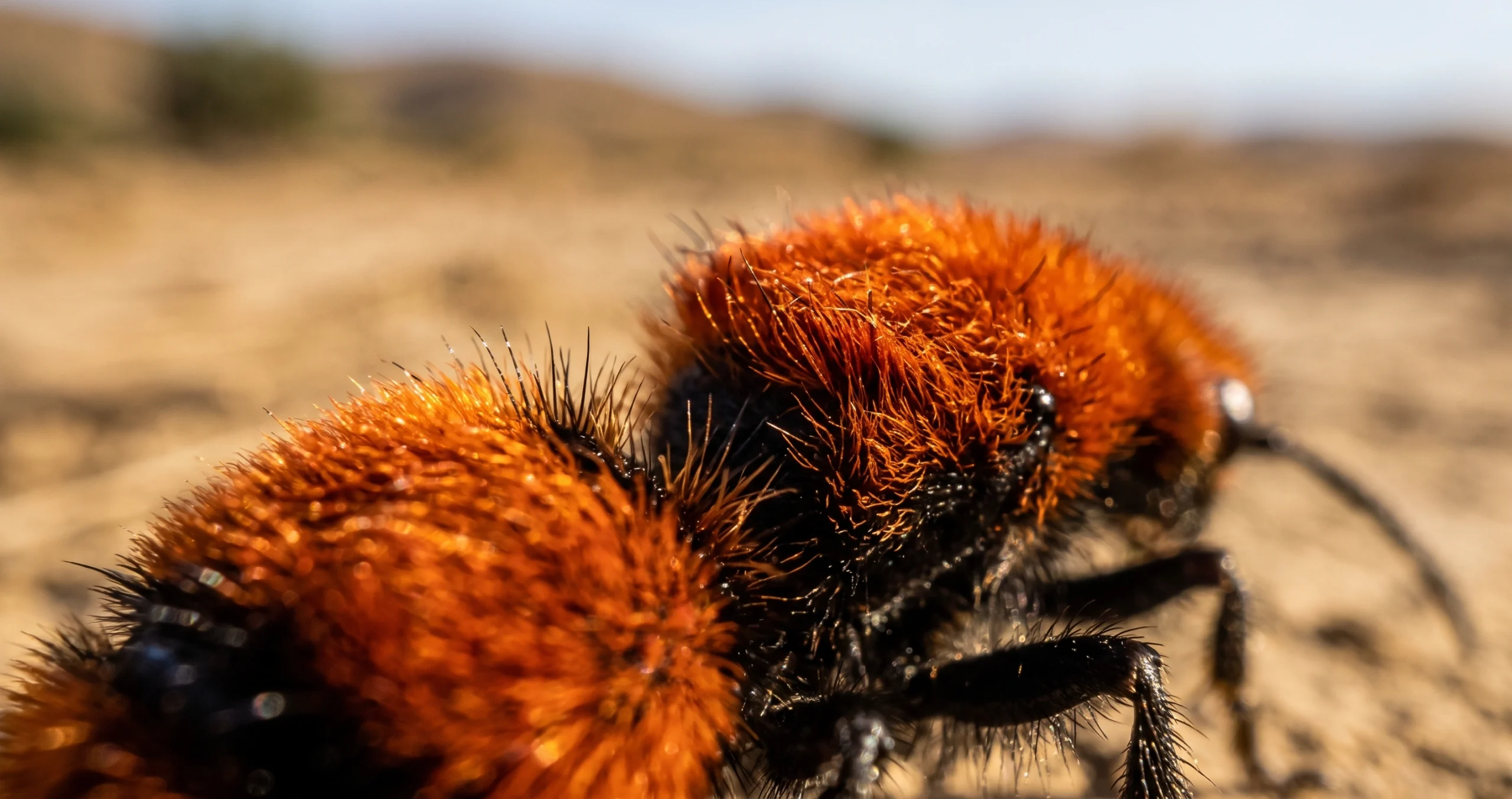
A bright red or orange insect covered in dense, velvety hair runs across a lawn. It has no visible wings, moves like an oversized ant, and looks almost inviting to touch. That resemblance has given velvet ants their familiar name, but the velvet ant cow killer is not an ant at all. It is a wasp—and the conspicuous individual walking on the ground is usually a wingless female capable of delivering an exceptionally painful sting.
The dramatic “cow killer” nickname has made these insects sound far more dangerous than they actually are. Velvet ants do not kill cattle, they do not hunt people, and their venom is not unusually lethal. The name comes from folklore surrounding the extraordinary pain of the female’s sting.
Their real biology is even more interesting. Velvet ants are solitary parasitoid wasps whose young develop using the immature stages of other insects as hosts.
Table of Contents
- What Is a Velvet Ant?
- Why Female Velvet Ants Have No Wings
- Why Male Velvet Ants Can Fly
- How the Velvet Ant Cow Killer Got Its Nickname
- How Painful Is a Velvet Ant Sting?
- Pain Does Not Mean Highly Toxic Venom
- Why Velvet Ants Are So Difficult to Attack
- How Velvet Ants Reproduce
- What Happens Inside the Host Nest?
- What Adult Velvet Ants Eat
- Where Velvet Ants Are Found
- What to Do If You Encounter One
- What to Do After a Sting
- Common Myths
- FAQ
- Conclusion
What Is a Velvet Ant?
Velvet ants belong to the family Mutillidae, a diverse group within the insect order Hymenoptera—the same order containing ants, bees, and other wasps.
The name comes from the appearance of the females.
Female mutillids are wingless and usually covered with dense hair-like setae. Depending on the species, these can create striking patterns of red, orange, yellow, white, black, silver, or other colors.
The combination of a wingless body and rapid movement across the ground makes females look remarkably ant-like.
Yet taxonomically, they are wasps.
The University of Florida IFAS Extension guide to velvet ants explains that the family Mutillidae includes thousands of species worldwide and confirms that the ant-like females are wingless wasps rather than true ants.
Why Female Velvet Ants Have No Wings
One of the easiest ways to understand the strange appearance of velvet ants is to compare the sexes.
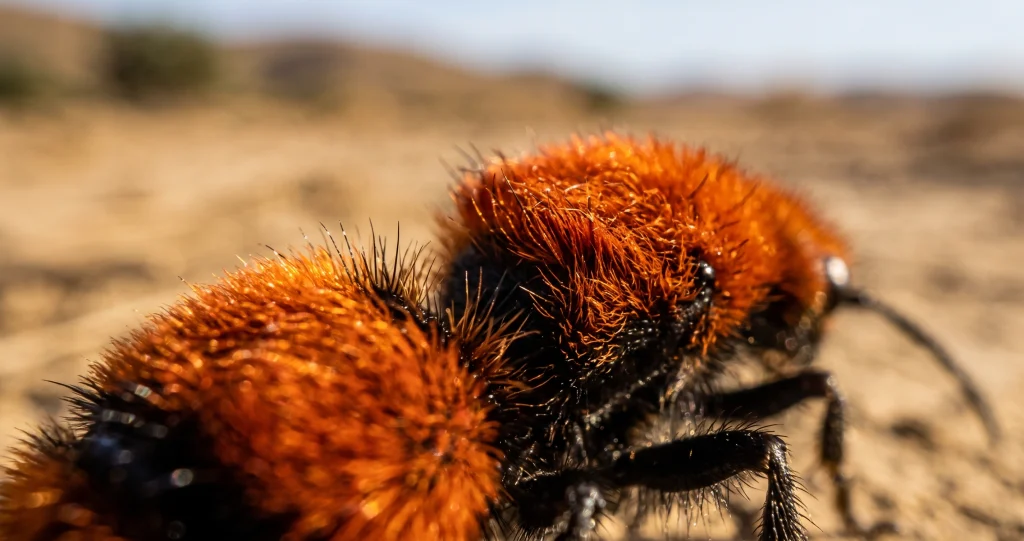
Adult females are wingless.
Their bodies are adapted for running across the ground and entering the nests or burrows of other insects during reproduction. Their compact, heavily armored form also provides considerable protection when they enter potentially dangerous environments.
A female walking through a lawn can therefore look like an unusually large, fuzzy ant.
The absence of wings is not an injury or developmental failure. It is a normal characteristic of female velvet ants.
They retain the basic body organization of a wasp while adopting a terrestrial lifestyle.
This extreme difference between the sexes is known as sexual dimorphism.
Why Male Velvet Ants Can Fly
Male velvet ants look surprisingly different.
They possess wings and generally resemble conventional wasps much more closely than females do.
Males fly while searching for females. They cannot sting because the stinger of female Hymenoptera is evolutionarily associated with the egg-laying apparatus, or ovipositor.
This creates an unusual identification challenge.
Someone seeing a winged male and a wingless female might reasonably assume they belong to completely different insect groups.
In reality, they can be male and female members of the same velvet ant species.
This also explains why the velvet ant cow killer people most often notice running across open ground is female.
How the Velvet Ant Cow Killer Got Its Nickname
The name “cow killer” is most famously associated in North America with the eastern velvet ant, Dasymutilla occidentalis.
The insect does not kill cows.
The nickname arose from the reputation of the female’s extraordinarily painful sting—the folk exaggeration being that a sting painful enough to affect a person so dramatically must be powerful enough to “kill a cow.”
UF/IFAS Extension specifically notes that the name refers to claims that the sting is painful enough to kill livestock, while emphasizing that velvet ants are not particularly aggressive and their venom is not comparatively highly toxic.
“Cow killer” should therefore be understood as colorful folklore rather than a description of the insect’s actual lethality.
The pain, however, is very real.
How Painful Is a Velvet Ant Sting?
Entomologist Justin Schmidt developed the famous Schmidt Sting Pain Index to compare the subjective pain produced by stinging Hymenoptera.
Some velvet ant stings rank very high on that scale.
A commonly cited velvet ant example reaches level 3 on Schmidt’s four-level index. Importantly, sting intensity varies among velvet ant species, so it is inaccurate to say that every member of the entire family automatically receives the same score.
Level 3 nevertheless places the tested velvet ant sting among the more intensely painful insect stings Schmidt evaluated.
That helps explain how the velvet ant cow killer acquired such a memorable reputation.
But the Schmidt index measures pain.
It is not a ranking of how deadly an insect is.
That distinction is essential.
Extreme Pain Does Not Mean Highly Toxic Venom
People naturally associate severe pain with severe medical danger.
In venomous animals, those two characteristics do not always match.
Velvet ant venom is an excellent example.
UF/IFAS describes their venom as relatively low in toxicity compared with several familiar stinging insects, despite the formidable pain caused by the sting.
The defensive value is easy to understand.
A predator does not necessarily need to die for venom to work. An immediate, memorable burst of pain can be enough to make an animal release the wasp and avoid similar prey in the future.
For most people, an isolated velvet ant sting is therefore primarily a problem of acute pain and localized reaction rather than systemic poisoning.
As with bees and other wasps, however, allergic reactions can be medically serious.
Why Velvet Ants Have So Many Defenses
A painful sting is only part of the velvet ant’s defensive system.
Many species advertise themselves with conspicuous colors.
Bright red, orange, black, or contrasting patterns can function as warning coloration, or aposematism. Rather than remaining perfectly camouflaged, the insect signals that attacking it may have unpleasant consequences.
Female velvet ants also possess a remarkably tough exoskeleton.
That armor is useful because their reproductive lifestyle requires them to enter nests belonging to other insects.
When disturbed, velvet ants may produce an audible squeaking or chirping sound through stridulation.
The combination is formidable: conspicuous warning colors, armor, rapid running, warning sounds, and—in females—a long, maneuverable stinger.
Yet none of this means they actively seek confrontations with humans.
These are defensive adaptations.
How Velvet Ants Reproduce
The reproductive biology of velvet ants is arguably stranger than their sting.
They are parasitoids.
A parasitoid differs from an ordinary parasite because its immature stage develops on or within a host and ultimately kills that host.
Female velvet ants search for the nests of suitable insects.
Depending on the velvet ant species, hosts commonly include ground-nesting bees and wasps. Other insect groups can also serve as hosts for particular mutillids.
Once an appropriate host nest is located, the wingless female enters it and deposits an egg in association with an immature host, often within a protected cell or cocoon.
The velvet ant larva later develops using that host as food.
The behavior explains several apparently unrelated characteristics of adult females.
Being wingless and heavily armored makes much more sense when an insect regularly enters underground nests belonging to other Hymenoptera.
What Happens Inside the Host Nest?
Velvet ants do not create ant-like colonies of their own.
There are no armies of velvet ant workers maintaining communal nests.
Instead, the female searches independently for host nests.
After her egg hatches, the velvet ant larva feeds on the developing host. It eventually pupates and completes its transformation into an adult.
The relationship is therefore lethal to the individual host.
From an ecological perspective, however, parasitoidism is an ordinary and widespread strategy among wasps.
Thousands of wasp species depend on other arthropods for larval development.
The striking appearance of velvet ants simply makes their version unusually visible.
For another example of a specialized insect predator using an extraordinary strategy, read our article on how antlion larvae construct sand pits to trap prey.
What Adult Velvet Ants Eat
There is an important difference between what velvet ant larvae consume and what adults eat.
The larvae develop at the expense of other insects.
Adults generally obtain energy from plant-based liquids such as nectar.
This pattern occurs widely among parasitoid wasps. A species can have a predatory or parasitoid immature stage while the adult relies largely on sugars for energy.
Seeing a velvet ant visiting flowers therefore does not contradict its parasitoid biology.
Different life stages have different nutritional requirements.
Where Are Velvet Ants Found?
The family Mutillidae occurs across many parts of the world.
North America supports numerous species, with particularly high diversity in warm, dry regions.
The eastern velvet ant, Dasymutilla occidentalis, is one of the most recognizable species in the eastern United States because of its size and striking red-orange and black appearance.
Female velvet ants may be encountered walking rapidly across lawns, gardens, pastures, sandy areas, trails, and other open ground.
Their presence does not mean a property is infested.
Velvet ants are solitary animals rather than colony-forming household pests.
UF/IFAS consequently states that control measures are generally unnecessary.
What to Do If You Encounter a Velvet Ant
The safest response is also the easiest: leave it alone.
Do not pick up a velvet ant with bare hands.
Avoid stepping on one barefoot, and teach children not to handle brightly colored fuzzy insects they find moving across the ground.
UF/IFAS notes that accidental stings commonly occur when a female is stepped on barefoot or becomes trapped against someone’s body.
If one appears outdoors, there is usually no reason to spray it.
It is not damaging your lawn, eating your house, establishing an aggressive colony, or seeking people to sting.
Give it space to continue moving.
Pets should also be prevented from pawing at or biting the insect, since its defensive equipment is designed specifically to discourage predators.
What to Do After a Velvet Ant Sting
First, move away from the insect and avoid further contact.
For an uncomplicated local sting reaction, basic first aid generally centers on cleaning the area and using a cold pack wrapped in cloth to reduce discomfort and swelling.
Avoid scratching or unnecessarily manipulating the sting site.
Because reactions to Hymenoptera venom vary between people, watch for symptoms extending beyond ordinary localized pain, redness, or swelling.
Difficulty breathing, swelling of the tongue or throat, widespread hives, faintness, severe dizziness, or other signs of a systemic allergic reaction require urgent emergency medical attention.
Anyone with a prescribed epinephrine auto-injector for a known severe insect-sting allergy should follow their existing medical emergency plan.
The spectacular pain associated with the velvet ant cow killer should not be dismissed, but pain intensity alone does not tell you whether an allergic emergency is occurring.
Common Myths About Velvet Ants
Myth 1: Velvet Ants Are Giant Ants
They are wasps in the family Mutillidae.
The wingless females merely resemble hairy ants.
Myth 2: A Cow Killer Can Actually Kill a Cow
The nickname is an exaggeration based on the painful sting.
UF/IFAS reports no basis for treating these insects as lethal threats to livestock and notes that their venom is comparatively low in toxicity.
Myth 3: Every Velvet Ant Can Sting
Only females possess functional stingers.
Males are winged and cannot sting.
Myth 4: Velvet Ants Are Aggressive
They are defensive rather than aggressive toward humans.
A female may sting when grabbed, stepped on, trapped, or otherwise threatened.
Myth 5: Velvet Ants Live in Colonies
They are solitary wasps.
They do not build ant-style colonies with queens and workers.
Myth 6: The Schmidt Pain Index Measures Venom Toxicity
It measures perceived sting pain.
An insect can produce an extremely painful sting without having exceptionally lethal venom.
Myth 7: Velvet Ant Larvae Eat Ants
The name can make this sound logical, but many velvet ants develop as parasitoids of other insects, especially solitary bees and wasps.
Their name refers to the adult female’s ant-like appearance, not a specialized diet of ants.
FAQ
Is a velvet ant really a wasp?
Yes. Velvet ants belong to the wasp family Mutillidae within the order Hymenoptera.
Females are wingless, which creates their unusual ant-like appearance.
Why is it called a velvet ant?
Dense hair-like setae give many species a fuzzy or velvety appearance.
Because wingless females walk on the ground and resemble large ants, the combination produced the common name “velvet ant.”
Why is the velvet ant called a cow killer?
The velvet ant cow killer nickname comes from folklore surrounding the severe pain of the female’s sting.
It does not mean that the insect normally kills—or is capable of casually killing—cattle.
How painful is a cow killer sting?
A velvet ant tested on the Schmidt Sting Pain Index has been placed at level 3 on its four-level scale, representing an exceptionally painful sting.
Ratings can differ among species, and the scale measures subjective pain rather than medical danger.
Can male velvet ants sting?
No.
Male velvet ants have wings but lack the female’s functional stinging apparatus.
Why don’t female velvet ants have wings?
Winglessness is part of their normal anatomy.
Females spend much of their reproductive activity traveling on the ground and entering host nests where they deposit eggs.
Are velvet ants dangerous to humans?
They can deliver a very painful sting if handled or trapped, so they should not be touched.
For most people they are not considered unusually dangerous, although severe allergic reactions to insect venom can occur and require emergency treatment.
What do velvet ants parasitize?
Many species use immature solitary bees or wasps as hosts, although host associations vary among velvet ant species.
The female locates a suitable nest and lays an egg associated with the developing host.
Should I kill a velvet ant in my yard?
Usually, no control is necessary.
The insect is solitary, does not damage plants or structures, and generally wants to avoid human contact. Simply keep children and pets away and allow it to move on.
Conclusion
The velvet ant cow killer has accumulated two misleading names.
It is neither an ant nor a killer of cows.
The animal most people recognize is a female wasp whose wings have been lost through evolution, leaving her with a compact, heavily armored body suited to traveling across the ground and entering the nests of other insects.
Males follow a completely different design.
They retain wings, fly in search of females, and cannot sting.
The female’s sting explains the second misleading name. Some velvet ants rank around level 3 on the Schmidt Sting Pain Index, making their defensive sting genuinely formidable.
But intense pain should not be confused with extreme venom toxicity.
The “cow killer” legend is folklore built around a real but exaggerated reputation.
Behind that reputation is an even more remarkable life cycle.
A female searches for the nests of suitable host insects, particularly other solitary bees and wasps. Her offspring then develop as parasitoids, consuming an immature host before eventually emerging as adult velvet ants.
Their brilliant colors, tough exoskeleton, warning sounds, speed, and painful sting form a sophisticated defensive system for an insect that spends much of its life exposed on the ground.
For people, the appropriate response is simple.
Observe from a distance, avoid handling the insect, wear footwear where velvet ants are common, and allow solitary individuals to continue on their way.
The velvet ant does not need its exaggerated nickname to be impressive.
Its real biology is more than enough.
Related Reading
Explore other unusual insect hunting strategies, defensive behaviors, and life cycles:
- How Antlion Larvae Construct Sand Pits to Trap Prey — Discover how antlion larvae engineer funnel-shaped traps in loose soil and use them to ambush small insects.
- Why Yellowjackets Become More Defensive in Late Summer — Learn how seasonal changes within yellowjacket colonies can influence their behavior and increase the likelihood of defensive encounters.
References and Further Reading
For additional scientific information about velvet ants, their parasitoid life cycle, defensive adaptations, and stinging behavior:
University of Nebraska–Lincoln Extension — University Extension resource providing entomological information on velvet ants, including their biology, identification, the “cow killer” nickname, and appropriate precautions around females.
University of Florida IFAS Extension — Velvet Ants, Mutillidae — University entomology resource covering identification, male and female differences, distribution, defensive behavior, stinging, and classification.
University of Florida IFAS Extension — Stinging or Venomous Insects and Related Pests — Extension safety resource covering velvet ant stings, accidental human encounters, and their parasitoid associations with solitary bees and wasps.