
Imagine stepping outside one morning and discovering a bright yellow, foamy-looking mass spreading across your garden mulch. It wasn’t there yesterday. Now it looks as though a dog has been sick right beside your favorite flowers.
Before reaching for a shovel or a bottle of fungicide, there’s something fascinating to know: that strange growth may be a living organism with an extraordinary life cycle.
Commonly called dog vomit slime mold, Fuligo septica is one of the most recognizable examples of slime mold in mulch. Despite its unpleasant nickname, it is generally harmless to garden plants, people, and pets under ordinary conditions.
Even more surprising, it isn’t actually a fungus.
This unusual organism can move, feed on microorganisms, and eventually transform into a dry, powdery structure that releases spores.
Understanding what it is, why it appears, and how it behaves can turn an alarming garden discovery into a fascinating lesson about the hidden life of soil.
What Is Dog Vomit Slime Mold?
Dog vomit slime mold is the common name for Fuligo septica, a species of plasmodial slime mold.
Its scientific name may be unfamiliar, but its appearance is difficult to forget.
A Strange Yellow Growth
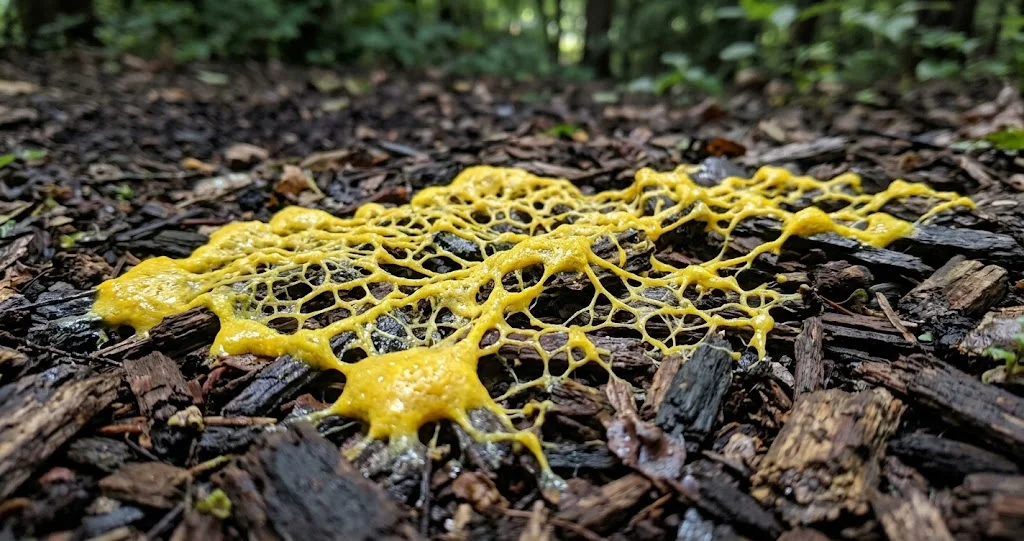
During its active stage, dog vomit slime mold often resembles a patch of yellow foam, scrambled eggs, or spilled mustard.
The mass can appear bright yellow, pale cream, or occasionally other muted shades.
Its surface may look wet, bubbly, or irregularly textured.
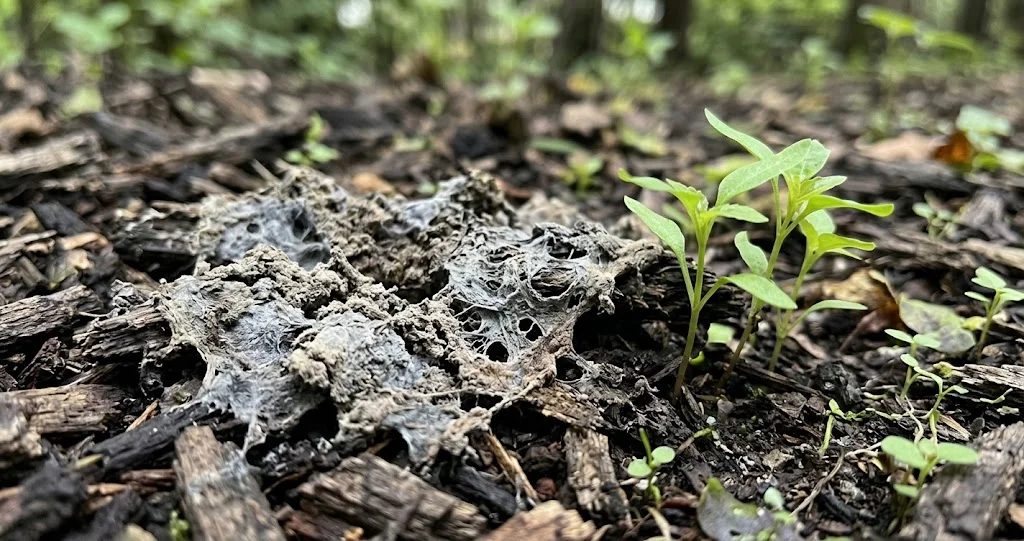
As the organism matures, the mass typically becomes drier and may develop a crustlike surface.
Eventually, it can turn brownish or tan and produce a dusty collection of spores.
It Is Not a True Fungus
Although slime molds were historically grouped with fungi, modern biological classification places plasmodial slime molds among amoebozoan organisms rather than within the fungal kingdom.
They differ from mushrooms and molds in important ways.
During their active feeding stage, plasmodial slime molds form a multinucleate mass of living cytoplasm called a plasmodium.
This mass can move slowly across surfaces while engulfing food particles.
Fungi generally absorb dissolved nutrients through their cell walls, whereas the active plasmodium feeds by engulfing microorganisms and organic particles.
That difference makes dog vomit slime mold biologically remarkable.
Where It Commonly Appears
Fuligo septica is frequently observed on wood-chip mulch, decaying logs, leaf litter, and other moist organic materials.
It may also appear on lawns or low-growing vegetation.
Its presence is especially noticeable when conditions have been damp.
Why Slime Mold in Mulch Appears After Rain
One of the most common gardening experiences is discovering slime mold shortly after a period of rain.
The timing is not accidental.
Moisture Creates Favorable Conditions
Slime molds need suitable moisture conditions for their active stages.
After rain or irrigation, damp mulch can provide an environment where the organism can move and feed.
Wood chips also retain moisture and shelter microorganisms.
This combination helps explain why slime mold is often noticed in mulched garden beds.
Mulch Supports Microbial Life
Organic mulch is not biologically inactive.
As wood chips and other plant materials weather, bacteria, fungi, and additional microorganisms colonize them.
These organisms participate in decomposition.
Plasmodial slime molds feed on some of the microorganisms associated with this environment.
Consequently, a mulch bed can provide both a suitable surface and potential food.
Why It Seems to Appear Overnight
A slime mold may remain unnoticed while its active mass moves through sheltered spaces.
When conditions favor reproduction, the plasmodium can gather into a conspicuous structure.
The resulting change in appearance may seem sudden.
In many cases, gardeners notice the organism only when its bright reproductive mass becomes visible on the mulch surface.
Warm, Humid Weather Can Help
Slime molds are often observed during warm, moist periods, although their activity varies with species and local conditions.
Rainfall, humidity, shade, and the moisture-retaining properties of mulch can influence where and when they become noticeable.
Their appearance does not necessarily mean the garden has been overwatered.
It simply indicates that the local environment has supported the organism’s development.
How Dog Vomit Slime Mold Lives, Moves, and Reproduces
The most surprising thing about dog vomit slime mold is that the yellow mass is not a conventional mushroom or fungal colony.
It represents part of a life cycle that includes microscopic cells, an actively feeding plasmodium, and spore-producing structures.
Stage 1: Spores Begin the Cycle
Like many other slime molds, Fuligo septica produces spores that can disperse through the environment.
Under suitable conditions, spores germinate and produce microscopic cells.
Depending on environmental conditions, these cells may have amoeboid forms or develop flagella that help them move through water films.
Stage 2: Cells Combine
Compatible cells can fuse during the sexual portion of the life cycle.
Subsequent nuclear divisions may produce a plasmodium containing many nuclei within a continuous mass of cytoplasm.
Unlike a multicellular animal, the plasmodium is not divided into numerous ordinary cells.
This unusual organization allows coordinated movement and feeding across a relatively large area.
Stage 3: The Plasmodium Moves and Feeds
The plasmodium creeps across suitable surfaces.
Its movement is driven by internal cytoplasmic flow and changes in its living tissues.
It feeds by engulfing bacteria, fungal spores, and other microscopic food particles.
This process is called phagocytosis.
Although movement is usually too slow to notice without repeated observations, the organism can change position and shape over time.
Stage 4: A Reproductive Structure Forms
When conditions favor reproduction, the plasmodium transforms into a spore-producing structure.
In Fuligo septica, this structure is commonly called an aethalium.
It may form a broad, cushionlike mass rather than the separate stalked structures produced by some other slime molds.
The familiar yellow or cream-colored patch gradually matures as spores develop.
Stage 5: The Mass Dries and Releases Spores
As the aethalium matures, its surface becomes more crustlike.
Inside, large numbers of spores develop.
When the structure dries and breaks apart, spores can be dispersed by air movement and other disturbances.
Under favorable conditions, some may eventually begin another life cycle.
Why This Life Cycle Matters
The slime mold’s transformation from a moving, feeding plasmodium into a stationary spore-producing mass is one of its most distinctive adaptations.
It allows the organism to exploit microbial food sources and then disperse offspring into new environments.
The visible yellow growth is therefore only one stage of a much more complex biological process.
Is Dog Vomit Slime Mold Harmful to Plants?
Despite its alarming appearance, Fuligo septica is not a plant pathogen.
It does not normally infect roots, invade stems, or cause the kinds of diseases associated with harmful fungi.
It Does Not Feed on Living Plant Tissue
Dog vomit slime mold primarily feeds on microorganisms living in moist organic environments.
If it spreads across a plant stem or leaf, it is usually using that surface as a temporary support rather than attacking the plant.
The University of Florida’s Institute of Food and Agricultural Sciences identifies Fuligo septica as a common, harmless inhabitant of landscape mulch.
Can It Smother Small Seedlings?
There is one practical exception worth understanding.
A sufficiently thick slime mold mass can temporarily cover small seedlings or grass blades, reducing their exposure to sunlight.
This is a physical obstruction, not an infection.
If a delicate seedling becomes heavily covered, gently remove the material without damaging the plant.
Established flowers, shrubs, and trees are unlikely to experience meaningful harm from a typical patch.
Does It Mean Your Mulch Is Bad?
No. Finding slime mold does not automatically indicate contaminated, poor-quality, or diseased mulch.
Organic mulch naturally supports microorganisms as it weathers.
Slime mold often appears because those organisms provide food.
However, if the bed remains persistently waterlogged, it is worth checking drainage and irrigation independently of the slime mold.
Is Dog Vomit Slime Mold Dangerous to People or Pets?
The name may sound unpleasant, but Fuligo septica is not generally considered poisonous or pathogenic to humans or pets.
Avoid Unnecessary Contact
Even harmless garden organisms should not be eaten or handled carelessly.
Children should be discouraged from tasting unfamiliar material in mulch beds.
Keep curious pets from ingesting unidentified outdoor growths, since a yellow patch should not be assumed to be Fuligo septica without proper identification.
If a pet eats an unknown substance and develops symptoms, contact a veterinarian.
Be Careful With Dry Spores
A mature slime mold can release fine, dusty spores when disturbed.
For people with asthma, allergies, or respiratory sensitivities, inhaling airborne particles may cause irritation.
Avoid brushing or breaking apart dry spore masses near your face.
If removal is necessary, work gently and consider wearing gloves and an appropriate dust mask.
Slime Mold, Fungi, and the Hidden Life of Mulch
The appearance of dog vomit slime mold reveals something important about garden ecology.
A mulch bed is not merely a decorative covering. It is a habitat containing many interacting organisms.
Who Actually Breaks Down the Wood?
Bacteria and fungi are major decomposers of organic mulch.
They produce enzymes and carry out biological processes that transform wood and other plant residues.
Slime molds participate in this ecosystem primarily by consuming microorganisms.
Therefore, it is more accurate to describe Fuligo septica as part of the mulch food web than as a major direct wood decomposer.
Why Microbial Diversity Matters
Microorganisms influence nutrient cycling, organic matter breakdown, and soil processes.
Their populations change as temperature, moisture, and available resources change.
Slime molds are one of many organisms responding to those conditions.
Seeing one does not prove that the soil is exceptionally healthy, but it can demonstrate that biological activity is occurring in the mulch.
In Your Own Yard: What to Do About Slime Mold
The simplest solution is often to do nothing.
Most patches mature, dry out, and become less noticeable without intervention.
If the appearance bothers you, there are several practical options.
Option 1: Leave It Alone
If the slime mold is growing on mulch away from vulnerable seedlings, allow it to complete its life cycle.
It will often become less conspicuous as conditions dry.
You do not need to disinfect the mulch or remove nearby healthy plants.
Option 2: Remove the Visible Mass
Use a small shovel or garden trowel to lift the visible growth along with a little surrounding mulch.
Place it in a bag or suitable disposal container.
Avoid shaking mature, powdery material, especially if anyone nearby has respiratory sensitivities.
Removing the visible patch improves appearance but does not guarantee that slime mold will never return.
Option 3: Gently Disturb the Mulch
If the growth is fresh and localized, lightly turning the affected mulch may help expose it to drier air.
Do not dig aggressively around shallow plant roots.
Keep mulch away from direct contact with tree trunks and plant crowns where excessive moisture could create other problems.
Option 4: Review Your Watering Routine
Water plants according to their actual needs rather than following an unnecessarily frequent schedule.
If the mulch stays saturated for long periods, check for overwatering, blocked drainage, or excessive irrigation.
Do not deliberately dry out plants just to discourage slime mold.
The goal is healthy soil moisture, not a sterile garden bed.
Option 5: Skip Fungicides and Household Chemicals
Because slime molds are not true fungi and generally do not damage plants, fungicide treatments are unnecessary.
Do not pour bleach, concentrated vinegar, or other harsh household chemicals onto garden beds.
These products may damage plants or disturb soil organisms without providing a meaningful long-term solution.
Can You Prevent Slime Mold From Returning?
Complete prevention is difficult because slime mold spores and suitable microorganisms can occur naturally in outdoor environments.
However, gardeners can make certain areas less favorable for repeated visible growth.
Avoid Constantly Saturated Mulch
Allow the mulch surface to dry naturally between watering events when plant requirements permit.
Check that irrigation systems are not running more often than necessary.
Use Mulch Appropriately
Avoid piling excessive amounts of wet mulch in poorly drained areas.
Choose mulch depth based on the material, soil, and plants being grown.
There is no need to remove all organic mulch simply because slime mold appeared once.
Expect Occasional Reappearances
Even well-maintained gardens may experience slime mold after favorable weather.
A new patch does not necessarily mean that the previous one survived in exactly the same location.
Spores can remain in the environment and develop when conditions permit.
Common Myths About Dog Vomit Slime Mold
Myth: It Means a Dog Was Sick in the Garden
The nickname describes the appearance, not the organism’s origin.
A patch can develop in a garden where no dog has been present.
Myth: It Is a Dangerous Fungus
Fuligo septica is not a true fungus and is not generally considered harmful to healthy plants.
Myth: It Is Eating Your Mulch Like a Wood-Rotting Fungus
It mainly consumes microorganisms associated with decaying organic material.
Fungi and bacteria perform much of the direct breakdown of the wood.
Myth: You Must Spray It Immediately
Chemical treatment is not normally necessary or recommended.
Leaving it alone is usually the most practical approach.
Myth: Every Yellow Growth Is Dog Vomit Slime Mold
Other organisms and substances can have similar appearances.
Color alone cannot establish an identification.
If the material has an unusual odor, appears associated with chemical contamination, or does not resemble known slime mold forms, seek local expert guidance before handling it.
Frequently Asked Questions
1. Why does dog vomit slime mold suddenly appear in my mulch?
It often becomes visible after warm, wet weather because moisture supports its active feeding stage. The organism consumes microorganisms living among the wood chips. When conditions favor reproduction, it can form a conspicuous yellow mass that seems to have appeared overnight.
2. Should I remove slime mold from my flower beds?
Usually not. Dog vomit slime mold generally does not damage established plants and often dries out naturally. If you dislike its appearance, carefully lift the visible mass with a garden trowel and dispose of it. Avoid scattering dry spores.
3. Will dog vomit slime mold come back after I remove it?
It can. Removing the visible growth does not eliminate every spore or prevent new slime molds from developing. Future appearances depend on moisture, available microorganisms, and environmental conditions. Proper watering and mulch management may reduce recurring growth, but complete prevention is unlikely.
Conclusion
That strange yellow blob beside your flowers may look like something has gone terribly wrong, but slime mold in mulch is usually a harmless part of the garden’s living ecosystem.
Dog vomit slime mold is not a true fungus, does not normally attack plants, and rarely requires treatment. Its ability to move, engulf microorganisms, and transform into a spore-producing structure makes it an extraordinary organism hiding in an ordinary landscape.
For most gardeners, the best response is simple: observe it, leave it alone, or remove the visible growth if necessary.
The next time you discover what looks like a mysterious pile of scrambled eggs in your mulch, remember that you may be witnessing one of nature’s strangest life cycles—not a garden disaster.
Internal Sources
1. How the Mulch You Choose Changes Your Soil Beneath the Surface — Best link for the section explaining moisture and microorganisms in mulch.
2. Worm Castings: Why Gardeners Call It “Black Gold” for Soil — Relevant to soil organisms, organic matter, and nutrient cycling.
3. Chop-and-Drop Mulching: The Low-Effort Way to Feed Your Soil — Useful for readers interested in organic mulch management and decomposition.
External Sources
1. Clemson Cooperative Extension — Dog Vomit Slime Mold. Describes the plasmodium, spore-producing stage, environmental conditions, and management options. Read the Clemson Extension article.
2. University of Maine Cooperative Extension — Slime Molds. Discusses slime mold ecology, possible temporary shading of seedlings, and why pesticide treatments are unnecessary. Read the University of Maine guide.