
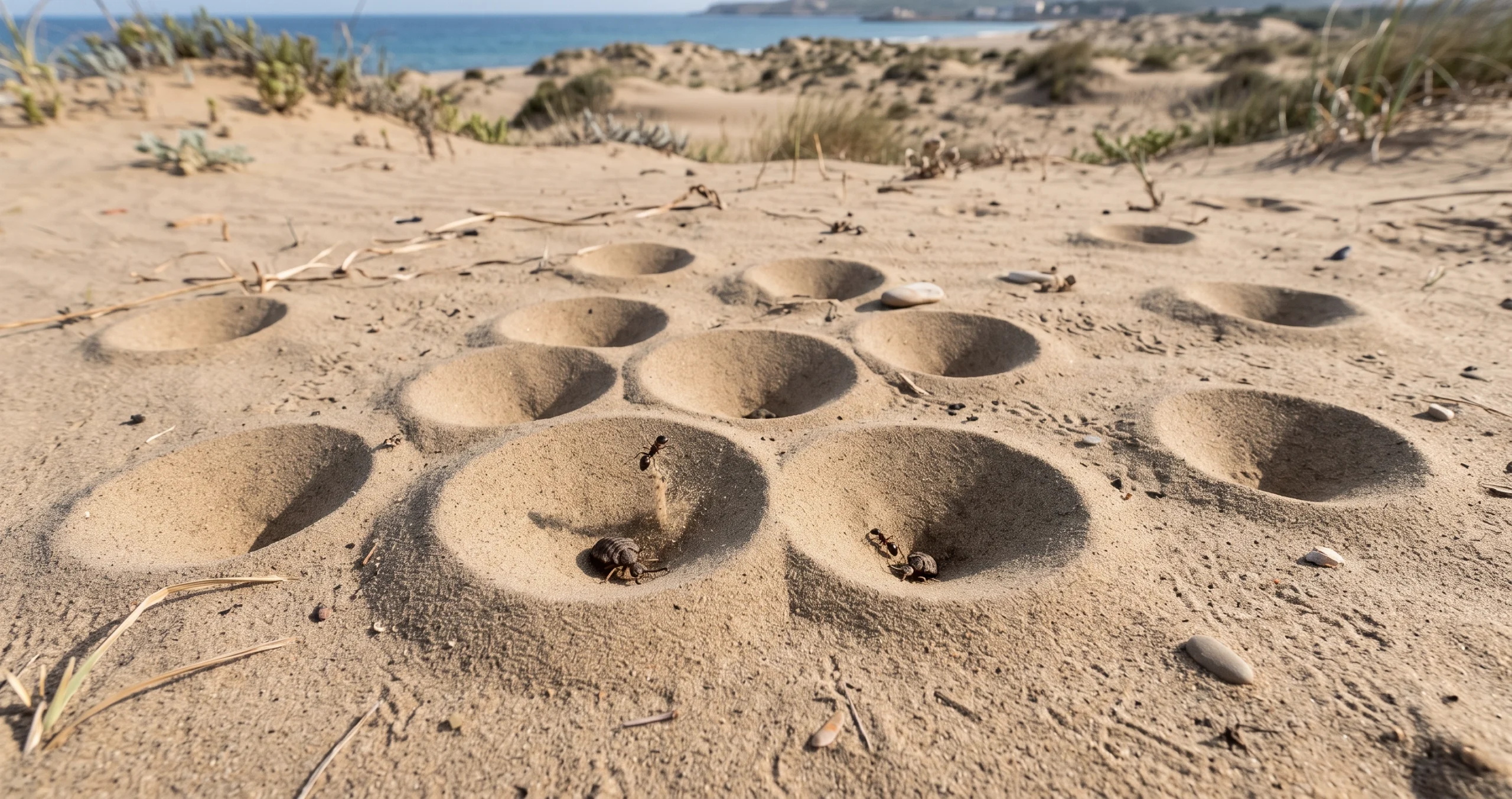
A tiny crater in dry, loose soil can look like nothing more than the mark left by a falling raindrop. But beneath some of these perfectly shaped funnels waits one of the insect world’s most specialized ambush predators. An antlion pit trap is an engineered hunting structure built by an antlion larva to turn loose sand and gravity into weapons against ants and other small arthropods.
The larva hides at the bottom with only its jaws exposed. When an insect steps onto the sloping wall, grains begin to slide beneath its feet. If the prey struggles upward, the antlion can make the situation even worse by throwing sand toward it.
What looks like a simple hole is actually a dynamic trap built around the physics of granular materials.
Table of Contents
- What Is an Antlion?
- What Does an Antlion Larva Look Like?
- How an Antlion Pit Trap Is Built
- Why Antlions Walk Backward While Digging
- The Physics of Unstable Sand Slopes
- What Happens When an Ant Enters the Pit
- Why Antlions Throw Sand at Escaping Prey
- How the Larva Captures and Eats Its Victim
- Where Antlion Pits Are Found
- From Pit-Building Larva to Flying Adult
- What Does an Adult Antlion Look Like?
- Do All Antlions Build Pits?
- Common Myths
- FAQ
- Conclusion
What Is an Antlion?
Antlions are insects belonging to the family Myrmeleontidae within the order Neuroptera. They are relatives of lacewings, owlflies, and other net-winged insects.
The name “antlion” is most strongly associated with the predatory larval stage.
Some antlion larvae construct the famous conical pits used to capture ants and other small arthropods. Others employ different hunting strategies and never construct pits at all.
This distinction matters because the classic antlion pit trap represents one specialized lifestyle within a much larger and diverse insect family.
According to the University of Florida’s Featured Creatures resource on antlions, antlion larvae are predators equipped with large, curved jaws and can be found in dry, sandy locations where suitable loose substrate is available.
Their appearance could hardly be more different from the delicate flying insect they eventually become.
What Does an Antlion Larva Look Like?
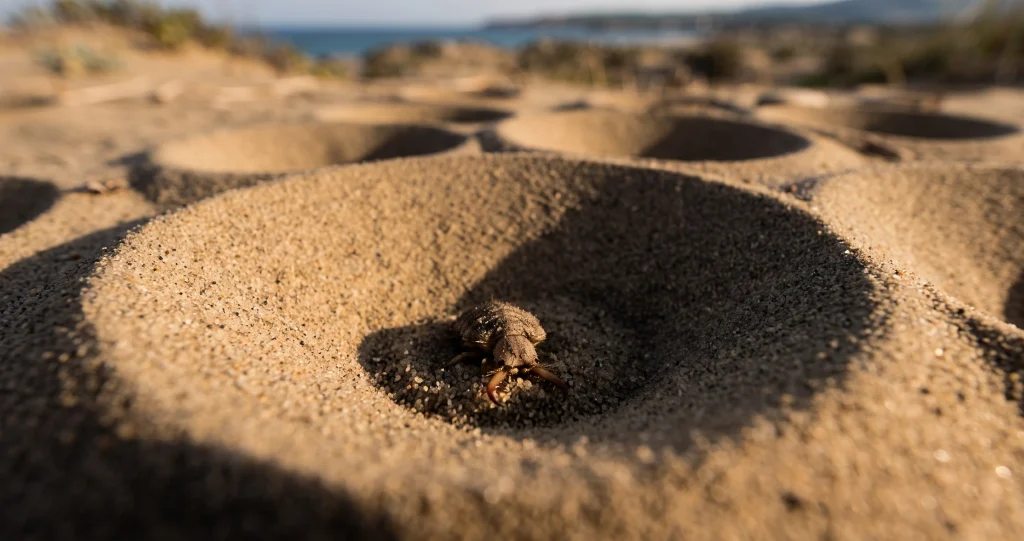
An antlion larva is compact, broad-bodied, and somewhat flattened.
Its most obvious features are the enormous curved mandibles projecting forward from its head.
These jaws are not merely for gripping prey.
They contain channels associated with feeding. Once prey is captured, the larva uses its specialized mouthparts to introduce digestive secretions and later draw liquefied material from the victim.
The body is often covered with small hairs or bristles and is adapted for life among loose particles.
Unlike its graceful adult form, the larva looks built for digging and ambush.
It also has an unusual talent: moving backward through loose soil.
That ability becomes essential when construction begins.
[Image placement: Cutaway scientific illustration showing an antlion larva buried at the bottom of a funnel-shaped sand pit while an ant slips down the wall. Alt text: “antlion pit trap with larva hidden beneath loose sand waiting for prey”]
How an Antlion Pit Trap Is Built
Construction begins when a pit-building antlion larva selects a suitable patch of loose, dry material.
Fine sand or dusty soil works especially well because individual grains move easily.
The larva begins traveling backward in a roughly circular or spiral path.
As it moves, it uses its head and jaws like a shovel.
Sand is scooped up and rapidly flicked outward.
With repeated circuits, the depression becomes deeper.
The larva continues removing material from the center and throwing it beyond the developing rim.
Eventually, a steep-sided cone appears.
The finished antlion pit trap resembles an inverted cone, with the narrowest point at the bottom.
That is exactly where the predator waits.
Why Antlions Walk Backward While Digging
Backward movement may look awkward, but it is extremely useful for a burrowing predator.
The antlion’s body is well suited to pushing through loose substrate in reverse.
While moving backward around the developing pit, its head remains oriented toward the material that needs to be removed.
The jaws and head can scoop grains and throw them away from the center.
The larva therefore excavates while simultaneously positioning itself deeper inside the structure.
Once construction is complete, it buries most of its body beneath the sand at the bottom.
Only the jaws may remain exposed.
An approaching ant can therefore enter the trap without seeing an obvious predator waiting below.
The Physics Behind an Antlion Pit Trap
The genius of an antlion pit trap is that the larva does not need to physically chase every insect entering its territory.
Gravity does much of the work.
Loose sand behaves differently from a solid surface.
A pile of dry granular material can maintain a slope only up to a certain steepness. This threshold is commonly described using the “angle of repose.”
Below that critical angle, the grains can remain relatively stable.
Make the slope sufficiently steep, however, and small disturbances can cause grains to avalanche downward.
Antlions exploit this property.
Building Near the Angle of Repose
The walls of a successful pit are maintained at a steep angle close to the stability limit of the substrate.
That means an ant walking onto the slope is entering terrain that is already close to failure.
Its legs disturb individual grains.
Those grains slide downward.
The ant tries to compensate, but its movements disturb still more material.
Instead of climbing a firm hill, the insect is attempting to climb a miniature landslide.
Researchers studying antlion pits have shown that the trap’s geometry and the physical properties of granular material contribute directly to prey capture.
The structure is therefore more than camouflage.
It actively changes the prey’s ability to escape.
What Happens When an Ant Enters the Pit?
Imagine an ant walking across apparently flat, dry soil.
It reaches the edge of the pit and steps onto the slope.
The first few steps may not immediately be disastrous.
But as the ant moves downward, loose grains begin shifting beneath its feet.
The ant attempts to climb back toward the rim.
That effort can make matters worse.
Rapid leg movements disturb the unstable slope, triggering small avalanches that carry the insect toward the center.
At the bottom, the hidden antlion senses the disturbance.
The predator can respond to vibrations transmitted through the sand even before direct contact occurs.
Then the trap becomes active.
Why Antlions Throw Sand at Escaping Prey
The antlion does not simply wait passively for gravity to deliver every victim.
If an insect begins climbing toward safety, the larva can violently flick sand upward with its head and jaws.
The behavior has sometimes been described as “sand throwing,” but its function is more sophisticated than simply striking the prey with individual grains.
The disturbance destabilizes the slope.
Sand thrown onto or beneath a struggling insect can trigger additional avalanches, reducing traction and carrying the prey downward.
Researchers have experimentally investigated this behavior and found that sand throwing can significantly improve trapping effectiveness.
The predator is essentially manipulating the granular environment in real time.
Turning the Trap Into a Moving Surface
This is what makes an antlion pit trap especially effective.
A prey animal might escape a static hole through persistent climbing.
The antlion can prevent the trap from remaining static.
Every sand flick changes the surface beneath the prey.
The larva can repeatedly throw material until the victim slides within reach.
In engineering terms, the predator is actively modifying the mechanical properties of its trap during an attempted escape.
For an insect weighing only a tiny fraction of a gram, it is an impressive form of environmental manipulation.
How the Larva Captures Its Prey
Once the victim reaches the bottom, the antlion’s large jaws snap around it.
Ants are common prey, which explains the name “antlion,” but they are not the only animals that can be captured.
Other small arthropods entering a suitable pit may also become prey.
After securing its victim, the larva uses specialized piercing-sucking mouthparts.
Digestive fluids help break down tissues externally, allowing the antlion to consume liquefied material.
The process is different from chewing an insect into pieces.
When feeding is complete, the remains can be discarded from the pit.
The antlion may throw the empty exoskeleton away in much the same way that it throws unwanted sand during construction.
This helps keep the hunting area clear.
Maintaining the Trap
A pit does not remain perfect indefinitely.
Wind, rain, falling debris, passing animals, failed prey escapes, and ordinary grain movement can damage its shape.
The antlion therefore performs maintenance.
Loose material can be removed and the walls restored to their effective slope.
This is especially important after a prey encounter because the struggling insect may have caused significant avalanching.
Environmental conditions matter as well.
Wet sand behaves differently from dry loose sand because water changes how particles adhere to one another.
For this reason, classic pits are often found in dry, sheltered places where rain does not repeatedly destroy the structure.
Where Antlion Pit Traps Are Found
Antlions occur in many parts of the world, particularly in warm and temperate regions where suitable habitat exists.
Pit-building larvae favor places containing dry, fine, loose substrate.
Potential locations include sandy ground beneath rock overhangs, sheltered banks, the bases of buildings, dry woodland edges, dunes, and protected areas beneath structures.
The best locations combine suitable sand with protection from heavy rainfall.
Finding multiple small funnel-shaped depressions together can indicate that several larvae are living in the same favorable patch.
They are not cooperating.
Each antlion pit trap belongs to an individual predator.
The pits simply cluster because the same small area provides appropriate physical conditions.
From Pit-Building Larva to Flying Adult
One of the most surprising things about antlions is how dramatically they change during development.
The predatory pit-builder is only the larval stage.
Antlions undergo complete metamorphosis.
After passing through their larval development, they eventually construct a cocoon incorporating silk and surrounding sand or soil particles.
Inside, the larva transforms into a pupa.
The adult later emerges as a winged insect.
Anyone expecting a larger version of the stocky larval predator is likely to be surprised.
The adult looks almost unrelated.
For another fascinating example of dramatic insect life-cycle changes, read our guide to the firefly life cycle and why most of its life is spent before the familiar glowing adult stage.
What Does an Adult Antlion Look Like?
Adult antlions are slender, delicate insects with long bodies and two pairs of transparent, extensively veined wings.
At first glance, they may resemble damselflies.
Look more carefully and important differences appear.
Antlions possess conspicuous antennae that are typically clubbed at the ends. Damselflies have very short, bristle-like antennae by comparison.
The wings also show the dense network of veins characteristic of Neuroptera—the “net-winged” insects.
Their flight can appear relatively weak or fluttering compared with the agile flight of dragonflies and damselflies.
Many adult antlions are most active around dusk or at night.
The transition is extraordinary.
A stout, jaw-dominated predator hidden beneath sand becomes a delicate flying insect with long wings.
Do All Antlion Larvae Build Pits?
No.
This is one of the most important facts lost in simplified descriptions of antlion biology.
Myrmeleontidae is a diverse family, and only some species use conical pits.
Non-pit-building larvae can hunt by hiding beneath sand, leaf litter, debris, or other substrates and ambushing prey directly.
Some actively pursue suitable prey over short distances.
Pit construction is therefore an evolutionary strategy, not a defining behavior performed by every antlion species.
The antlion pit trap is simply the most visually recognizable example of antlion predation.
Antlions as Ecosystem Predators
Antlions are small, but they occupy a genuine predatory role in terrestrial food webs.
Their larvae consume ants and other arthropods.
They are themselves potential prey for birds, reptiles, other insects, and various small predators.
Pit construction also provides an excellent example of an animal modifying its immediate environment to improve hunting success.
Other animals build webs, burrows, funnels, snares, or physical structures to acquire food.
Antlions do something particularly economical.
They reshape an ordinary patch of sand until gravity becomes part of the hunting mechanism.
Common Myths About Antlions
Myth 1: Every Antlion Builds a Pit
False.
Only certain antlion larvae use pit traps. Other species employ different ambush strategies.
Myth 2: The Pit Is Just a Hole the Ant Falls Into
A well-constructed pit is more sophisticated than an ordinary hole.
Its steep granular walls are maintained near an unstable angle, making upward movement difficult and encouraging avalanches.
Myth 3: The Larva Throws Sand Mainly to Hit and Injure the Ant
The grains may strike the prey, but destabilizing the slope is particularly important.
Sand throwing reduces the escaping animal’s traction and can trigger avalanches that pull it downward.
Myth 4: Adult Antlions Still Live in Sand Pits
The pit-building stage is the larva.
Adults are winged insects that leave the larval hunting structure behind.
Myth 5: Adult Antlions Are Dragonflies
They can superficially resemble damselflies or delicate dragonflies, but antlions belong to Neuroptera.
Their prominent clubbed antennae are one useful identifying feature.
Myth 6: Antlion Pits Are Designed Only for Ants
Ants are common victims, but other suitably sized arthropods can also be captured.
The trap responds to physical interaction with the sand rather than recognizing a particular prey species.
FAQ
What is an antlion pit trap?
An antlion pit trap is a funnel-shaped depression excavated in loose, dry substrate by the larvae of certain antlion species.
The larva hides at the bottom and captures small arthropods that lose their footing on the steep walls.
How does an antlion build its pit?
The larva typically moves backward while traveling around the developing depression.
It uses its head and jaws to scoop up sand and throw it beyond the rim, gradually creating a steep inverted cone.
Why can’t ants simply climb out?
The pit walls consist of loose grains maintained near their angle of repose.
An escaping ant disturbs those grains, causing small avalanches that reduce traction and carry it downward.
Why does an antlion throw sand?
Sand flicking helps destabilize escaping prey.
The disturbance can trigger additional avalanches and send the victim sliding toward the larva’s jaws.
Does an antlion actually eat ants?
Yes, ants are common prey for many pit-building antlion larvae.
Other small arthropods can also be captured.
Are antlion larvae dangerous to humans?
No. Antlion larvae are specialized predators of small arthropods and are not considered dangerous to people.
They should simply be observed without handling or destroying their pits.
What does an adult antlion look like?
Adults are slender flying insects with long bodies, two pairs of transparent, heavily veined wings, and conspicuous antennae that are usually clubbed toward the tips.
They can superficially resemble damselflies.
Where can I find antlion pits?
Look for sheltered patches of fine, dry, loose soil or sand.
Depending on the region and species, pits may occur beneath overhangs, around sheltered structures, on sandy banks, or in other locations protected from frequent rainfall.
How big is an antlion pit?
Pit size varies according to species, larval size, substrate, hunger, and environmental conditions.
Rather than relying on one universal measurement, the distinctive feature to look for is a small, symmetrical funnel in loose material.
What happens to an antlion after the larval stage?
It eventually pupates inside a cocoon and undergoes complete metamorphosis.
The adult emerges as a winged insect that looks dramatically different from the larva.
Conclusion
The antlion pit trap is remarkable precisely because it is built from such ordinary material.
There is no sticky silk web, complicated mechanical trigger, or permanent structure.
There is only loose sand, gravity, and an insect that has evolved to manipulate both.
Construction begins when the larva moves backward through suitable substrate, repeatedly scooping and throwing particles away from the center. Gradually, a steep inverted cone develops.
Its geometry places the walls near the stability limit of loose granular material.
When an ant steps inside, the slope begins working against it.
Every attempt to climb can dislodge grains. Those grains avalanche downward, making the next step even harder.
If the prey begins escaping anyway, the hidden predator changes the trap.
A rapid flick of the head sends sand toward the struggling insect, destabilizing the surface and producing additional slides.
Once the prey reaches the bottom, enormous curved jaws complete the ambush.
Yet this specialized predator eventually disappears.
After metamorphosis, the compact sand-dwelling larva emerges as an elegant winged adult resembling a lacewing or damselfly.
That transformation makes antlions fascinating even without their traps.
But their larval engineering remains their most extraordinary achievement.
An antlion does not need to outrun an ant.
It builds a landscape where running becomes the ant’s disadvantage.
Related Reading
Explore other fascinating insect life cycles and beneficial predators:
- Firefly Life Cycle and Why Most of Its Life Is Spent Before the Familiar Glowing Adult Stage — Discover how fireflies develop through very different life stages before reaching the short-lived glowing adult form most people recognize.
- Lacewings and Their Role as Insect Predators — Learn how lacewings, relatives of antlions within the order Neuroptera, use their predatory larval stage to hunt other small insects in gardens and natural habitats.
References and Further Reading
For additional scientific information about antlions, their pit-building behavior, life cycle, and place within the order Neuroptera:
Smithsonian National Museum of Natural History — Department of Entomology — Scientific research and collections resource providing broader information on insect diversity, classification, and entomology.
University of Florida IFAS — Featured Creatures: Antlion — University entomology resource covering antlion identification, larval behavior, pit construction, prey capture, life cycle, and adult appearance.
University of Kentucky Entomology — Antlions — Academic reference covering antlion larvae, their characteristic pit traps, adult morphology, and general biology.