
Inside a humid tropical cave, the ceiling can be as biologically active as the floor. Bats cluster against limestone surfaces, arthropods move through cracks and crevices, and predators exploit opportunities created by animals living close together in a confined three-dimensional environment.
Among the more remarkable predators documented in this setting is Scolopendra gigantea, one of the largest living centipedes. Researchers working in a Venezuelan cave observed these centipedes climbing cave surfaces and capturing bats, including individuals hanging from the ceiling while holding and feeding on their prey.
Such observations can easily produce an exaggerated picture of a giant centipede specializing in bats. The scientific evidence supports something more interesting. Large scolopendrid centipedes are versatile, opportunistic predators. Their long segmented bodies, numerous legs, powerful venom-delivering forcipules and flexible behavior allow them to exploit prey ranging from arthropods to occasional small vertebrates.
Bat predation represents an exceptional and well-documented demonstration of those abilities rather than proof that bats are the normal or primary food of Scolopendra gigantea.
Meet Scolopendra gigantea
Scolopendra gigantea Linnaeus, 1758 belongs to the class Chilopoda, order Scolopendromorpha and family Scolopendridae. Its status as a valid species is recognized in modern centipede taxonomic resources.
The species is native to northern South America and parts of the southern Caribbean. A major taxonomic revision documented it from northern Colombia and Venezuela as well as Trinidad, Margarita Island, Curaçao and Aruba. Later catalog work extended its recognized distribution along the Caribbean coastline toward Guyana and Suriname, while several records from more distant regions have been regarded as doubtful, mislabeled or associated with accidental introductions.
This distribution is more precise than the common name “Amazonian giant centipede” might suggest. That name is widely used, but it can give an overly broad impression of the species’ confirmed geographic range.
Scolopendra gigantea is nevertheless genuinely enormous by centipede standards. Reliable sources document individuals reaching roughly a quarter of a meter or more in length, placing the species among the largest living centipedes.
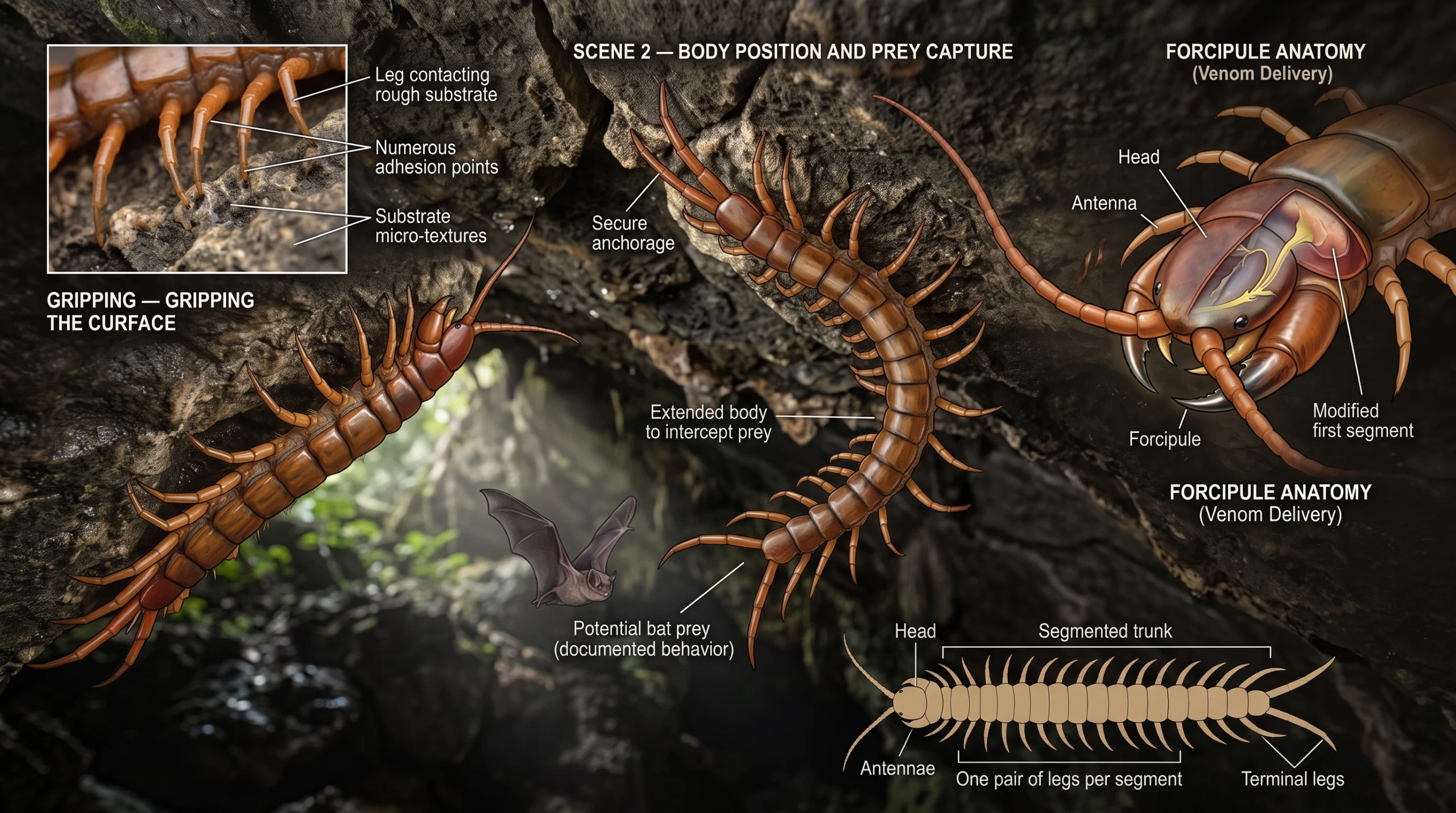
Like other large Scolopendra, it has a dorsoventrally flattened body, conspicuous antennae and a succession of powerful legs running along the trunk. Its form is suited to moving across the ground, under debris, through narrow spaces and, when the substrate permits, across steep or inverted surfaces.
A Body Built From Repeating Segments
The centipede body is fundamentally modular.
At the front is the head, carrying a pair of antennae and mouthparts. Immediately behind it is a specialized trunk segment bearing the forcipules, the venom-delivering appendages characteristic of centipedes.
Behind that lies the long trunk with repeated leg-bearing segments.
Centipedes have one pair of walking legs per leg-bearing trunk segment, distinguishing them from millipedes, in which most apparent body rings carry two pairs.
This repeated arrangement gives a large scolopendrid many separate points at which it can interact with the environment.
Flexibility along a long body
A centipede is not a rigid structure supported at only four or six locations.
Its body can bend as successive segments change their orientation relative to one another. At the same time, multiple legs can establish contact with different parts of an irregular surface.
That arrangement is useful in environments filled with rocks, bark, roots, crevices and uneven cave walls.
At the rear is a conspicuous final pair of appendages commonly called ultimate legs. These differ from ordinary walking legs and do not participate in locomotion in the same way. Across centipedes, ultimate legs have evolved diverse sensory, defensive and other functions. Their exact form and function vary considerably among species.
How a Giant Centipede Holds Onto Cave Rock
A centipede hanging from a ceiling may appear to require some extraordinary adhesive system.
It does not.
There is no need to invoke suction cups, gecko-like adhesive pads or a supernatural grip to explain the behavior documented in Scolopendra gigantea.
Instead, the basic centipede body plan provides many opportunities for mechanical contact with an irregular substrate.
Walking legs terminate in structures that can interact with surface irregularities. On coarse limestone, cracks, projections and crevices provide numerous potential points of purchase.
The animal’s elongated, flexible body allows different legs to contact the substrate at different positions.
Distributed contact
This produces an important mechanical advantage.
Instead of depending on one attachment point, the centipede can distribute contact along much of its body. As it moves, some legs can maintain support while others change position.
The precise mechanics of inverted locomotion in Scolopendra gigantea have not been quantified well enough to justify claims about exact gripping forces or maximum loads.
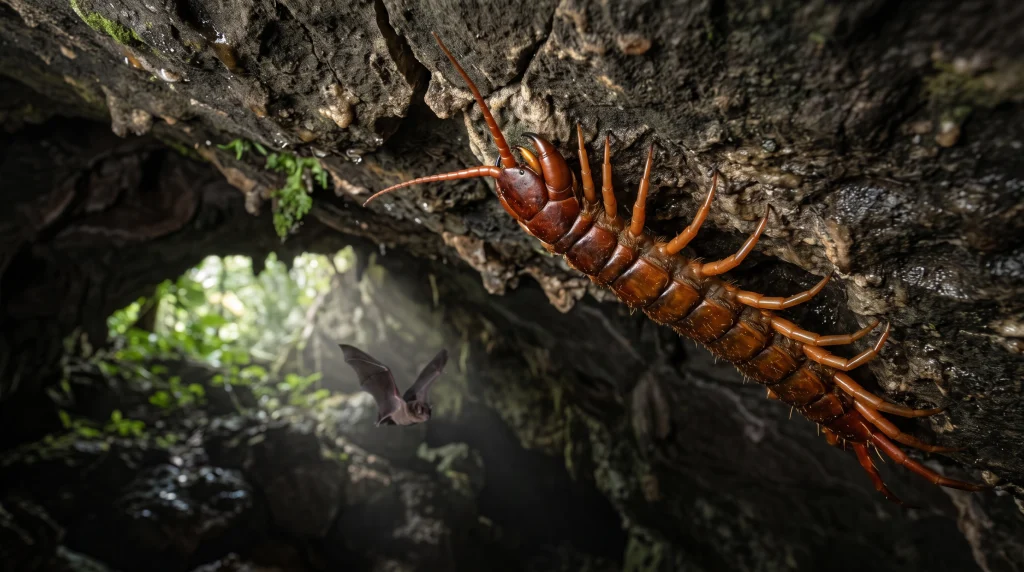
The observed behavior itself, however, leaves no doubt that the species can negotiate cave walls and ceilings under natural conditions. Molinari and colleagues specifically documented centipedes climbing cave ceilings and holding bats while suspended there.
Hunting From Above
A cave ceiling creates a hunting situation very different from open ground.
The centipede must first reach and maintain contact with an elevated or inverted surface. It can then position itself where accessible prey may come within reach.
Published observations from Venezuela show that Scolopendra gigantea can exploit exactly this situation.
Researchers reported centipedes catching bats that were flying or perching in a cave. Photographic documentation included a centipede hanging from the ceiling while holding and consuming a freshly killed bat.
The general predatory sequence can be described conservatively.
The centipede maintains its position on the substrate. Accessible prey comes within capture range. The predator uses its appendages and body to seize and restrain the animal, while the forcipules provide the specialized venom-delivery system used to subdue prey.
Not every movement during every observed attack was recorded in enough detail to reconstruct a universal attack sequence.
That distinction matters. Evidence that a centipede captured a bat while hanging from a cave ceiling does not justify inventing precise descriptions of how it detects, targets or intercepts every bat.
The Forcipules Are Not Ordinary Fangs
One of the most common anatomical mistakes in descriptions of centipedes involves their venom apparatus.
Centipedes do not possess snake-like fangs.
Their characteristic venom-delivery structures are called forcipules.
Forcipules are a highly modified pair of appendages belonging to the first trunk segment immediately behind the head. Evolutionarily, they originated from leg-like appendages rather than from teeth or ordinary mouthparts.
They curve forward beneath and around the head, forming a powerful paired apparatus capable of piercing prey.
Venom glands connect to ducts running through the forcipules, allowing venom to be delivered through openings near their tips.
A unique arthropod weapon
This evolutionary modification is one of the defining characteristics of centipedes.
Comparative research on centipede anatomy describes forcipules as an unusual evolutionary innovation in which appendages associated ancestrally with locomotion became specialized for venom delivery.
The actual mouthparts remain anatomically distinct.
Calling the forcipules “jaws” therefore obscures what makes them so remarkable. They work alongside the mouthparts during feeding, but they originated from a different part of the arthropod body plan.
Venom and Prey Subjugation
Venom is central to centipede predation.
Once the forcipules penetrate prey, venom can assist in rapidly impairing the captured animal and making continued restraint easier.
Centipede venoms are chemically complex mixtures containing numerous biologically active components. Research has identified peptides, proteins and other compounds with effects on physiological targets in prey.
The exact composition differs among centipede lineages and species.
For Scolopendra gigantea, there is no need to assign an unsupported numerical measure of “venom strength” to explain its ability to capture vertebrate prey.
Venom operates as one component of a larger predatory system.
Physical capture comes first. The centipede must make contact, maintain control and place its forcipules effectively. Venom then contributes to subduing the struggling prey.
This combination becomes particularly important when the target is a vertebrate capable of resisting physically.
More Than an Insect Hunter
Centipedes are fundamentally predators, and arthropods make up an important portion of the prey taken by many species.
Large scolopendrids, however, can exploit a broader range of animals.
Reviews of centipede predation and venom biology document prey that includes insects, spiders and other invertebrates as well as occasional vertebrates such as amphibians, reptiles and mammals.
Their feeding behavior is best described as opportunistic rather than narrowly specialized.
A large centipede encountering a manageable animal does not necessarily restrict itself to one taxonomic category of prey.
This helps explain reports of large scolopendrids attacking vertebrates. Such events are biologically plausible extensions of an opportunistic predatory strategy.
It does not follow that vertebrates dominate their normal diets.
The distinction becomes especially important with Scolopendra gigantea because photographs and reports of bat predation are so dramatic that they can overshadow the animal’s broader ecology.
The Extraordinary Case of Bat Predation
The strongest evidence for bat predation by Scolopendra gigantea comes from work published by Jesús Molinari and colleagues in the Caribbean Journal of Science in 2005.
The researchers worked at Cueva del Guano, a limestone cave on Venezuela’s Paraguaná Peninsula.
The cave supported colonies of several bat species.
Researchers documented Scolopendra gigantea preying on three bats: Mormoops megalophylla, Pteronotus davyi and Leptonycteris curasoae. The paper described these as the first known cases of predation by giant centipedes on those bat species.
Predation in an unusual dimension
The striking element was not merely that a centipede could kill a small vertebrate.
The observations demonstrated that the centipedes could climb onto cave ceilings and capture bats in places inaccessible to many terrestrial predators.
The researchers recorded predation associated with both flying and perching bats and documented centipedes holding prey while suspended from cave surfaces.
This turned the cave ceiling itself into a hunting platform.
The study also provided evidence through observations and examination of feeding material that the interaction represented genuine predation rather than scavenging.
Yet the scientific interpretation needs to remain proportional to the evidence.
The study establishes that Scolopendra gigantea can prey on bats and can exploit bat roosting environments.
It does not establish that the species is fundamentally a bat specialist or that bats constitute its primary food across its range.
Cave Walls Create Unusual Hunting Opportunities
Caves reorganize ecological space.
On an open landscape, flying bats spend much of their active period beyond the reach of a terrestrial arthropod. Inside a roost, that relationship changes.
Bats must land.
They cluster on walls and ceilings, pass through narrow areas and repeatedly use particular sections of the cave.
At the same time, cave surfaces provide cracks, ledges and irregularities that climbing arthropods can exploit.
A predator capable of moving across those surfaces gains access to a resource that would normally remain physically separated from it.
The cave also contains other potential food.
Arthropods can be abundant around guano deposits and organic material, while crevices provide shelter for numerous invertebrates.
The presence of bats therefore does not mean every centipede entering a cave is there specifically to hunt them.
Instead, caves create concentrated ecological communities in which unusual predator-prey encounters become possible.
A Predator That Uses Touch and Chemical Information
Centipedes operate in environments where vision may provide limited information.
Their antennae are important sensory structures, bearing numerous sensilla capable of gathering information from the surrounding environment.
Research across centipedes supports both mechanical and chemical sensory functions. Olfactory sensilla occur on centipede antennae, and experimental work in some scolopendrid species has demonstrated responses to chemical and contact-related stimulation.
This sensory equipment is well suited to animals frequently moving through leaf litter, beneath logs, inside cracks and through dark spaces.
Touch provides information about nearby surfaces and objects. Chemical cues can provide information about the immediate environment.
Sensory structures also occur on other parts of the centipede body. Research on ultimate legs in various centipedes, for example, has identified evidence consistent with mechanical and chemical sensory functions in some groups.
Specific claims about Scolopendra gigantea detecting a bat from a particular distance would go beyond the available evidence.
It is safer to say that a centipede’s sensory system provides mechanical and chemical information that helps it navigate and encounter potential prey, while the precise sensory sequence preceding natural bat attacks remains incompletely understood.
Giant Centipedes Still Have Limits
A centipede hanging from a cave ceiling with a bat can create a misleading impression of almost unlimited predatory ability.
The biological reality is much narrower.
Scolopendra gigantea remains a terrestrial arthropod constrained by its body dimensions, physiology and environment.
It requires surfaces that its legs can negotiate. It must establish physical contact with prey to capture it. The prey must be accessible and sufficiently manageable for the centipede to restrain and envenomate.
Environmental moisture is also important to centipedes. Their terrestrial physiology makes them vulnerable to water loss, helping explain their strong association with sheltered and humid microhabitats.
A cave can provide favorable conditions, but it does not remove the mechanical limits imposed by the centipede’s size.
Bat predation therefore represents an impressive extension of its normal opportunistic predatory abilities, not evidence that every vertebrate sharing a cave is potential prey.
Why This Behavior Matters
The Venezuelan observations are valuable because they challenge an overly simple division between vertebrate predators and invertebrate prey.
Ecological food webs do not always follow that hierarchy.
Large arthropods can sometimes capture vertebrates.
Spiders, mantises, aquatic insects and other predatory invertebrates have all been documented taking small vertebrate prey under appropriate circumstances. Large scolopendrid centipedes belong to the same broader ecological pattern.
The important factor is not whether an animal possesses a backbone.
It is whether predator and prey meet under circumstances in which the predator’s anatomy, behavior and weapons allow successful capture.
For Scolopendra gigantea, cave surfaces create one such opportunity.
Its ability to climb transforms vertical and inverted surfaces into usable hunting space. Its numerous legs help maintain contact with complicated substrates. Its flexible body can reposition itself across irregular rock. Its forcipules provide a specialized venom-delivery apparatus.
Together, those characteristics occasionally allow a terrestrial arthropod to interact with animals that would ordinarily seem beyond its ecological reach.
What Scientists Still Need to Learn
The spectacular nature of bat predation makes another scientific distinction especially important.
Documented behavior is not automatically common behavior.
Researchers have convincingly established that Scolopendra gigantea can prey on bats in at least one natural cave system.
Much less is known about how important that behavior is across the species’ entire range.
Scientists still need better information about how frequently individual centipedes capture vertebrates compared with arthropods, whether bats make a meaningful contribution to the diets of particular cave-associated populations, and whether similar hunting occurs regularly in other caves.
Population differences could also be important.
A centipede living in leaf litter may encounter a completely different prey community from one repeatedly using a bat cave.
More detailed behavioral observations could clarify how centipedes locate favorable positions, which sensory cues contribute to attacks and how different legs and body regions participate while the animal is suspended.
Dietary studies could place visually dramatic vertebrate captures within the much larger picture of what these centipedes actually consume over time.
Until such evidence becomes available, the best interpretation remains conservative.
Bat predation by Scolopendra gigantea is genuine, scientifically documented and biologically remarkable.
Its frequency and overall dietary importance remain much less certain.
An Integrated Predatory System
Across the uneven ceiling of a tropical cave, a giant centipede moves with its body close to the rock.
Its ability to operate there does not depend on one impossible feature.
There are no suction cups holding it overhead. There is no supernatural ability to sense bats through darkness. There is no single weapon that explains everything.
Instead, the animal brings together a series of adaptations.
A flexible segmented body allows it to conform to complicated surfaces. Numerous legs provide repeated points of contact. Antennae and other sensory structures gather information about the immediate environment. Powerful appendages help control prey.
Most distinctively, the first trunk appendages have been transformed through evolution into forcipules, a specialized system capable of piercing prey and delivering venom.
Add opportunistic behavior to that anatomy, and an animal normally associated with the terrestrial world can sometimes exploit one of the most unusual hunting positions imaginable.
A Scolopendra gigantea moving across a cave ceiling is therefore remarkable not because it behaves like a monster, but because it demonstrates what natural selection can accomplish by integrating ordinary arthropod structures into an extraordinarily versatile predatory system.
Sources and Further Reading
Molinari, J., Gutiérrez, E. E., de Ascenção, A. A., Nassar, J. M., Arends, A., & Márquez, R. J. — 2005. “Predation by giant centipedes, Scolopendra gigantea, on three species of bats in a Venezuelan cave.” Caribbean Journal of Science, 41(2), 340–346. The primary source documenting S. gigantea climbing cave ceilings and preying on three bat species at Cueva del Guano in Venezuela.
Shelley, R. M., & Kiser, S. B. — 2000. “Neotype designation and a diagnostic account for the centipede, Scolopendra gigantea L. 1758, with an account of S. galapagoensis Bollman 1889.” Tropical Zoology, 13, 159–170. A major taxonomic treatment addressing the identity and geographic distribution of S. gigantea.
Undheim, E. A. B., & King, G. F. — 2011. “On the venom system of centipedes (Chilopoda), a neglected group of venomous animals.” Toxicon, 57. Review of centipede venom systems, forcipule anatomy and predatory biology.
Undheim, E. A. B., Fry, B. G., & King, G. F. — 2015. “Centipede venom: recent discoveries and current state of knowledge.” Toxins, 7, 679–704. Review covering centipede venom biology, prey capture and the evolution of venom-delivery structures.
Dugon, M. M., & Arthur, W. — 2012. “Comparative studies on the structure and development of the venom-delivery system of centipedes, and a hypothesis on the origin of this evolutionary novelty.” Evolution & Development, 14, 128–137. Comparative research on the origin and structure of centipede forcipules.
Kenning, M., Müller, C. H. G., & Sombke, A. — 2017. “The ultimate legs of Chilopoda (Myriapoda): a review on their morphological disparity and functional variability.” PeerJ, 5, e4023. Review of the diverse morphology and sensory or defensive functions of terminal appendages in centipedes.
ChiloBase 2.0 — A World Catalogue of Centipedes. Taxonomic database for Chilopoda confirming Scolopendra gigantea Linnaeus, 1758 within Scolopendromorpha and Scolopendridae.