
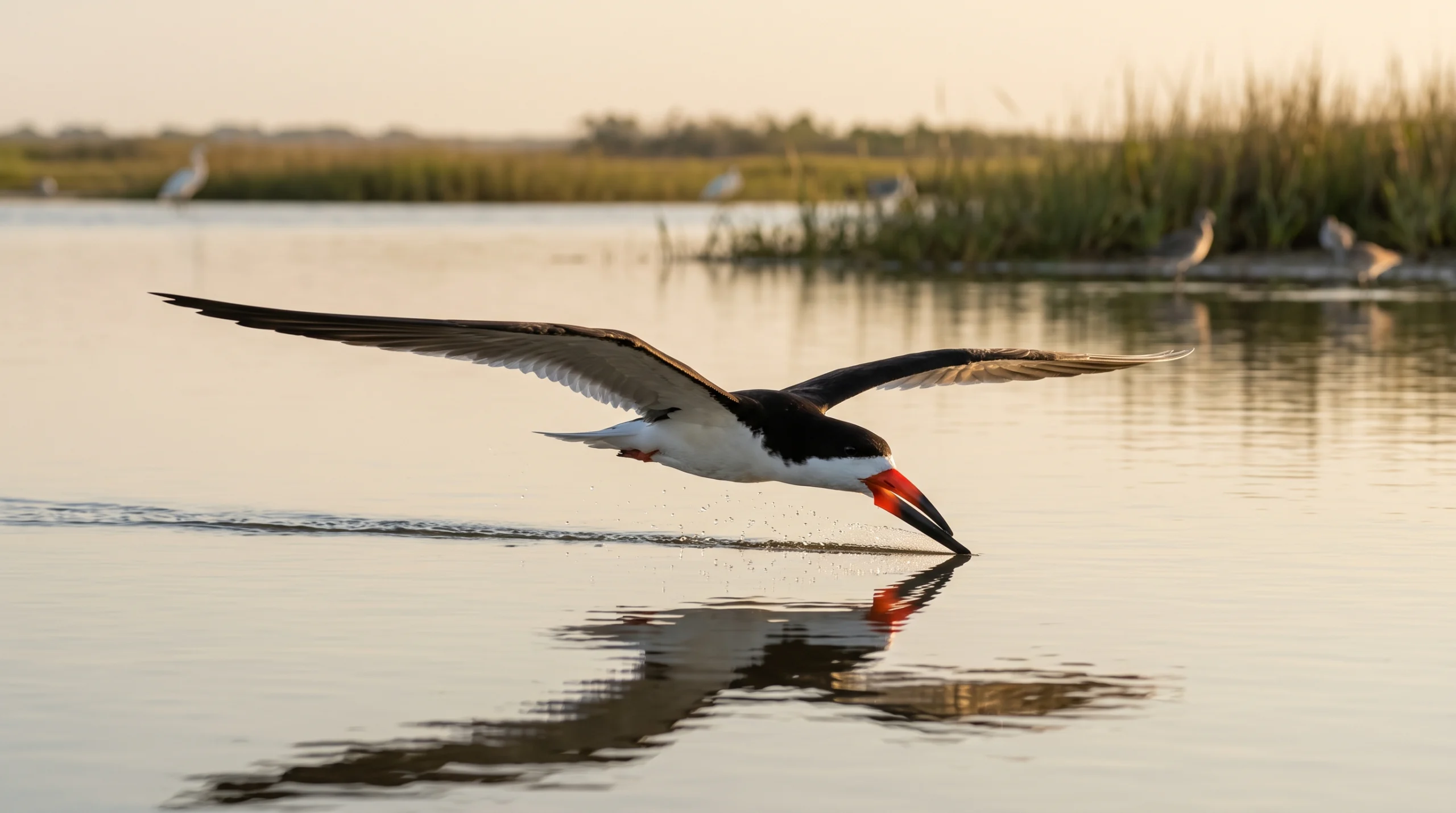
A Black Skimmer glides just above quiet coastal water, its long wings carrying its body only centimeters above the surface. The bird appears almost to be tracing a line across the water. Its lower bill is partly submerged, slicing continuously through the surface while the rest of the bird remains airborne.
Then contact occurs. The bill closes, the head and neck respond, and a small fish may be lifted from the water without the bird ever diving beneath it.
This extraordinary technique is known as skimming, and it is one of the most distinctive feeding behaviors among living birds. The Black Skimmer, Rynchops niger, has an unusually shaped bill specifically associated with this style of fishing. Rather than relying on a visual plunge toward a fish, it flies through a feeding area with its elongated lower mandible in the water and can respond rapidly when the bill contacts suitable prey.
Successful skimming requires far more than an unusual bill. Flight control, tactile information, vision, prey availability and the physical conditions at the water surface all contribute to a remarkably specialized feeding system.
A Bird Built for Surface Fishing
The Black Skimmer is immediately recognizable.
Adults combine a black upper body and cap with bright white underparts. Their wings are long and pointed, their legs relatively short, and their large bill is strikingly colored red-orange near the base and dark toward the tip.
Yet the bill’s proportions are even more distinctive than its colors.
Black Skimmers belong to the order Charadriiformes, the broad group containing gulls, terns, shorebirds and their relatives. In North America they are strongly associated with coastal environments, although the species as a whole occurs through a much larger portion of the Americas, and some South American populations use major freshwater river systems.
Their feeding behavior separates them dramatically from most familiar coastal birds.
A tern may hover and plunge into the water. A cormorant pursues fish underwater. A pelican can seize fish at or below the surface.
The Black Skimmer has developed another solution. It brings the water to its bill while continuing to fly.
The Black Skimmer’s Unequal Bill
An adult Black Skimmer has a feature that looks almost anatomically improbable.
Its lower mandible extends distinctly beyond the upper mandible.
This unequal arrangement is intimately connected with skimming. The long, narrow lower mandible is the part inserted into the water as the bird moves forward. The upper mandible remains above the surface until prey contact leads to closure of the jaws.
The lower mandible is also laterally compressed, producing a narrow profile for interaction with the water. Classic anatomical studies of skimmers have examined how the shape of the bill, skull and neck relates to this highly specialized feeding technique.
Researchers have even identified microscopic longitudinal structures on skimmer bills that have been investigated for their possible effects on fluid drag. Such findings illustrate how strongly the feeding apparatus interacts with the physical properties of water, although the contribution of individual surface structures to feeding performance should not be overstated.
A bill specialized through development
The extreme difference between the two mandibles is primarily an adult condition.
Young Black Skimmers do not hatch with the dramatically projecting lower bill of their parents. The upper and lower mandibles of newly hatched chicks are much closer in length.
As the bird develops, the lower mandible grows disproportionately, eventually producing the characteristic adult feeding apparatus.
That developmental transition is important because a newly hatched chick does not need to skim for itself. Adults initially supply food to their young. The specialized bill develops as the juvenile approaches the stage when independent feeding becomes increasingly important.
How Skimming Works
Skimming appears graceful from a distance, but mechanically it is a demanding interaction between a flying bird and water.
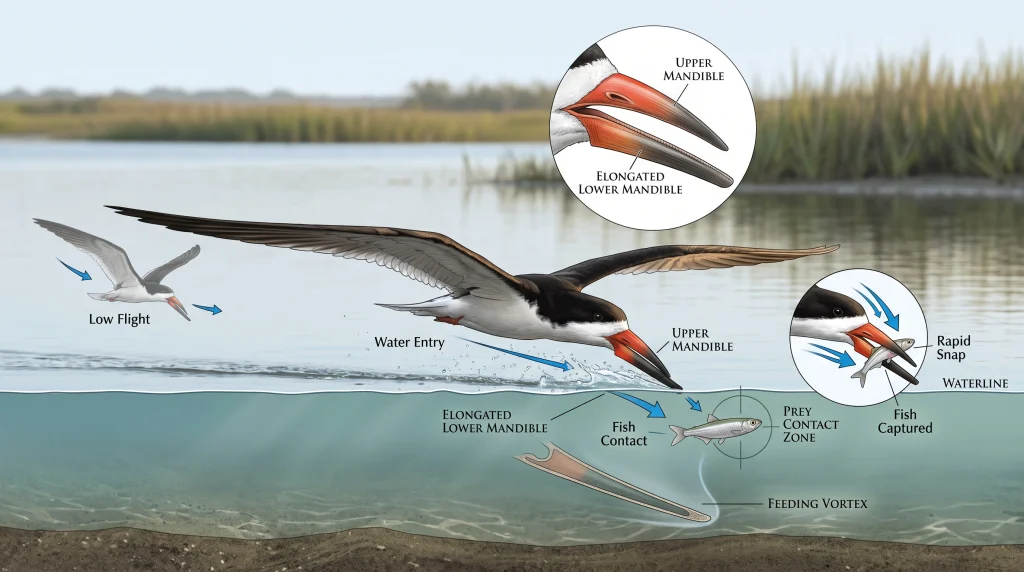
The basic sequence is straightforward.
The Black Skimmer approaches a suitable feeding area and flies very close to the water. It opens its bill and lowers the elongated lower mandible until the tip enters the surface.
It then continues flying forward.
The lower mandible cuts through the water while the bird maintains its low flight path. When the submerged portion encounters a suitable object such as a small fish, tactile contact triggers the feeding response.
The bird rapidly closes its bill and attempts to secure the prey.
Observations and biomechanical studies indicate that movement of the head and neck helps accommodate the sudden forces generated during prey contact. This is important because the bird is still moving forward when the lower mandible encounters an object.
The process should not be imagined as a bird simply flying with a rigid bill fixed in place.
Skimming requires continuous coordination among the wings, body, head, neck and jaws.
Fishing Without Diving Underwater
Many fish-eating birds cross the boundary between air and water during feeding.
Gannets and some terns plunge into the water from above. Cormorants and loons submerge themselves and chase prey underwater. Herons often stand or wade before striking at visible prey. Other seabirds seize food from the surface.
The Black Skimmer uses a fundamentally different approach.
During typical skimming, its body remains airborne.
Only the elongated lower mandible needs to penetrate the water. The bird can therefore sample a path through the surface layer while moving continuously across a feeding area.
This method is especially suited to prey occurring close enough to the surface to encounter the submerged lower bill.
It also means that a skimmer does not have to identify and visually target each individual fish before initiating its feeding maneuver.
Instead, it can maintain the skimming posture until tactile contact provides immediate information about something encountered by the bill.
The Challenge of Dragging a Bill Through Water
Water is far denser than air. Pushing even a narrow structure through it creates resistance.
A Black Skimmer therefore faces an unusual aerodynamic and hydrodynamic problem. Its wings and body move through air while part of its feeding apparatus simultaneously moves through water.
The shape of the lower mandible helps make this possible. Its narrow, laterally compressed form presents a relatively small frontal area as it moves through the surface.
Flight behavior is equally important.
Skimmers fly extremely close to the surface during feeding and constantly adjust their wings, body and head as conditions change.
Researchers studying skimmer flight have also examined potential energetic benefits of flying close to a surface. Flying within ground effect can alter aerodynamic performance because the nearby surface influences the airflow generated by the wings.
A 2024 study of foraging Black Skimmers further showed that the birds can exploit wind gradients close to the water during skimming flight, demonstrating how their behavior interacts with atmospheric conditions immediately above the surface.
These findings do not mean skimming is mechanically effortless. They instead demonstrate that the behavior occurs within a finely controlled relationship between flight and the physical environment.
Vision and Touch Work Together
The Black Skimmer is often described as a tactile feeder.
That description is accurate but can be misunderstood.
It does not mean the bird is effectively blind while fishing or that vision has no function during skimming.
The actual capture mechanism depends strongly on tactile information. As the lower mandible travels through the water, physical contact provides the immediate trigger associated with prey capture.
Research into Black Skimmer visual fields, however, suggests that vision remains relevant to the overall feeding system.
The position of the bill falls within the bird’s frontal visual field. Researchers have proposed that this visual arrangement can help skimmers control the position of the bill relative to the water and inspect items after capture.
More than a visual strike
This distinction is important.
A visually striking kingfisher can identify a fish and direct an attack toward its position. A skimming Black Skimmer does not necessarily need to see and individually target every fish before contact.
Tactile information becomes crucial once something meets the lower mandible.
Vision, meanwhile, can contribute to navigation, maintaining position over the surface, avoiding obstacles, locating promising feeding areas and dealing with captured objects.
Successful skimming is therefore best understood as a coordinated sensory and motor process rather than as either purely visual fishing or purely tactile fishing.
Feeding in Low Light
The importance of tactile feeding becomes particularly apparent after sunset.
Black Skimmers can forage around dawn and dusk and during nighttime conditions. Audubon and Cornell both note their ability to feed in darkness, while physiological research has examined adaptations of the Black Skimmer visual system to low-light activity.
A 1997 study comparing visual function in Black Skimmers and tactile-feeding ibises found substantial differences consistent with stronger nocturnal visual capabilities in the skimmer.
This creates an important nuance.
Tactile prey contact means the Black Skimmer does not need excellent visual resolution of each fish for the capture mechanism to work. At the same time, nocturnal visual adaptations can still help the bird navigate and control its flight under low illumination.
Night feeding therefore does not demonstrate that vision is irrelevant.
Instead, it shows the advantage of a feeding method in which final prey contact can be detected mechanically even when visual conditions are limited.
What Black Skimmers Eat
Fish dominate the Black Skimmer’s diet.
The bird generally takes relatively small fish occurring near the surface, exactly where its submerged lower mandible is most likely to encounter them. Audubon also reports small crustaceans as part of the diet.
The particular prey species available to a skimmer naturally vary among regions and habitats.
An estuary on the Atlantic coast does not contain the same fish community as a South American river. Tides, seasons, water depth, salinity and local prey movements can all change which organisms become available near the surface.
The feeding apparatus therefore specializes the bird for a particular location in the water column rather than for one specific fish species.
Anything suitable must be accessible to the bill and manageable as prey.
Habitats That Support Skimming
Black Skimmers occupy a wide range of aquatic environments across the Americas.
In coastal regions they use estuaries, bays, lagoons, tidal creeks, inlets and other shallow or relatively protected waters. Elsewhere in their range they also occur along large rivers, lakes and associated freshwater habitats.
The key requirement for feeding is not simply the presence of water.
Suitable prey must occur close to the surface, and physical conditions must allow the bird to maintain controlled low flight while skimming.
Relatively calm and shallow waters can provide especially favorable opportunities. Low tides may concentrate fish or make surface-feeding areas more accessible in some environments.
Wind matters as well.
Strongly disturbed water changes the surface that the lower mandible must follow. Wind also changes the aerodynamic conditions encountered by a bird flying only a short distance above the water.
The feeding landscape of a Black Skimmer is therefore dynamic. Tides, wind, light and prey movements can all affect when and where skimming becomes profitable.
Black Skimmer Chicks Are Born With Different Bills
A colony of Black Skimmers offers a striking demonstration that their unusual feeding anatomy must develop.
The chicks hatch on the ground, usually in shallow nest scrapes on open sandy or similar substrates.
Their bills initially look far more conventional than those of adults.
The two mandibles are approximately similar in length during the earliest stages. As development proceeds, the lower mandible becomes increasingly elongated relative to the upper one.
This change reflects the different feeding requirements of chicks and adults.
Young chicks receive food from their parents rather than immediately performing the difficult aerial skimming technique themselves. As their flight abilities and independence develop, their feeding apparatus increasingly takes on adult proportions.
The familiar Black Skimmer bill is therefore not merely a species identification feature. Its growth accompanies the transition toward an exceptionally specialized adult way of obtaining food.
Black Skimmers and Their Relatives
The Black Skimmer belongs to a tiny and highly distinctive group of birds.
Traditionally, skimmers are placed in the family Rynchopidae, although some modern classifications place the genus Rynchops within the broader gull and tern family Laridae.
Three living skimmer species are generally recognized.
The Black Skimmer, Rynchops niger, occurs in the Americas. The African Skimmer, Rynchops flavirostris, occurs in sub-Saharan Africa, while the Indian Skimmer, Rynchops albicollis, occurs in South Asia.
All share the fundamental feeding specialization associated with an elongated lower mandible and low skimming flight.
The geographic separation of the species makes their common feeding architecture particularly notable. Few living birds have taken surface fishing to such an anatomical extreme.
Why This Feeding Strategy Matters
The Black Skimmer provides an unusually clear illustration of the connection between anatomy and behavior.
Its lower mandible makes little sense when considered separately from its feeding behavior. Skimming, in turn, depends on the specialized bill.
The wings maintain low controlled flight. The bill samples the surface layer. Tactile information signals contact. The neck and jaws respond during capture. Vision contributes to flight control and the broader sensory task.
None of these elements operates in isolation.
Natural selection can favor combinations of anatomical and behavioral characteristics that improve performance in particular ecological circumstances. The Black Skimmer is a powerful example because its specialization is visible immediately in both its anatomy and its behavior.
The precise historical sequence by which skimming evolved should not be reconstructed from modern anatomy alone. Fossils, phylogenetic relationships and comparative anatomy are required to evaluate specific evolutionary scenarios.
What the living birds demonstrate clearly is the extraordinary degree to which a feeding behavior and a physical structure can become functionally integrated.
Threats Along the Coast
The same dependence on shorelines and shallow aquatic environments that supports Black Skimmer feeding also creates conservation challenges.
Black Skimmers frequently nest colonially on open beaches, sandbars, shell banks and similar exposed areas. These habitats can be affected by human recreation, coastal development, vehicles, predators, flooding and severe weather.
Disturbance is particularly problematic during breeding because eggs and young chicks are located directly on the ground.
Changes to coastal and estuarine ecosystems can also alter feeding habitat and prey availability.
In the United States, the Black Skimmer is included by the U.S. Fish and Wildlife Service among Birds of Conservation Concern. This designation identifies species that warrant conservation attention and should not be confused with federal Endangered Species Act listing.
Protecting nesting areas from unnecessary disturbance while maintaining healthy estuaries, beaches, islands and shallow-water feeding habitats can therefore benefit the species.
A Remarkable Combination of Anatomy and Behavior
The Black Skimmer’s feeding system begins with one of the strangest bills among modern birds.
Yet the elongated lower mandible alone does not explain its success.
The bird must hold a precise flight path immediately above a moving surface. It must keep part of its bill submerged despite water resistance. It must process tactile contact and coordinate movements of the head, neck and jaws while continuing to fly.
Vision still contributes to the larger task, particularly for flight control and orientation, even though the final encounter with prey is strongly tactile.
The result is not a bird blindly dragging its bill through the water, nor a conventional visual predator chasing individual fish.
It is a specialized sensory and motor system built around continuous surface contact.
A Specialized Flight Across the Water
Near sunset, a Black Skimmer crosses a quiet estuary.
Its long wings beat above the reflected sky while its body remains suspended in the air. Below, only the projecting lower mandible breaks the surface, drawing a narrow line through the water.
From a distance, the movement looks effortless.
Biologically, it is anything but simple.
The unusual bill, controlled low-altitude flight, tactile detection of prey, visual information and rapid feeding response must operate together. Conditions at the water surface and the presence of appropriately positioned prey determine whether the technique can succeed.
The Black Skimmer does not need to plunge beneath the surface to pursue a fish.
Instead, evolution has produced a bird capable of bringing flight and fishing together at the boundary between air and water, using one of the most distinctive feeding adaptations found among living birds.
Sources and Further Reading
Cornell Lab of Ornithology — All About Birds, Black Skimmer. Species overview covering identification, habitat, feeding behavior and natural history.
National Audubon Society — Black Skimmer Field Guide. Natural-history account covering skimming behavior, diet, habitat and breeding biology.
Rojas, L. M., McNeil, R., Cabana, T., & Lachapelle, P. — 1997. “Diurnal and Nocturnal Visual Function in Two Tactile Foraging Waterbirds: The American White Ibis and the Black Skimmer.” The Condor, 99, 191–200. Research examining visual function associated with daytime and nighttime activity in tactile-foraging birds.
Martin, G. R., & Katzir, G. — Vision and the foraging technique of skimmers. Research examining Black Skimmer visual fields and the relationship between vision, bill positioning and tactile feeding.
Wind gradient exploitation during foraging flights by Black Skimmers — 2024. A modern experimental study examining how Rynchops niger interacts with wind gradients during its specialized low-altitude skimming flights.
U.S. Fish and Wildlife Service — Black Skimmer, Rynchops niger. Federal conservation information identifying the species as a Bird of Conservation Concern in the continental United States.