
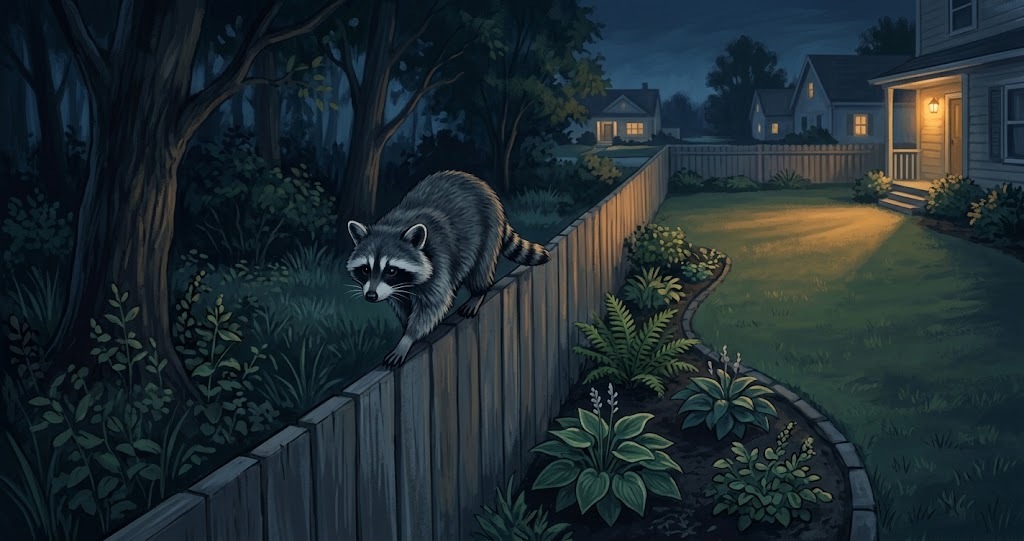
The trash can that went untouched in June suddenly tips over twice in one week. Something empties the bird feeder after dark, grapes disappear from the garden, and the security camera keeps recording a masked visitor crossing the patio. There are biological reasons you may notice raccoons more active late summer, especially as the season begins shifting toward fall.
Raccoons are adaptable, mostly nocturnal omnivores that take advantage of whatever food is easiest to obtain. During late summer and fall, they feed heavily as seasonal foods become available and build fat reserves that help carry them through periods of reduced winter activity. Young raccoons are also becoming increasingly mobile during this part of the year.
For homeowners, the solution isn’t trapping or confronting them. It is making the property less rewarding by removing reliable food sources and preventing access to buildings before a raccoon decides that your yard is worth visiting every night.
Table of Contents
- Why Raccoons Seem Busier in Late Summer
- Why Raccoons Build Fat Before Winter
- Why Late-Summer Nights Mean More Foraging
- Young Raccoons Add to the Activity
- What Raccoons Are Looking for in Your Yard
- Why One Successful Visit Can Lead to Another
- How to Secure Trash Properly
- Bird Feeders and Raccoons
- Pet Food, Compost, and Fallen Fruit
- Preventing Raccoons From Denning Around Your Home
- How to Seal Potential Den Entrances Safely
- What Not to Do Around Raccoons
- Does Daytime Activity Mean Rabies?
- Frequently Asked Questions
- Final Thoughts
Why Raccoons Seem Busier in Late Summer
Raccoons (Procyon lotor) are active throughout the year and do not truly hibernate. Their activity, however, changes with weather, food availability, reproduction, and season.
MassWildlife describes raccoons as highly adaptable opportunistic omnivores. They eat foods ranging from berries, nuts, and seeds to insects, crayfish, eggs, and other animal matter, and readily exploit human food sources such as garbage, pet food, crops, and chicken coops. (Massachusetts Government)
They are primarily nocturnal and crepuscular, meaning much of their activity occurs at night and around dawn and dusk. (Massachusetts Government)
That basic lifestyle helps explain why increased activity around a home may initially go unnoticed.
A raccoon can visit after everyone has gone to bed, investigate several food sources, and leave before sunrise. Unless it knocks over a garbage can or triggers a camera, you may never know it was there.
Late summer can make those visits much more obvious.
Why Raccoons Build Fat Before Winter
One of the most important seasonal changes is preparation for colder weather.
The Pennsylvania Game Commission explains that by late autumn raccoons have accumulated a substantial layer of fat that helps sustain them through winter. Unlike animals that store caches of food, raccoons depend partly on body reserves during periods when severe weather keeps them in their dens. (Gouvernement de Pennsylvanie)
The process begins before winter actually arrives.
Wildlife-management guidance describes raccoons as accumulating large fat deposits during late summer and fall. Those reserves become particularly important because raccoons are not true hibernators, yet they can remain inactive in dens for extended periods during harsh winter weather. (Gouvernement de Pennsylvanie)
This shouldn’t be confused with the extreme hyperphagia associated with black bears. Raccoons and bears have different winter biology.
Still, both demonstrate an important ecological principle: seasonal food availability and approaching winter can strongly influence feeding behavior.
For comparison, our guide Why Black Bears Eat Almost Nonstop in Late Summer explains how bears undergo a much more pronounced seasonal feeding phase before denning.
With raccoons, the important point for homeowners is simpler. Late summer and fall are important feeding periods, and a backyard full of easy calories can become especially attractive.
Raccoons More Active Late Summer: Why Nighttime Foraging Increases
A raccoon’s menu changes with what is available.
The Pennsylvania Game Commission lists fruits, berries, apples, corn, acorns, beechnuts, insects, crayfish, frogs, eggs, and numerous other foods as part of the raccoon’s highly varied diet. (Gouvernement de Pennsylvanie)
Late summer can therefore be a productive time.
Fruit is ripening. Vegetable gardens are mature. Corn may be available in agricultural landscapes. Invertebrates remain active. As the season progresses, nuts and other fall foods become increasingly available.
Human neighborhoods add another layer of opportunity.
Garbage contains calorie-rich scraps. Bird seed accumulates beneath feeders. Outdoor pet dishes offer concentrated food requiring virtually no searching. Compost piles may contain kitchen scraps, and fruit trees can scatter ripe fruit across the ground.
For an opportunistic omnivore, these are valuable resources.
A raccoon doesn’t understand that the bird seed belongs to chickadees or that the cat food was intended for a pet. It simply encounters food.
Young Raccoons Add to Late-Summer Activity
Seasonal behavior isn’t only about adults preparing for winter.
Spring-born young are also becoming increasingly active.
MassWildlife notes that raccoon cubs are typically born in spring, become active within their first couple of months, and are weaned by late summer. They become progressively more independent as the year advances, although family groups can remain together into colder weather. (Massachusetts Government)
A female with growing young has substantial energetic demands, while those young are learning where food can be found.
This can make family groups particularly noticeable.
A security camera may record several raccoons traveling together rather than one solitary adult. Tracks around garbage cans may multiply, and more than one animal may appear beneath a bird feeder.
This is another reason raccoons more active late summer doesn’t necessarily mean the local population suddenly exploded.
Some of the animals were already nearby. They are simply larger, more mobile, and easier to notice.
What Raccoons Are Looking for in Your Yard
Raccoons thrive around people because suburban landscapes can provide three things wildlife needs: food, water, and shelter.
The food list is often longer than homeowners realize.
Garbage is obvious, but spilled bird seed, suet, outdoor pet food, fallen apples, ripe melons, sweet corn, unsecured compost, chicken feed, and other edible materials can all attract opportunistic wildlife.
Raccoons are remarkably versatile eaters.
Illinois Department of Natural Resources lists berries, corn, fruits, insects, fish, crayfish, nuts, small mammals, turtles, garbage, and other foods in the raccoon diet. It also notes that the species commonly occupies urban environments when food, water, and suitable den sites are available. (dnr.illinois.gov)
Shelter can be equally important.
Attics, chimneys, crawl spaces, barns, sheds, decks, and spaces beneath porches can resemble the protected cavities raccoons use naturally.
A property offering both food and shelter is particularly attractive.
Why One Successful Visit Can Lead to Another
A garbage raid may look random the first time.
If the raccoon receives a substantial food reward, however, the location remains worth investigating.
Wildlife doesn’t need to understand property boundaries to learn where resources occur. An animal moving through its normal feeding range can repeatedly check productive locations.
The Pennsylvania Game Commission notes that raccoons typically use central dens as well as additional dens scattered throughout their feeding ranges and travel at night in search of food. (Gouvernement de Pennsylvanie)
This is why prevention works best before a pattern becomes established.
If the trash can opens every night, the raccoon has little reason to stop checking it.
If the lid never opens and there is nothing edible nearby, the property becomes less rewarding.
Secure Trash Before Anything Else
For many homes, garbage management is the most important step.
MassWildlife specifically recommends keeping garbage in tightly closed containers and putting trash outside on the morning of collection rather than the previous evening. Compost should also be kept in secure containers. (Massachusetts Government)
MassWildlife — Learn About Raccoons
Don’t assume that simply placing a lid loosely on a can is enough.
Raccoons have dexterous front paws and are skilled at manipulating objects. A container that can be knocked over and opened isn’t genuinely secure.
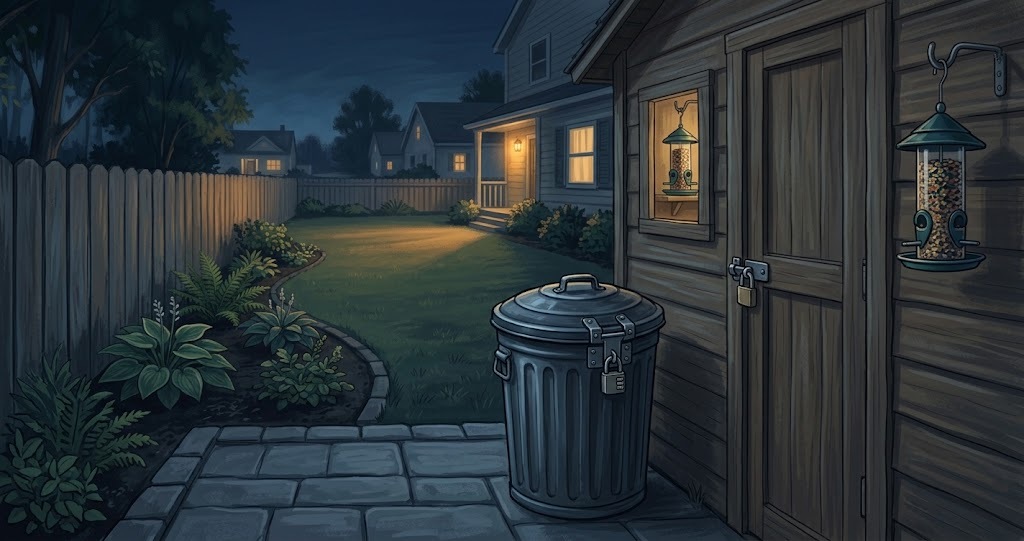
Use a durable container with a tightly fitting lid. Where appropriate, secure the lid with a suitable locking mechanism or strong fastener.
If possible, store garbage inside a secure garage, shed, or other protected location until collection day.
The goal isn’t to make the raccoon afraid of the trash can. The goal is to make opening it unsuccessful.
Bring Bird Feeders In at Night
Bird feeders are another commonly overlooked wildlife attractant.
The problem isn’t limited to a raccoon physically climbing onto the feeder. Seed falling onto the ground can create a concentrated food source accessible to many mammals.
Illinois wildlife guidance recommends cleaning up beneath bird feeders and avoiding outdoor food sources that encourage nuisance wildlife. (dnr.illinois.gov)
If raccoons are repeatedly visiting your feeding station, bring feeders indoors before evening and return them in the morning.
Clean up spilled seed underneath them as well.
This is especially useful when you are seeing raccoons more active late summer around the same part of the yard each night.
Simply hanging a feeder higher may not solve the problem. Raccoons are excellent climbers and surprisingly capable problem-solvers.
Removing the nighttime reward is more dependable.
Don’t Leave Pet Food Outside
A bowl of dog or cat food may be one of the most calorie-dense meals a raccoon encounters all night.
MassWildlife advises feeding pets indoors and not leaving pet food outside because it attracts raccoons and other wildlife. (Massachusetts Government)
Water bowls can also attract animals, although food is generally the more significant reward.
Feed pets indoors whenever possible. If outdoor feeding is unavoidable, remove the food and clean up leftovers immediately afterward rather than leaving dishes outside overnight.
Never intentionally feed raccoons.
Regular feeding can encourage wildlife to associate homes and people with food, increasing the likelihood of conflicts.
Pick Up Fallen Fruit and Protect the Garden
Fruit trees can quietly become wildlife feeding stations.
Apples, pears, plums, grapes, berries, and other fruits are all potential raccoon foods. The Pennsylvania Game Commission specifically documents numerous fruits and plant foods in their diet. (Gouvernement de Pennsylvanie)
Harvest ripe produce promptly and collect fallen fruit from the ground.
If raccoons repeatedly enter a vegetable garden, physical exclusion is preferable to attempting to frighten or harm them.
Chicken coops require particularly careful protection. MassWildlife recommends secure enclosures designed to prevent entry from both above and below. (Massachusetts Government)
Feed should also be stored in wildlife-resistant containers.
Compost Can Be an Unintentional Food Source
A poorly managed compost pile can contain exactly what a hungry omnivore wants.
Food scraps placed in an open pile may attract raccoons as well as rodents and other mammals.
Use a secure composting system where wildlife conflicts are common.
MassWildlife recommends secure, vented compost containers to prevent raccoon access. (Massachusetts Government)
You don’t need to stop composting. You simply need to prevent the compost system from becoming an all-night buffet.
Prevent Raccoons From Moving Into the House
Food isn’t the only reason raccoons approach homes.
Buildings can provide excellent denning opportunities.
MassWildlife advises homeowners to close openings beneath porches and buildings, seal entrances leading to sheds and attics, and appropriately cap chimneys. (Massachusetts Government)
Inspect your home before cold weather arrives.
Look for damaged soffits, loose vents, uncapped chimneys, openings near rooflines, gaps beneath decks, and deteriorated sections that could provide access.
However, exclusion must be done carefully.
Never seal an opening until you are certain no animal is inside. Closing an entrance while a raccoon—or a female with dependent young—is occupying the space can create a much more serious animal-welfare and property problem.
MassWildlife specifically cautions that exclusion should be performed properly so animals aren’t trapped inside or separated from dependent young. (Massachusetts Government)
If you suspect an occupied den, contact an appropriate wildlife professional or your state wildlife agency for guidance.
Don’t Confront a Raccoon
A raccoon passing through a yard doesn’t need to be chased, cornered, or handled.
Give it space and remove whatever attracted it after the animal leaves.
Illinois Department of Natural Resources guidance recommends observing wildlife from a distance and specifically advises against approaching, touching, cornering, or trapping raccoons and other wild animals. (dnr.illinois.gov)
Keep dogs controlled and bring small pets indoors when raccoons are active nearby.
If an animal has entered a building, appears trapped, or is behaving in a way that creates an immediate safety concern, contact local animal control, a licensed wildlife-control professional, or your state wildlife agency rather than attempting hands-on removal.
Does Seeing a Raccoon During the Day Mean Rabies?
Not necessarily.
This is an important misconception because raccoons are commonly described as nocturnal.
MassWildlife states clearly that raccoons can be active during daylight when food is available and that daytime activity by itself does not indicate disease. (Massachusetts Government)
A female caring for young, an animal moving between shelters, or a raccoon taking advantage of an available food source may appear during the day.
Behavior matters more than the clock.
MassWildlife notes that neurological signs associated with rabies can include uncoordinated movement, unusual lethargy, or unprovoked aggression. (Massachusetts Government)
Never approach an animal to determine whether it is sick.
Keep your distance and contact local authorities if a raccoon appears seriously ill, injured, unusually aggressive, or unable to move normally.
Raccoons Don’t Truly Hibernate
Another common misconception is that raccoons disappear completely once winter arrives.
They don’t.
Raccoons remain active year-round, although severe cold can cause them to remain in dens for several days. (Massachusetts Government)
The Pennsylvania Game Commission similarly explains that raccoons are not true hibernators. Their accumulated fat helps sustain them during winter periods when they remain inactive and food is harder to obtain. (Gouvernement de Pennsylvanie)
That makes late-summer and fall fat accumulation biologically useful.
It also explains why removing backyard food sources is preferable to assuming raccoon activity will automatically disappear after the first frost.
Frequently Asked Questions
Why are raccoons more active in late summer?
Several seasonal factors overlap. Raccoons feed heavily during late summer and fall as they accumulate fat that helps sustain them through winter, while spring-born young are becoming larger and more mobile. Seasonal fruits, crops, insects, nuts, and human food sources can also provide abundant foraging opportunities. (Gouvernement de Pennsylvanie)
Why does a raccoon keep coming back every night?
Your property may contain a dependable food source.
Garbage, pet food, bird seed, fallen fruit, compost, chicken feed, or ripe garden produce can reward repeated visits.
Remove the reward rather than trying to frighten the animal temporarily.
Should I stop feeding birds if raccoons appear?
You don’t necessarily need to abandon bird feeding permanently.
If raccoons are visiting at night, bring feeders indoors before evening, clean spilled seed from underneath the feeding station, and put feeders back out during daylight.
How can I keep raccoons out of my trash?
Use durable containers with tightly secured lids and, when possible, keep them inside a secure structure until collection morning.
Don’t leave bags of garbage exposed outdoors overnight.
Can raccoons live under a porch?
Yes. Raccoons can use human structures as den sites, including spaces associated with porches, sheds, attics, barns, and chimneys. (Massachusetts Government)
Before sealing an entrance, make absolutely sure no raccoon or dependent young are inside.
Should I trap a raccoon that visits my yard?
A raccoon simply passing through or looking for food generally doesn’t require trapping.
Wildlife-control laws vary by state, and relocating wildlife can create additional welfare, disease, and legal issues. Start by removing attractants and preventing access to buildings, following guidance from your state wildlife agency when intervention is necessary.
Are raccoons dangerous to pets?
Wild raccoons should be given space.
Keep pet food indoors, supervise pets outside where raccoons are active, and don’t allow dogs to chase or corner wildlife. Keeping pets appropriately vaccinated is also an important part of responsible pet care.
Final Thoughts
Seeing raccoons more active late summer isn’t necessarily evidence that something has gone wrong with the local wildlife.
Raccoons are naturally opportunistic, primarily nocturnal foragers. As late summer transitions toward fall, feeding helps them accumulate fat reserves that will be valuable during periods of winter inactivity. At the same time, growing young are becoming more mobile and seasonal foods are increasingly available. (Gouvernement de Pennsylvanie)
Problems usually begin when natural foraging overlaps with easy human-provided food.
An unsecured trash can, overflowing bird feeder, outdoor pet dish, open compost pile, or fallen fruit can turn an occasional nighttime visitor into a persistent one.
The most effective response is also the least invasive.
Secure garbage. Bring feeders indoors at night when raccoons are visiting. Feed pets inside. Pick up fallen fruit. Protect poultry and animal feed. Inspect buildings for potential den entrances, but never seal an opening until you know it is unoccupied.
You don’t need to eliminate raccoons from the neighborhood.
You simply need to teach them, through consistent lack of reward, that your backyard isn’t the easiest place to find dinner.
Internal Link Suggestions:
Why Black Bears Eat Almost Nonstop in Late Summer
Why You’re Seeing More Lone Coyotes
External Dofollow Authoritative Sources:
Massachusetts Division of Fisheries and Wildlife — Learn About Raccoons
https://www.mass.gov/info-details/learn-about-raccoons
Pennsylvania Game Commission — Raccoon
https://www.pa.gov/agencies/pgc/wildlife/discover-pa-wildlife/raccoon
Illinois Department of Natural Resources — Raccoon
https://dnr.illinois.gov/education/wildaboutpages/wildaboutwildmammals/wildaboutmammalscarnivores/wawmraccoon.html