
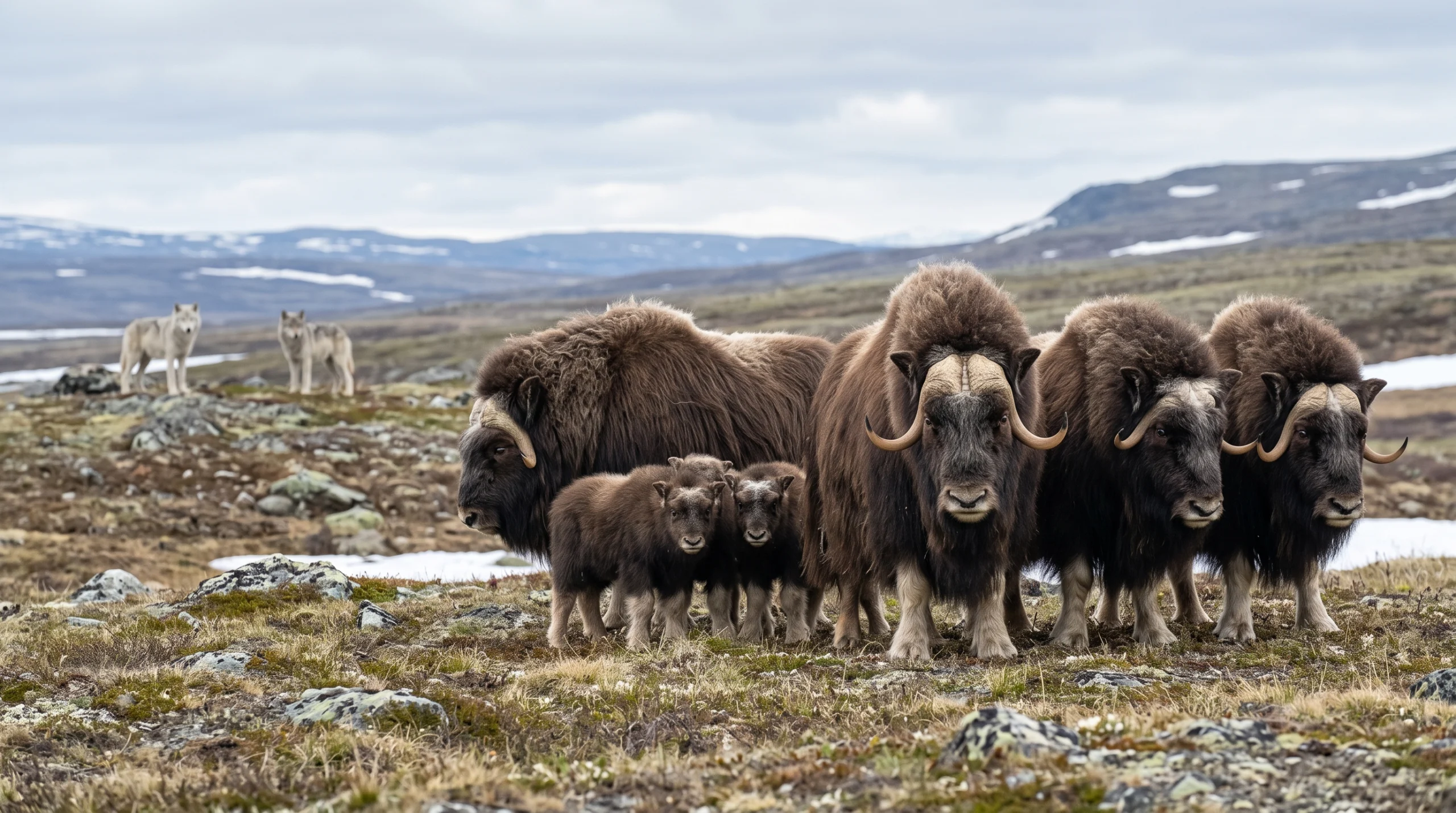
Across an open Arctic landscape, a group of musk oxen notices wolves approaching in the distance. The herd becomes more compact. Large adults turn toward the threat, while younger and more vulnerable animals become less exposed.
This scene has produced one of the most famous descriptions of Arctic wildlife behavior: musk oxen supposedly forming a perfect defensive circle, calves in the exact center and adults locking their horns together into an impenetrable wall.
The reality is more interesting.
Musk ox defense is flexible rather than geometrically perfect. Depending on the direction of danger, terrain, herd composition, and predator behavior, musk oxen may bunch together, form a line or arc, create a roughly circular formation, move as a group, or make defensive advances.
The underlying principle remains remarkably effective: powerful adults can place themselves between vulnerable calves and a predator, making an attack considerably more difficult.
When Running Isn’t the Only Option
Many prey animals respond to predators by fleeing.
Musk oxen have another option.
When wolves approach, a musk ox herd can use cohesion, large adult bodies, and formidable horns to create a collective defense. Instead of immediately scattering across the tundra, individuals may gather more tightly and confront the approaching threat.
Calves can then occupy safer positions within or behind the adults.
This strategy matters because wolves benefit when they can isolate vulnerable prey. A compact group makes that much harder.
Yet a defensive musk ox herd should not be imagined as a frozen fortress.
Individuals continue watching and reacting to predators. Adults can change orientation as wolves move. The formation itself may shift, tighten, open, or move.
It is an active interaction between predators and prey.
Meet the Musk Ox
The musk ox, Ovibos moschatus, is one of the most recognizable large mammals of the Arctic.
Despite its common name, it is not an ox in the same sense as domestic cattle. Musk oxen are bovids and belong to the caprine branch of the family, making their evolutionary relationships closer to animals such as goats and sheep than their heavy, cattle-like appearance might suggest.
Today, musk oxen occur in Arctic and sub-Arctic regions, including parts of Greenland, Canada, and Alaska, with additional populations established through introductions or reintroductions in some northern regions.
Their environment can be exceptionally demanding.
Long winters, strong winds, deep or hardened snow, limited seasonal vegetation, and extreme cold all influence their ecology.
One of their most important adaptations is their coat.
Beneath the long outer guard hairs is exceptionally insulating underwool known as qiviut. This insulation helps musk oxen conserve heat during severe Arctic conditions.
Adults also possess massive horn structures that curve downward beside the head before sweeping outward and upward. Those horns are important in social interactions and can also become formidable defensive weapons.
Combined with their tendency to live socially, these physical characteristics give musk oxen options that smaller prey animals do not possess.
Why Calves Need the Herd
A newborn musk ox may be mobile surprisingly quickly, but mobility does not make it equivalent to an adult.
Calves are smaller, less experienced, and far less capable of physically confronting a large predator.
Their vulnerability creates a major challenge during encounters with wolves.
Maternal behavior is particularly important. A cow can remain close to her calf and position herself in relation to approaching danger. But protection can extend beyond a simple mother-calf pair when several herd members become part of a compact defensive formation.
That does not mean every adult is consciously acting as a babysitter.
Individual musk oxen respond to threats according to their own position, condition, social circumstances, and the movement of nearby animals. Collectively, however, those responses can produce a formation in which calves have substantially less exposure to predators.
The distinction matters.
An effective group defense does not require human-like planning.
What Happens When Wolves Approach?
There is no single rigid sequence that every musk ox herd follows.
A realistic encounter can begin with vigilance.
One or more animals detect approaching wolves and monitor them. As the perceived threat becomes more immediate, spacing between herd members may decrease.
Vulnerable animals can become positioned away from the exposed edge, while adults orient themselves toward the danger.
If wolves move around the herd, musk oxen may change position as well.
A defensive group can therefore shift between several configurations rather than maintaining one shape.
At close range, adults may make short advances or charges. Under other circumstances, the herd may move away while attempting to remain cohesive.
The response depends on context.
That flexibility is essential for understanding the behavior.
Do Musk Oxen Really Form a Perfect Circle?
Musk oxen really are capable of forming compact defensive formations, and circular or ring-like arrangements have long been associated with their antipredator behavior.
The mistake is turning that observation into an absolute rule.
Real animals do not arrange themselves according to a diagram.
A defensive formation can be roughly circular when threats are approaching from several directions. In other situations, musk oxen may form a line, arc, semicircular front, dense cluster, or another arrangement suited to the position of the predators and the landscape.
If wolves are primarily on one side, there may be little advantage in maintaining a mathematically perfect ring.
Terrain also matters.
A herd near a slope, riverbank, snowdrift, or other landscape feature does not face the same spatial problem as animals surrounded on flat, open tundra.
The familiar musk ox defensive circle is therefore a useful description of one recognizable configuration—not a mandatory formation performed identically during every predator encounter.
Adults Outside, Calves in Safer Positions
Whatever the exact geometry, the protective principle is straightforward.
A healthy adult musk ox is a much more dangerous target than a young calf.
By keeping large adults between predators and vulnerable herd members, the group creates a serious obstacle.
Calves can become concentrated toward the interior or otherwise remain on a protected side of the formation. Mothers may maintain close proximity to their offspring while the positions of other adults further restrict predator access.
This does not make the calf unreachable.
Wolves can continue moving around the group, watching for openings and responding to changes in the herd.
But reaching a calf may now require passing close to a large adult equipped with horns and capable of charging.
That changes the predator’s risk.
Horns Turn the Herd’s Edge Into a Serious Obstacle
The horns of an adult musk ox are visually impressive, but their defensive value comes from more than appearance.
The horns emerge from a heavy base on the skull, curve downward alongside the head, and then sweep outward and upward.
When an adult faces a predator, those horns become part of the defensive front.
A wolf approaching too closely must account for the possibility of a rapid head movement or charge.
This helps explain why adult orientation matters.
A predator facing the head and horns of a musk ox confronts a very different situation from one approaching an unprotected calf.
However, popular illustrations sometimes exaggerate this behavior by showing adults literally locking or overlapping their horns to create a continuous fence.
That is not necessary to explain the defense.
The barrier is created primarily by the proximity, orientation, size, and readiness of multiple powerful animals—not by constructing a physically interlocked wall of horn.
Why Wolves Don’t Simply Charge Into the Group
A predator’s goal is to obtain food without suffering an injury serious enough to compromise future survival.
That makes a compact group of adult musk oxen a difficult proposition.
Wolves can observe a herd before committing to close contact. They may approach, retreat, change direction, circle around animals, or provoke movement.
These behaviors should not be described as a consciously designed military plan.
They emerge from predator behavior shaped by experience, immediate opportunities, and natural selection.
A wolf can benefit when prey moves.
Movement may expose differences among individuals. A calf may fall behind. An animal in poorer physical condition may become apparent. Cohesion can weaken.
Instead of blindly attacking the most dangerous part of the formation, wolves can continue testing the situation for a better opportunity.
Predation is therefore an interaction.
Each side responds to what the other is doing.
The Importance of Keeping the Herd Together
Collective defense works best when vulnerable animals remain close to animals capable of defending themselves.
Separation changes the balance.
A calf alone on open ground lacks the surrounding adults that make a compact herd difficult to approach.
The same can apply to an injured, weakened, or otherwise vulnerable individual.
Predators can therefore benefit from circumstances that disrupt cohesion.
That does not mean wolves always deliberately “break the formation” according to a predetermined strategy. Their movements and attacks can nevertheless create conditions in which herd members move, and movement can sometimes produce separation.
For musk oxen, staying close maintains the physical advantages of group defense.
The result resembles a general principle seen in many social prey species: the group can change the risks faced by each individual.
When a Musk Ox Charges
A defensive formation is not necessarily stationary.
An adult musk ox may advance or charge when a predator approaches too closely.
Such movements can force wolves to retreat, alter direction, or increase their distance.
The effectiveness of a charge does not depend on an adult pursuing a wolf over a great distance.
A relatively short defensive advance can restore space between predator and herd.
This creates a dynamic boundary.
Wolves approach and evaluate. Musk oxen orient toward them. A predator moves sideways. Adults reposition. A wolf comes closer, and a musk ox may advance.
The interaction can continue as each side responds to changing circumstances.
This is why the popular image of motionless adults surrounding motionless calves captures only part of the behavior.
Is This Behavior Cooperative?
At the group level, musk ox defense clearly can have a cooperative effect.
Multiple adults participating in a compact formation can make it harder for predators to reach vulnerable animals.
But words such as “courage,” “sacrifice,” and “military coordination” add human motives that are difficult to demonstrate scientifically.
Collective defense does not require the animals to understand the formation as humans would.
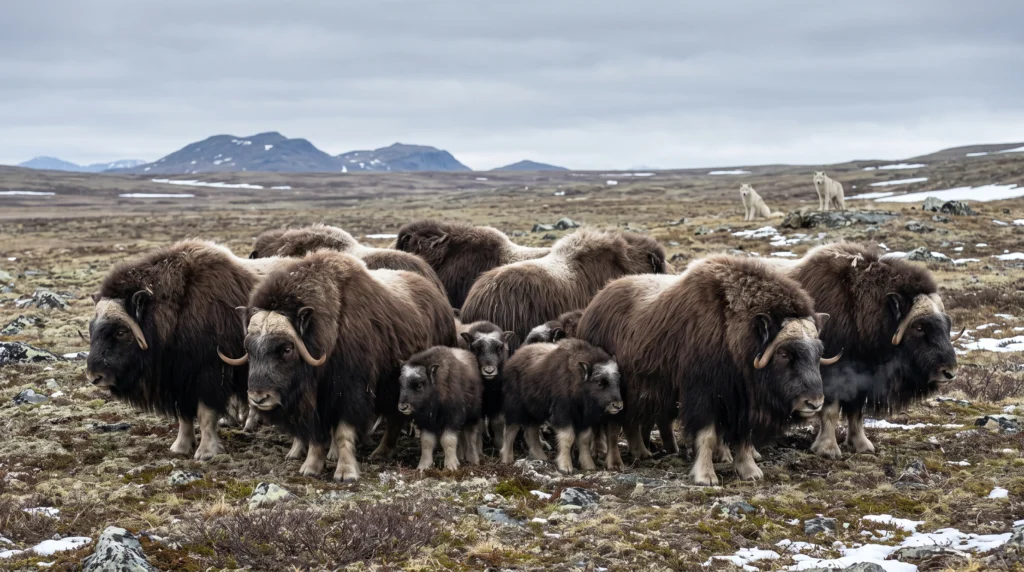
Imagine several individuals responding to the same threat by staying near companions, facing the predator, maintaining proximity to calves, and defending themselves when approached.
Those individual actions can automatically produce an effective group-level defense.
Natural selection can favor behaviors that improve survival and reproductive success without animals consciously calculating the evolutionary benefits of cooperation.
Defense Has Limits
A musk ox formation is formidable.
It is not invincible.
Many variables can affect the outcome of an encounter.
Herd size matters because a larger group may provide more adults capable of creating a defensive front, although group composition is also important.
The number and age of calves can affect vulnerability.
The physical condition of individual musk oxen matters.
Terrain and snow conditions can influence mobility.
The number, experience, and persistence of predators can alter the pressure placed on the herd.
Most importantly, the effectiveness of collective defense can decline if a vulnerable animal becomes separated.
Predation does occur.
The existence of a powerful defense should never be interpreted as proof that wolves cannot successfully hunt musk oxen.
Evolution produces strategies that influence probabilities—not guarantees.
An Arctic Strategy Shaped by Open Country
Musk ox defense makes particular sense when considered in the landscape where it occurs.
Much musk ox habitat is open.
The tundra does not consistently provide dense forests or heavy vegetation into which a large animal can disappear.
Open country can help prey detect predators at a distance, but it also means that hiding may not be an option.
Musk oxen possess characteristics suited to another strategy.
They are large.
Adults carry substantial horns.
They frequently live in social groups.
And vulnerable animals can benefit from remaining close to more powerful herd members.
Together, those characteristics make physical group defense possible.
The landscape and the animal’s biology therefore work together.
Wolves and Musk Oxen — A Long Predator-Prey Relationship
A wolf approaching a musk ox calf is not a villain, and the musk ox defending it is not a hero in the human sense.
Both are participating in a normal ecological relationship.
Wolves require food to survive and reproduce.
Musk oxen must avoid being killed if they are to survive and reproduce.
Those opposing pressures shape behavior on both sides.
Predators that repeatedly take unnecessary risks around large, horned prey may suffer injuries that reduce their ability to hunt later.
Prey animals that respond poorly to predators may be less likely to survive.
Over evolutionary time, this interaction contributes to behavioral adaptations in both predator and prey.
That is what makes musk ox vs. wolves encounters biologically fascinating.
Neither animal is following a script.
Both are responding to a continuously changing situation.
What About Other Threats?
Wolves are among the most important natural predators of musk oxen, but they are not the only possible threat.
Bears can be relevant predators in parts of musk ox range, with vulnerability varying according to circumstances and the age or condition of the musk ox.
Humans can also trigger defensive responses.
But a person approaching a musk ox herd should not assume the animals will respond exactly as they would to wolves.
Animals distinguish among threats using multiple cues, and their reactions can vary according to distance, previous experience, landscape, season, and behavior of the approaching stimulus.
This has an important practical consequence.
A defensive musk ox should never be treated as passive simply because it initially stands its ground.
Approaching too closely can provoke dangerous behavior from a large wild animal.
As Calves Grow, the Balance Changes
A newborn calf begins life at a considerable physical disadvantage compared with an adult.
That vulnerability does not remain constant.
As calves grow, their body size, mobility, experience, and ability to remain with the herd improve.
Older young animals are not identical to newborns from a predator’s perspective.
This means the costs and benefits associated with attacking different herd members change over time.
The social environment changes too.
Season, reproduction, herd composition, food availability, and environmental conditions can influence how musk oxen associate with one another.
Collective defense is therefore part of a broader, changing social system rather than a behavior that occurs independently of age and season.
Common Misconceptions About Musk Ox Defense
“Musk oxen always form a perfect circle.”
No. Circular formations can occur, but defensive groups can also appear as arcs, lines, clusters, and other arrangements.
“Every calf immediately runs to the exact center.”
Calves can occupy safer positions among or behind adults, but real herd geometry is variable and dynamic.
“Adults lock their horns together into a wall.”
This popular description exaggerates the mechanism. Adults can present their horns toward predators without physically constructing an interlocked horn barrier.
“The formation is completely impenetrable.”
No antipredator defense guarantees success. Wolves can sometimes exploit separation, vulnerability, or changing circumstances.
“Musk oxen remain motionless.”
Adults may reposition, move with the herd, or make defensive advances and charges.
“Wolves simply charge directly into the herd.”
Wolves can approach, observe, reposition, test reactions, and take advantage of opportunities rather than blindly attacking the most dangerous part of a group.
“Musk oxen always defeat predators.”
Predation on musk oxen occurs naturally. Collective defense reduces risk; it does not eliminate it.
“Wolves can never capture a protected calf.”
Calves remain vulnerable, particularly when group cohesion fails or other conditions favor predators.
Frequently Asked Questions
Why do musk oxen form defensive groups?
Grouping allows powerful adults to reduce predator access to more vulnerable herd members. It also enables several animals to monitor and respond to a threat while maintaining social cohesion.
Do musk oxen really surround their calves?
They can position calves within safer portions of a compact group or behind adults relative to a threat. The precise arrangement varies rather than following one universal pattern.
Do musk oxen form circles when wolves attack?
Roughly circular defensive formations are documented and widely associated with musk oxen, particularly when threats occur around a group. However, lines, arcs, and compact clusters can also occur depending on the situation.
Do musk oxen lock their horns together?
They do not need to create an interlocking horn wall for collective defense to work. The important features are adult positioning, orientation toward danger, large body size, horns, and willingness to respond to close approaches.
Can a musk ox injure a wolf?
A large adult musk ox possesses horns and considerable body mass, making close contact potentially dangerous for a wolf. This risk is one reason predators must balance an opportunity to obtain food against the possibility of injury.
How do wolves hunt musk oxen?
Wolf behavior varies with circumstances. Wolves may observe, approach, move around the herd, provoke movement, and exploit vulnerable or separated individuals. Hunting success is not guaranteed, and confronting cohesive adult musk oxen carries risks.
Conclusion
The most impressive feature of musk ox defense is not the perfect circle shown in simplified diagrams.
It is flexibility.
Adults can gather, orient toward danger, reposition as predators move, make defensive advances, and create safer positions for calves. Wolves simultaneously adjust their own behavior, searching for opportunities while avoiding unnecessary risks.
The shape of the herd can change throughout the encounter.
Sometimes it may resemble a circle. Sometimes it may look more like an arc, line, or dense cluster.
What matters is the underlying function: keeping vulnerable animals close to powerful adults and making direct access more dangerous for a predator.
In the open Arctic, where hiding is often difficult, social cohesion can become a form of protection.
The result is one of the tundra’s most striking examples of collective antipredator behavior—not because musk oxen build an impenetrable fortress, but because a flexible group can be much harder to hunt than an isolated calf.
Internal-Linking Opportunities
- Link “Arctic predator-prey behavior” to an article explaining how wolves hunt large northern ungulates.
- Link “collective animal defenses” to related content about herd, flock, or colony antipredator strategies.
- Link “Arctic wildlife adaptations” to an article about surviving extreme cold, wind, and seasonal food shortages.
- Link “wolf hunting behavior” to an evidence-based article explaining how wolves evaluate and pursue large prey.
Authoritative External Sources
For publication, strong supporting references should include:
- IUCN species information for Ovibos moschatus and its distribution and conservation biology.
- Government wildlife resources from Alaska and Canadian Arctic agencies covering musk ox ecology and behavior.
- Peer-reviewed field studies of wolf predation on musk oxen in Arctic ecosystems.
- Peer-reviewed mammalogy literature examining musk ox social organization, calf survival, and antipredator behavior.
- Arctic research institutions documenting musk ox ecology, predator-prey relationships, and environmental adaptations.