
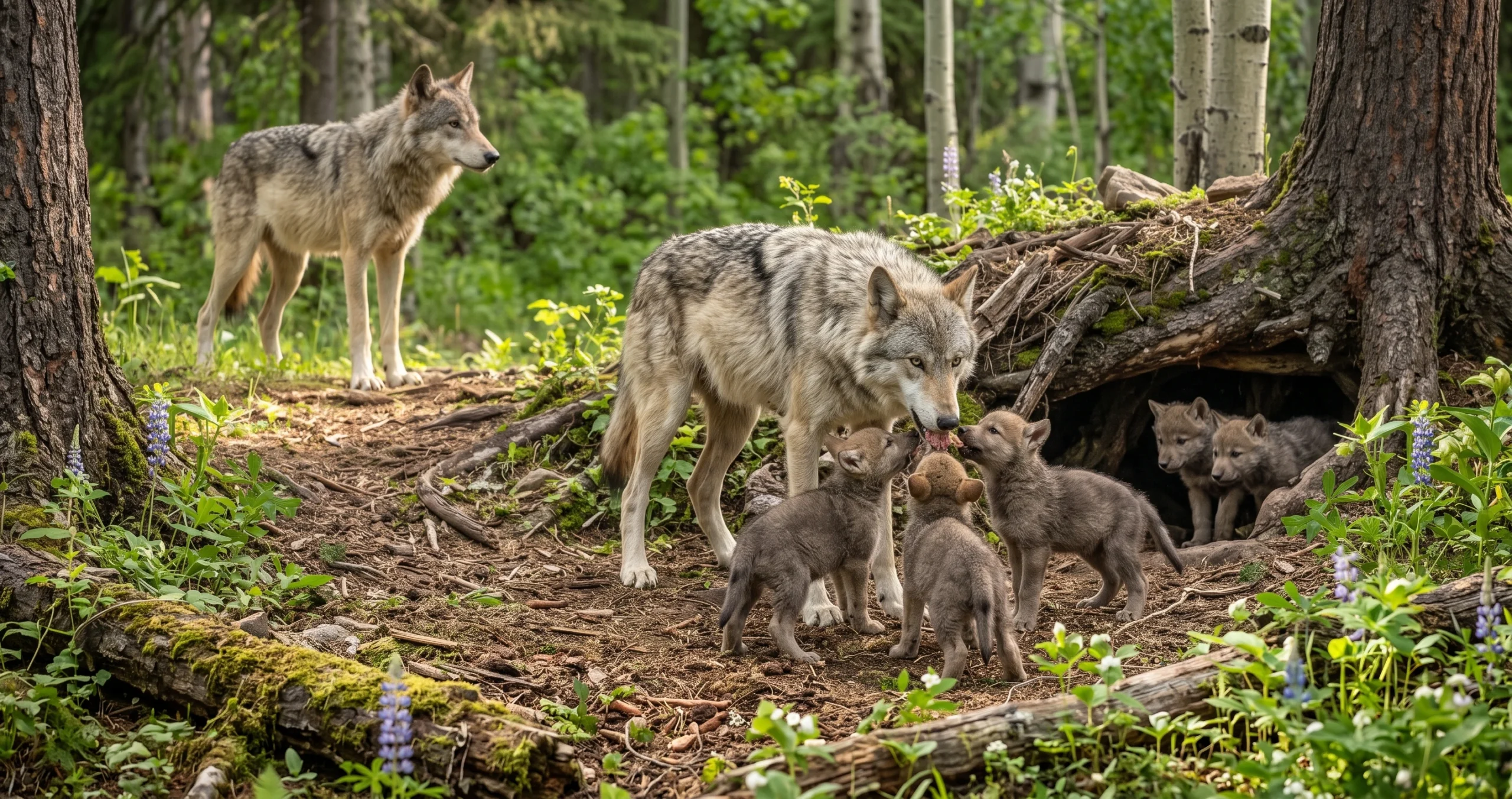
For gray wolves, survival depends on far more than strength or hunting skill. One of the most remarkable aspects of their lives is wolf pack pup care, a highly organized system in which multiple family members work together to feed, defend, teach, and nurture the next generation. Instead of leaving parenting to just one or two adults, an entire pack contributes to raising vulnerable pups during their earliest months.
This cooperative approach has helped wolves thrive across forests, mountains, tundra, grasslands, and northern wilderness for thousands of years. Every member of the pack has a role, whether standing guard near the den, bringing food to hungry pups, or teaching young wolves the skills they need to survive.
Understanding how wolves raise their young also helps explain why these predators are among the most socially complex mammals on Earth. Their success comes not only from powerful bodies and sharp senses, but also from strong family bonds, communication, and teamwork.
In this article, we’ll explore how wolf packs raise their pups, why cooperation is essential, and what scientists have learned about one of nature’s most successful family systems.
Table of Contents
- Understanding the Wolf Family
- Where Wolves Raise Their Pups
- Wolf Anatomy That Supports Parenting
- How Wolf Pack Pup Care Begins
- Every Pack Member Has a Role
- Feeding and Teaching Young Wolves
- Protecting the Den
- Learning Through Play
- Communication Within the Family
- Ecological Importance of Wolf Families
- Conservation Challenges
- What People Often Get Wrong
- Responsible Wildlife Observation
- Frequently Asked Questions
- Conclusion
Understanding the Wolf Family
Gray wolves (Canis lupus) live in family groups known as packs. Unlike the outdated idea of unrelated wolves competing for dominance, most wild packs are simply families.
A typical pack consists of:
- A breeding pair
- Their pups from the current year
- Older offspring from previous years
Some packs may also include unrelated wolves that have joined temporarily, but family relationships remain the foundation of most wolf societies.
This structure creates an ideal environment for cooperative pup care.
Where Wolves Raise Their Pups
Wolves occupy an enormous range across the Northern Hemisphere.
They can be found in:
- Boreal forests
- Mountain ranges
- Arctic tundra
- Temperate woodlands
- Grasslands
- Wetland regions
Each spring, the breeding female selects a den that offers shelter and protection.
Dens may be:
- Natural caves
- Enlarged burrows
- Hollow spaces beneath tree roots
- Sandy riverbanks
- Rocky hillsides
The den remains the center of family life during the first weeks after birth, when pups cannot regulate their body temperature or travel long distances.
Wolf Anatomy That Supports Parenting
Several physical adaptations help wolves care for and protect their young.
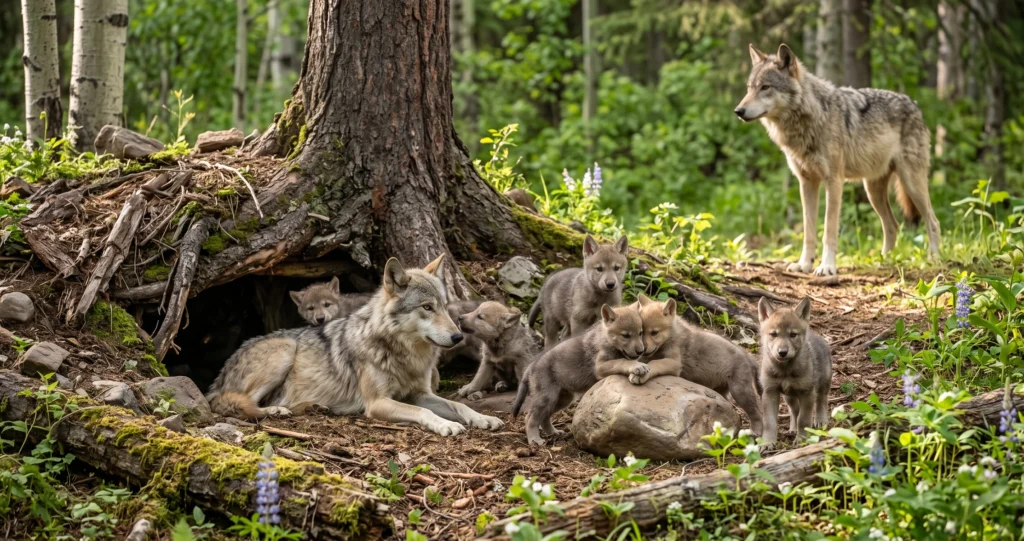
Powerful Sense of Smell
A wolf’s nose allows adults to locate prey, identify pack members, detect danger, and find wandering pups.
Excellent Hearing
Large, mobile ears help adults monitor approaching predators or unfamiliar wolves while remaining near the den.
Strong Legs and Endurance
Adult wolves can travel many miles while hunting before returning to feed their pups.
Thick Double Coat
Dense fur protects both adults and growing pups from harsh weather, especially in northern climates.
Strong Teeth
Powerful jaws allow adults to process large prey before transporting food back to young wolves.
How Wolf Pack Pup Care Begins
Wolf pups are usually born during spring, when improving weather and increasing prey availability provide better conditions for raising young.
Newborn pups are:
- Blind
- Deaf
- Nearly helpless
- Entirely dependent on adults
For the first several weeks, the mother stays close to the den, nursing and keeping the pups warm.
During this period, the rest of the pack becomes especially important.
Other adults bring food to the nursing female, reducing the need for her to leave the den.
This cooperative support increases the pups’ chances of survival.
Every Pack Member Has a Role
Parents
The breeding pair provides most direct care.
The mother nurses the pups while the father hunts and helps defend the den.
Older Siblings
Older brothers and sisters often act as helpers.
They may:
- Watch over younger pups
- Play with them
- Guard the den
- Share food
- Escort growing pups during early exploration
These older siblings also gain valuable parenting experience that may benefit them if they later establish packs of their own.
Other Adults
In larger packs, additional adults contribute through hunting, defense, and vigilance.
Because multiple wolves participate, responsibility is shared across the family.
Feeding Growing Pups
As pups grow, milk alone is no longer enough.
Adults begin introducing meat by returning from hunts and regurgitating partially digested food.
Although this may seem unusual to people, it provides several important advantages.
The food is:
- Soft enough for young pups
- Nutrient-rich
- Easy to digest
- Quickly delivered to the den
As pups mature, they begin eating pieces of fresh prey brought directly from hunting sites.
This gradual transition supports healthy growth.
Teaching Survival Skills
Young wolves are not born knowing how to hunt.
Instead, they learn gradually by watching experienced adults.
Lessons include:
Following Adults
Pups first accompany the pack on short trips away from the den.
Recognizing Prey
Older wolves expose pups to different prey species and teach them appropriate hunting behavior through experience.
Reading Social Signals
Pack life requires understanding body language, facial expressions, posture, scent, and vocalizations.
Young wolves learn these skills through daily interaction.
Building Endurance
As the pups grow stronger, they begin traveling farther with the pack.
These journeys strengthen muscles and prepare them for adult life.
Protecting the Den
The den is one of the most important places in a wolf family’s life.
Adults defend it from potential threats such as:
- Rival wolves
- Bears
- Coyotes in some regions
- Human disturbance
Rather than relying solely on aggression, wolves often avoid conflict whenever possible.
Their first priority is keeping the pups safe.
If necessary, adults may relocate the pups to another den or rendezvous site after they become old enough to travel short distances.
Learning Through Play
Play is much more than entertainment.
It serves as an essential part of development.
Pups frequently engage in:
- Chasing
- Wrestling
- Pouncing
- Tugging
- Mock stalking
These activities improve:
- Coordination
- Balance
- Social relationships
- Bite control
- Communication
- Hunting preparation
Scientists recognize play as an important learning tool across many social mammals.
Communication Within the Family
Successful wolf pack pup care depends on constant communication.
Wolves use multiple forms of communication.
Vocalizations
Howls help reunite pack members across long distances.
Whines, growls, and barks communicate different needs depending on the situation.
Body Language
Tail position, ear posture, facial expressions, and body stance all convey information.
Scent Marking
Adults use scent to define territory and communicate with neighboring packs.
Young wolves gradually learn these signals as they mature.
Ecological Importance of Wolf Families
Healthy wolf populations contribute to balanced ecosystems.
As apex predators, wolves help regulate populations of large herbivores such as deer, elk, and moose.
This can influence:
- Forest regeneration
- Plant diversity
- Habitat quality
- Food availability for other wildlife
Strong family groups also improve hunting efficiency, allowing wolves to target healthy prey populations naturally.
Conservation Challenges
Although wolves have recovered in some regions, many populations continue to face challenges.
Habitat Fragmentation
Roads, development, and expanding human activity reduce suitable habitat.
Human-Wildlife Conflict
Conflicts involving livestock can result in wolf mortality if preventive measures are not used.
Illegal Killing
Poaching remains a concern in parts of the species’ range.
Disease
Diseases such as canine distemper, mange, and parvovirus can affect wolves, particularly vulnerable pups.
Conservation efforts increasingly emphasize habitat protection, science-based management, conflict reduction, and public education.
What People Often Get Wrong
Wolf Packs Are Not Constantly Fighting for Dominance
Modern research shows that most packs function as family groups rather than collections of unrelated wolves competing for leadership.
Only the Mother Does Not Raise the Pups
Many pack members contribute to feeding, guarding, and teaching young wolves.
Wolves Avoid People When Possible
Healthy wild wolves generally avoid human contact rather than seeking confrontation.
Howling Does Not Always Mean Aggression
Howls often help pack members stay connected across large territories.
Responsible Wildlife Observation
If you visit areas where wolves live:
- Observe from a safe distance.
- Never approach dens or rendezvous sites.
- Keep dogs under control where required.
- Follow park regulations.
- Use binoculars or a spotting scope instead of getting closer.
- Respect seasonal wildlife closures designed to protect breeding animals.
Responsible viewing helps reduce disturbance during the critical pup-rearing season.
Frequently Asked Questions
How many pups does a wolf usually have?
A litter commonly contains four to six pups, although litter size can vary depending on the population and environmental conditions.
Do all wolves help raise the pups?
In many packs, several family members assist with feeding, guarding, and teaching the young, making pup care a cooperative effort.
When do wolf pups leave the den?
Pups usually begin venturing outside the den after several weeks and later move with the pack to rendezvous sites as they grow stronger.
Why do adult wolves regurgitate food?
Regurgitated food provides young pups with easily digestible nutrition before they can consume larger pieces of prey.
How long do young wolves stay with their family?
Many remain with the pack for one to several years before dispersing to establish territories and families of their own.
Conclusion
Wolf pack pup care is one of nature’s finest examples of cooperative parenting. Rather than depending on a single adult, gray wolves rely on the strength of the entire family to feed, protect, educate, and nurture their young. Every hunt, every howl, and every lesson learned through play helps prepare pups for the challenges of life in the wild.
This remarkable level of cooperation has allowed wolves to survive in some of the world’s most demanding environments. By understanding how wolf families function, we gain a deeper appreciation for the complexity of these intelligent predators and the importance of protecting the habitats that allow future generations of wolves to thrive.
Suggested Internal Link Opportunities
Without inventing specific URLs, consider linking naturally to existing or future articles on:
- How Wolves Communicate Through Howls and Body Language
- How Apex Predators Keep Ecosystems Healthy
- Why Animal Family Groups Improve Survival
- How Coyotes and Wolves Differ in the Wild
Recommended Authoritative External Sources
- U.S. Fish & Wildlife Service (USFWS) — Gray Wolf information and conservation
- National Park Service (NPS) — Yellowstone Wolf Project
- International Union for Conservation of Nature (IUCN) — Canis lupus assessment
- Smithsonian National Zoo & Conservation Biology Institute — Gray Wolf resources
- Peer-reviewed journals such as Behavioral Ecology, Journal of Mammalogy, and Canadian Journal of Zoology