
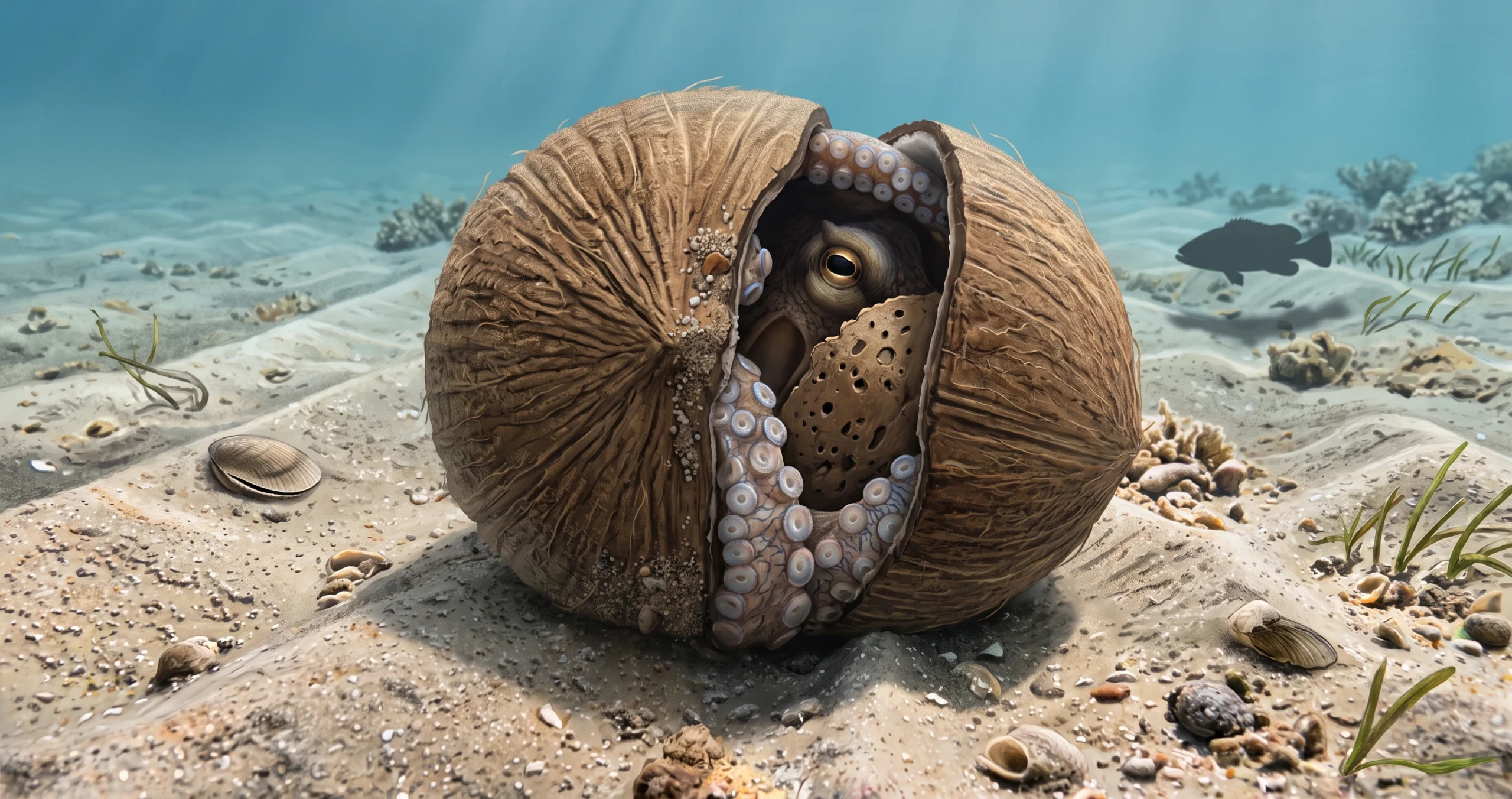
The seafloor can be a dangerous place for an animal without a shell. For the veined octopus, Amphioctopus marginatus, survival depends partly on finding places where its soft body can disappear from view. Sometimes, instead of waiting until danger arrives to search for shelter, this octopus takes shelter material with it.
This remarkable octopus coconut tool use involves collecting coconut shell halves, transporting them across exposed seafloor, and later arranging them into protective cover. Researchers have documented octopuses carrying shells even though doing so makes movement more awkward and provides little immediate protection during transport. The payoff comes later, when the shells can be deployed as a refuge.
That delayed benefit is what makes the behavior scientifically interesting. Rather than simply hiding inside an object it happens to encounter, the octopus transports a useful object for possible future use—behavior described in peer-reviewed research as defensive tool use.
Table of Contents
- Meet the Veined Octopus
- Where Veined Octopuses Live
- Anatomy Built for Exploration
- Octopus Coconut Tool Use Explained
- How the Coconut Shell Is Transported
- Why Portable Shelter Matters
- Intelligence and Flexible Behavior
- Ecological Role
- What People Often Get Wrong
- Conservation and Human Impacts
- How to Observe Octopuses Responsibly
- FAQs
- Conclusion
Meet the Veined Octopus
The veined octopus belongs to the family Octopodidae and is scientifically recognized as Amphioctopus marginatus. Current taxonomic databases accept that scientific name, with older names such as Octopus marginatus retained as historical combinations or synonyms.
It is also widely called the coconut octopus because of its famous shell-carrying behavior.
Like other octopuses, it has a soft body without the rigid external shell protecting many other mollusks. This flexibility provides enormous advantages. An octopus can squeeze into narrow spaces, manipulate objects, explore crevices, and rapidly change its posture.
But having a soft body also means protection matters.
A secure hiding place can therefore be extremely valuable.
Where Veined Octopuses Live
The coconut-carrying behavior was documented in veined octopuses living on soft sediment, where permanent hiding places can be limited. Researchers observing these animals underwater repeatedly recorded them gathering and transporting shell material across the bottom.
This habitat helps explain why carrying shelter can be advantageous.
A rocky reef offers holes, cracks, and overhangs that animals can use as refuges. A comparatively open stretch of sand, mud, or sediment may provide fewer ready-made structures.
For a small octopus moving across such terrain, the distance between hiding places matters.
A portable refuge changes that equation.
Instead of depending entirely on whatever shelter happens to be available at its next stopping point, the animal can bring useful material along.
Anatomy Built for Exploration
An octopus is particularly well equipped to interact with objects.
Eight flexible arms surround the mouth, and the arms contain numerous suckers capable of gripping and exploring surfaces. The animal can manipulate objects while simultaneously adjusting its body position.
Octopus arm control is also unusual among animals.
A substantial amount of neural processing occurs outside the central brain, allowing the arms to perform complex movements while remaining coordinated with the animal’s overall behavior.
The lack of bones makes those arms extraordinarily flexible.
That combination of flexibility, sensory ability, and motor control helps octopuses manipulate shells, stones, and other objects in their environment.
A Body Made for Hiding
The mantle contains most of the major internal organs, while the arms can fold tightly around the body.
When threatened, an octopus can compress itself into surprisingly confined spaces.
Its skin also contains specialized structures that allow rapid changes in appearance. These changes contribute to camouflage and communication in cephalopods.
Camouflage, however, does not eliminate the value of physical shelter.
Sometimes disappearing behind a solid barrier is safer than relying on appearance alone.
Octopus Coconut Tool Use Explained
The famous behavior begins when an octopus encounters suitable shell material.
Researchers reported veined octopuses collecting coconut shell halves from the seafloor. Instead of simply entering them immediately, the animals could manipulate and transport the shells.
Most importantly, the shell could be carried somewhere else and deployed later.
That distinction matters.
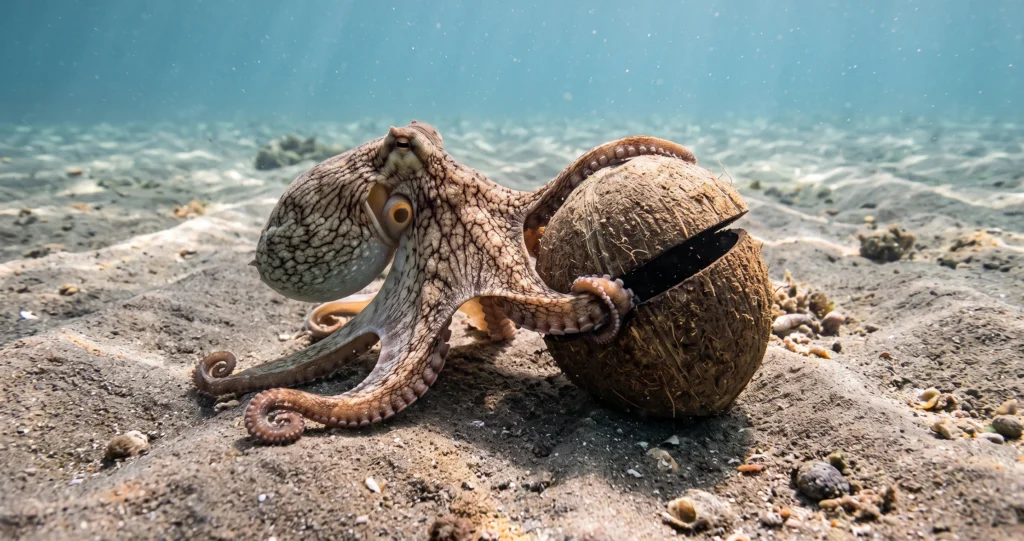
During transportation, carrying the coconut shell can actually be inconvenient. The animal must position itself and its arms in an unusual way to move while holding the object.
The shell therefore isn’t necessarily helping the octopus at the exact moment it is being transported.
Its usefulness lies in the future.
This separation between collection and later deployment helped researchers interpret the behavior as tool use rather than ordinary sheltering.
How an Octopus Carries a Coconut Shell
Moving with a large piece of coconut shell is not easy when you normally crawl using eight arms.
The octopus gathers the shell beneath its body and extends parts of its arms toward the bottom.
Researchers described the resulting movement as a form of “stilt-walking.”
The octopus essentially moves across the substrate while keeping the shell gathered underneath.
The posture looks awkward for a reason.
It is.
Carrying the object temporarily interferes with the animal’s normal locomotion and leaves it relatively exposed.
That apparent disadvantage strengthens the interpretation that the shell is being transported because of what it can provide later.
Turning Two Halves Into Shelter
The behavior becomes particularly striking when compatible shell pieces are available.
An octopus can manipulate the pieces and position them around itself, effectively creating protective cover.
The result functions much like a temporary den.
Instead of finding an existing hole and moving into it, the octopus has transported components capable of producing its own shelter.
Why Portable Shelter Matters
Imagine crossing an open landscape where predators could appear at almost any moment.
Now imagine being able to carry a hiding place.
That captures the practical advantage of this behavior.
For an octopus living over soft sediment, transporting shelter materials can potentially reduce its dependence on permanent structures.
The animal can forage or travel beyond an existing refuge while retaining the ability to create cover elsewhere.
Research on other benthic octopuses likewise shows how important shelters can be, with animals using natural shells and, in some environments, discarded human objects when natural dens are limited.
This does not mean coconut shells are essential to the species.
Rather, they represent one useful option within a flexible behavioral repertoire.
Intelligence and Flexible Behavior
Octopuses have attracted scientific attention because their nervous systems and behavior differ dramatically from those of familiar intelligent vertebrates.
They are mollusks.
Their evolutionary lineage separated from ours very long ago, meaning sophisticated behaviors in octopuses evolved within a radically different body plan and nervous system.
That makes examples of flexible object manipulation particularly valuable for comparative research.
The coconut behavior should not be interpreted as evidence that an octopus thinks exactly like a human.
There is no need for that comparison.
What scientists can observe is the behavior itself: an animal selects an object, transports it despite an immediate cost, and uses it later as protection.
That alone is remarkable.
The Ecological Role of the Veined Octopus
Veined octopuses are predators within benthic marine food webs.
Like other octopuses, they use their arms, suckers, mobility, and powerful mouthparts to capture and consume suitable prey.
At the same time, octopuses themselves can become prey for larger marine predators.
They therefore occupy both sides of predator-prey relationships.
Their behavior can influence the communities living along the seafloor through feeding, movement, shelter use, and interactions with other organisms.
The coconut-shell behavior demonstrates another ecological dimension: animals don’t merely respond to habitats.
Some actively modify how they interact with them.
A shell lying on the bottom becomes something different when an octopus picks it up, transports it, and transforms it into a refuge.
What People Often Get Wrong
Coconut Shells Aren’t the Octopus’s Permanent Home
Calling the veined octopus a “coconut octopus” can create the impression that every individual lives permanently inside a coconut.
That isn’t what the observations demonstrate.
Coconut pieces can function as portable shelter materials rather than permanent homes.
The Octopus Isn’t Carrying the Shell for Camouflage Alone
A coconut shell can help conceal an octopus once deployed, but camouflage doesn’t fully explain the behavior.
The important detail is transportation.
The octopus carries an object that may become protective later.
Humans Didn’t Teach Octopuses This Behavior
There is no evidence that people trained wild veined octopuses to perform this behavior.
Researchers observed it naturally in the field.
Human activity may supply some of the objects available in marine habitats, but the octopus itself decides how to interact with them.
Not Every Octopus Carries Coconut Shells
More than 300 octopus species are known, and their behaviors and habitats vary substantially.
Coconut carrying should not be generalized to every octopus.
It is particularly associated with Amphioctopus marginatus.
Tool Use Doesn’t Mean Human-Like Intelligence
Tool use is scientifically interesting, but it shouldn’t become a shortcut for ranking animals according to human intelligence.
Different animals solve ecological problems using abilities shaped by their own evolutionary histories.
The veined octopus provides an excellent example of sophisticated behavior without requiring exaggerated comparisons.
Conservation and Human Impacts
The coconut-shell story also highlights the increasingly complicated relationship between marine animals and human objects.
Benthic octopuses have been documented using discarded bottles, cans, and other artificial objects as shelter. A scientific review of underwater imagery found widespread interactions between octopuses and marine debris, showing that artificial materials can sometimes substitute for natural shelter.
That should not be interpreted as evidence that litter benefits marine ecosystems overall.
An animal’s ability to exploit debris doesn’t erase the environmental problems associated with pollution.
Protecting healthy seafloor habitats, maintaining natural shelter opportunities, reducing unnecessary disturbance, and preventing marine debris remain more responsible approaches.
The broader lesson is adaptability.
Octopuses can incorporate unfamiliar materials into behaviors that originally evolved within natural environments.
How to Observe Octopuses Responsibly
Divers and snorkelers fortunate enough to encounter an octopus should allow its natural behavior to unfold without interference.
Avoid moving shells toward the animal to encourage a photograph.
Don’t remove an octopus from its refuge or rearrange its surroundings to expose it.
Maintain enough distance that the animal doesn’t repeatedly retreat, change behavior, or attempt to escape.
Photographers should be especially patient.
A photograph of genuinely natural behavior has greater scientific and educational value than a scene manipulated for the camera.
Marine conservation also begins far away from an octopus encounter.
Reducing plastic waste, disposing of fishing equipment responsibly, supporting habitat protection, and choosing responsible wildlife tourism all help limit unnecessary pressure on marine environments.
Frequently Asked Questions
Why do veined octopuses carry coconut shells?
Coconut shell pieces can later be assembled or positioned as protective shelter. Carrying them allows an octopus to transport potentially useful refuge material across areas where immediate shelter may be limited.
Is carrying coconut shells really considered tool use?
The researchers who formally described the behavior classified it as defensive tool use because the octopus collected and transported an object for later deployment, accepting an immediate locomotion cost in exchange for a future benefit.
How does an octopus carry a coconut shell?
The animal gathers the shell underneath its body and moves across the substrate using an unusual form of locomotion described by researchers as “stilt-walking.”
Do veined octopuses only use coconut shells?
No. The scientific interpretation of the behavior does not depend on coconuts being the only suitable shelter material. Natural shell materials can serve similar protective purposes, and octopuses more broadly are known to use various available structures as refuges.
Are coconut octopuses intelligent?
They display flexible behaviors including sophisticated object manipulation. Scientists can study those abilities without assuming their intelligence operates exactly like human intelligence.
Where does the name coconut octopus come from?
It refers to the well-documented behavior of Amphioctopus marginatus collecting and using coconut shell pieces as shelter. The accepted scientific name remains Amphioctopus marginatus.
Conclusion
The veined octopus doesn’t need to construct a permanent fortress to make its environment safer.
Instead, it can take useful shelter material with it.
The scientific importance of octopus coconut tool use comes from this separation between immediate action and later benefit. The octopus accepts awkward movement while transporting shell pieces that can subsequently become protection.
This behavior expands our understanding of what tool use can look like in nature.
A tool doesn’t have to be a stick held by a primate or a carefully shaped object used by a bird.
Sometimes it is half a coconut carried across the ocean floor by an eight-armed mollusk preparing for the possibility that it might need somewhere to hide.
Internal-Link Opportunities
On this article to at least three relevant existing pieces if available, such as an article explaining octopus or cephalopod intelligence, an article covering unusual examples of animal tool use, and an article about marine animals with unusual survival adaptations.
include camouflage and defensive adaptations, animals that construct or modify shelters, and examples of problem-solving in non-mammal species.
Recommended Authoritative Sources
The strongest primary reference is Finn, Tregenza, and Norman’s 2009 Current Biology paper, “Defensive tool use in a coconut-carrying octopus.” It directly documents the collection, transportation, and later deployment of coconut shells and explains why the authors classified the behavior as defensive tool use.
For current taxonomy, the World Register of Marine Species/MolluscaBase recognizes Amphioctopus marginatus as the accepted species name and provides its taxonomic history. peer-reviewed source is the research on underwater litter use by benthic octopuses, which provides broader context for how octopuses use both natural shelters and human-made objects in seafloor habitats.
For broader conceptual background, peer-reviewed work examining tool use in the context of animal construction behavior provides useful scientific context for understanding how researchers define and compare tool-related behaviors across animals.