
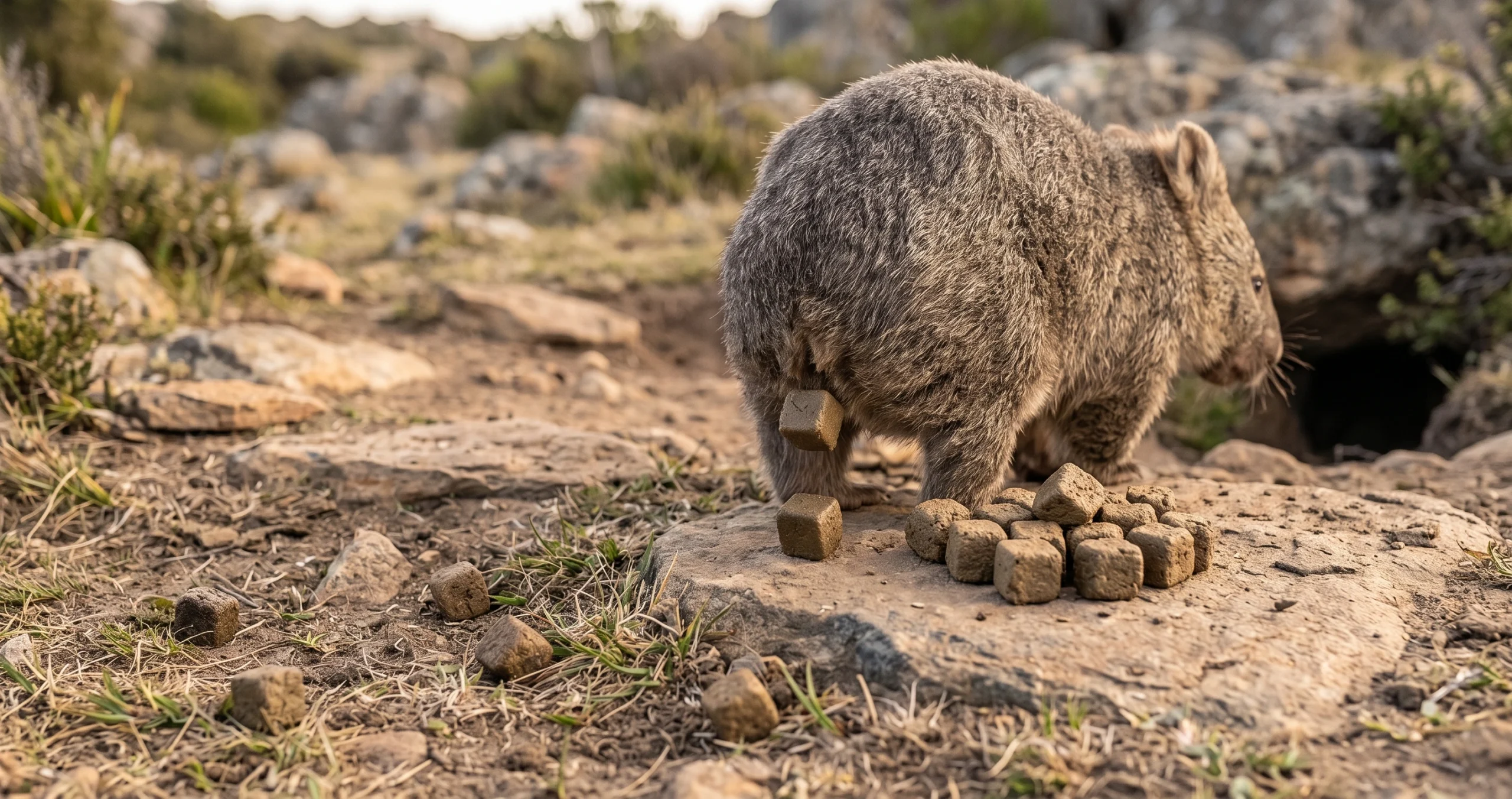
Few wildlife facts sound as unbelievable as the idea that an animal produces cube-shaped droppings. Yet this is exactly what happens with wombats. Scientists have confirmed that wombat cube poop is real, and the explanation has little to do with the shape of the animal or the ground where the droppings land. Instead, the secret lies inside the wombat’s remarkable digestive system.
Unlike nearly every other mammal, wombats create droppings with distinct flat sides and sharp edges. This unusual adaptation allows the cubes to stay in place when deposited on rocks, logs, or elevated surfaces used for communication. Rather than rolling away like round pellets, the cubes remain where other wombats are most likely to find them.
The more researchers study wombat cube poop, the more they discover about mammalian evolution, digestive anatomy, and the surprising ways animals adapt to their environments.
Table of Contents
- Meet the Wombat
- Why Wombats Produce Cube-Shaped Droppings
- The Anatomy Behind the Cubes
- How the Digestive System Creates the Shape
- Why Cube-Shaped Droppings Matter
- Habitat and Daily Life
- Ecological Importance
- Threats and Conservation
- What People Often Get Wrong
- How to Observe Wombats Responsibly
- Frequently Asked Questions
- Conclusion
Meet the Wombat
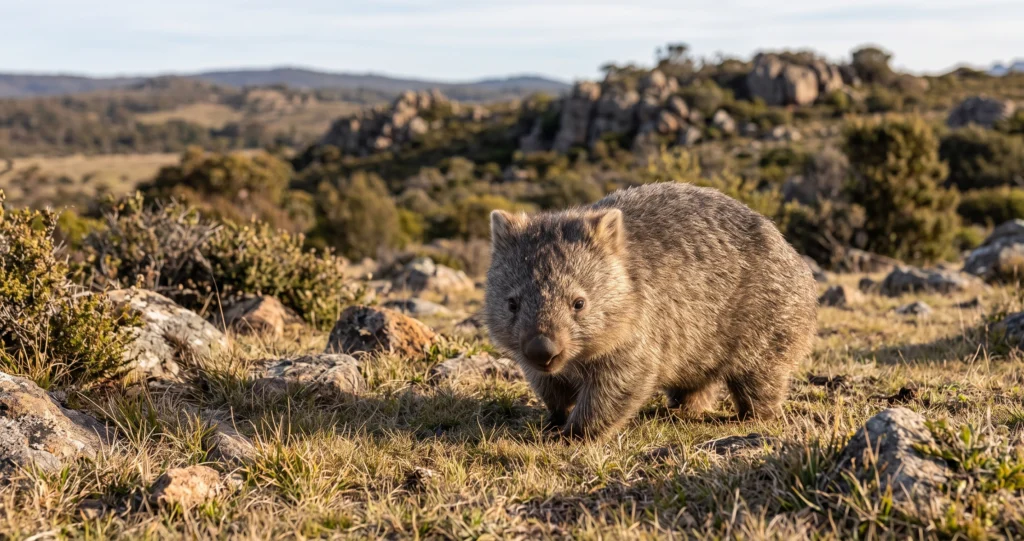
Wombats are sturdy, burrowing marsupials native to Australia. Although they may resemble small bears, they are actually close relatives of koalas within the marsupial family.
Three living species exist today:
- Common wombat (Vombatus ursinus)
- Southern hairy-nosed wombat (Lasiorhinus latifrons)
- Northern hairy-nosed wombat (Lasiorhinus krefftii)
Adult wombats typically weigh between 45 and 80 pounds, depending on the species. Their compact bodies, powerful legs, and strong claws make them exceptional diggers capable of creating extensive tunnel systems that provide shelter from predators and extreme weather.
They spend much of the day resting underground before emerging at dusk or night to graze on grasses, sedges, roots, and bark.
Why Wombats Produce Cube-Shaped Droppings
The answer begins with communication.
Wombats are generally solitary animals. Because they spend much of their time alone, scent plays an important role in marking territory and signaling their presence to neighboring wombats.
They often place droppings on elevated objects such as:
- Rocks
- Fallen logs
- Tree stumps
- Burrow entrances
If these droppings were round, they would easily roll away.
Cube-shaped feces remain stable, allowing scent marks to stay where they are most effective.
This simple geometric advantage likely explains why natural selection favored this unusual digestive adaptation.
The Anatomy Behind the Cubes
For years, researchers wondered whether the cubes formed near the anus or after leaving the body.
Detailed anatomical studies have shown that neither explanation is correct.
Instead, the shape develops inside the final section of the intestine.
An Exception Among Mammals
Most mammals produce cylindrical feces because the intestines contract fairly evenly around their contents.
Wombats are different.
Their intestines contain sections with varying flexibility and stiffness.
As waste gradually loses water during digestion, these alternating mechanical properties compress the material differently along its length.
By the time the droppings reach the end of the digestive tract, distinct edges have formed.
Researchers studying wombat intestines found that this process naturally transforms soft digestive material into remarkably consistent cubes.
How the Digestive System Creates the Shape
Extremely Slow Digestion
Wombats have one of the slowest digestive systems among mammals.
Food may remain inside the digestive tract for several days.
This extended digestion helps extract maximum nutrients and water from the tough, fibrous plants that dominate their diet.
Water Absorption
Australia’s dry environments make water conservation essential.
The intestine removes large amounts of moisture from partially digested food.
As the material becomes firmer, the changing elasticity of the intestinal walls gradually shapes it into cubes.
Scientists believe the final portion of the large intestine plays the most important role.
Rather than relying on bones, muscles, or external pressure, the cubes emerge because of carefully coordinated tissue mechanics.
Why Cube-Shaped Droppings Matter
At first glance, cube-shaped droppings seem like little more than an amusing curiosity.
In reality, they provide important survival advantages.
Stable Scent Markers
Because cubes resist rolling, they remain on elevated surfaces where scent travels farther.
Neighboring wombats can detect these territorial markers more easily.
Reduced Energy Costs
The animal does not need to repeatedly replace scent marks that have rolled off rocks or logs.
Over time, this may reduce the energy spent maintaining territory.
Effective Communication
Chemical signals contained in feces provide information about territory occupancy and possibly reproductive status.
Keeping those signals in visible, elevated locations benefits both the resident wombat and neighboring individuals.
Habitat and Distribution
Wombats occupy a variety of Australian habitats, including:
- Open forests
- Woodlands
- Grasslands
- Heathlands
- Mountain regions
- Semi-arid landscapes
They require soils suitable for digging extensive burrow systems.
Some burrows extend more than 60 feet and include multiple entrances, sleeping chambers, and escape routes.
These underground homes remain cooler during hot summers and warmer during winter, creating a stable environment for the animals.
Daily Behavior
Wombats are primarily nocturnal or crepuscular.
After sunset, they leave their burrows to forage slowly across their home ranges.
Although they appear calm, wombats can run surprisingly fast over short distances when threatened.
They possess excellent senses of smell and hearing, which help them navigate at night.
Their eyesight is relatively limited compared to these other senses.
Adult wombats generally live alone except during breeding.
Each individual maintains overlapping but defended territories marked with scent and cube-shaped droppings.
Ecological Importance
Wombats are ecosystem engineers.
Soil Aeration
Their extensive burrowing mixes soil layers and improves aeration.
Habitat Creation
Abandoned burrows provide shelter for many other Australian animals, including reptiles, mammals, birds, and invertebrates.
During bushfires and extreme weather, these burrows may even serve as emergency refuges for multiple species.
Plant Community Influence
By grazing selectively, wombats influence vegetation growth and nutrient cycling across their habitats.
Their droppings also return organic matter and nutrients to the soil.
Threats and Conservation
Although common wombats remain widespread, several threats affect different populations.
Habitat Loss
Urban development, agriculture, and road construction fragment habitat and isolate local populations.
Vehicle Collisions
Road mortality remains a significant cause of death in many regions where wombats cross highways at night.
Disease
Sarcoptic mange, caused by parasitic mites, can seriously affect wombat health. Severe infestations damage the skin, reduce body condition, and may become fatal without treatment.
Climate Change
Long-term changes in rainfall patterns and vegetation may alter food availability and suitable habitat.
The northern hairy-nosed wombat remains one of Australia’s rarest mammals. Intensive conservation programs, habitat protection, predator management, and ongoing monitoring have helped increase its numbers in recent decades, although it remains endangered.
What People Often Get Wrong
Several myths surround wombat cube poop.
Wombats Push the Cubes Into Shape
No. The cubes form naturally inside the intestine before they are expelled.
The Shape Comes From the Anus
Research shows the anus is not responsible for creating the cube shape.
Every Australian Animal Produces Cube-Shaped Droppings
Wombats are the only known mammals that consistently produce cube-shaped feces.
Cube Poop Is Just a Random Mutation
Scientists believe the shape evolved because it helps droppings remain in place for territorial communication.
The Cubes Are Perfect Squares
Individual droppings vary slightly in size and shape. They are generally cube-like rather than mathematically perfect cubes.
How to Observe Wombats Responsibly
Seeing a wild wombat is a memorable experience.
To help protect these animals:
- Observe quietly from a respectful distance.
- Never feed wild wombats.
- Stay on designated walking tracks.
- Drive carefully at dawn, dusk, and night in wombat habitat.
- Avoid entering active burrows.
- Support protected reserves and wildlife conservation organizations.
Leaving animals undisturbed allows them to maintain their natural behaviors.
Frequently Asked Questions
Why do wombats produce cube-shaped poop?
Their intestines contain sections with different elasticity that gradually compress drying waste into cube-like shapes before it leaves the body.
Are wombats the only animals that make cube-shaped droppings?
Yes. Wombats are the only known mammals that consistently produce cube-shaped feces.
Does cube poop help wombats survive?
Yes. The cubes stay on rocks and logs more easily, helping scent marks remain visible and effective for territorial communication.
How long does digestion take in a wombat?
Digestion can take several days, allowing wombats to extract as much water and nutrition as possible from tough vegetation.
Are wombats dangerous?
Wild wombats are generally shy and avoid people. However, they are powerful animals and should always be observed from a safe distance without being approached or handled.
Conclusion
The mystery of wombat cube poop highlights how evolution often produces solutions that seem almost impossible until scientists uncover the underlying biology. Rather than relying on unusual bones or muscles, wombats create cube-shaped droppings through specialized intestinal mechanics combined with slow digestion and exceptional water absorption.
Those tiny cubes are more than a biological curiosity. They help wombats communicate, mark territory, and thrive in Australia’s challenging landscapes. As researchers continue studying these remarkable marsupials, their unusual digestive system offers valuable insights into biomechanics, evolution, and the incredible diversity of adaptations found in the natural world.
Suggested Internal Link Opportunities
Search your existing wildlife content for articles covering:
- Animal parenting and unusual reproductive behaviors.
- Animal adaptations and evolutionary biology.
- Other Australian wildlife or marsupial species.
- Wildlife conservation and habitat protection.
Recommended Authoritative External Sources
- Smithsonian National Zoo & Conservation Biology Institute
- IUCN Red List
- Australian Museum
- CSIRO (Commonwealth Scientific and Industrial Research Organisation)
- Soft Matter (peer-reviewed journal describing the biomechanics of wombat cube-shaped feces)