
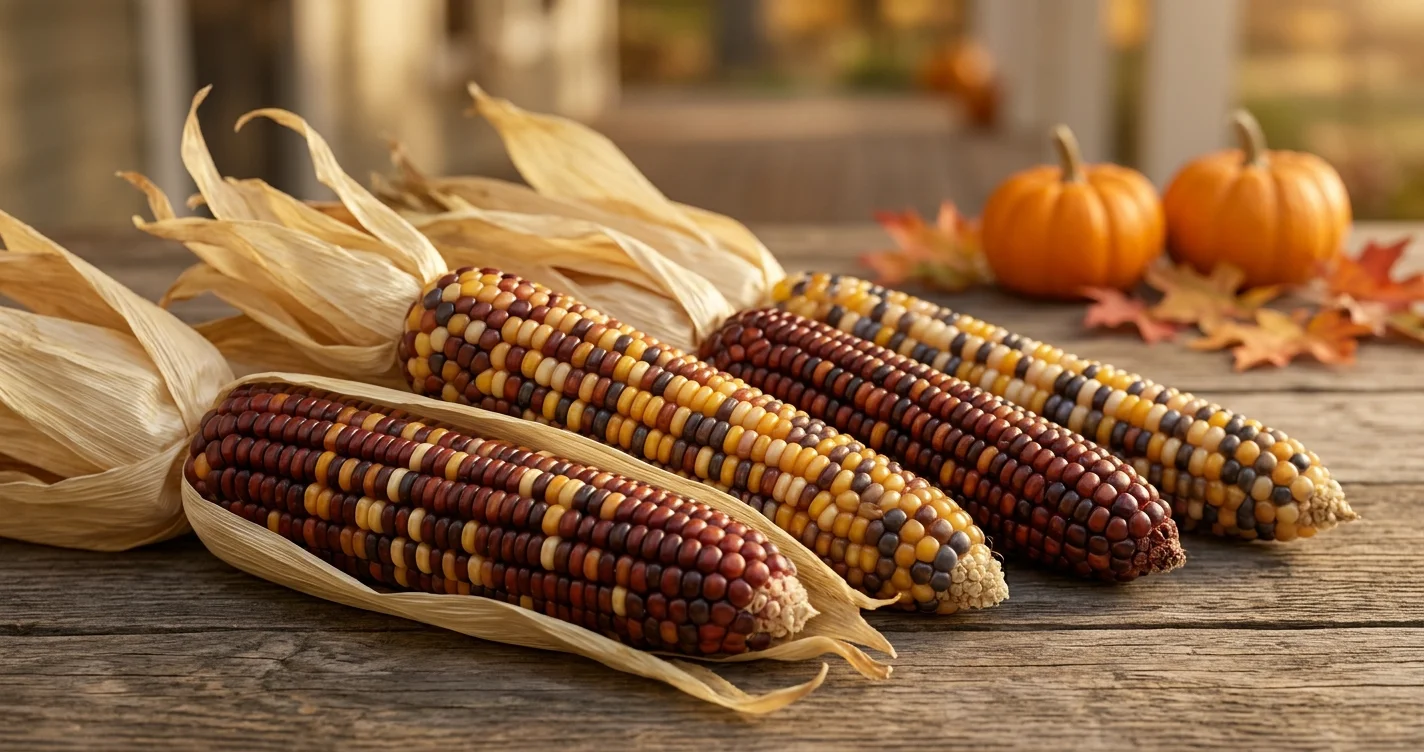
Picture a Thanksgiving table decorated with dried corn, pumpkins, and autumn leaves. One ear of corn catches your attention. Its kernels form a mosaic of deep purple, golden yellow, reddish brown, and creamy white, sometimes with completely different colors sitting side by side.
The remarkable explanation for why Indian corn has different colors lies in the genetics of maize and the way individual kernels develop.
These colors are not painted onto the corn. They emerge through natural pigments, inherited genes, and the interactions between different tissues inside each kernel.
Behind this familiar autumn decoration is a fascinating story of plant biology, agricultural history, and the extraordinary diversity preserved through generations of cultivation.
Table of Contents
- The Colorful Corn That Appears Every Thanksgiving
- What Is Indian Corn?
- Why Indian Corn Has Different Colors: Understanding Kernel Genetics
- Why Two Kernels on the Same Cob Can Look Completely Different
- The Science Behind Purple, Red, Yellow, and Blue Corn
- Flint Corn vs. Sweet Corn: Important Differences
- Is Indian Corn Only for Decoration?
- The Indigenous History of Colorful Maize
- Can You Grow Multicolored Flint Corn in Your Backyard?
- Common Misconceptions About Indian Corn
- In Your Own Yard: Growing and Saving Colorful Corn
- Frequently Asked Questions
The Colorful Corn That Appears Every Thanksgiving
As autumn arrives across the United States, multicolored corn becomes a familiar sight in seasonal decorations.
Ears with tightly packed, jewel-like kernels appear in wreaths, harvest displays, and Thanksgiving centerpieces.
Unlike the uniformly yellow sweet corn commonly served at summer cookouts, ornamental corn may contain an impressive range of natural colors.
Some ears are mostly purple. Others combine yellow, orange, red, cream, and nearly black kernels.
The patterns can vary dramatically, even between ears harvested from the same garden.
This diversity makes colorful corn visually striking, but its importance extends beyond decoration.
Each ear reflects the genetic complexity of maize, a crop shaped by thousands of years of cultivation and selection.
What Is Indian Corn?
The expression Indian corn is a traditional American term commonly used today for colorful ornamental maize.
However, it is not the scientific name of a single variety.
The plant belongs to the species Zea mays, which includes sweet corn, field corn, popcorn, flour corn, and flint corn.
Many ornamental multicolored varieties are types of flint corn, although colorful kernels can occur in other maize types.
Understanding flint corn
Flint corn typically develops mature kernels with a substantial hard, glassy outer region of endosperm.
This structure makes dried kernels relatively firm.
Many flint corn varieties are grown for grain, traditional foods, seed saving, or ornamental purposes.
A crop with Indigenous origins
Maize was domesticated from wild ancestral grasses in what is now Mexico.
Indigenous peoples developed, cultivated, and diversified maize over thousands of years.
Through selection and agricultural knowledge, communities across the Americas created numerous locally adapted varieties with different colors, textures, shapes, and uses.
The colorful corn displayed today is part of this much larger agricultural history.
Why Indian Corn Has Different Colors: Understanding Kernel Genetics
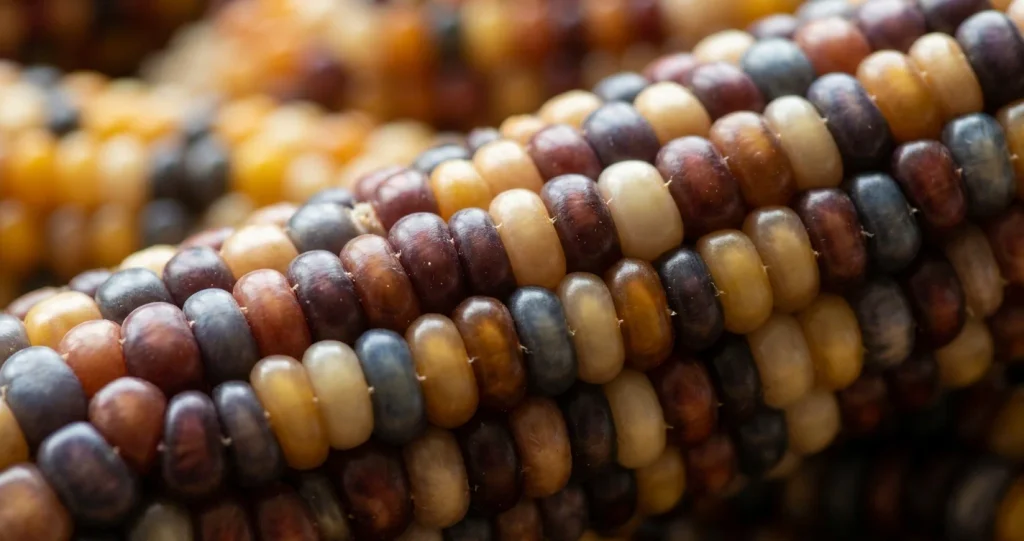
The science of colorful corn begins with an important fact: a corn kernel is not made from one genetically uniform tissue.
Different parts of the kernel have different developmental origins, and their pigments can contribute separately to its final appearance.
Three important kernel tissues
The pericarp is the outer protective covering of the kernel.
It develops from the mother plant’s ovary wall and is therefore maternal tissue. Its color is determined by the genetic makeup of the plant producing the ear.
The aleurone is a specialized outer layer of the endosperm.
It develops after fertilization and can contain pigments that contribute purple, red, or other visible colors.
The endosperm makes up much of the mature kernel’s internal storage tissue.
Its color may be influenced by compounds such as carotenoids, which contribute yellow and orange tones.
The aleurone and endosperm arise through fertilization and generally contain genetic contributions from both parents, with two maternal chromosome sets and one paternal set.
Why these layers matter
A kernel’s visible color depends partly on which tissues contain pigments and how those tissues overlap.
A strongly pigmented outer covering may conceal colors underneath.
A relatively transparent pericarp may allow the aleurone or endosperm to influence the visible appearance.
Consequently, two kernels can look different even when they belong to the same ear.
The role of inherited genes
Corn kernel pigmentation is controlled by multiple genes.
Some regulate pigment production, while others influence where pigments accumulate or whether particular biochemical pathways become active.
Different inherited combinations can produce different results.
Because each kernel develops from a separate fertilization event, neighboring kernels may inherit different combinations of alleles.
This helps explain why Indian corn has different colors without requiring every ear to have been pollinated by several unrelated corn varieties.
Why Two Kernels on the Same Cob Can Look Completely Different
An ear of corn is a remarkable reproductive structure.
Each silk connects to an individual ovule that can develop into a kernel after successful pollination and fertilization.
Although the kernels share the same mother plant, their fertilization-derived tissues are not necessarily genetically identical.
Genetic segregation creates variation
During reproduction, genes are passed to offspring in different combinations.
When the parent plants carry different alleles affecting pigmentation, individual kernels may inherit combinations that produce contrasting colors.
One kernel might develop a strongly pigmented aleurone.
Its neighbor might lack the genetic combination needed for that pigment to appear.
Another may show a different color because of pigments in the pericarp or underlying endosperm.
Cross-pollination is only part of the story
Corn is wind-pollinated, and pollen from nearby plants can sometimes fertilize kernels on an ear.
However, multicolored ears do not necessarily require pollen from different varieties.
Genetic variation already present within a breeding population can produce diverse kernel appearances.
The exact outcome depends on the parent plants, the genes involved, and which tissues express those genes.
There is no single inheritance ratio that explains every colorful corn variety.
The Science Behind Purple, Red, Yellow, and Blue Corn
The striking Indian corn colors arise from several biological processes.
Two important groups of plant pigments are anthocyanins and carotenoids.
Purple, red, and blue pigments
Anthocyanins are water-soluble pigments that contribute red, purple, and blue coloration to many plants.
In maize, they can accumulate in particular kernel tissues when the necessary pigment-production genes are active.
Their appearance can depend on pigment composition, concentration, cellular conditions, and the surrounding tissues.
Some kernels look almost black because their pigmentation is exceptionally dark.
Yellow and orange pigments
Carotenoids contribute yellow and orange coloration, particularly in the endosperm of certain maize varieties.
Different genetic backgrounds influence which carotenoids accumulate and in what amounts.
Some kernels have pale or white endosperm because they contain relatively little visible pigment.
Color is a layered effect
A kernel does not necessarily display only one pigment.
Pigmented outer tissues may overlap yellow endosperm, creating an appearance influenced by multiple layers.
This makes corn kernel pigmentation more complicated than a simple one-gene, one-color explanation.
The resulting patterns are part of what makes multicolored flint corn so visually distinctive.
Flint Corn vs. Sweet Corn: Important Differences
Although flint corn and sweet corn belong to the same species, they are commonly grown for different purposes.
Sweet corn is usually harvested while its kernels are immature and tender.
Its sweetness results from genetic differences affecting how sugars are converted into starch.
Flint corn is generally allowed to mature and dry when grown for grain.
Its kernels contain substantial hard endosperm, making them suitable for certain milling and traditional food uses.
| Feature | Flint corn | Sweet corn |
|---|---|---|
| Common harvest stage | Mature and dry | Immature and tender |
| Kernel texture | Hard when dry | Tender when fresh |
| Typical uses | Grain, meal, decoration | Fresh eating, cooking |
| Color range | Can be highly varied | Often yellow, white, or bicolor |
These categories describe common characteristics rather than every possible maize variety.
Is Indian Corn Only for Decoration?
Colorful flint corn is not inherently inedible.
Many food-grade varieties can be processed into cornmeal, flour, or other traditional preparations.
However, ornamental corn sold for decoration should not automatically be treated as food.
Some decorative ears may have been treated with chemicals, exposed to unsuitable storage conditions, or handled without food-safety precautions.
Mold is another concern, especially when ears have not been dried and stored properly.
If you intend to eat colorful corn, choose a variety specifically sold for culinary use and follow appropriate preparation instructions.
The fact that kernels are naturally colorful does not establish whether a particular decorative ear is safe to consume.
The Indigenous History of Colorful Maize
Long before colorful corn became associated with Thanksgiving decorations, maize was a foundational crop for many Indigenous communities throughout the Americas.
Its domestication and diversification represent generations of agricultural observation, experimentation, and seed selection.
Different communities developed maize varieties suited to local climates, soils, growing seasons, and culinary traditions.
More than ornamental beauty
Maize colors and types have held different agricultural, cultural, and sometimes ceremonial meanings among Indigenous peoples.
These meanings vary among communities and should not be reduced to one universal tradition.
Many colorful varieties also served practical food purposes.
The continued existence of diverse maize landraces reflects the importance of seed stewardship and traditional agricultural knowledge.
Recognizing that history adds depth to the familiar autumn display.
Can You Grow Multicolored Flint Corn in Your Backyard?
Growing flint corn can be rewarding for gardeners who have sufficient space and a suitable growing season.
Most varieties need full sunlight, warm soil, and enough frost-free time to reach maturity.
Choose the right variety
Select seed adapted to your region and intended purpose.
Some varieties are grown primarily for ornamental ears, while others are suitable for grain production.
Check the seed supplier’s expected maturity period before planting.
Understand wind pollination
Corn relies heavily on wind to move pollen from tassels to silks.
Planting in blocks rather than a single long row can improve pollination in small gardens.
Adequate spacing and healthy plant growth also matter.
Nearby corn varieties may exchange pollen when their flowering periods overlap.
This can affect kernel characteristics in the current harvest for some traits and influence the genetics of saved seed.
Allow ears to mature
Flint corn intended for dry grain or decoration generally remains on the plant until the kernels mature.
Harvest timing depends on variety, weather, and intended use.
Drying should continue under suitable conditions to reduce spoilage risks.
Common Misconceptions About Indian Corn
Colorful maize is surrounded by several persistent misunderstandings.
The kernels are artificially dyed
Authentic multicolored corn develops its colors naturally through genetics and pigmentation.
Artificially colored decorative products may exist, but natural flint corn does not require dye.
All colorful corn is genetically modified
Natural variation and traditional breeding can produce multicolored corn.
A colorful ear is not, by itself, evidence of genetic engineering.
Every ear should look identical
Genetic segregation can create differences between ears and among kernels on the same ear.
Even plants grown from the same seed population may produce varying patterns.
All decorative corn is safe to eat
Food suitability depends on the variety, handling, treatment, drying, and storage conditions.
Decorative appearance alone provides no assurance of food safety.
In Your Own Yard: Growing and Saving Colorful Corn
For American gardeners interested in growing flint corn, careful planning begins before planting.
Choose a sunny location with suitable soil and enough room for effective wind pollination.
Follow regional planting guidance and wait until soil conditions are appropriate for corn germination.
Maintain healthy growing conditions
Corn generally benefits from adequate nutrients, consistent moisture during important growth stages, and good weed management.
A soil test can help guide fertilizer decisions.
Avoid unnecessary overfertilization.
Preserve genetic diversity
If saving seed from an open-pollinated variety, collect seed from multiple healthy, representative plants rather than relying on one unusually colorful ear.
This can help maintain a broader sample of the population’s genetic diversity.
Small seed-saving populations may experience genetic drift or inbreeding.
Manage unwanted cross-pollination
If maintaining a particular variety matters, consider separation distances, flowering-time differences, or other appropriate pollination-control methods.
No single distance guarantees isolation under every wind and landscape condition.
Dry and store seed carefully
Allow ears to mature fully before collecting seed intended for future planting.
Dry harvested ears in a protected, well-ventilated location.
Once adequately dry, store seed in suitable containers under cool, dry conditions.
Label saved seed with the variety and harvest year.
Even with careful selection, future generations may not reproduce the exact color pattern of the original ears.
That variation is part of the fascinating genetics behind colorful maize.
Frequently Asked Questions
Why does Indian corn have different colors on one cob?
Different kernels can inherit different combinations of pigmentation-related genes. The visible colors also depend on pigments in the pericarp, aleurone, and endosperm. Because kernels develop through separate fertilization events, neighboring kernels may show different appearances.
Is Indian corn genetically modified?
Not necessarily. Many colorful corn varieties result from natural genetic variation and traditional breeding. The presence of purple, red, yellow, or cream kernels does not indicate that a plant was genetically engineered.
Can you eat colorful Indian corn?
Some food-grade colorful flint corn varieties are suitable for culinary uses after appropriate processing. However, decorative ears should not be eaten unless their variety, treatment, handling, and storage conditions establish that they are safe for food.
Conclusion
Return to that Thanksgiving table and look closely at a colorful ear of corn.
The purple, yellow, red, and cream kernels are more than a seasonal decoration.
They reveal how plant pigments, inherited genes, and the structure of individual kernels combine to create remarkable natural diversity.
Understanding why Indian corn has different colors also connects a familiar harvest tradition to the long history of Indigenous maize cultivation.
Every ear carries a visible reminder that agriculture and genetics have been intertwined for generations.
External Sources
1. University of Wisconsin–Madison — Indian Corn
This university extension article is specifically about Indian corn. It covers colorful varieties, ornamental uses, flint corn, and growing considerations.
2. Genetic Analysis of Pericarp Pigmentation Variation in Maize
A peer-reviewed genetics study explaining how maize kernel color relates to inherited pigmentation and the differences between maternal pericarp tissue and fertilization-derived tissues.
3. . Genetic and Molecular Mechanisms of Anthocyanins in Maize Kernels
A 2026 scientific review examining how genes regulate anthocyanin production and accumulation in colored maize kernels.