
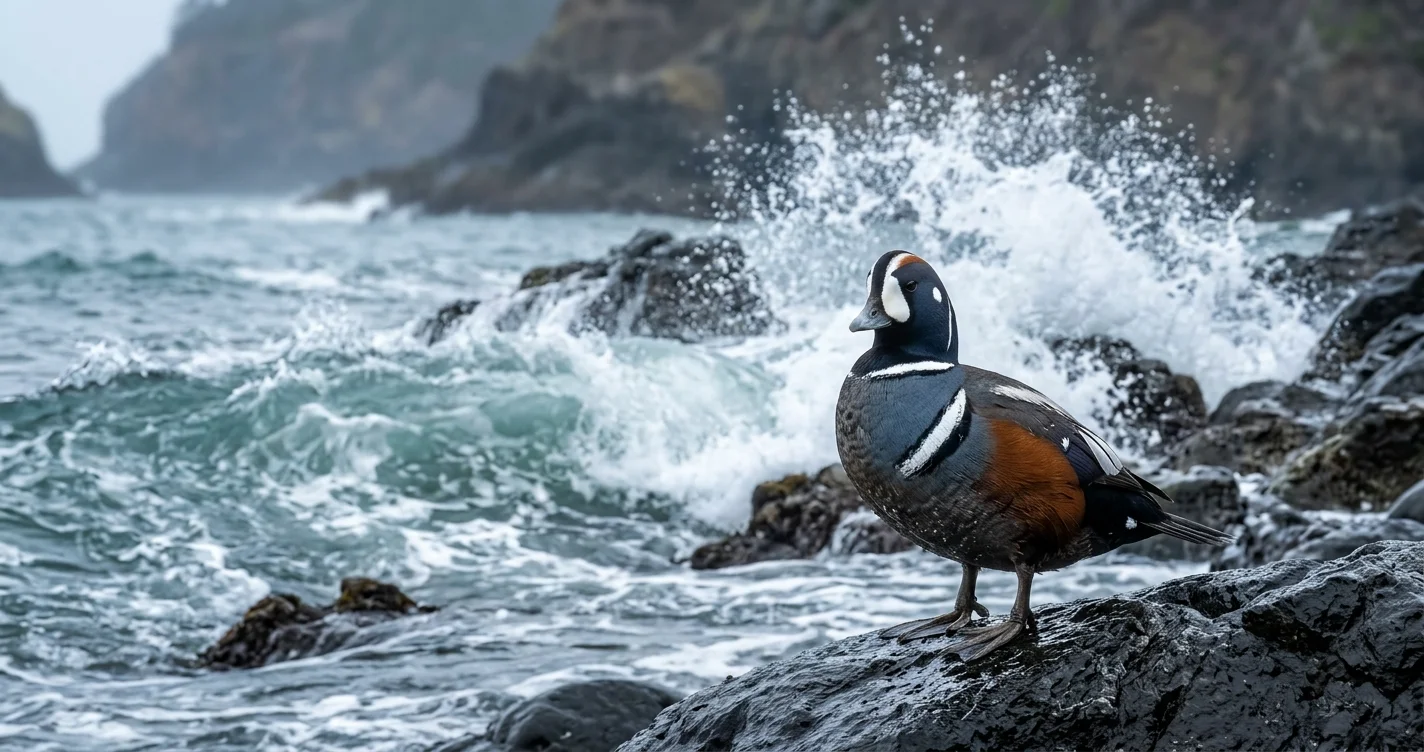
Waves crash against dark coastal rocks, sending white spray into the cold morning air. Between the breaking waves, a small duck stands on a slippery ledge. Its slate-blue feathers, chestnut markings, and brilliant white stripes seem almost too colorful for such a rugged setting.
Yet this is exactly where harlequin ducks are often found.
Unlike many familiar ducks that gather on quiet ponds, these remarkable birds spend much of the nonbreeding season along rocky coastlines where powerful waves continually reshape the water around them.
Their story becomes even more surprising when spring arrives. Many leave the ocean behind and travel inland to breed beside rushing mountain streams.
The harlequin duck, scientifically known as Histrionicus histrionicus, is a fascinating example of how wildlife can depend on two dramatically different aquatic environments.
Table of Contents
- Meet the Painted Duck of Crashing Waves
- What Makes Harlequin Ducks So Unusual?
- Why Harlequin Ducks Spend Winter Along Rocky Coasts
- Male vs. Female Harlequin Ducks: Two Very Different Looks
- What Do Harlequin Ducks Eat?
- From Ocean Waves to Mountain Streams
- Where Do Harlequin Ducks Build Their Nests?
- How Harlequin Ducklings Survive Fast Water
- Where to Find Harlequin Ducks in North America
- Threats Facing Harlequin Ducks
- How to Observe Harlequin Ducks Responsibly
- In Your Own Yard: Helping Protect Aquatic Wildlife
- Frequently Asked Questions
Meet the Painted Duck of Crashing Waves
The harlequin duck is a small diving sea duck with an unmistakable appearance.
Adult males in breeding plumage display an intricate combination of slate-blue, chestnut, and sharply defined white markings. Females are more subdued, wearing brown feathers that help them blend into rocky and wooded surroundings.
Both sexes have compact bodies suited to swimming and diving.
Among North American sea ducks, harlequins are particularly associated with rocky marine shorelines and swift freshwater streams.
Their unusual habitat preferences make them a favorite subject for birdwatchers and wildlife photographers.
What Makes Harlequin Ducks So Unusual?
Many ducks are associated with marshes, lakes, or sheltered wetlands.
Harlequin ducks frequently use much more turbulent environments.
They dive in coastal waters, navigate around submerged rocks, and forage where moving water supports abundant aquatic invertebrates.
Their compact shape and strong swimming behavior help them operate in these demanding habitats.
Another distinctive feature is their seasonal habitat change.
In much of their range, adults spend the nonbreeding season near the ocean, while breeding birds move inland toward freshwater rivers and streams.
This combination of marine and freshwater habitats is central to their ecology.
Why Harlequin Ducks Spend Winter Along Rocky Coasts
The harlequin duck winter habitat is often a rugged shoreline with exposed rocks, shallow water, and breaking waves.
At first glance, these places may appear unsuitable for a relatively small bird.
However, rocky marine environments provide valuable feeding opportunities.
Food hidden among coastal rocks
Submerged rocks support communities of marine invertebrates.
Small crustaceans, mollusks, and other organisms occupy crevices, attach to hard surfaces, or move through the surrounding water.
Harlequin ducks dive to reach these food sources.
Their feeding behavior is closely connected to the structure of the shoreline and the availability of prey.
How they handle moving water
Harlequin duck adaptations include a compact body, effective underwater swimming, and behavior suited to navigating turbulent conditions.
Birds may time their movements around breaking waves, dive beneath the surface, or move between feeding areas and nearby resting sites.
These abilities do not make them immune to rough water.
Strong surf remains physically demanding, and birds still depend on suitable conditions, accessible food, and places where they can rest.
Why rocky coastlines matter
Not every stretch of ocean offers the same habitat.
Sandy beaches, sheltered bays, and wave-exposed rocky shores support different ecological communities.
Harlequin ducks are especially associated with rocky coastal habitats where underwater structures support suitable prey.
The availability of these habitats helps determine where wintering birds concentrate.
Protecting rocky shorelines therefore supports more than the birds themselves. It also helps preserve the interconnected marine communities on which they depend.
Male vs. Female Harlequin Ducks: Two Very Different Looks
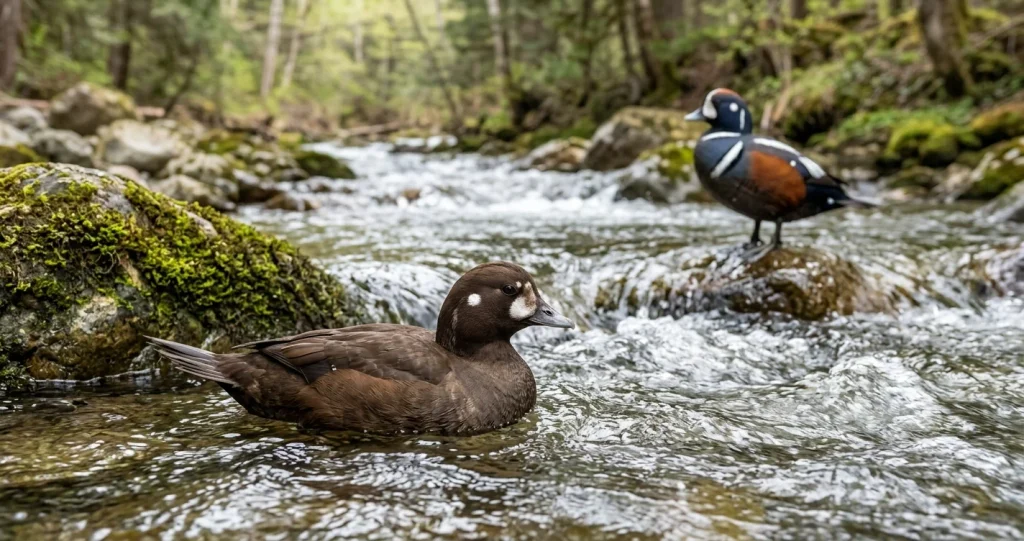
The differences between a harlequin duck male and female are striking.
The colorful male
A male in breeding plumage has a dark slate-blue body accented by chestnut patches and bright white stripes and spots.
White facial markings and curved body stripes create the elaborate pattern that inspired the bird’s name.
His appearance is especially distinctive against dark coastal rocks.
The brown female
Females are predominantly dark brown, with characteristic pale or white spots on the face.
Their understated plumage provides a very different appearance from that of adult males.
This difference between the sexes is called sexual dimorphism.
Male plumage plays a role in visual signaling, while the female’s subdued coloration can make her less conspicuous around nesting habitat.
However, the full evolutionary history of these differences cannot be explained by appearance alone.
Males also pass through less colorful plumage stages during their annual molt.
What Do Harlequin Ducks Eat?
The harlequin duck diet consists largely of aquatic invertebrates.
In marine habitats, prey can include small crustaceans, mollusks, and other organisms associated with rocky underwater environments.
The exact diet varies with location, season, and prey availability.
During the breeding season, birds using freshwater streams feed on aquatic invertebrates, including insect larvae.
Harlequins obtain food by diving and searching underwater.
They may investigate rocky substrates and capture prey in moving water.
Their dependence on aquatic invertebrates connects their survival to the health of both marine and freshwater food webs.
From Ocean Waves to Mountain Streams
One of the most remarkable features of harlequin duck ecology is the seasonal movement between contrasting habitats.
During much of the nonbreeding season, many birds occupy rocky coastal waters.
As breeding approaches, birds in several North American populations travel to fast-flowing freshwater streams.
Two habitats, one life cycle
Coastal environments provide feeding and resting areas during the nonbreeding season.
Freshwater rivers and streams provide breeding habitat, including suitable nesting sites and food for developing ducklings.
The connection is important because damage to either habitat can affect the same population at different times of year.
Migration patterns vary geographically.
Some populations travel considerable distances between breeding and wintering areas, while others make shorter seasonal movements.
Not every harlequin duck follows an identical route.
Where Do Harlequin Ducks Build Their Nests?
Harlequin duck breeding typically takes place near fast-flowing freshwater rivers and streams.
Females select concealed nesting locations on land, often among vegetation, beneath protective cover, or in sheltered spaces near water.
The eggs are laid in a nest rather than floating in the stream.
Incubation and parental care
The female incubates the eggs and provides care after hatching.
Males generally leave the breeding area before the young are fully developed.
Ducklings hatch covered in down and are capable of moving and feeding relatively soon after emergence.
Nevertheless, they remain dependent on their mother for guidance, protection, and access to suitable feeding habitat.
Successful breeding requires more than a nest site. Nearby freshwater habitat must also provide appropriate food and conditions for the developing young.
How Harlequin Ducklings Survive Fast Water
A mountain stream may seem like a difficult nursery.
Water moves around rocks, currents change with rainfall and snowmelt, and suitable resting areas can be scattered along the river.
Young harlequin ducks must learn to function in this environment.
Their early development allows them to swim and begin feeding soon after hatching.
The mother leads her brood through suitable areas, where ducklings can search for aquatic invertebrates.
The challenges of river life
Strong currents, cold conditions, predators, and changes in streamflow can create risks.
Ducklings are not invulnerable to moving water.
Access to sheltered sections, suitable feeding areas, and connected stream habitat may help them navigate these challenges.
Their survival illustrates the importance of maintaining healthy freshwater ecosystems throughout the breeding season.
Where to Find Harlequin Ducks in North America
Harlequin ducks occur in both western and eastern parts of North America, although their distribution is far from uniform.
Pacific populations
In the West, breeding habitat includes suitable rivers and streams in Alaska, western Canada, and parts of the mountainous Pacific Northwest and northern Rocky Mountains.
During the nonbreeding season, birds can be found along rocky Pacific coastlines, including parts of Alaska, British Columbia, Washington, and Oregon.
Eastern populations
Eastern North American harlequin ducks have a more restricted distribution.
Breeding occurs in suitable areas of eastern Canada, while wintering birds use rocky Atlantic coastal habitats, including parts of New England.
The species is not equally common across the United States.
For American birdwatchers, knowing the season and local habitat is essential when deciding where sightings are most likely.
Threats Facing Harlequin Ducks
Although harlequin ducks remain widely distributed across parts of their broader range, conservation concerns vary among populations.
Some regional populations are much more vulnerable than others.
Oil pollution
Because wintering birds spend considerable time in coastal waters, oil contamination can pose a serious threat.
Oil can damage feather insulation and expose birds to harmful substances.
It may also affect the marine organisms on which they feed.
Coastal disturbance
Human activity near feeding and resting sites can disturb birds.
Repeated disturbance may reduce opportunities to feed or rest, particularly where suitable habitat is limited.
Freshwater habitat degradation
Changes to river flow, sediment conditions, water quality, and streamside vegetation can affect breeding environments.
Development and other watershed activities may alter habitats used by nesting females and ducklings.
Climate-related changes may also influence aquatic conditions, although impacts depend on region and ecological context.
Conservation assessments should distinguish local population concerns from the status of the species across its entire range.
How to Observe Harlequin Ducks Responsibly
Watching harlequin ducks in their natural environment can be an unforgettable experience.
A rocky shoreline offers opportunities to see their feeding behavior, striking plumage, and interactions with moving water.
However, both the birds and the observer deserve protection.
Use binoculars or a telephoto lens rather than approaching closely.
Avoid entering areas where birds are resting or feeding.
During the breeding season, never search through streamside vegetation for nests or attempt to approach ducklings.
Rocky shorelines can also be dangerous for people. Unexpected waves, slippery surfaces, and changing tides create serious hazards.
Observing from a safe distance protects wildlife while allowing natural behavior to continue.
In Your Own Yard: Helping Protect Aquatic Wildlife
Most residential yards are not harlequin duck habitat.
Nevertheless, everyday decisions can influence the waterways that eventually connect to rivers, estuaries, and coastal ecosystems.
Reduce polluted runoff
Prevent fertilizers, pesticides, motor oil, and other contaminants from entering storm drains.
Use lawn and garden products only when needed and according to their labels.
Protect soil and water
Healthy soil, appropriate vegetation, and erosion-control practices can reduce sediment movement during rainfall.
Where suitable, maintaining native vegetation near waterways can help protect stream banks.
Support watershed conservation
Community stream restoration, responsible stormwater management, and protection of aquatic habitats benefit many species.
These actions should not be presented as guaranteed ways to increase harlequin duck populations.
Instead, they contribute to the broader health of freshwater and coastal environments.
Frequently Asked Questions
Why do harlequin ducks live in rough ocean water?
Harlequin ducks use rocky marine shorelines because these habitats provide access to aquatic invertebrates and suitable feeding areas. Their swimming and diving behavior helps them navigate moving water, although rough surf still presents challenges.
Where do harlequin ducks nest?
They generally nest on land near fast-flowing freshwater rivers and streams. Females select concealed sites among vegetation or other protective cover, incubate the eggs, and care for the ducklings after hatching.
Are harlequin ducks rare in the United States?
Their abundance depends strongly on location. They occur regularly in suitable areas of Alaska and the Pacific Northwest, while eastern populations are more restricted. They are uncommon or absent across much of the country’s interior and southern regions.
Conclusion
Return to the rocky shoreline where waves explode into white spray.
There, a brilliantly patterned duck waits beside the turbulent ocean, perfectly recognizable against the dark stone.
The beauty of harlequin ducks is only one part of their remarkable natural history.
These birds connect coastal feeding grounds with rushing freshwater breeding streams, depending on both environments during different stages of life.
Protecting the habitats that sustain them means recognizing a simple ecological truth: the health of the ocean and the health of inland waterways are often closely connected.
External Sources
1. Cornell Lab of Ornithology — Harlequin Duck Life History
Cornell describes the species’ seasonal habitats, aquatic invertebrate diet, and nesting biology.
2. National Audubon Society — Harlequin Duck
Audubon documents the species’ plumage differences and contrasting seasonal habitats.
3. Massachusetts Division of Fisheries and Wildlife — Harlequin Duck
This state wildlife agency explains the conservation challenges affecting the eastern population.