
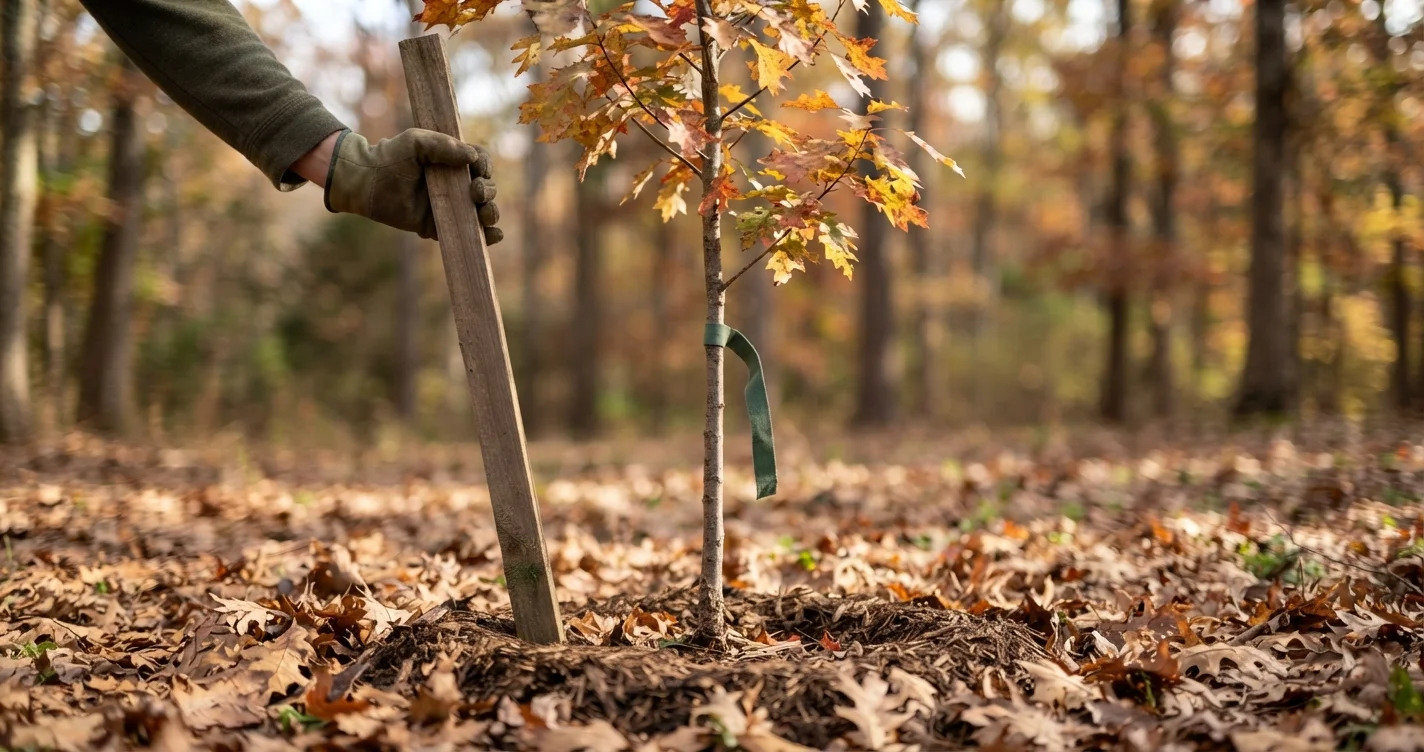
A young tree that sways gently in the wind may develop a stronger trunk than one that is held perfectly still. Surprisingly, the wooden stakes intended to protect newly planted trees can interfere with their natural development when left in place for too long.
Knowing when to remove tree stakes is an essential part of helping young trees establish healthy roots, develop sturdy trunks, and become independently stable.
Although temporary staking can be beneficial in windy locations or where newly planted trees have unstable root balls, many young trees need support for only one growing season. Others may never require staking at all.
Understanding how trees respond to movement explains why removing their supports at the right time can make such a difference to their long-term health.
Table of Contents
- Why Young Trees Sometimes Need Stakes
- When to Remove Tree Stakes: Finding the Right Time
- The Science Behind Trunk Strength and Natural Movement
- Five Signs Your Tree No Longer Needs Support
- What Happens When Tree Stakes Stay Too Long
- How to Remove Tree Stakes Safely
- When Young Trees May Need Extra Support
- Common Tree Staking Mistakes
- In Your Own Yard: Helping Young Trees Grow Stronger
- Frequently Asked Questions
Why Young Trees Sometimes Need Stakes
Planting a young tree involves more than simply transferring it from a nursery container into the ground.
Its root system must gradually establish connections with the surrounding soil, absorb moisture, and provide sufficient physical stability.
During this transitional period, some trees benefit from temporary support.
Protecting Newly Planted Roots
Strong winds can cause an unstable root ball to shift within the planting hole.
Repeated movement of the root ball may interfere with the establishment of delicate new roots.
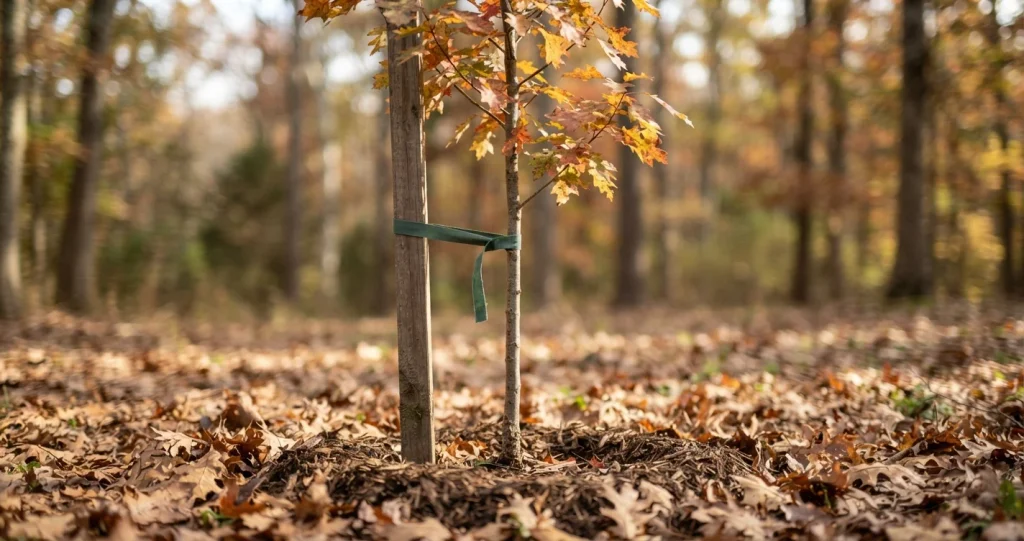
Proper staking helps stabilize the lower portion of the tree while allowing some natural movement in its trunk and crown.
Supporting Trees in Exposed Locations
Trees planted in open fields, coastal gardens, or areas frequently exposed to strong winds may benefit from temporary support.
Young trees with unusually large crowns or relatively small root systems may also require additional stability.
Many Trees Grow Better Without Stakes
A healthy nursery-grown tree with a stable root ball and a sufficiently strong trunk may establish successfully without staking.
In sheltered gardens with suitable soil conditions, additional supports are often unnecessary.
The decision to stake should depend on the individual tree and planting environment rather than being an automatic part of every planting project.
When to Remove Tree Stakes: Finding the Right Time
One of the most common landscaping mistakes is assuming that young trees need support for several years.
In many cases, temporary stakes can be removed after the first growing season, often within approximately 6–12 months of planting.
However, root establishment and tree stability are more important than the calendar alone.
General Tree Staking Timeline
| Time after planting | Recommended action |
|---|---|
| First month | Check stability and adjust ties if necessary |
| 1–3 months | Inspect supports and monitor trunk development |
| 3–6 months | Assess whether the tree can stand independently |
| 6–12 months | Remove stakes if the root ball is stable |
| 12 months or longer | Reassess the reason continued support is necessary |
These time frames are general guidelines rather than fixed rules for every tree species or growing condition.
Consider the Season
A tree planted in spring may be ready to lose its supports by fall or the following spring.
A tree planted in late autumn may benefit from support through its first active growing season if staking was necessary in the first place.
Inspecting the tree’s stability is the most reliable way to determine whether it is ready.
Why One Growing Season Is Often Enough
During favorable growing conditions, young trees gradually produce roots that extend beyond their original root balls.
As these roots spread into the surrounding soil, they improve anchorage and reduce the need for artificial support.
Once the tree can remain upright and stable independently, its stakes have generally completed their purpose.
The Science Behind Trunk Strength and Natural Movement
Trees may appear to be passive organisms, but they respond continuously to physical forces in their environment.
Wind, gravity, and mechanical movement all influence how their trunks and branches develop.
Understanding Thigmomorphogenesis
Thigmomorphogenesis is the process through which plants alter their growth in response to repeated mechanical stimulation.
For trees, gentle movement caused by wind can influence stem thickness, height growth, and the distribution of structural tissues.
Instead of directing all their resources toward growing taller, mechanically stimulated young trees may develop thicker, sturdier stems.
This natural response helps prepare them for the physical demands of their environment.
Why Trunk Movement Matters
A young tree held rigidly upright by tight supports experiences less natural movement.
Depending on the species and staking method, prolonged restriction can reduce the development of trunk diameter and taper.
Trunk taper refers to the gradual decrease in trunk thickness from the base toward the crown.
A well-developed taper contributes to the tree’s ability to withstand bending forces.
Root Stability and Trunk Flexibility Are Different
Successful staking should stabilize the root ball without completely preventing the upper trunk from moving.
Gentle swaying allows the tree to respond naturally to wind while its developing roots remain protected from excessive disturbance.
This balance is central to effective temporary staking.
Why Trees Should Gradually Become Independent
In nature, young trees must adapt to changing wind conditions without permanent artificial supports.
Removing stakes once adequate stability develops allows planted trees to continue this natural process.
The goal of staking is not to eliminate movement indefinitely but to provide temporary assistance during establishment.
According to Purdue University Extension, trees held rigidly in place for extended periods may grow taller but develop thinner trunks and smaller root systems than trees allowed to move naturally. Purdue Ag College
Five Signs Your Tree No Longer Needs Support
Before removing the stakes, examine your young tree for signs of independent stability.
1. The Root Ball Remains Stable
Temporarily loosen the support straps and gently push the trunk of a small tree.
Observe the soil around its base. If the trunk flexes slightly without the root ball shifting, the tree may have developed sufficient anchorage.
2. The Tree Stands Upright Independently
A tree that maintains its position without tension from the support straps may no longer require staking.
3. The Trunk Has Developed Greater Thickness
A noticeable increase in trunk diameter can indicate healthy structural development, although thickness alone does not guarantee root stability.
4. The Tree Has Completed Its First Growing Season
A full season of active growth provides a useful opportunity to assess root establishment and overall stability.
5. The Support Straps Remain Slack
If the straps are consistently loose and the tree remains upright, the staking system may no longer serve a useful purpose.
Colorado State University Extension recommends examining root ball movement when determining whether a tree is ready to have its supports removed. CSU Extension
What Happens When Tree Stakes Stay Too Long
Leaving supports attached indefinitely can gradually create problems that may remain unnoticed until significant damage occurs.
Trunk Girdling
As a young tree grows, its trunk expands in diameter.
Fixed ties, ropes, and wires may eventually press into the bark, damaging tissues responsible for transporting sugars and supporting new growth.
This injury is known as girdling.
Severe girdling can weaken or eventually kill a tree.
Reduced Trunk Strength
Excessively rigid supports may interfere with the natural development of trunk thickness and taper.
When these supports are finally removed, the tree may struggle to withstand strong winds.
Bark Damage and Abrasions
Repeated contact between the trunk and rough staking materials can create wounds.
These injuries may expose underlying tissues and compromise the tree’s natural defenses.
Colorado State University Extension reports that staking-related trunk injuries can develop as early as six months after planting. CSU Extension
How to Remove Tree Stakes Safely
Removing temporary supports is generally straightforward, provided the young tree has established sufficient stability.
Step 1: Choose a Calm Day
Select a day with moderate weather and little wind. This makes it easier to evaluate the tree’s natural position.
Step 2: Loosen the Support Ties
Carefully release all straps, ropes, or other attachments.
If a tie has become deeply embedded in the bark, consult an arborist rather than attempting to pull it out forcibly.
Step 3: Check the Tree’s Stability
Observe whether the tree remains upright and whether its root ball stays firmly in the soil during gentle movement.
Step 4: Remove the Stakes
Carefully pull the stakes from the ground without disturbing nearby roots. Remove all remaining support materials from the trunk and surrounding area.
Step 5: Monitor the Tree
Check the tree periodically over the following weeks, especially after heavy rainfall or strong winds.
Some movement is normal. Significant leaning or root ball displacement deserves further investigation.
When Young Trees May Need Extra Support
Although one growing season is often sufficient, certain circumstances may require additional attention.
Trees in Extremely Windy Locations
Exposed coastal gardens and open landscapes may present greater challenges for newly planted trees.
Trees With Poor Root Establishment
Compacted soil, inadequate watering, damaged roots, and incorrect planting depth can delay establishment.
Correcting these underlying conditions is generally more important than extending the staking period.
Permanently Supported Fruit Trees
Some dwarf apple trees grown on specific rootstocks require long-term or permanent support.
These specialized orchard systems differ from temporary staking used for ordinary landscape trees.
If a conventional landscape tree remains unstable after one year, consider consulting a certified arborist before extending its support period.
Common Tree Staking Mistakes
| Common mistake | Better approach |
|---|---|
| Leaving stakes for several years | Assess stability after one growing season |
| Attaching ties too tightly | Allow gentle trunk movement |
| Using thin wire or rope | Choose broad, flexible tree straps |
| Placing stakes against the trunk | Maintain sufficient separation |
| Driving stakes through the root ball | Position stakes outside the root ball |
| Staking every newly planted tree | Provide support only when necessary |
Correct staking should always encourage eventual independence rather than permanent reliance on external support.
In Your Own Yard: Helping Young Trees Grow Stronger
Removing stakes is only one part of establishing a healthy landscape tree.
Several simple gardening practices can encourage stronger roots and better structural development.
Maintain a Protective Mulch Ring
Apply approximately 2–3 inches of organic mulch around the tree’s root zone.
Keep the mulch several inches away from the trunk to prevent excessive moisture accumulation against the bark.
Water According to Soil Conditions
Young trees need consistent moisture during establishment.
Check the soil before watering and adjust irrigation according to rainfall, temperature, drainage, and seasonal conditions.
Reduce Competition From Grass
Maintaining a mulched area around the tree can reduce competition from lawn grasses and help protect the trunk from lawnmowers and string trimmers.
Preserve Healthy Lower Branches
Temporary lower branches can contribute to trunk diameter development in young trees.
Rather than removing them all immediately, use gradual, appropriate structural pruning as the tree matures.
Set a Reminder to Remove the Stakes
Record your tree’s planting date and schedule a stability inspection near the end of its first growing season.
This simple habit helps prevent temporary gardening equipment from becoming a permanent source of damage.
Frequently Asked Questions
1. Can tree stakes be removed after six months?
Yes. Some young trees establish sufficient stability within six months, particularly when planted in spring under favorable growing conditions. Check root ball stability and the tree’s ability to remain upright before removing its supports.
2. Can leaving tree stakes too long kill a tree?
Yes. Forgotten ties can become embedded in expanding trunks, causing girdling and serious tissue damage. Prolonged rigid staking can also interfere with normal structural development.
3. Is it normal for a young tree to sway after removing its stakes?
Yes. Gentle trunk movement is a natural and beneficial response to wind. However, excessive leaning, soil displacement, or movement of the entire root ball may indicate an anchorage problem.
Conclusion
The next time you notice a young tree swaying gently in the garden, remember that its movement is part of a remarkable biological process.
Understanding when to remove tree stakes allows gardeners to encourage natural trunk development, protect expanding bark, and support long-term tree stability.
Temporary support has its place, but independence should remain the ultimate goal.
Sometimes, the best thing you can do to help a young tree grow stronger is simply to give it the freedom to move.
External Sources
1. Staked Trees Can Grow Taller but Weaker
Trees prevented from moving naturally may grow taller while developing thinner trunks and smaller root systems, leaving them more vulnerable when their supports are removed. Purdue Ag College. https://ag.purdue.edu/department/btny/ppdl/_media/publications/forestry/fnr-547-w.pdf
2. Staking Damage Can Appear After Just Six Months
Staking materials can cause compression injuries and girdling as early as six months after planting, well before many gardeners consider removing them. CSU Extension. https://cmg.extension.colostate.edu/Gardennotes/654.pdf
3. Leaving Stakes Longer May Provide No Additional Benefit
If ordinary landscape trees have failed to develop sufficient anchorage after one year of staking, leaving the same supports in place longer may provide no additional benefit. University of Maryland Extension. https://extension.umd.edu/resource/planting-tree-or-shrub.