
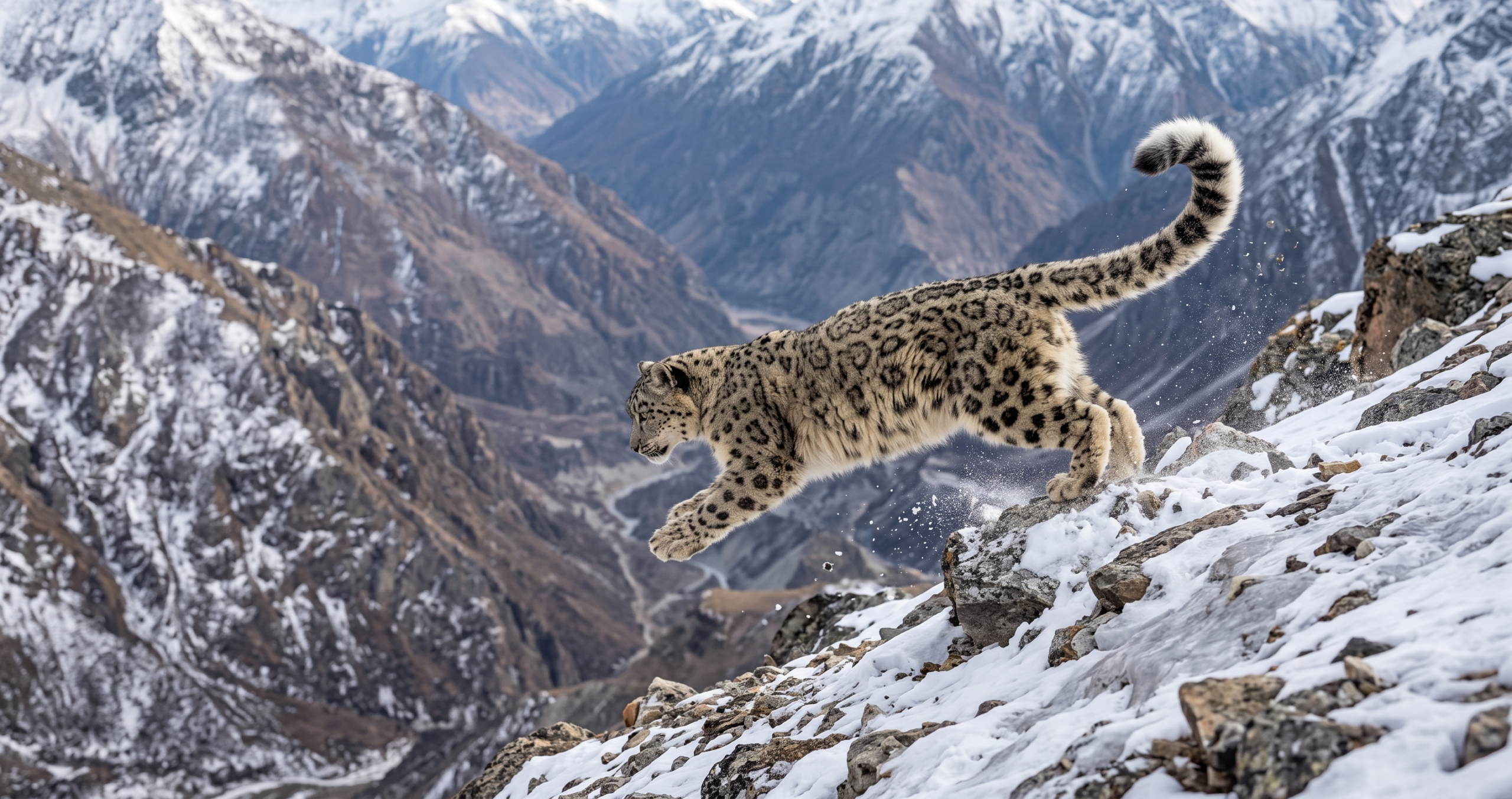
One of the most recognizable features of the snow leopard is its remarkably long, thick, and fluffy tail. At first glance, it may appear oversized compared to the rest of the cat’s body, but this distinctive feature is one of the finest examples of evolution shaping an animal for life in an extreme environment. Understanding snow leopard tail adaptation reveals how a single body part can perform several vital functions at once, helping these elusive predators survive some of the harshest landscapes on Earth.
Snow leopards inhabit rugged mountain ranges where freezing temperatures, steep cliffs, deep snow, and thin air create constant challenges. Every part of their anatomy has evolved to meet these demands, and the tail plays an essential role in maintaining balance, conserving heat, communicating with other snow leopards, and supporting successful hunting.
Far from being just an attractive feature, the tail is a multi-purpose survival tool that has helped snow leopards thrive across Central and South Asia for thousands of years.
Table of Contents
- Meet the Snow Leopard
- Habitat: Life Above the Clouds
- The Anatomy of a Remarkable Tail
- How the Tail Improves Balance
- Staying Warm in Freezing Mountains
- Communication and Social Behavior
- Tail Movements During Hunting
- Why Evolution Favored Such a Long Tail
- Ecological Importance
- Conservation Challenges
- What People Often Get Wrong
- Practical Wildlife Observation and Conservation Tips
- Frequently Asked Questions
- Conclusion
Meet the Snow Leopard
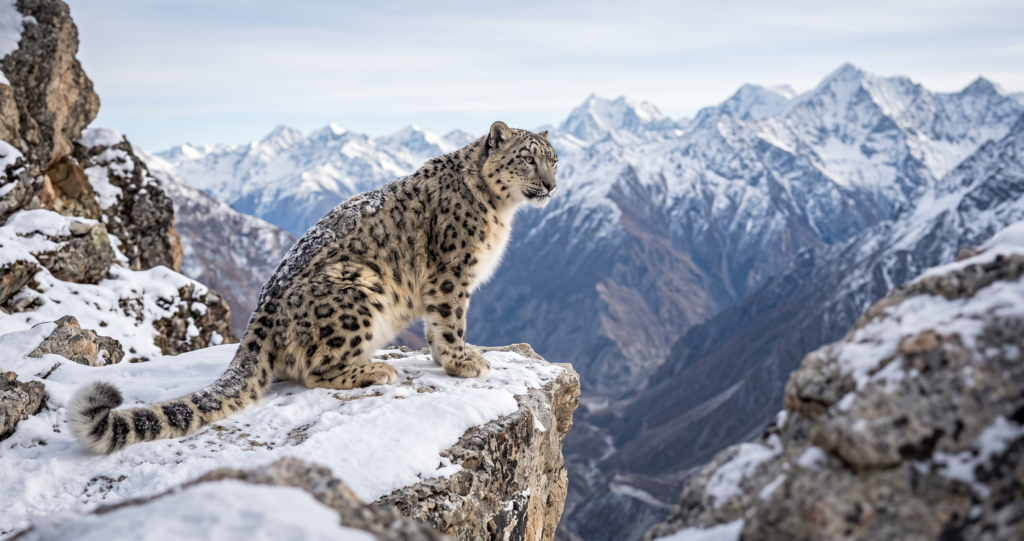
The snow leopard (Panthera uncia) is one of the world’s most specialized big cats. Unlike lions or tigers, it lives almost entirely in rugged mountain environments stretching across 12 countries, including Mongolia, China, Nepal, India, Pakistan, Bhutan, Kyrgyzstan, Kazakhstan, Tajikistan, Uzbekistan, Afghanistan, and Russia.
Its thick fur, powerful limbs, enlarged nasal passages, and exceptionally long tail all reflect adaptations to cold, rocky landscapes.
Although snow leopards belong to the genus Panthera, they cannot roar like lions or tigers. Instead, they communicate using chuffs, growls, yowls, scent marking, and body language.
Because they are naturally elusive and inhabit remote terrain, they are among the least frequently observed large cats in the wild.
Habitat: Life Above the Clouds
Understanding snow leopard tail adaptation begins with understanding where these cats live.
Snow leopards typically inhabit alpine and subalpine ecosystems between approximately 3,000 and 5,500 meters (9,800–18,000 feet), although elevations vary by region and season.
Their habitat includes:
- Rocky cliffs
- High mountain ridges
- Alpine meadows
- Scree slopes
- Snow-covered valleys
Winter temperatures regularly fall well below freezing, while steep cliffs require exceptional agility.
Few predators face such a demanding combination of cold, altitude, and difficult terrain.
The Anatomy of a Remarkable Tail
A snow leopard’s tail can measure nearly as long as its body, typically reaching 80–105 centimeters (31–41 inches).
Several anatomical features make it unique.
Thick Fur
The tail is covered in exceptionally dense, insulating fur.
This heavy coat reduces heat loss and protects exposed skin from icy winds.
Fat Storage
The tail also stores fat reserves.
Although it is not the primary location for energy storage, these fat deposits provide additional insulation and can serve as an energy reserve during periods when prey is scarce.
Flexible Muscles
Powerful muscles throughout the tail allow precise movement during climbing, jumping, and balancing.
This flexibility is especially valuable when navigating unstable rocks or narrow ledges.
How the Tail Improves Balance
Perhaps the best-known example of snow leopard tail adaptation is its role in balance.
Mountain landscapes demand constant adjustments to body position.
Snow leopards often:
- Walk across narrow rock ledges.
- Leap between cliffs.
- Descend steep slopes.
- Pursue prey over uneven ground.
The long tail functions as a counterbalance.
Much like a tightrope walker using a balancing pole, the snow leopard shifts its tail to help stabilize its body while moving.
This allows smoother, more controlled movement across terrain where a slip could lead to serious injury.
Precise Landings
Snow leopards are capable of impressive leaps across rocky gaps.
During these jumps, subtle tail movements help maintain body orientation before landing.
Combined with powerful hind legs and flexible joints, the tail contributes to remarkable agility.
Staying Warm in Freezing Mountains
Cold weather presents another challenge.
Temperatures in snow leopard habitat often remain below freezing for extended periods.
When resting, snow leopards frequently curl into a compact position and wrap their thick tail around their nose and face.
This behavior provides several advantages.
Reduced Heat Loss
Covering the face helps reduce exposure to icy winds.
Warm air exhaled from the nose becomes partially trapped beneath the fur, helping conserve body heat.
Protection From Frost
Sensitive areas around the nose and mouth remain shielded during snowstorms and cold nights.
Few mammals possess such an effective built-in winter blanket.
Communication and Social Behavior
Although snow leopards are solitary for much of the year, they still communicate with one another.
The tail contributes to visual signaling.
Researchers have observed tail movements during:
- Territorial encounters
- Courtship
- Interactions between mothers and cubs
Like domestic cats, snow leopards may express emotional states through body posture and tail position.
Because these interactions often occur in remote mountain habitats, scientists continue learning more through camera traps and field observations.
Tail Movements During Hunting
Snow leopards specialize in ambush hunting.
Rather than chasing prey over long distances, they rely on stealth, patience, and explosive bursts of speed.
Their prey includes:
- Blue sheep (bharal)
- Siberian ibex
- Himalayan tahr
- Marmots
- Pikas
- Wild sheep
During careful stalking, balance remains essential.
Small shifts of the tail help maintain stability while moving slowly across rocks.
Once the attack begins, coordinated tail movements assist with rapid turns and controlled landings.
Although the tail does not directly generate power, it contributes to efficient movement throughout the hunt.
Why Evolution Favored Such a Long Tail
Evolution rarely produces features without multiple benefits.
The snow leopard’s tail represents an excellent example of one structure serving several purposes simultaneously.
Benefits include:
- Balance on steep terrain
- Improved jumping control
- Thermal insulation
- Fat storage
- Communication
- Protection while resting
Rather than evolving separately, these functions reinforce one another.
Natural selection favored individuals whose tails improved survival and reproductive success in mountainous environments.
Ecological Importance
Snow leopards are apex predators throughout much of their range.
Healthy snow leopard populations help regulate populations of large mountain herbivores.
Balanced herbivore numbers reduce excessive grazing pressure on alpine vegetation.
Healthy vegetation contributes to:
- Soil stability
- Water regulation
- Biodiversity
- Habitat quality for many smaller species
Because mountain ecosystems provide freshwater for millions of people downstream, conserving snow leopards indirectly supports broader ecological health.
Conservation Challenges
Despite their remarkable adaptations, snow leopards face growing conservation pressures.
Major threats include:
Habitat Fragmentation
Infrastructure development, roads, and expanding human activities can divide suitable habitat into smaller patches.
Declining Wild Prey
Overhunting of wild ungulates may reduce food availability.
Human-Wildlife Conflict
Livestock losses sometimes lead to retaliatory killing of snow leopards.
Climate Change
Warming temperatures may shift alpine ecosystems upward, reducing suitable habitat and altering prey distributions.
Fortunately, international conservation partnerships have improved monitoring, anti-poaching efforts, community-based conservation, and habitat protection across much of the species’ range.
Because snow leopards occupy remote landscapes spanning multiple countries, successful conservation depends on long-term international cooperation.
What People Often Get Wrong
The Tail Is Only for Balance
Balance is important, but the tail also provides insulation, communication, fat storage, and protection during rest.
Snow Leopards Live Only in Snow
Despite their name, they spend much of their lives on rocky slopes, alpine grasslands, and rugged cliffs where snow cover varies seasonally.
Snow Leopards Are Aggressive Toward Humans
Wild snow leopards are generally shy and avoid human contact whenever possible.
Every Big Cat Has the Same Tail Function
Different cat species have evolved tails suited to their environments. The unusually thick tail of the snow leopard reflects the unique demands of mountain life.
Thick Fur Alone Explains Cold Adaptation
The tail works alongside dense fur, enlarged lungs, wide paws, muscular limbs, and specialized physiology to help snow leopards survive cold climates.
Practical Wildlife Observation and Conservation Tips
If you’re interested in supporting snow leopard conservation:
- Support organizations working with local mountain communities.
- Learn about responsible ecotourism that follows wildlife viewing guidelines.
- Avoid purchasing products made from wild cat fur or body parts.
- Choose educational resources produced by scientific institutions.
- Help raise awareness about the importance of protecting mountain ecosystems and wild prey populations.
Responsible conservation benefits both wildlife and the people who share these landscapes.
Frequently Asked Questions
Why is a snow leopard’s tail so thick?
Its thick fur provides insulation against freezing temperatures, while fat deposits add warmth and serve as an energy reserve.
How long is a snow leopard’s tail?
The tail typically measures about 80–105 centimeters (31–41 inches), making it nearly as long as the body.
Do snow leopards use their tails while hunting?
Yes. The tail helps maintain balance during stalking, climbing, jumping, and rapid changes of direction.
Why do snow leopards wrap their tails around their faces?
Covering the nose and mouth helps conserve heat and protects sensitive facial tissues from freezing winds.
Are snow leopard tails unique among big cats?
All cats use their tails for balance, but the snow leopard’s exceptionally long, thick, and heavily furred tail is especially adapted for cold mountain environments.
Conclusion
The remarkable snow leopard tail adaptation demonstrates how evolution can transform a single anatomical feature into a versatile survival tool. More than a balancing aid, the tail functions as an insulated blanket, a communication device, a source of stored energy, and an essential support for navigating steep alpine terrain.
Together with powerful limbs, dense fur, wide paws, and exceptional agility, the tail allows snow leopards to thrive where few large predators can survive. As climate change, habitat fragmentation, and human pressures continue to affect mountain ecosystems, protecting these extraordinary cats means conserving the rugged landscapes and healthy prey populations they depend upon.
Studying the snow leopard’s remarkable tail offers more than an appreciation of one beautiful species—it provides insight into the incredible ways wildlife adapts to some of Earth’s most demanding environments.
Suggested Internal-Link Opportunities
Link naturally to related articles on https://secretsofthegreengarden.com, such as:
- An article about mountain animal adaptations to cold climates.
- A feature explaining how big cats hunt in different habitats.
- A guide to camouflage and survival strategies in wild mammals.
- An article exploring apex predators and healthy ecosystems.
Recommended Authoritative External Sources
- International Union for Conservation of Nature (IUCN) Red List – Snow Leopard assessment
- Smithsonian’s National Zoo & Conservation Biology Institute – Snow Leopard species profile
- Snow Leopard Trust – Research and conservation publications
- Journal of Mammalogy and Biological Conservation (peer-reviewed studies on snow leopard ecology and conservation)
- World Wildlife Fund (WWF) – Snow Leopard conservation resources