
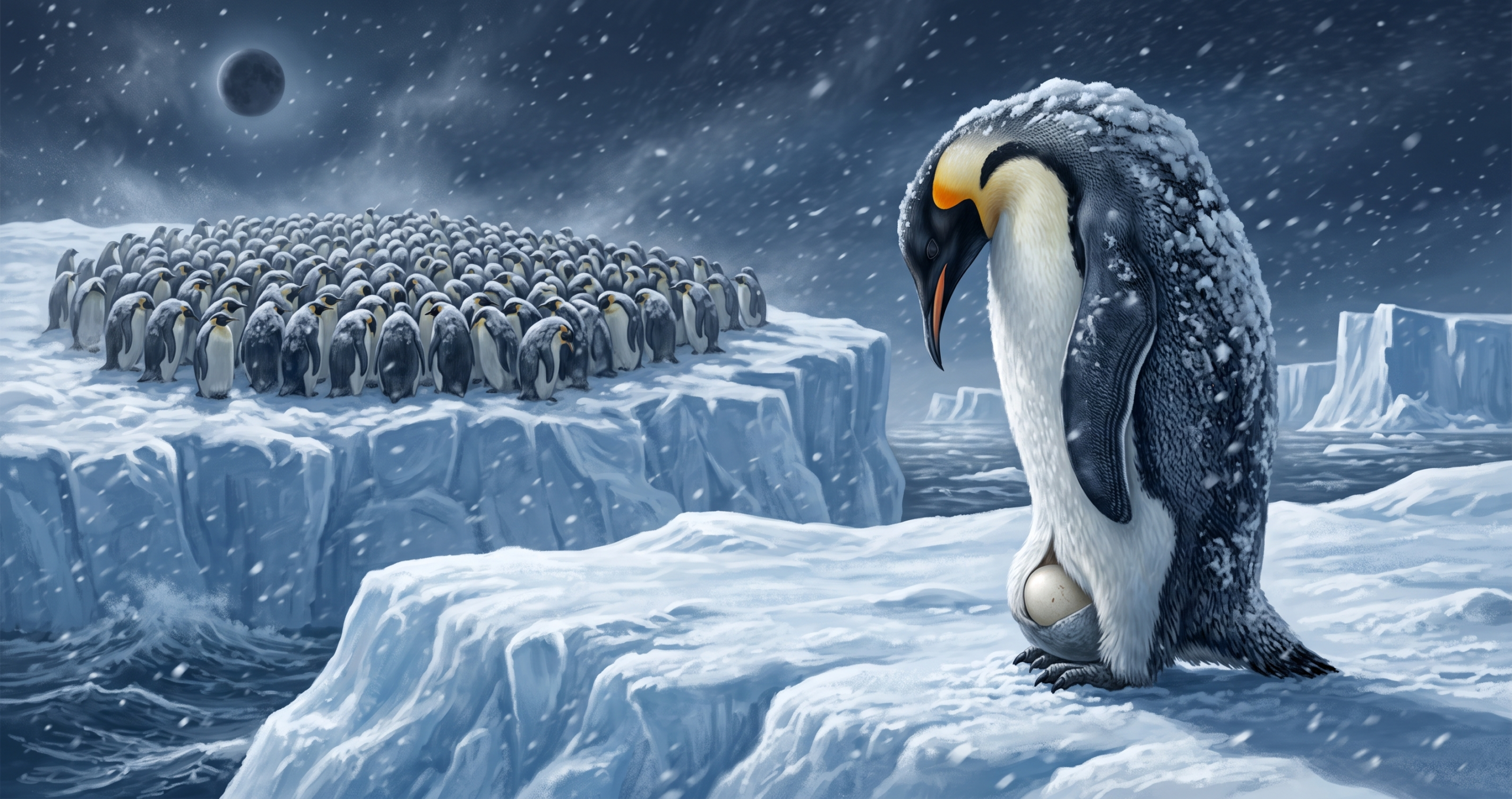
One of the most remarkable examples of parental dedication in nature is emperor penguin father egg care. While many birds share incubation duties, emperor penguins have evolved a unique strategy that places nearly the entire responsibility for protecting the egg on the male during Antarctica’s darkest and coldest months.
After the female lays a single egg, she transfers it to the male before beginning a long journey to the sea to feed. From that moment until she returns roughly two months later, the father must keep the egg alive through freezing temperatures, hurricane-force winds, and complete darkness—all without eating.
This extraordinary behavior is not simply an interesting wildlife fact. It represents one of the most specialized breeding strategies among birds and highlights how evolution has shaped emperor penguins to survive in one of Earth’s harshest environments.
Table of Contents
- Emperor Penguins and Their Antarctic Home
- Why Fathers Incubate the Egg
- The Critical Egg Transfer
- Anatomy That Makes Incubation Possible
- Surviving the Antarctic Winter Fast
- The Power of the Huddle
- Keeping the Egg Warm
- What Happens When the Chick Hatches?
- Why This Parenting Strategy Works
- Ecological Importance
- Conservation Challenges
- What People Often Get Wrong
- Practical Wildlife Observation Tips
- Frequently Asked Questions
- Conclusion
Emperor Penguins and Their Antarctic Home
The emperor penguin (Aptenodytes forsteri) is the largest living penguin species and is found only in Antarctica. Unlike most penguins that breed during relatively mild seasons, emperor penguins intentionally breed during the Antarctic winter.
This unusual timing means chicks hatch in spring, when sea ice conditions improve and food becomes more accessible. Although winter nesting seems risky, it provides young birds with several months to grow before facing their first Antarctic winter.
Breeding colonies are often located on stable sea ice attached to the Antarctic coastline. Here, thousands of birds gather in one of nature’s most spectacular breeding events.
Why Fathers Incubate the Egg
The division of parental responsibilities begins almost immediately after the female lays her single egg.
Producing the egg requires enormous energy reserves. Once laying is complete, the female’s priority becomes replenishing those reserves by traveling to open water to feed on fish, squid, and krill.
Meanwhile, the father assumes complete responsibility for incubation.
This arrangement benefits both parents:
- The female restores energy needed for feeding the future chick.
- The male protects the egg during the harshest part of winter.
- When the female returns, both parents can alternate feeding duties.
Rather than being unequal, the system represents a carefully balanced partnership shaped by millions of years of evolution.
The Critical Egg Transfer
One of the most delicate moments occurs immediately after the egg is laid.
The female carefully rolls the egg toward the father’s feet. Both parents must coordinate this transfer without allowing the egg to touch the ice.
Because Antarctic surface temperatures can fall below -40°C (-40°F), even brief exposure may threaten embryo survival.
The exchange often takes only seconds, yet it is among the riskiest moments in the breeding cycle.
Once the father secures the egg, he lifts it onto the tops of his feet and covers it with a specialized fold of abdominal skin known as the brood pouch.
From this point forward, the egg rarely leaves this protected position.
Anatomy That Makes Incubation Possible
The Brood Pouch
The brood pouch is not a nest.
Instead, it is a warm fold of feathered skin that hangs over the egg while it rests on the father’s feet.
The pouch greatly reduces heat loss and shields the egg from freezing winds.
Dense Feathers
Emperor penguins possess one of the densest feather coverings among birds.
Their feathers trap insulating air while overlapping layers help block wind and moisture.
Combined with a thick layer of body fat, this insulation allows fathers to conserve precious energy throughout their fasting period.
Specialized Feet
Unlike many birds, emperor penguins incubate eggs directly on their feet.
This keeps the egg elevated above the ice, minimizing heat loss through contact with the frozen ground.
Surviving the Antarctic Winter Fast
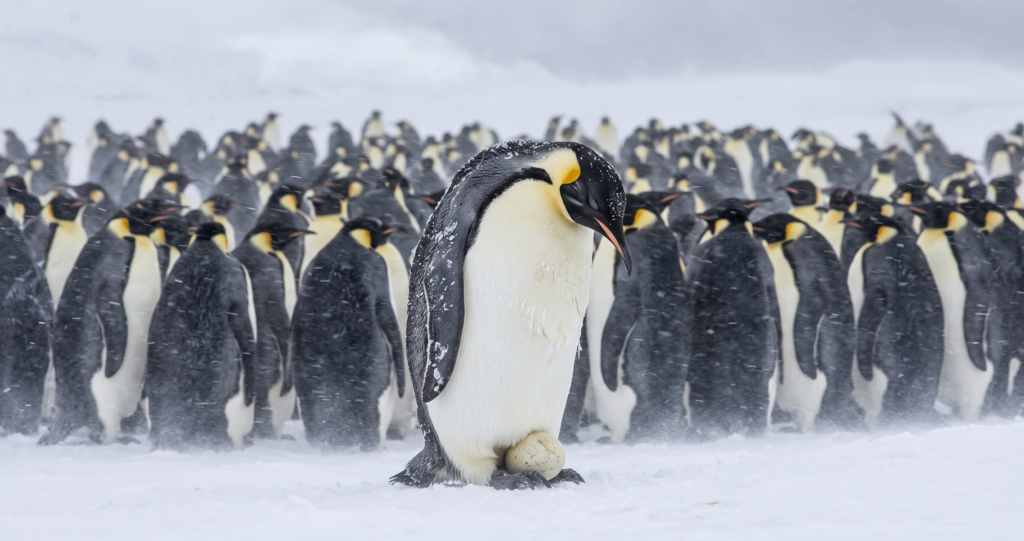
Perhaps the most astonishing part of emperor penguin father egg care is the fasting period.
Male emperor penguins typically stop eating after arriving at the breeding colony and may fast for around four months while courting, incubating the egg, and waiting for the female’s return.
During this time they depend entirely on stored body fat.
To conserve energy they:
- Stand nearly motionless for long periods.
- Reduce unnecessary movement.
- Rely on social huddling.
- Minimize exposure to strong winds.
By the time females return, males have often lost a substantial portion of their body weight.
The Power of the Huddle
One emperor penguin alone would struggle to survive prolonged Antarctic storms.
Thousands together create one of nature’s most effective examples of cooperative thermoregulation.
Constant Rotation
Penguins slowly rotate positions within the huddle.
Individuals exposed to the freezing outer edge gradually move inward, while birds from the warmer center cycle outward.
This continuous movement allows every father access to warmer conditions over time.
Reduced Heat Loss
Research has shown that tightly packed huddles dramatically reduce heat loss compared with isolated birds.
The strategy helps fathers conserve energy while maintaining safe temperatures for their developing eggs.
Importantly, even while packed closely together, each father continues balancing his egg carefully beneath the brood pouch.
Keeping the Egg Warm
The developing embryo requires a stable temperature throughout incubation.
Several adaptations make this possible.
Continuous Contact
The egg remains in nearly constant contact with the father’s warm feet and brood pouch.
Wind Protection
The father’s body shields the egg from direct exposure to powerful Antarctic winds.
Careful Balance
Even while walking, males carefully shift their weight to avoid dropping the egg.
This remarkable coordination demonstrates how precisely their breeding behavior has evolved.
What Happens When the Chick Hatches?
If timing works as intended, the female returns from the sea shortly before or soon after the chick hatches.
If she is delayed, the father has one more adaptation.
Specialized glands in his esophagus can produce a nutrient-rich secretion that temporarily feeds the newly hatched chick until the mother returns with food.
This secretion is not the same as mammalian milk, but it provides valuable nourishment during a critical period.
Once the female arrives, she recognizes her mate and chick using vocal calls unique to each individual.
The parents then begin alternating trips between feeding at sea and caring for the growing chick.
Why This Parenting Strategy Works
At first glance, relying on fasting fathers in Antarctica may seem unnecessarily dangerous.
However, the strategy provides several important advantages.
Spring Food Availability
By hatching in spring, chicks have better access to food brought by both parents.
Stable Sea Ice
Winter sea ice offers secure breeding platforms away from many marine predators.
Shared Responsibilities
Although males incubate alone initially, both parents later contribute extensively to raising the chick.
This division of labor maximizes survival under challenging environmental conditions.
Ecological Importance
Emperor penguins occupy an important position within the Antarctic food web.
They feed primarily on fish, squid, and krill while serving as prey for leopard seals and killer whales.
Because their breeding success depends on stable sea ice, scientists also consider emperor penguins valuable indicators of environmental change.
Monitoring colony size, breeding success, and chick survival helps researchers understand how changing Antarctic conditions affect the broader ecosystem.
Conservation Challenges
Although emperor penguins inhabit one of the world’s most remote environments, they are not isolated from global environmental changes.
The greatest long-term concern is the loss of stable sea ice.
Breeding colonies require reliable sea ice throughout incubation and chick development. If ice breaks up too early, chicks may enter the water before developing waterproof feathers, greatly reducing survival.
Scientists also monitor:
- Changing sea ice patterns
- Ocean warming
- Variations in krill abundance
- Increased frequency of extreme weather events
Long-term satellite monitoring has significantly improved scientists’ ability to track colonies across Antarctica and better understand population trends.
International conservation efforts continue to focus on protecting Antarctic ecosystems while improving scientific monitoring.
What People Often Get Wrong
The Father Does Everything
The male performs the winter incubation, but the female invests enormous energy producing the egg and later returns to feed the chick. Successful breeding depends on both parents.
Penguins Build Nests
Emperor penguins do not construct nests. The egg remains balanced on the father’s feet beneath the brood pouch.
Penguins Live Only in Snow
Although emperor penguins breed on sea ice, they spend much of their lives swimming and hunting in the Southern Ocean.
The Egg Can Safely Touch Ice
Even brief exposure to extreme Antarctic cold may threaten embryo survival, making careful egg handling essential.
All Penguin Species Raise Chicks the Same Way
Different penguin species have evolved very different breeding strategies. Emperor penguins are unusual because males alone incubate the egg during winter.
Practical Wildlife Observation and Conservation Tips
If you’re interested in emperor penguins or Antarctic wildlife:
- Watch documentaries produced in partnership with scientific organizations.
- Support conservation groups working to protect Antarctic ecosystems.
- Learn about climate science from trusted research institutions.
- Avoid disturbing wildlife during authorized Antarctic tourism by following established viewing guidelines.
- Choose educational resources grounded in peer-reviewed research rather than sensational wildlife claims.
Responsible wildlife appreciation encourages greater understanding without disturbing sensitive habitats.
Frequently Asked Questions
How long do emperor penguin fathers incubate the egg?
Male emperor penguins typically incubate the egg for about 64 days while the female feeds at sea.
Do emperor penguin fathers eat during incubation?
No. Fathers fast throughout incubation, relying on stored body fat accumulated before breeding.
Why don’t females stay with the egg?
Producing the egg depletes the female’s energy reserves. She must return to the ocean to feed before helping raise the chick.
How do fathers keep the egg from freezing?
They balance the egg on their feet beneath a warm brood pouch that insulates it from Antarctica’s freezing surface and cold winds.
What happens if the female returns late?
The father can temporarily feed the newly hatched chick with a nutrient-rich secretion produced in his esophagus until the female returns.
Conclusion
The story of emperor penguin father egg care demonstrates one of the most extraordinary examples of parental commitment in the animal kingdom. Through months of fasting, constant vigilance, precise egg handling, and cooperative huddling, emperor penguin fathers keep a single fragile egg alive under conditions that challenge even the toughest wildlife.
Their success depends not on one remarkable adaptation alone but on a combination of specialized anatomy, cooperative behavior, careful timing, and an equal partnership between both parents. As scientists continue studying emperor penguins and monitoring changes in Antarctic sea ice, these birds also remind us how closely wildlife survival is connected to healthy polar ecosystems.
For anyone fascinated by animal behavior, emperor penguins remain a powerful example of how evolution can produce parenting strategies perfectly suited to one of Earth’s most demanding environments.
Suggested Internal-Link Opportunities
Link naturally to related articles on https://secretsofthegreengarden.com, such as:
- An article about penguin adaptations for surviving extreme cold.
- A guide to Antarctic wildlife and food webs.
- A feature on remarkable examples of animal parenting and parental care.
- An article explaining how sea ice supports Antarctic ecosystems.
Recommended Authoritative External Sources
- British Antarctic Survey – Emperor Penguin Research
- Smithsonian’s National Zoo & Conservation Biology Institute – Emperor Penguin species profile
- International Union for Conservation of Nature (IUCN) Red List – Emperor Penguin assessment
- National Snow and Ice Data Center (NSIDC) – Antarctic sea ice research
- Peer-reviewed studies published in journals such as Proceedings of the National Academy of Sciences (PNAS), Global Change Biology, and Biology Letters