
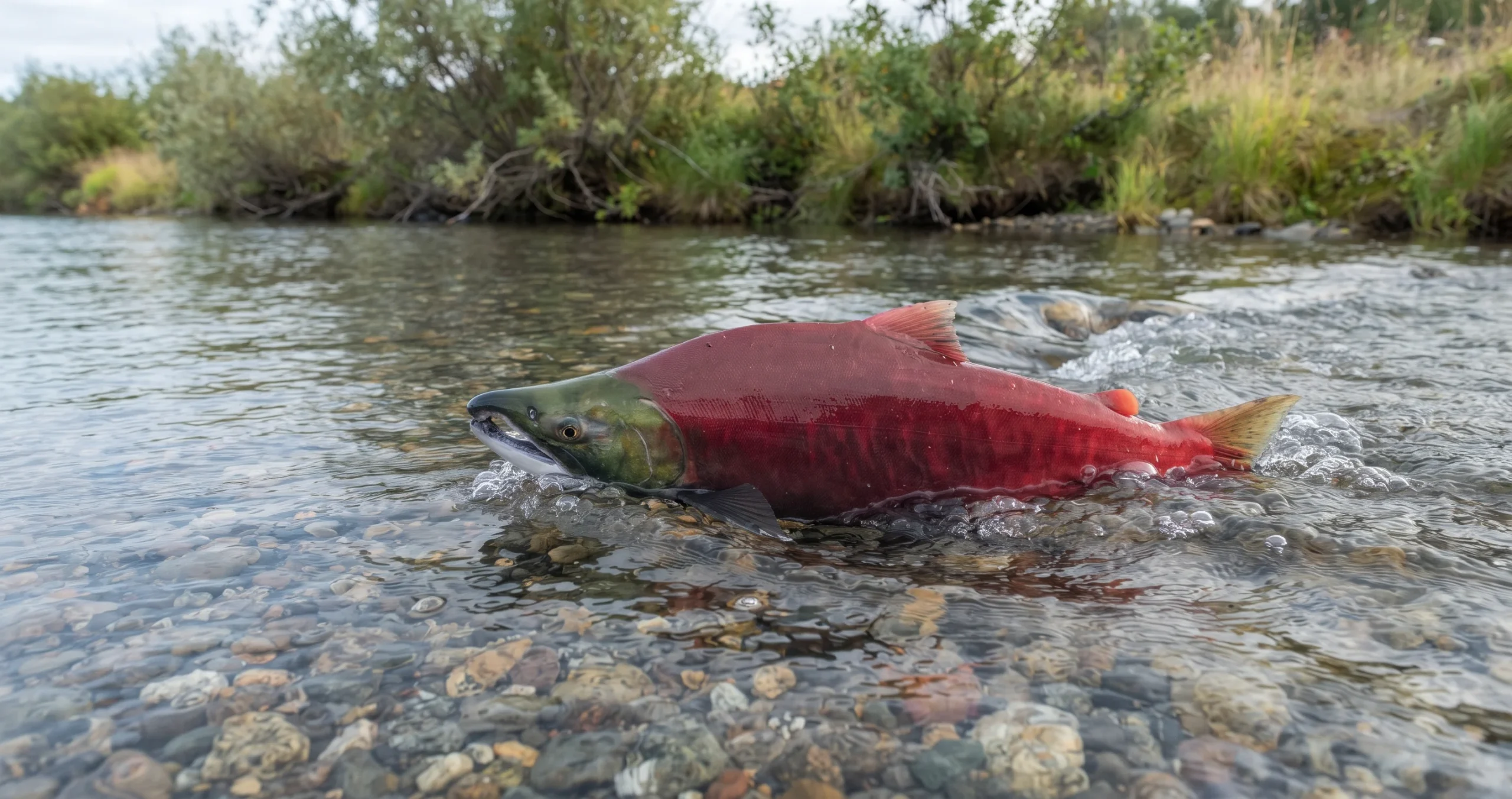
Few animal migrations are as remarkable as the journey of a salmon returning from the ocean to the freshwater stream where its life began. After spending months or years in distant waters, many salmon navigate complex river systems to reach familiar spawning grounds.
The phenomenon of salmon homing by smell demonstrates how powerful sensory abilities help fish survive, reproduce, and maintain connections with their birthplace. Scientists have also discovered evidence that salmon use Earth’s magnetic field to navigate across the ocean.
Together, these abilities support a life cycle that connects rivers, oceans, forests, and wildlife in an extraordinary ecological relationship.
Table of Contents
- Understanding the Salmon Life Cycle
- How Salmon Find Their Home Stream
- Salmon Homing by Smell: How It Works
- How Salmon Use Earth’s Magnetic Field
- The Journey Upstream
- Spawning and the Importance of Redds
- Pacific vs. Atlantic Salmon
- Why Salmon Matter to Forests and Wildlife
- Threats to Salmon Migration and Habitat
- How We Can Help Protect Salmon
- Frequently Asked Questions
Understanding the Salmon Life Cycle
Many salmon are anadromous fish, meaning they reproduce in freshwater but spend a significant portion of their lives growing in saltwater.
Their life cycle involves major physical and behavioral changes that allow them to survive in these contrasting environments. The timing and duration of each stage vary among species and populations.
Eggs and alevins
A salmon’s life begins inside a fertilized egg buried beneath freshwater gravel. Cool, oxygen-rich water flowing through the gravel helps support embryonic development.
After hatching, young salmon remain within the gravel as alevins. During this stage, they obtain nourishment from an attached yolk sac.
Fry and juvenile salmon
Once their yolk reserves are largely absorbed, young salmon emerge from the gravel and begin feeding independently.
They consume small aquatic organisms while developing the swimming abilities necessary for surviving in streams and rivers. Depending on the species, they may remain in freshwater for a relatively short period or several years.
Smolts and ocean migration
Before entering saltwater, juvenile salmon undergo a physiological transformation called smoltification.
Changes in their bodies allow them to regulate water and salt more effectively in marine environments. This developmental period is also particularly important for learning the chemical characteristics of their home waters.
Ocean adults and returning spawners
At sea, salmon feed and grow until they approach reproductive maturity. Their diet may include small fish, crustaceans, and other marine organisms.
Eventually, migratory adults return toward freshwater spawning habitats, beginning the reproductive stage of their life cycle.
How Salmon Find Their Home Stream
Returning to a particular freshwater stream after an extended ocean journey requires more than simply swimming toward land.
Salmon must navigate large marine environments, identify the appropriate river system, and select suitable tributaries leading toward their spawning habitat.
Researchers believe that different sensory mechanisms become important during different stages of this journey.
Magnetic information may help salmon navigate across the ocean, while their highly developed sense of smell becomes especially important as they approach and enter freshwater.
Salmon Homing by Smell: How It Works
The scientific term for detecting chemical odors is olfaction. In salmon, this sense plays a central role in recognizing familiar freshwater environments.
Unlike humans, who primarily detect odors carried through the air, salmon detect chemical substances dissolved in water.
Every stream has a chemical signature
Water flowing through a watershed interacts with soil, rocks, vegetation, microorganisms, and decaying organic material.
These interactions create combinations of dissolved substances that can differ between rivers and tributaries.
Salmon can learn and later recognize particular odor combinations associated with their early freshwater habitats. This ability forms the foundation of salmon homing by smell.
Learning the scent of home
Young salmon develop memories of familiar chemical cues through a process known as olfactory imprinting.
This learning can occur at important developmental stages, including the period when juvenile fish prepare to migrate toward the ocean.
How salmon detect odors underwater
Water passes through specialized olfactory chambers containing sensory tissues. Receptor cells respond to particular dissolved chemicals and send information to the brain.
Unlike gills, these structures are involved in chemical detection rather than obtaining oxygen.
When mature salmon encounter familiar odors during their return migration, these signals can help guide their upstream movements.
The process of salmon homing by smell is particularly useful at river junctions, where water from different tributaries mixes.
How Salmon Use Earth’s Magnetic Field
Although smell helps salmon identify familiar rivers, it does not fully explain how they navigate across vast ocean environments.
Scientists have found evidence that salmon can detect characteristics of Earth’s magnetic field. This sensory ability is known as magnetoreception.
A natural magnetic map
Earth’s magnetic field varies geographically. Its strength and inclination provide information that certain migratory animals can potentially use to determine their approximate location.
Salmon may use these magnetic characteristics to orient themselves during ocean migration.
One influential study examined historical migration patterns of sockeye salmon returning to Canada’s Fraser River. The findings suggested that changes in Earth’s magnetic field influenced the routes taken by returning fish.
Magnetism and smell work together
Magnetic navigation may guide salmon toward the general coastal region associated with their birthplace. Once they encounter freshwater carrying familiar chemical signals, salmon homing by smell becomes particularly important.
However, scientists are still investigating exactly how salmon detect magnetic fields and combine magnetic information with other environmental cues.
Their navigation system is more complex than a simple biological compass.
The Journey Upstream
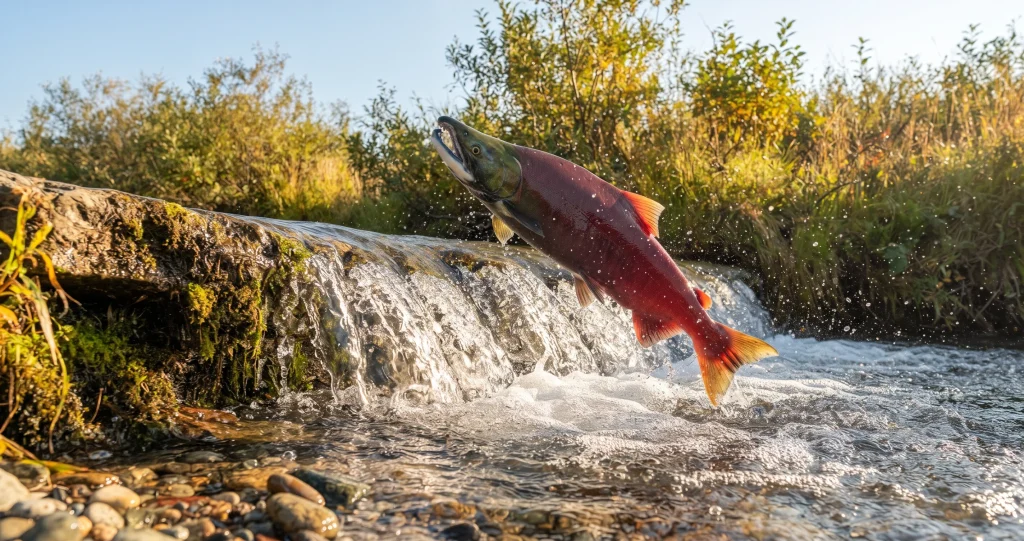
Returning salmon must overcome considerable physical challenges as they travel from the ocean toward their spawning grounds.
Strong currents, waterfalls, shallow passages, predators, and changing water temperatures can make upstream migration demanding.
Many salmon reduce or stop feeding during their freshwater spawning migration, relying heavily on energy accumulated during their time at sea.
Physical changes during migration
As salmon approach reproductive maturity, their appearance may change dramatically.
Some Pacific salmon develop brighter colors, enlarged jaws, or pronounced body changes. The characteristics depend on the species, sex, and stage of reproductive development.
Finding the correct tributary
Large river systems contain numerous smaller streams and branching channels. Choosing the appropriate route requires responding to environmental information at multiple points.
Salmon homing by smell helps returning fish distinguish familiar tributaries from unfamiliar ones. Nevertheless, some individuals enter streams other than their birthplace, a natural behavior known as straying.
Straying can contribute to genetic exchange and the establishment of new populations.
Spawning and the Importance of Redds
When mature salmon reach suitable spawning habitat, reproduction takes priority.
Female salmon search for areas with appropriate gravel, water flow, and oxygen availability. They then use movements of their tails to excavate shallow depressions in the streambed.
These gravel nests are called redds.
How salmon reproduce
The female deposits her eggs into the redd while a male releases sperm into the surrounding water, allowing external fertilization.
The female subsequently covers the fertilized eggs with gravel. This provides physical protection while allowing water to circulate around the developing embryos.
Clean gravel and adequate water flow are particularly important because developing eggs require oxygen.
Recognizing a salmon redd
A redd may appear as a patch of relatively clean, disturbed gravel that contrasts with the surrounding streambed.
When observing salmon in the wild, avoid walking through potential spawning areas. Stepping on gravel nests can damage developing eggs or disturb the protective structure surrounding them.
Pacific vs. Atlantic Salmon
Although Pacific and Atlantic salmon share several life cycle characteristics, important differences exist between them.
Atlantic salmon belong to the species Salmo salar, while Pacific salmon include several species within the genus Oncorhynchus.
| Characteristic | Pacific salmon | Atlantic salmon |
|---|---|---|
| Natural ocean range | North Pacific | North Atlantic |
| Common species | Chinook, coho, sockeye, pink, chum | Atlantic salmon |
| Spawning habitat | Freshwater rivers and streams | Freshwater rivers and streams |
| Homing mechanism | Chemical cues and magnetic information | Chemical cues, with evidence of magnetic sensitivity |
| Survival after spawning | Typically die after reproduction | Some survive and reproduce again |
| Ecological importance | Aquatic and terrestrial food webs | Aquatic ecosystems and wildlife food webs |
Why Pacific salmon usually die after spawning
The commonly recognized Pacific salmon species undergo major physiological changes during reproduction. Their bodies generally deteriorate after spawning, leaving little opportunity for recovery.
Their death is a natural part of their reproductive strategy.
Atlantic salmon can reproduce more than once
Some Atlantic salmon survive spawning and return to the ocean, where they may recover before undertaking another reproductive migration.
However, surviving and reproducing again is not guaranteed.
Despite their differences, salmon homing by smell remains an important navigational mechanism in both groups.
Why Salmon Matter to Forests and Wildlife
The ecological importance of salmon extends far beyond rivers and oceans.
Returning salmon transport nutrients accumulated during their marine lives into freshwater ecosystems. These nutrients can subsequently reach surrounding forests and terrestrial habitats.
Providing food for wildlife
Salmon support numerous predators and scavengers, including bears, bald eagles, river otters, wolves, and various aquatic animals.
In some regions, seasonal salmon migrations provide important feeding opportunities for wildlife preparing for winter.
Salmon eggs and carcasses also contribute food resources to aquatic invertebrates and other fish.
Carrying ocean nutrients into forests
Bears and other animals sometimes carry captured salmon away from streams before consuming them.
Uneaten remains decompose on the forest floor, releasing nutrients such as nitrogen and phosphorus. Animal waste can provide another pathway through which marine-derived nutrients enter terrestrial ecosystems.
Connecting entire ecosystems
Streamside trees provide shade, stabilize riverbanks, and contribute organic materials to aquatic habitats. Healthy salmon populations can, in turn, supply nutrients that support these surrounding environments.
The strength of this relationship varies among watersheds, but it illustrates the interconnected nature of marine, freshwater, and terrestrial ecosystems.
Threats to Salmon Migration and Habitat
Even highly developed navigation abilities cannot protect salmon from every environmental challenge.
Successful salmon homing by smell depends on access to suitable waterways and the ability to detect meaningful chemical information.
Dams and migration barriers
Dams and poorly designed road culverts can restrict access to historical spawning grounds.
Fish ladders and other passage structures may improve connectivity, although their effectiveness varies according to design, species, and environmental conditions.
Rising water temperatures
Salmon generally depend on relatively cool, well-oxygenated freshwater.
Excessively warm conditions can increase physiological stress, reduce migration success, and affect developing eggs. Drought and altered river flows may further restrict access to suitable habitats.
Water pollution and habitat degradation
Certain pollutants can interfere with fish sensory functions, potentially affecting their ability to recognize environmental signals.
Excess sediment can also accumulate between gravel particles, reducing water circulation around developing eggs.
The loss of streamside vegetation may increase erosion and reduce natural shading.
Changing ocean conditions
Marine temperatures, food availability, fisheries, and disease can influence salmon survival before adults begin their return journey.
Protecting salmon therefore requires conservation measures across their entire life cycle rather than focusing exclusively on spawning streams. NOAA Fisheries+2
How We Can Help Protect Salmon
Gardeners, landowners, and local communities can contribute to healthier watersheds, even when they live far from major salmon rivers.
Practical conservation measures include:
- Protecting native vegetation along rivers and streams.
- Reducing unnecessary fertilizer and pesticide runoff.
- Supporting wetland restoration and fish passage improvements.
- Preventing soil erosion near waterways.
- Respecting protected spawning habitats.
- Following local fishing regulations.
- Supporting scientifically informed salmon conservation programs.
Protecting freshwater habitats helps preserve the conditions that make salmon homing by smell possible.
Frequently Asked Questions
How do salmon remember their home stream?
Young salmon learn familiar chemical characteristics of their freshwater environment through olfactory imprinting. Returning adults can recognize these cues and use them during upstream migration.
Can salmon smell their home river from across the ocean?
Scientists have not established that salmon can detect their home river’s odor across an entire ocean. Magnetic information and other environmental cues probably contribute to long-distance navigation before smell becomes especially important near freshwater.
Do all salmon return to the exact stream where they were born?
Many salmon return to their natal streams or nearby spawning areas. Some naturally stray into other waterways, so homing is not perfectly accurate.
Do salmon use Earth’s magnetic field?
Scientific studies provide evidence that salmon can detect and respond to Earth’s magnetic field. Researchers continue investigating how this ability contributes to navigation and homing.
What is a salmon redd?
A redd is a gravel nest excavated by a female salmon. Fertilized eggs develop within the gravel, where flowing water supplies oxygen.
Why do salmon swim upstream?
Migratory salmon travel upstream primarily to reach suitable freshwater spawning habitats. These environments provide the conditions necessary for egg development and the beginning of a new generation.
Do all salmon die after spawning?
The commonly recognized Pacific salmon species generally die after spawning. Some Atlantic salmon survive and may reproduce during another season.
Can pollution interfere with salmon homing by smell?
Yes. Certain contaminants can impair olfactory functions in fish, although the effects depend on the pollutant, concentration, exposure duration, and species.
Conclusion
Salmon homing by smell is one of nature’s most remarkable examples of sensory memory and migration.
By learning familiar chemical signals during their early lives, salmon develop an ability that helps guide them back toward freshwater spawning grounds. Scientific evidence also suggests that magnetic information contributes to their long-distance ocean navigation.
Their remarkable journeys sustain wildlife, transport nutrients between ecosystems, and demonstrate the importance of connected, healthy waterways.
Protecting rivers, forests, wetlands, and marine habitats is essential to preserving these extraordinary migrations for future generations.
External Sources
1. Fish Olfaction and Homing Research
Explain the scientific mechanisms behind olfactory imprinting, chemical recognition, and the ability of salmon to locate their natal streams. NOAA Fisheries. https://www.fisheries.noaa.gov/west-coast/science-data/fish-olfaction-and-homing-research?utm_source
2. How Do Salmon Know Where Their Home Is When They Return From the Ocean?
Explain how magnetic navigation and smell contribute to the different stages of salmon migration. U.S. Geological Survey (USGS). https://www.usgs.gov/faqs/how-do-salmon-know-where-their-home-when-they-return-ocean?utm_source
3. Evidence for Geomagnetic Imprinting as a Homing Mechanism in Pacific Salmon
Provide peer-reviewed scientific evidence supporting the hypothesis that Pacific salmon use Earth’s magnetic field during their return migration. Current Biology – PubMed, National Library of Medicine. https://pubmed.ncbi.nlm.nih.gov/23394828/?utm_source