
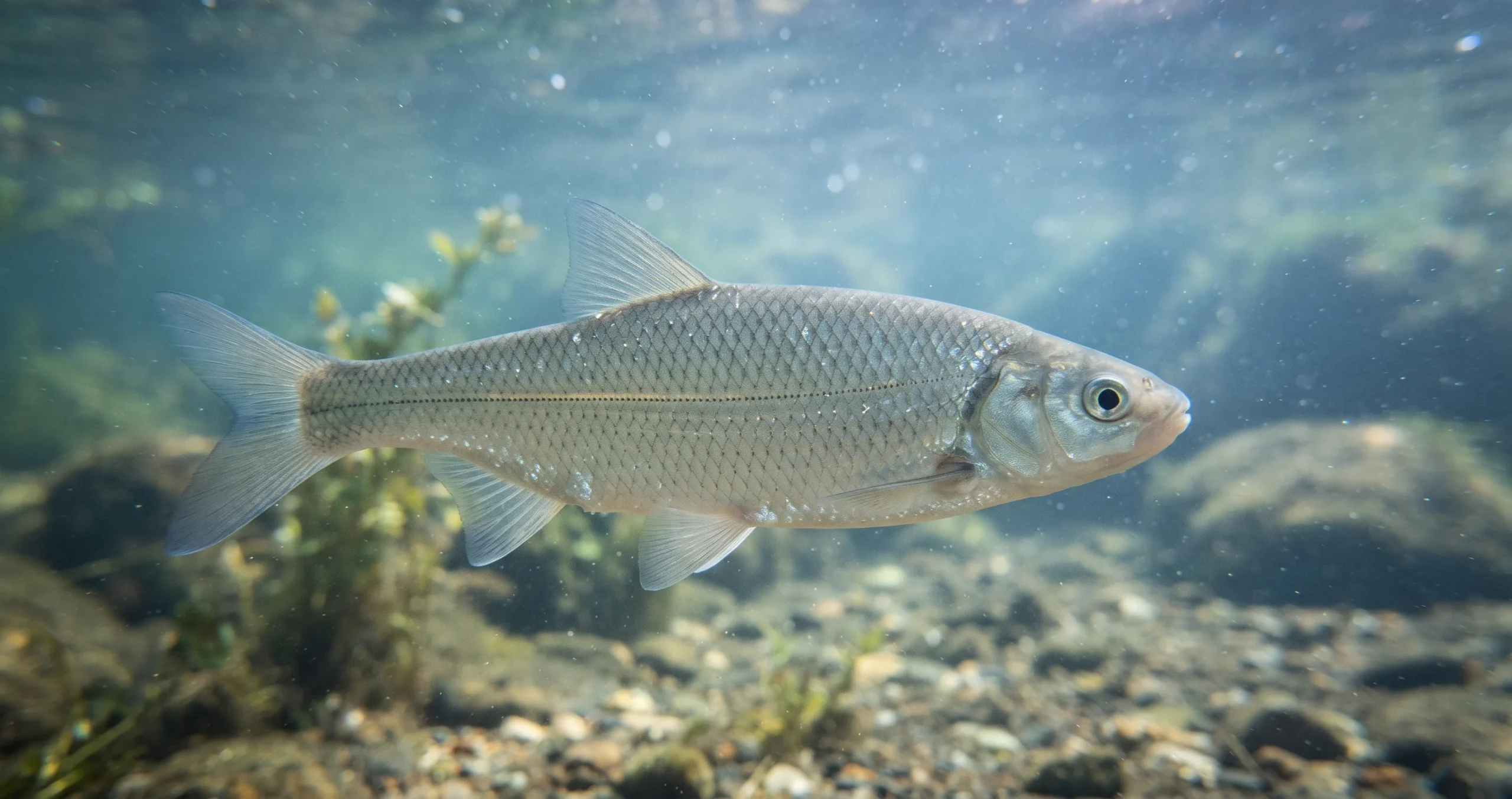
Fish experience their underwater surroundings in ways that humans cannot easily imagine. Beyond sight, hearing, smell, and taste, they possess a specialized sensory system that allows them to detect subtle movements in the water around them.
The fish lateral line is an extraordinary biological adaptation that helps aquatic animals navigate, locate food, avoid predators, and coordinate their movements with other fish.
Whether you observe goldfish in a garden pond, tropical fish in an aquarium, or wild fish swimming through a river, this sensory system plays an important role in their everyday behavior.
Understanding how it works also reveals why maintaining a peaceful, suitable aquarium environment matters for fish welfare.
Table of Contents
- What Is the Fish Lateral Line?
- How Does the Lateral Line Work?
- The Main Functions of the Lateral Line
- How Fish Navigate in Murky Water
- Blind Cavefish and Their Remarkable Senses
- How to See the Lateral Line on Aquarium Fish
- Why Tapping on Aquarium Glass Can Stress Fish
- Other Important Fish Senses
- Creating a Fish-Friendly Aquarium Environment
- Frequently Asked Questions
What Is the Fish Lateral Line?
The lateral line is a specialized mechanosensory system found in most fish. It detects nearby water movement, localized pressure differences, and disturbances produced by surrounding objects and animals.
In many species, part of this system appears as a narrow line running along each side of the body, usually extending from behind the gill cover toward the tail. Additional sensory structures are distributed around the head.
Although it may resemble a decorative marking, the lateral line is a functional network of sensory organs connected to the nervous system.
Its sensitivity allows fish to gather information about their immediate environment without depending entirely on their eyes.
The structure and arrangement of this sensory network vary considerably among species. These differences reflect adaptations to particular habitats, feeding strategies, and environmental conditions.
How Does the Fish Lateral Line Work?
The lateral line operates through specialized sensory structures called neuromasts. These microscopic organs respond to mechanical disturbances in the surrounding water.
Each neuromast contains sensory hair cells that help convert physical movement into signals the nervous system can interpret.
Sensory pores and canals
In many fish, tiny external pores connect the surrounding water to fluid-filled canals located beneath the skin or within specialized scales.
When nearby water movement creates pressure differences between these openings, fluid inside the canals moves. This movement stimulates the neuromasts positioned within them.
The resulting sensory information helps the fish detect changes occurring nearby.
Sensory hair cells
Neuromasts contain specialized cells equipped with microscopic projections. These projections extend into a flexible, gelatinous structure called the cupula.
When water movement bends the cupula, the sensory hair cells respond and alter the signals transmitted through associated nerve fibers.
The brain processes this information alongside signals from other sensory organs.
Two types of neuromasts
The fish lateral line generally contains two main categories of sensory organs.
| Neuromast type | Location | Main function |
|---|---|---|
| Superficial neuromasts | On the skin surface | Detect local water movement |
| Canal neuromasts | Inside sensory canals | Detect pressure differences associated with water disturbances |
These complementary structures allow fish to respond to different characteristics of their aquatic environment.
The Main Functions of the Lateral Line
The fish lateral line contributes to several behaviors essential to survival. Its importance depends on the species, surrounding conditions, and the availability of information from other senses.
1. Swimming together in schools
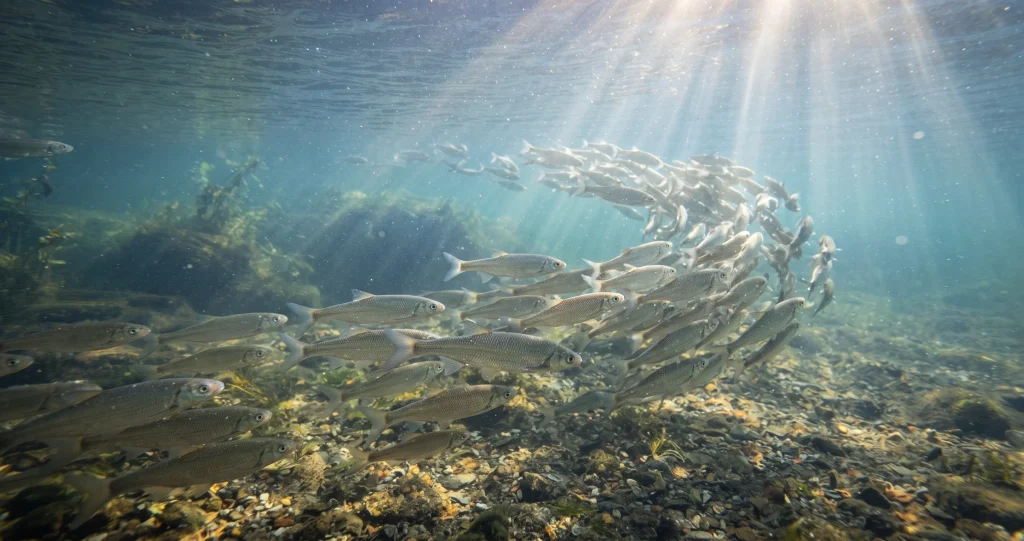
Large groups of fish can change direction with remarkable coordination. Individual fish must continually adjust their speed, position, and orientation to remain close to their neighbors without colliding.
The lateral line can detect water disturbances generated by nearby swimming fish. These signals complement visual information and help individuals maintain coordinated movements.
Different species rely on vision and lateral line input to different degrees. Schooling is therefore a combined sensory behavior rather than the result of one organ alone.
2. Avoiding obstacles
As a fish swims, its body displaces water. Nearby rocks, plants, walls, and other objects can alter the resulting flow patterns.
The lateral line helps certain fish detect these changes, providing information about obstacles before direct physical contact occurs.
This ability is particularly valuable in unfamiliar environments or habitats where visibility is limited.
3. Detecting potential prey
Small aquatic animals produce disturbances as they swim, struggle, or move through their surroundings.
Predatory fish can use the fish lateral line to detect some of these movements, especially when prey is nearby.
Water movement alone does not necessarily identify the animal responsible. Fish frequently combine mechanical information with sight, smell, and other sensory cues before attacking prey.
4. Detecting approaching predators
A swimming predator creates disturbances in the surrounding water. Sensitive fish may detect these changes and respond by escaping, hiding, or altering their direction.
The lateral line provides an additional source of information that can contribute to defensive behavior.
However, its usefulness depends on the predator’s proximity, surrounding currents, and the sensory capabilities of the fish.
5. Responding to water currents
Fish living in rivers and streams must continually adjust their swimming behavior in response to moving water.
The fish lateral line contributes to sensing local flow conditions, helping some species maintain their position or orient themselves against currents.
This behavior can be important when searching for food, resting near underwater structures, or navigating flowing habitats.
How Fish Navigate in Murky Water
Visibility underwater can change dramatically depending on suspended sediment, algae, depth, and available sunlight.
In muddy rivers, densely vegetated ponds, and dark aquatic habitats, fish may have difficulty relying exclusively on vision.
Because the lateral line responds to physical water disturbances rather than light, it can continue functioning under conditions where visual information is limited.
This allows certain fish to detect nearby animals, respond to currents, and navigate around obstacles even in relatively poor visibility.
Nevertheless, the fish lateral line is primarily a short-range sensory system. It does not provide an unlimited view of the underwater environment, and strong turbulence may complicate the detection of subtle signals.
Fish also rely on smell, hearing, touch, and other sensory abilities to compensate for reduced visibility.
Blind Cavefish and Their Remarkable Senses
The Mexican tetra (Astyanax mexicanus) provides an especially interesting example of sensory adaptation.
Some populations inhabit surface waters and possess functional eyes. Other populations evolved in dark underground caves, where their eyes became reduced and their dependence on nonvisual senses increased.
Research indicates that cave-dwelling forms can use lateral line information to locate moving prey and navigate their surroundings.
Together, these examples demonstrate how aquatic animals evolve sensory systems suited to their particular environments.
How to See the Fish Lateral Line on Aquarium Fish
You may be able to observe part of the lateral line without specialized equipment. Its visibility depends on the species, body coloration, scale structure, and lighting.
Fish such as goldfish, koi, and many cichlids provide useful opportunities to examine the external appearance of this sensory system.
Look along the sides of the body
Observe a fish from the side while it swims naturally. Look for a subtle row of modified scales or small openings extending along its body.
In some species, the line is relatively straight. In others, it curves, changes position, or appears interrupted.
Use suitable lighting
Normal aquarium lighting may make the lateral line easier to distinguish, particularly when a fish turns sideways.
Avoid using intense flashlights, repeated camera flashes, or sudden changes in illumination simply to examine the fish more closely.
A magnified photograph taken from outside the aquarium can help reveal details that are difficult to see directly.
Distinguish sensory structures from color patterns
Not every horizontal stripe on a fish represents its lateral line. Many aquarium species possess natural pigmentation patterns that have no direct connection to sensory canals.
Furthermore, superficial neuromasts are generally too small to identify individually without magnification.
The visible row of scales represents only part of a more extensive sensory network.
Why Tapping on Aquarium Glass Can Stress Fish
Tapping on aquarium glass may seem like a harmless way to attract a fish’s attention. However, the impact produces mechanical vibrations and underwater acoustic disturbances that fish can detect.
Depending on the strength and location of the disturbance, fish may respond through their lateral line, inner ears, or other sensory pathways.
Sudden disturbances and startle responses
Fish may react to unexpected tapping by swimming away rapidly, hiding, or briefly interrupting normal behavior.
Responses vary between species and individuals. A single accidental tap does not necessarily cause lasting harm, but deliberately creating repeated disturbances is unnecessary.
Observe fish without disturbing them
Approach the aquarium calmly and allow fish to continue their natural activities.
Teach children to observe aquatic animals without striking the glass, chasing fish with their hands, or moving decorations unnecessarily.
Respecting the sensitivity of the fish lateral line is one simple way to encourage responsible aquarium keeping.
Other Important Fish Senses
Although the lateral line is remarkable, fish rely on several additional sensory systems to interpret their surroundings.
Vision
Fish use their eyes to recognize food, detect predators, identify other individuals, and navigate underwater environments.
Visual capabilities vary considerably between species. Some fish are adapted to bright, shallow waters, while others possess specialized eyes suited to dim conditions.
Hearing and balance
Fish have internal ears that contain structures involved in hearing and balance.
Many bony fish possess small mineralized structures called otoliths, which contribute to detecting movement and acoustic particle motion.
Some species also have anatomical adaptations that improve their ability to detect sound pressure.
Smell
Fish possess olfactory organs that detect dissolved chemical substances in water.
Their sense of smell can help them locate food, recognize environmental signals, and navigate during migration.
Taste
Taste receptors are found inside the mouth and, in certain species, on external body structures.
Catfish, for example, possess sensory barbels that help them investigate food in environments where visibility may be limited.
Electroreception
Certain fish, including sharks, rays, and some freshwater species, can detect weak electrical fields.
Electroreception differs from the mechanical sensing performed by the fish lateral line. It provides information about electrical rather than hydrodynamic disturbances.
Together, these sensory systems allow fish to respond to a complex and constantly changing underwater environment.
Creating a Fish-Friendly Aquarium Environment
Understanding fish sensory biology can help aquarium owners make more informed decisions about tank placement, equipment, and daily care.
Consider these practical recommendations:
- Place aquariums away from loud speakers and unnecessary vibration sources.
- Avoid tapping or striking the glass.
- Provide appropriate hiding places and environmental enrichment.
- Match filter-generated currents to the needs of the fish species.
- Maintain suitable water quality, temperature, and oxygen levels.
- Introduce lighting changes gradually when possible.
- Avoid overcrowding and incompatible tank inhabitants.
Normal water circulation is not inherently harmful. Many fish benefit from appropriate currents, while others prefer sheltered areas with gentler flow.
Understanding the species you keep is more useful than attempting to eliminate every movement or sound from the aquarium.
Frequently Asked Questions
Do all fish have a lateral line?
Most fish possess a lateral line system, although its arrangement and complexity vary considerably.
Some species have reduced canals or sensory structures that are difficult to see externally.
Can fish sense movement without seeing it?
Yes. The lateral line allows fish to detect nearby mechanical disturbances independently of vision.
However, detection depends on factors such as distance, water conditions, and the characteristics of the disturbance.
Is the lateral line the same as hearing?
No. The lateral line primarily detects local water movement and pressure differences, while the inner ear contributes to hearing and balance.
Both systems contain mechanically sensitive hair cells, but their functions and anatomical organization differ.
Can humans see the fish lateral line?
In many species, part of the lateral line is visible as a row of specialized scales or pores.
The individual microscopic sensory structures generally require magnification to observe clearly.
Does tapping on aquarium glass hurt fish?
Tapping can startle fish and create unnecessary stress, particularly when repeated.
It is not accurate to assume that every tap causes physical injury, but avoiding deliberate disturbances is a responsible aquarium practice.
Can fish use their lateral line in complete darkness?
Yes. The system detects mechanical changes rather than light, allowing it to function in darkness.
Blind cavefish demonstrate how certain species can rely heavily on nonvisual sensory information.
Do sharks have a lateral line?
Yes. Sharks possess a lateral line system that helps them detect nearby water disturbances.
They also have separate electroreceptive organs that detect weak electrical fields.
Can the lateral line detect distant objects?
The lateral line is primarily useful for detecting nearby hydrodynamic disturbances.
Its effective range varies with the fish species, the strength of the signal, and surrounding water conditions.
Conclusion
The fish lateral line is a remarkable example of how aquatic animals adapt to their surroundings. Through specialized pores, canals, neuromasts, and sensory hair cells, fish can detect physical changes in water that humans would struggle to perceive.
This sensory network contributes to schooling, prey detection, obstacle avoidance, and responses to potential threats.
For aquarium owners, understanding the lateral line also highlights the importance of appropriate water circulation, suitable habitats, and peaceful observation.
By respecting the sensory abilities of fish, we can better appreciate their natural behavior and make more informed decisions about their care.
External Sources
1. Hearing and Lateral Line: Lateral Line Structure
Explain lateral line anatomy, sensory hair cells, neuromasts, canals, and the detection of water movement. University of Rhode Island
https://digitalcommons.uri.edu/bio_facpubs/574/
2. Evolutionary Shift Towards Lateral Line Dependent Prey Capture Behavior in the Blind Mexican Cavefish
Provide scientific evidence explaining how blind cavefish use lateral line information to detect and capture prey without relying on vision. Developmental Biology – PubMed Central, National Library of Medicine
https://pmc.ncbi.nlm.nih.gov/articles/PMC6450390/
3. Effects of Aquarium-Related Stressors on the Zebrafish: A Comparison of Behavioral, Physiological, and Biochemical Indicators
Provide scientific context for aquarium-related disturbances, mechanical tapping, startle responses, and fish welfare. Journal of Aquatic Animal Health – Oxford Academic
https://academic.oup.com/jaah/article-abstract/25/1/53/7815236