
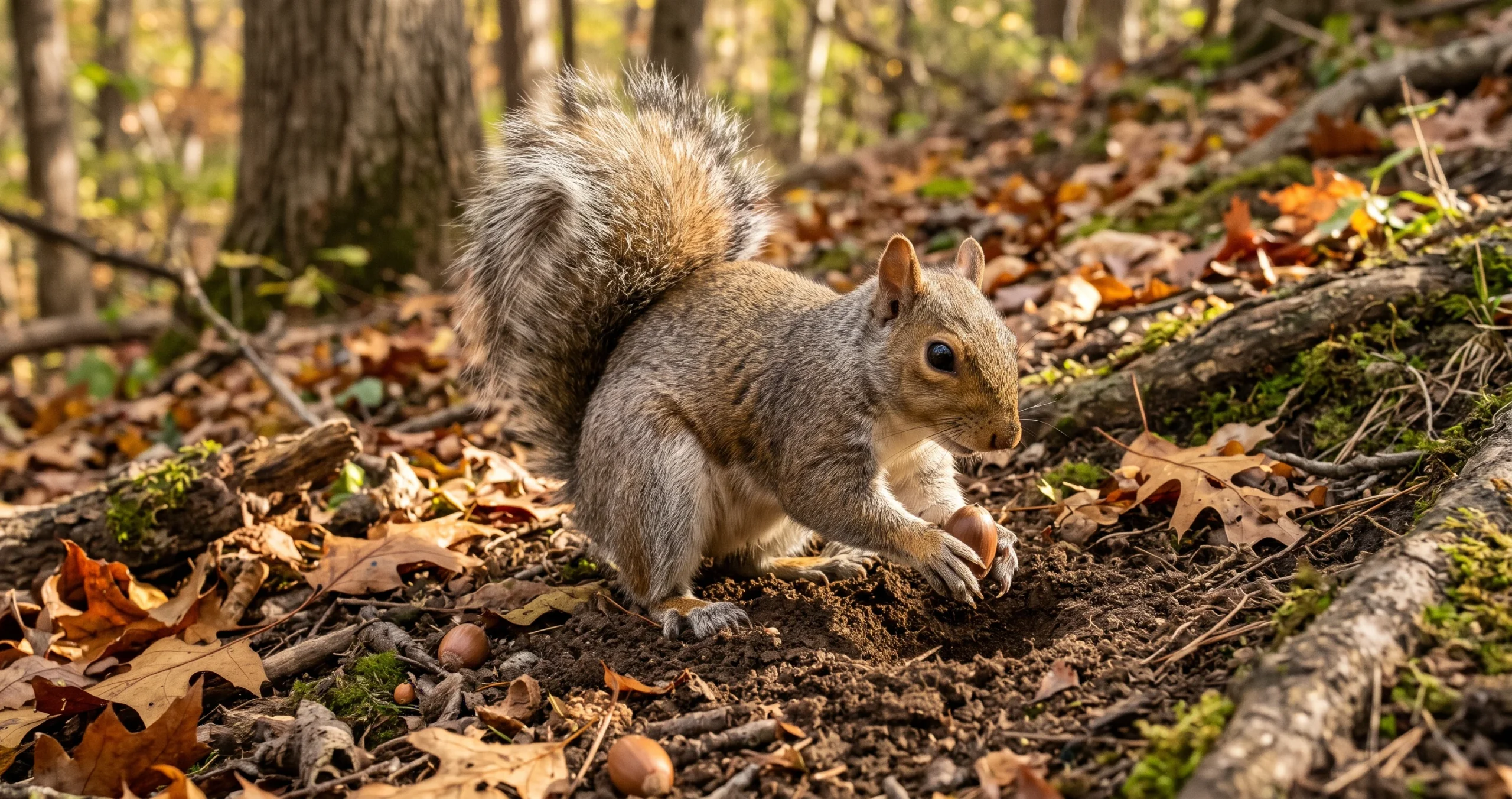
Understanding how squirrels remember buried nuts reveals one of the most fascinating examples of animal memory in North American wildlife. Every autumn, eastern gray squirrels (Sciurus carolinensis) collect acorns, walnuts, hickory nuts, and other foods, hiding them in scattered locations across their territories.
Weeks or months later, these small mammals can return to many of their hidden food supplies, even when fallen leaves or snow cover the ground.
Their success is not simply a matter of luck.
Scientific research suggests that squirrels combine spatial memory, environmental information, and sensory cues to locate stored food. Their caching behavior also reflects decisions about food quality, storage locations, and the presence of potential competitors.
Unlike animals that keep food in one central storage area, eastern gray squirrels distribute their supplies among numerous individual hiding places.
This strategy helps reduce the risk of losing an entire food supply to another animal.
However, squirrels do not necessarily remember every buried nut. Some caches are stolen, consumed, forgotten, or left untouched.
Those unrecovered seeds can sometimes germinate, contributing to the growth of new trees.
Table of Contents
- Why Squirrels Bury Nuts in Autumn
- What Is Scatter Hoarding?
- How Squirrels Remember Buried Food
- How Squirrels Select Nuts for Storage
- How Many Food Caches Can a Squirrel Maintain?
- Do Squirrels Remember Every Buried Nut?
- How Forgotten Nuts Contribute to Forest Regeneration
- How Squirrels Prepare for Winter
- Frequently Asked Questions
- Conclusion
Why Squirrels Bury Nuts in Autumn
Autumn is an important season for many tree squirrels because numerous hardwood trees produce energy-rich seeds and nuts.
Oak trees release acorns, while hickories, walnuts, and other species provide additional food resources.
Eastern gray squirrels take advantage of these seasonal supplies by collecting food for immediate consumption and later use.
Although squirrels remain active during winter, food availability often decreases as temperatures fall.
Snow, frozen ground, and reduced plant growth can make feeding more difficult.
Storing nuts allows squirrels to access resources collected during periods of abundance.
This behavior is particularly valuable because nuts contain fats, carbohydrates, and other nutrients that help support energy requirements.
Squirrels may begin storing food before autumn, depending on local conditions and food availability.
However, caching often becomes especially noticeable when trees produce abundant nuts.
The amount of food stored can vary substantially between years.
During years of heavy acorn production, commonly called mast years, squirrels may encounter unusually large quantities of available food.
In years with fewer nuts, they may rely more heavily on alternative foods and previously stored resources.
For more information about these important tree seeds, see How Oak Trees Produce Acorns and Support Wildlife.
What Is Scatter Hoarding?
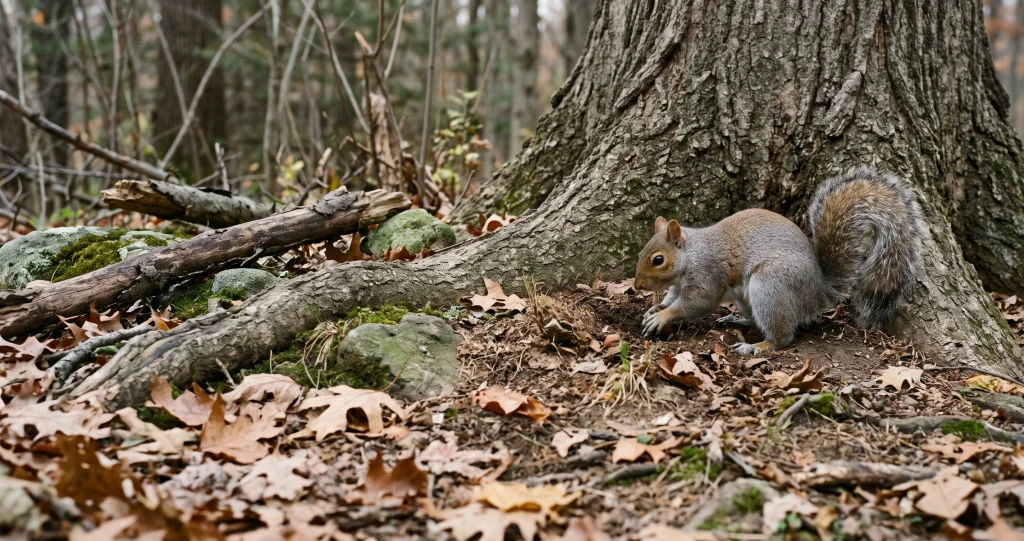
Scatter hoarding is a food-storage strategy in which animals distribute individual food items or small groups of items across multiple locations.
Eastern gray squirrels are well-known scatter hoarders.
Rather than placing all their nuts in a single nest or underground chamber, they bury food in numerous shallow caches.
A squirrel may carry a nut away from its original collection site, select a suitable location, dig a small hole, place the nut inside, and cover it with soil or leaf litter.
The animal may then move to another location to store additional food.
This distribution offers an important advantage.
If another squirrel, bird, or small mammal discovers one cache, the remaining food supplies may still be available elsewhere.
Scatter hoarding also spreads the risk of food loss across different parts of the landscape.
However, this strategy creates a challenge.
The squirrel must later locate individual food items scattered across a complex environment.
This is where memory and sensory information become particularly important.
How Squirrels Remember Buried Food
Scientists studying how squirrels remember buried nuts have investigated several mechanisms that may help these animals retrieve stored food.
The strongest evidence supports the importance of spatial information, although scent and other environmental cues can also contribute.
Spatial Memory
Squirrel spatial memory refers to the ability to remember locations and navigate through familiar environments.
When a squirrel buries a nut, it may encode information about the cache’s position relative to surrounding features.
Later, this information can help guide the animal back toward the storage site.
Controlled experiments have demonstrated that squirrels can use remembered spatial locations when searching for previously cached food.
This suggests that cache recovery involves more than randomly digging in suitable areas.
However, remembering a general location does not necessarily mean that the squirrel possesses a perfectly accurate mental record of every buried nut.
Spatial memory can vary with experience, environmental conditions, and the time elapsed since caching.
Environmental Landmarks
Landmarks provide reference points that help animals navigate.
For squirrels, these may include trees, rocks, logs, fences, or other recognizable features.
A cache might be located near a particular tree trunk or within a familiar arrangement of vegetation.
When returning to the area, the squirrel can use surrounding spatial information to narrow its search.
Scientists studying animal navigation often investigate how landmarks interact with memory.
The importance of individual landmarks may depend on their visibility, stability, and relationship to the stored food.
In urban environments, squirrels may also encounter artificial features that remain relatively consistent over time.
Nevertheless, research does not establish that every squirrel consciously memorizes specific landmarks in the same way.
The Role of Smell
Smell can contribute to food detection, especially when squirrels search at close range.
A buried nut may produce odor cues that help an animal identify a potential food location.
However, scent alone cannot fully explain squirrel cache retrieval.
Odor availability changes with soil moisture, temperature, burial depth, and other environmental conditions.
Squirrels can also investigate and recover food stored by other animals.
This indicates that finding a buried nut does not always mean the searching squirrel remembers placing it there.
The most accurate explanation is that squirrels can combine remembered spatial information with sensory cues.
The relative importance of these mechanisms may change according to circumstances.
How Squirrels Select Nuts for Storage
Squirrels do not necessarily treat every food item identically.
Research suggests that food characteristics can influence whether a nut is eaten immediately, transported, or cached.
Important characteristics may include size, nutritional value, condition, and the likelihood that the item will remain suitable for later consumption.
Larger or more valuable food items may justify additional transportation effort.
Some squirrels carry particular nuts farther from the collection site, potentially reducing the chance that competitors will discover them.
Food Quality and Storage Decisions
Nuts differ in their nutritional composition and susceptibility to deterioration.
Acorns, for example, vary among oak species in characteristics such as tannin content and germination behavior.
These differences can influence how squirrels handle and store them.
Researchers have documented food-handling behaviors that suggest squirrels respond to characteristics of individual seeds.
However, the exact relationship between food quality and caching decisions varies among species and environmental conditions.
Competition and Cache Protection
Other squirrels may observe food-storage behavior and later investigate caching locations.
This creates opportunities for cache theft, known as pilferage.
Squirrels may respond by changing where they bury food or by moving valuable items away from areas with high competition.
Some experimental studies have also documented deceptive caching-related behavior under particular conditions.
These observations suggest that food storage involves flexible behavioral decisions rather than a completely automatic routine.
How Many Food Caches Can a Squirrel Maintain?
Eastern gray squirrels can distribute food across numerous locations during periods of abundant food availability.
However, assigning one universal number to their caches would be misleading.
The number of stored items depends on several factors, including food supply, habitat, population density, season, and individual behavior.
A squirrel living near productive oak trees may have access to more nuts than one occupying an area with limited seed-producing vegetation.
Competition can also influence how much food an animal stores and how widely it distributes its caches.
Why Exact Numbers Are Difficult to Establish
Researchers may track individual caching events during controlled experiments or field observations.
However, the number of caches created during a study does not necessarily represent the total number maintained by a wild squirrel throughout an entire season.
Some caches are retrieved quickly.
Others are stolen, moved, or abandoned.
A squirrel may also create new caches while consuming older ones.
Consequently, the total number of active caches changes over time.
The most scientifically defensible conclusion is that scatter-hoarding squirrels can manage numerous distributed food-storage locations without necessarily maintaining a complete or permanent memory of every one.
Do Squirrels Remember Every Buried Nut?
Squirrels are capable of impressive spatial learning, but their memory is not perfect.
Some stored nuts are recovered successfully, while others remain buried.
A cache may be lost for several reasons.
Another animal may discover and consume the nut before its original owner returns.
Environmental changes may make a location more difficult to recognize.
Leaves, snow, soil disturbance, or human landscaping activities can alter the surrounding environment.
The original squirrel may also fail to retrieve a cache because it no longer needs the food or because other resources are available.
Importantly, an unrecovered nut is not necessarily a forgotten nut.
Scientists cannot always determine whether an animal has forgotten a location, deliberately left the food untouched, or lost access to it.
This distinction matters when interpreting wildlife behavior.
The phrase “squirrels forget where they bury their nuts” describes a familiar outcome, but it oversimplifies the underlying biology.
A more accurate explanation is that squirrels recover some caches while others remain unused for a variety of reasons.
How Forgotten Nuts Contribute to Forest Regeneration
Scatter hoarding creates an ecological relationship between squirrels and seed-producing trees.
When squirrels bury nuts, they move seeds away from the parent tree.
This process is a form of seed dispersal.
Some cached seeds are later eaten, but others remain in the soil.
If environmental conditions are suitable and the seeds remain viable, they may germinate.
From Buried Nut to Young Tree
A buried acorn may begin developing roots when moisture, temperature, and seasonal conditions support germination.
Successful establishment depends on several factors, including soil conditions, competition, herbivory, and seed viability.
Not every buried acorn becomes a seedling.
Even fewer seedlings survive long enough to become mature trees.
Nevertheless, scatter-hoarding animals can influence where new trees establish.
This relationship is particularly important in forests containing oaks and other large-seeded hardwood species.
Squirrels as Seed Dispersers
By transporting and burying nuts, squirrels can move seeds into locations different from where they originally fell.
Some of these sites may provide suitable conditions for germination.
However, squirrels also consume substantial quantities of seeds.
Their ecological role therefore combines seed predation with seed dispersal.
The balance between these outcomes varies according to habitat, tree species, and animal behavior.
Over time, this interaction can contribute to patterns of forest regeneration.
How Squirrels Prepare for Winter
Eastern gray squirrels remain active throughout winter rather than entering prolonged hibernation.
Their seasonal survival depends on several adaptations.
Building and Maintaining Shelters
Squirrels use tree cavities and leaf nests, often called dreys, for shelter.
These structures provide protection from wind, precipitation, and exposure.
Tree cavities can offer particularly valuable protection during severe weather.
Maintaining Energy Reserves
Squirrels may accumulate body fat during periods of abundant food.
These reserves help support energy needs when conditions become challenging.
Retrieving Stored Food
Cached nuts provide an additional source of energy when fresh food becomes less accessible.
Squirrels may search for stored items during suitable weather conditions, including periods when snow covers the ground.
Their ability to locate food depends on memory, sensory information, and environmental conditions.
Adjusting Activity to Weather
During severe storms or extremely cold periods, squirrels may remain sheltered for extended periods.
They often resume activity when conditions improve.
Food caching is therefore one component of a broader winter survival strategy.
For additional information, see How Wildlife Stores Food for Winter.
Gardeners interested in observing these behaviors can also explore Understanding Backyard Squirrel Behavior.
Frequently Asked Questions
1. How do squirrels remember where they bury their nuts?
Squirrels use spatial memory and environmental information to locate previously stored food. Landmarks can help guide their searches, while smell may assist in detecting buried nuts at close range.
2. Do squirrels find all the nuts they bury?
No. Some caches are recovered, while others are stolen, left unused, or become difficult to locate. An unrecovered nut does not necessarily mean the squirrel forgot its location.
3. Can squirrels smell nuts buried underground?
Squirrels can use odor cues when searching for food. However, scent availability varies with environmental conditions, and research indicates that spatial information also contributes to cache recovery.
4. Why do squirrels bury nuts in different locations?
Scatter hoarding spreads food supplies across multiple sites. This reduces the risk that a single discovery by another animal will eliminate the entire stored food supply.
5. Do buried acorns grow into oak trees?
Some buried acorns can germinate when they remain viable and encounter suitable environmental conditions. Many are eaten or fail to establish, but unrecovered caches can contribute to oak regeneration.
Conclusion
Understanding how squirrels remember buried nuts reveals the complexity of food-storage behavior among North American mammals.
Eastern gray squirrels distribute food across numerous locations and use spatial information, environmental landmarks, and sensory cues to help recover stored supplies.
Their behavior is flexible, responding to food characteristics, competition, and seasonal conditions.
Although squirrels successfully retrieve many caches, they do not necessarily recover every buried nut.
Some unrecovered seeds may germinate, contributing to forest regeneration and demonstrating the ecological importance of scatter hoarding.
From autumn food collection to winter survival, squirrel caching behavior provides a fascinating example of the relationship between animal memory, seasonal adaptation, and forest ecosystems.
External Sources
- Jacobs and Liman (1991) — Grey Squirrels Remember the Locations of Buried Nuts Published in Animal Behaviour, Read the research study.
- Macdonald (1997) — Field Experiments on Duration and Precision of Grey and Red Squirrel Spatial Memory. Read the research study.
- Delgado and Jacobs (2017) — Caching for Where and What: Evidence for a Mnemonic Strategy in a Scatter-Hoarder, Published in Royal Society Open Science, Read the peer-reviewed article.