
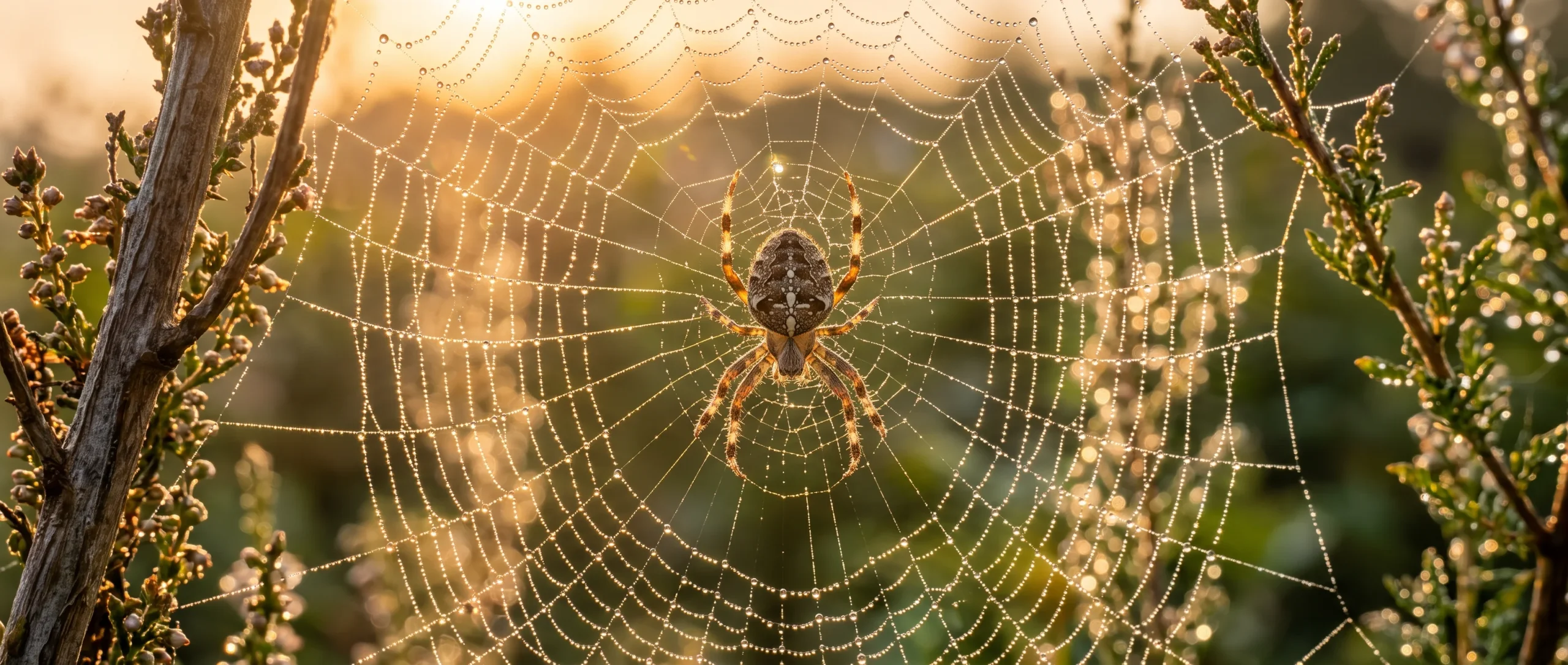
A spider can transform an empty space between two branches into a nearly perfect circular trap using nothing but silk produced by its own body. There are no measuring tools, no construction plans, and no second spider helping with the work.
Understanding how spiders build webs reveals an extraordinary combination of instinct, engineering, and biological materials. An orb-weaver creates a framework of supporting threads, adds spokes, and finishes with a spiral designed to intercept flying insects.
Even more remarkable, many orb-weavers can dismantle and rebuild their intricate structures repeatedly. Their webs are temporary hunting tools, yet their construction reflects millions of years of evolutionary refinement.
Table of Contents
- What Is an Orb Web?
- How Spiders Build Webs: Six Construction Stages
- What Is Spider Silk Made Of?
- Why Orb-Weavers Rebuild and Recycle Their Webs
- How Spiders Avoid Getting Stuck in Their Own Webs
- Why Spider Webs Become Visible With Morning Dew
- The Science Behind the Orb Web’s Design
- How Orb-Weaver Spiders Help Your Garden
- How to Share Your Garden With Spiders Safely
- Common Myths About Spiders and Their Webs
- Frequently Asked Questions
What Is an Orb Web?
An orb web is the familiar wheel-shaped structure often seen suspended between branches, garden plants, fences, and porch railings.
It usually contains a supporting outer framework, radial threads extending toward the center, and a spiral of silk that intercepts flying insects.
Orb webs are associated with several spider families, particularly the orb-weavers in the family Araneidae.
Common examples include garden orb-weavers, spotted orb-weavers, and the striking black-and-yellow garden spider (Argiope aurantia).
Although their webs share a recognizable pattern, different species construct them with variations in size, shape, spacing, and orientation.
Some spiders build webs almost vertically, while others create structures tilted at different angles.
The design depends on the spider’s species, available space, hunting strategy, and surrounding conditions.
How Spiders Build Webs: Six Construction Stages
Watching an orb-weaver construct its web is like observing a carefully coordinated engineering project.
The spider follows a sequence of behaviors, but the exact order and details can vary among species.
Step 1: Sending Out the First Bridge Line
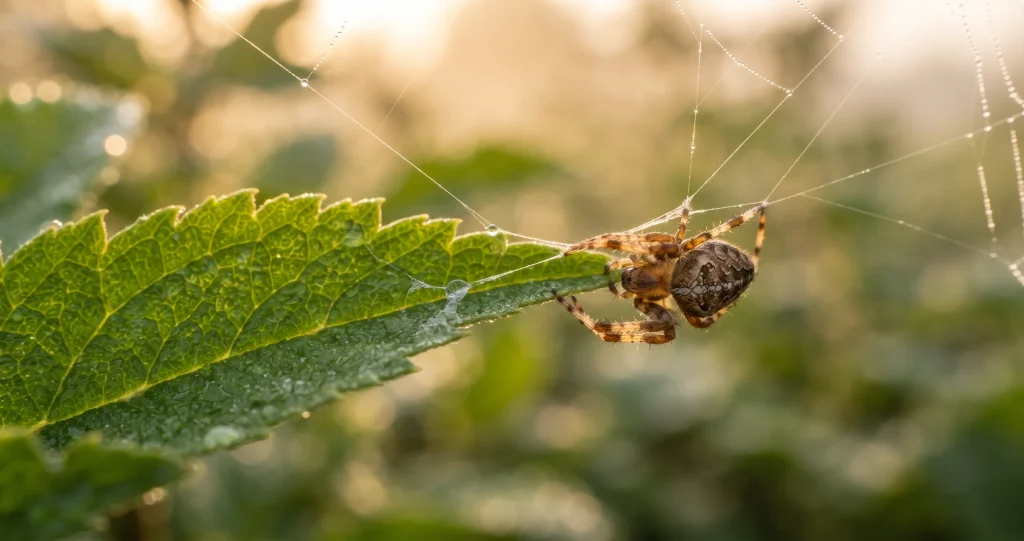
Construction often begins when the spider releases a fine strand of silk into moving air.
A breeze may carry the strand toward a nearby branch, leaf, or other support.
If the thread catches and becomes anchored, the spider can establish a connection between two previously separated points.
This first connection is commonly called a bridge line.
The spider may cross it and reinforce the strand with additional silk, creating a stronger support for the developing web.
When wind is unsuitable, spiders may use other routes or attachment methods rather than relying entirely on airborne silk.
Step 2: Creating the Initial Y-Shaped Structure
After establishing the first bridge, the spider adds another thread that hangs downward.
It can move along the bridge and descend on a silk line, producing a structure resembling the letter Y.
This arrangement helps establish the central area from which the rest of the web will develop.
The spider then adds additional supporting threads to create a more stable framework.
The exact geometry is not identical in every species, but the Y-shaped arrangement is a useful way to understand the early construction of many orb webs.
Step 3: Building the Outer Frame
Next, the spider connects surrounding anchor points with stronger supporting silk.
These threads form the outer framework and help maintain the web’s overall shape.
The frame may attach to branches, stems, fences, or other nearby structures.
A strong framework is essential because it distributes tension and supports the remaining silk.
Unlike a rigid manufactured frame, the spider’s construction remains flexible enough to move with wind and the impact of insects.
Step 4: Adding the Radial Threads
The spider begins constructing lines that extend between the central hub and the outer frame.
These radial threads resemble the spokes of a bicycle wheel.
They provide structural support and create routes the spider can use to move around its web.
The spider repeatedly travels between the center and outer framework, adding and adjusting individual threads.
The final arrangement may look almost symmetrical, although natural webs often contain irregularities.
Radial threads are generally made from silk that lacks the sticky droplets characteristic of the finished capture spiral.
Step 5: Laying a Temporary Spiral
Once enough radial threads are in place, many orb-weavers construct a temporary spiral.
This initial spiral is usually made from relatively nonsticky silk.
It provides temporary support and helps the spider move between the radial threads while maintaining appropriate spacing.
The spider commonly works outward from the central region as it constructs this temporary structure.
Later, during construction of the capture spiral, much of the temporary spiral is removed.
This stage illustrates an important feature of orb-web building: some threads function as construction aids rather than permanent components.
Step 6: Adding the Sticky Capture Spiral
The final major stage is the creation of the capture spiral.
The spider generally works inward from the outer region, laying down a new spiral made from specialized capture silk.
In many familiar orb-weavers, this silk carries microscopic adhesive droplets that help retain flying insects.
As the spider progresses, it often removes sections of the temporary spiral.
The finished web combines supporting threads with a flexible capture surface designed to intercept and restrain prey.
Once construction is complete, the spider may wait at the central hub or retreat to a nearby shelter connected to the web by a signaling thread.
What Is Spider Silk Made Of?
Spider silk is primarily composed of proteins produced in specialized glands inside the spider’s abdomen.
These proteins, commonly called spidroins, are processed into fibers as silk material passes through the spider’s spinning system.
The finished fibers emerge through structures called spinnerets.
Different glands can produce silk with different mechanical and functional properties.
Structural Silk
Orb-weavers use strong, relatively nonsticky silk for supporting threads, including frame lines and radii.
This silk helps maintain the web’s shape and withstand mechanical forces.
Its combination of strength and flexibility allows the structure to absorb movement without behaving like a brittle frame.
Capture Silk
Many orb-weavers use specialized elastic silk for the capture spiral.
In typical araneid orb webs, this silk carries adhesive droplets that improve prey retention.
These droplets are different from the dry structural silk used elsewhere in the web.
The distinction matters because the web is not uniformly sticky.
Other Silk Types
Spiders also produce silk for purposes beyond building orb webs.
Depending on the species, silk may be used to wrap prey, protect eggs, create retreats, or form safety lines.
A spider’s silk system is therefore more versatile than a single thread-producing mechanism.
Why Orb-Weavers Rebuild and Recycle Their Webs
A spider web is exposed to wind, rain, dust, plant debris, and struggling insects.
Over time, these forces can damage the structure or reduce its effectiveness.
Many orb-weaver species respond by dismantling and rebuilding their webs regularly, sometimes approximately once a day.
However, rebuilding frequency varies with species, environmental conditions, and the web’s condition.
Recycling Valuable Silk Proteins
Some orb-weavers consume portions of their old webs before constructing replacements.
By eating silk, they can recover nutrients that may contribute to future silk production.
This behavior helps reduce the nutritional cost of repeatedly producing a complex structure.
The spider is not simply abandoning an old hunting tool. In some cases, it is reclaiming part of the material investment.
Why Rebuilding Can Improve Hunting
Fresh capture silk can restore effective spacing, tension, and adhesive performance.
A newly constructed web may also be positioned to take advantage of changes in vegetation or insect activity.
Rebuilding allows the spider to maintain a functioning trap in a constantly changing environment.
How Spiders Avoid Getting Stuck in Their Own Webs
A common misconception is that spiders possess a universal immunity to sticky silk.
In reality, the explanation involves several adaptations and behaviors.
They Use Nonsticky Routes
The radial threads and supporting framework of many orb webs are not coated with the same adhesive droplets as the capture spiral.
Spiders can move along these routes while limiting contact with sticky threads.
This is one reason the different silk types are so important.
Their Movements Are Carefully Controlled
Orb-weavers often place their feet precisely as they navigate the web.
Their legs and claws help them grasp threads while minimizing unnecessary contact with adhesive regions.
Specialized surface properties of their legs may also reduce adhesion.
However, these adaptations do not make spiders completely incapable of becoming entangled.
The Web Is a Selective Trap
A flying insect usually collides with several capture threads at once.
Its struggling movements may increase contact with sticky silk.
The spider, by contrast, approaches the web in a controlled manner and uses established routes.
The difference between accidental impact and deliberate movement is central to understanding why the web works as a hunting device.
Why Spider Webs Become Visible With Morning Dew
An orb web may be almost invisible during the afternoon but suddenly appear as a sparkling geometric pattern at sunrise.
The silk itself has not necessarily changed.
Instead, tiny water droplets have condensed on the threads.
Condensation Reveals the Structure
When humid air cools sufficiently, water vapor can condense on exposed surfaces.
Spider silk provides numerous small surfaces where droplets may collect.
The droplets reflect and scatter light, making individual threads much easier to see.
A web covered in dew can therefore reveal details that are difficult to notice when the silk is dry.
Why Early Morning Is Ideal
Cool nights followed by calm, humid mornings often create favorable conditions for dew.
Low-angle sunlight can illuminate the droplets and emphasize the web’s circular structure.
However, not every web collects dew equally, and moisture can affect different types of silk in different ways.
For photographers and nature observers, early morning offers an excellent opportunity to appreciate web architecture without disturbing the spider.
The Science Behind the Orb Web’s Design
An orb web is more than a decorative pattern.
Its geometry helps the spider intercept insects while balancing material costs and mechanical performance.
Radial Threads Distribute Forces
When an insect strikes the web, the impact produces tension across multiple threads.
Radial lines help transmit these forces toward the supporting framework.
The web’s flexibility allows it to deform rather than behave like a rigid barrier.
This can help prevent a localized impact from immediately destroying the entire structure.
Spiral Threads Help Retain Prey
The capture spiral provides much of the web’s prey-catching function.
Its elastic properties and adhesive droplets help slow and retain insects that collide with the web.
The spacing between spiral turns affects how likely an insect is to pass through without contacting silk.
Web construction therefore involves a trade-off between available silk, capture area, and prey retention.
Spiders Respond to Their Surroundings
Orb-weavers do not necessarily produce identical webs every time.
Available anchor points, wind exposure, prey conditions, and the spider’s physical state can influence construction.
Even the same individual may create webs with noticeable differences.
This flexibility helps explain why orb webs are recognizable but rarely perfectly uniform.
How Orb-Weaver Spiders Help Your Garden
Orb-weavers are natural predators that capture a variety of flying insects.
Their prey can include flies, moths, mosquitoes, and other small insects that encounter their webs.
By consuming these animals, spiders participate in the food webs that support garden ecosystems.
Natural Insect Population Regulation
Spiders can contribute to regulating insect populations, although they are not selective pest-control machines.
They may capture insects considered pests as well as harmless or beneficial species.
Their ecological role is best understood as part of a diverse community of predators rather than a guaranteed solution to a particular garden problem.
Supporting Garden Biodiversity
Gardens with varied vegetation often provide more opportunities for spiders to establish webs.
Tall stems, shrubs, trellises, and sheltered corners offer useful attachment points.
A mixture of native plants can also support diverse insect communities, providing food for many predators.
How to Share Your Garden With Spiders Safely
Most garden spiders prefer avoiding human contact.
Orb-weavers are generally not considered medically significant to people, although any spider may bite if trapped or handled.
The simplest approach is to observe them without unnecessary disturbance.
Leave Useful Webs Undisturbed
When a web is located away from walkways, doors, and frequently used seating areas, consider leaving it in place.
This allows the spider to continue hunting and maintaining its structure.
If a web blocks an essential passage, gently clearing the web when the spider is absent may encourage rebuilding elsewhere.
Reduce Unnecessary Pesticide Use
Broad-spectrum insecticides can affect spiders directly or reduce the insects they eat.
Using targeted pest-management practices can help preserve beneficial predators.
Practice Safe Observation
Avoid handling unfamiliar spiders, particularly in regions where medically important species occur.
Wear gloves when moving stored materials or working in sheltered spaces where spiders may be hiding.
If you encounter a spider you cannot identify, maintain a comfortable distance rather than attempting to capture it.
Common Myths About Spiders and Their Webs
Myth 1: All Spiders Are Dangerous
Most spiders pose little risk to humans.
A relatively small number of species are associated with medically significant bites, and identification matters when evaluating risk.
Myth 2: Every Spider Builds the Same Web
Spider webs vary dramatically.
Some species create orb webs, others build sheet webs, funnels, or irregular three-dimensional structures.
Many hunting spiders do not use capture webs at all.
Myth 3: Every Thread in an Orb Web Is Sticky
The supporting framework and radial threads are generally different from the adhesive capture spiral.
A typical orb web combines several silk types with distinct functions.
Myth 4: Spider Webs Are Always Perfect Circles
Natural webs frequently contain uneven spacing, missing sections, and irregular outlines.
Their shape reflects environmental conditions and the spider’s construction behavior.
Frequently Asked Questions
How long does it take a spider to build an orb web?
Construction time varies with species, web size, and environmental conditions. Many orb-weavers can complete a functional web within roughly an hour, although some take longer.
Do spiders remember how to build their webs?
Web construction is largely guided by inherited behavioral patterns, sensory feedback, and responses to the developing structure. Spiders do not need to learn the entire sequence from another spider, although experience and conditions can influence their behavior.
Do spiders eat their old webs?
Some orb-weavers consume silk from older webs before rebuilding. This allows them to recover nutrients, including components that can contribute to future silk production, although not every species follows the same recycling routine.
Conclusion
The next time you see a dew-covered web glowing between garden branches, consider the sequence of events that created it.
The science of how spiders build webs begins with a simple bridge line and progresses through a framework, radial spokes, a temporary spiral, and a carefully positioned capture spiral.
Each component serves a purpose, and the spider’s specialized silk allows the finished structure to combine flexibility, strength, and prey-catching ability.
Orb-weavers are not only skilled builders. They are important members of garden ecosystems, helping regulate insect populations while demonstrating one of nature’s most elegant examples of biological engineering.
External Sources
1. Spider Webs
Explains the bridge line, Y-shaped framework, radii, temporary spiral, sticky spiral, and silk recycling. The Australian Museum
2. How Spiders Avoid Getting Tangled
Explains the role of nonsticky supporting threads, specialized foot claws, and controlled movement in preventing entanglement. The Library of Congress.