
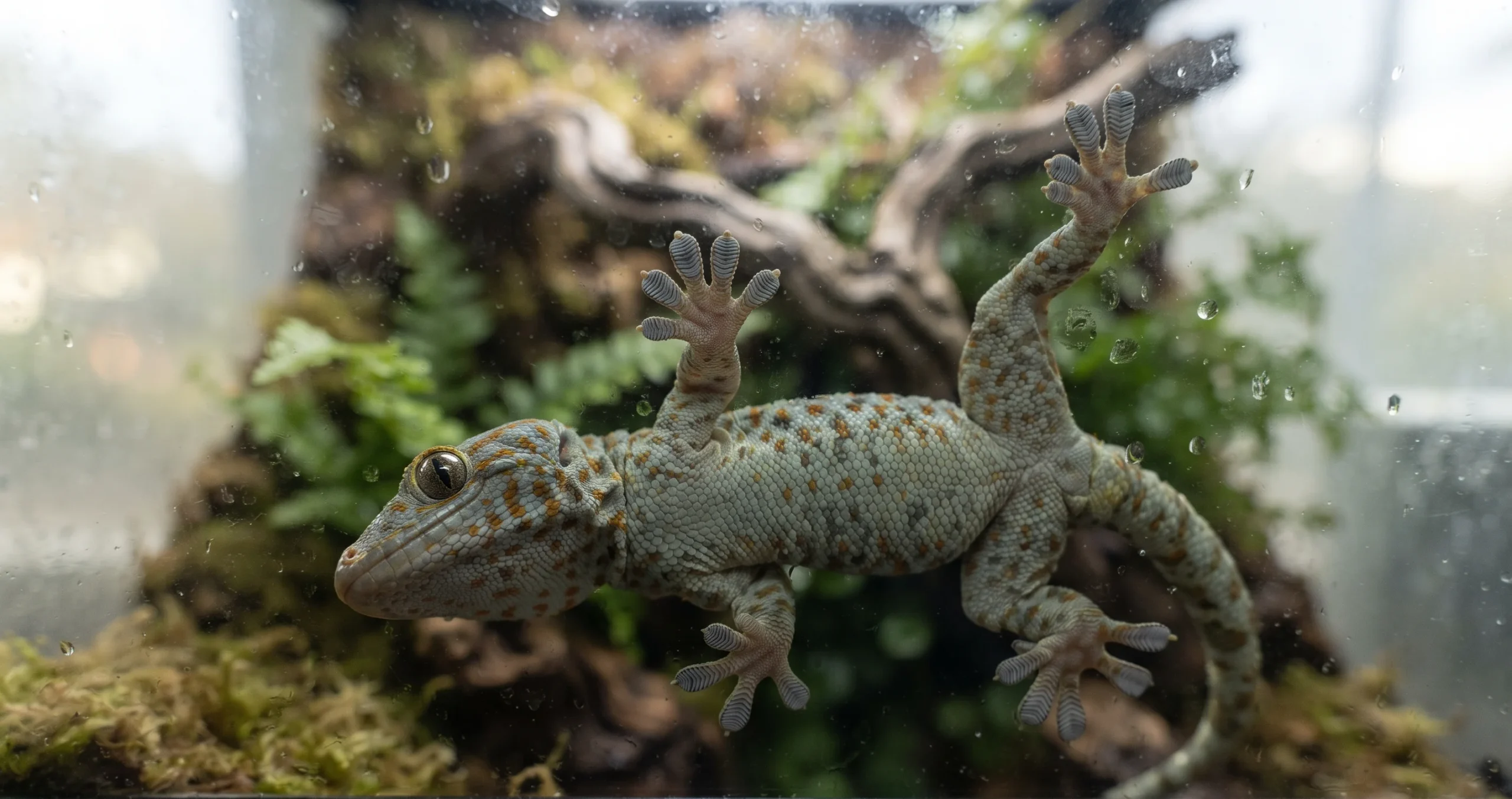
A gecko can race across a vertical wall, pause on a windowpane, and even hang upside down from a ceiling without falling. Its feet appear almost magical, yet the secret lies in microscopic structures that interact with surfaces at the molecular level.
Understanding how geckos stick to walls reveals one of nature’s most remarkable adaptations. These little lizards rely on millions of tiny contact points rather than glue or suction, allowing them to grip, release, and move with extraordinary precision.
Their unusual feet have also inspired scientists to develop new adhesives, climbing robots, and technologies that imitate nature’s ability to create strong but reversible attachments.
Table of Contents
- What Makes Gecko Feet So Remarkable?
- How Geckos Stick to Walls: The Science Explained
- Inside a Gecko’s Toe Pads: Setae and Spatulae
- How Geckos Release Their Grip Instantly
- Why Gecko Feet Stay Remarkably Clean
- Which Surfaces Can Geckos Climb?
- How Gecko Feet Inspire Modern Technology
- Geckos in the Garden and Home
- Common Myths About Gecko Feet
- How to Observe Geckos Without Disturbing Them
- Frequently Asked Questions
What Makes Gecko Feet So Remarkable?
Geckos belong to a diverse group of lizards found in warm regions around the world. Some inhabit tropical forests, while others live in deserts, rocky landscapes, gardens, and buildings.
Many gecko species are exceptional climbers. They can move across tree trunks, leaves, walls, and smooth surfaces that would challenge most other animals.
However, not every gecko possesses the same climbing equipment. Some species have specialized adhesive toe pads, while others depend primarily on claws and ordinary friction.
For species with adhesive pads, climbing is possible because their toes can establish close contact with surfaces at an extremely small scale.
Unlike an insect walking across a rough wall with tiny claws, an adhesive gecko can attach to surfaces that provide little opportunity for mechanical gripping.
That ability is especially useful when hunting insects, escaping predators, and moving through complicated habitats.
How Geckos Stick to Walls: The Science Explained
The fundamental mechanism behind gecko adhesion involves molecular attraction.
When two materials come extremely close together, weak attractive interactions can occur between their molecules. These interactions include what scientists call van der Waals forces.
Individually, these forces are extremely weak. But when countless microscopic contact points act together, their combined effect can become substantial.
The Importance of Molecular Contact
Imagine placing your hand against a glass window. Although the surface looks smooth, your skin does not make sufficiently close, extensive contact to support your body weight.
A gecko’s specialized toes solve this problem by dividing their contact area into vast numbers of flexible microscopic structures.
These structures conform to tiny surface irregularities, bringing their tips close enough for molecular attraction to become effective.
The result is a form of dry adhesion: attachment that does not require a conventional liquid glue.
Why It Is Not Suction
Suction cups work by creating a pressure difference between an enclosed space and the surrounding environment.
Gecko toe pads operate differently. They do not need to form airtight seals against the surfaces they climb.
Research has demonstrated that molecular interactions play a central role in gecko adhesion, rather than suction.
Claws may still help certain geckos grip rough materials, but claws alone cannot explain their ability to cling to smooth glass.
How Weak Forces Produce Strong Adhesion
The impressive strength comes from the enormous number of tiny contacts working together.
A single microscopic attachment contributes very little force. Collectively, however, the contacts can support the gecko as it moves across vertical or inverted surfaces.
The arrangement is also directional. Gecko toe structures produce their strongest adhesion when loaded in particular directions, allowing the animal to control its attachment.
This combination of close contact, distributed forces, and directional movement makes gecko feet unusually effective.
Inside a Gecko’s Toe Pads: Setae and Spatulae
The secret becomes even more fascinating when gecko feet are examined under powerful microscopes.
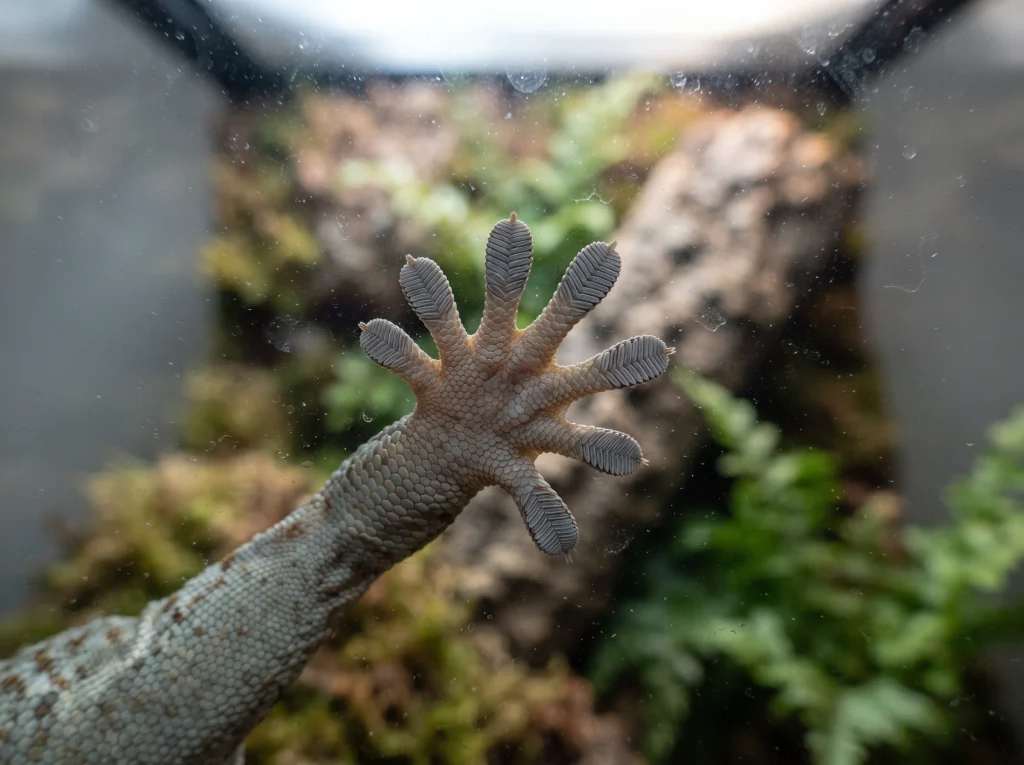
Many adhesive geckos have enlarged toe pads covered with fine ridges known as lamellae. These ridges support dense arrays of microscopic hairlike structures called setae.
Each seta branches into even finer terminal structures called spatulae.
Setae: Microscopic Hairlike Structures
Setae are not ordinary hairs like those found on mammals.
They are specialized structures made largely of keratin, the structural protein also found in reptile scales, human fingernails, and hair.
Their flexibility helps them follow the contours of a surface, even when that surface contains microscopic bumps and depressions.
By spreading contact across many tiny structures, the toe pads can attach without depending on one large, perfectly flat surface.
Spatulae: The Tiny Contact Tips
At the ends of the branching setae are extremely small, flattened spatulae.
These terminal tips provide the intimate contact needed for van der Waals attraction to become effective.
A gecko’s adhesive system is therefore hierarchical: broad toe pads contain ridges, ridges support setae, and setae terminate in spatulae.
Each level contributes to the flexibility and adaptability of the whole foot.
Why the Structure Matters
A single rigid pad would struggle to maintain contact across uneven surfaces.
Thousands of flexible contact structures can accommodate irregularities much more effectively.
The design also distributes forces across numerous attachment points, reducing dependence on any one part of the foot.
This is why scientists are interested not only in the adhesive strength of gecko toes but also in their microscopic architecture.
How Geckos Release Their Grip Instantly
Strong adhesion would become a serious problem if geckos could not release their feet quickly.
Fortunately, their attachment mechanism is highly controllable.
Rather than pulling every contact point directly away from a surface, geckos change the orientation of their toes and adhesive structures.
The Role of Toe Angle
When a gecko positions its toes and applies force in the appropriate direction, the microscopic structures engage with the surface.
To release them, it changes the loading angle and peels the toes away.
This peeling motion reduces the effective contact area and allows attachment to break with comparatively little effort.
High-speed observations show that geckos can repeatedly attach and detach their feet during rapid movement.
Why This Is Different From Glue
Ordinary glue typically creates a bond that must be broken or weakened before the objects can separate.
Gecko adhesion is reversible and direction-dependent.
The animal can establish contact, apply force, and release the attachment without depositing a conventional adhesive coating.
This controlled release is one reason gecko-inspired materials have attracted interest from engineers.
Why Gecko Feet Stay Remarkably Clean
A climbing animal that depends on microscopic contact faces an obvious challenge: dust and dirt.
Particles trapped between adhesive structures and a climbing surface can interfere with attachment.
Gecko feet possess a remarkable ability to recover adhesion after contamination.
The Self-Cleaning Effect
Experiments have shown that contaminated gecko toe pads can regain much of their adhesive performance through repeated contact and movement.
One explanation involves differences in how strongly particles interact with the toe structures and the surfaces being contacted.
During repeated steps, some particles are transferred away from the toe pads, restoring effective contact.
The system is not perfectly immune to dirt, and environmental conditions can affect performance.
Nevertheless, this passive cleaning ability is especially valuable for animals that climb dusty rocks, tree bark, and building walls.
A Lesson for Materials Science
Synthetic adhesives often lose effectiveness when their surfaces collect debris.
A material that can recover attachment strength through ordinary use would offer significant practical advantages.
Gecko feet provide researchers with a biological example of how adhesion and contamination resistance can coexist.
Which Surfaces Can Geckos Climb?
Adhesive geckos can climb many materials, including glass, painted walls, smooth stone, and certain plastics.
However, their feet are not universally effective.
Surface chemistry, texture, contamination, and moisture all influence how well the microscopic structures attach.
Why Glass Is So Easy to Climb
Glass offers a relatively smooth surface that allows many spatulae to make intimate contact.
This helps explain why a gecko can move across a window without visible difficulty.
Its feet do not need holes, grooves, or suction to remain attached.
Why Teflon-Like Surfaces Are Different
Materials such as polytetrafluoroethylene, commonly known as PTFE or Teflon, have low surface energy.
Their chemical properties can make it harder for certain gecko adhesive systems to develop effective attachment.
Researchers have observed reduced adhesion on some low-energy surfaces, although performance varies with the species, material, and experimental conditions.
Therefore, the familiar claim that geckos can climb absolutely anything is an exaggeration.
Roughness and Moisture Matter
Very rough surfaces may prevent enough microscopic tips from contacting the material simultaneously.
Water can also alter adhesion, depending on the gecko species, surface, and degree of wetness.
Some species possess adaptations that help them cope with challenging environmental conditions, but none should be considered universally unaffected by moisture.
The important principle is that successful attachment depends on both the gecko’s feet and the properties of the surface.
How Gecko Feet Inspire Modern Technology
Nature has spent millions of years refining biological structures through evolution.
Engineers study these structures to identify useful principles that can be reproduced in manufactured materials.
Gecko adhesion is a particularly promising example of biomimicry, the practice of developing technologies inspired by living organisms.
Reusable Dry Adhesives
Researchers have created synthetic surfaces with microscopic fibers or patterned structures designed to imitate gecko toe pads.
Some of these materials can attach firmly when force is applied in one direction and release more easily when peeled away.
Potential applications include reusable gripping systems, specialized manufacturing equipment, and tools for handling delicate objects.
Unlike conventional pressure-sensitive tapes, certain experimental designs aim to work without a sticky liquid coating.
Wall-Climbing Robots
Roboticists have also explored gecko-inspired attachment mechanisms for machines that climb vertical surfaces.
These systems may use directional adhesive pads, mechanical supports, or combinations of different gripping technologies.
Potential uses include inspection of difficult-to-reach structures and movement across specialized surfaces.
However, engineering reliable climbing robots remains challenging because real environments contain dust, moisture, irregular textures, and changing loads.
Space and Industrial Applications
Gecko-inspired gripping devices have also been investigated for handling objects in specialized environments, including space-related robotics.
Their appeal comes from the possibility of reversible attachment without conventional glue.
The research illustrates how understanding a small lizard’s feet can influence technology far beyond biology.
Geckos in the Garden and Home
Geckos are more than extraordinary climbers. They also participate in local food webs.
Many species feed on insects and other small invertebrates, including moths, flies, beetles, and spiders.
In warm climates, geckos are often observed around outdoor lights, walls, windows, and sheltered garden structures.
Natural Insect Hunters
Outdoor lighting attracts numerous flying insects.
Geckos may take advantage of these concentrations by waiting nearby and capturing prey.
Their climbing abilities allow them to hunt on vertical surfaces that many other insect-eating animals cannot easily access.
Although geckos consume insects, they should not be treated as a complete solution to household or garden pest problems.
Their ecological value is broader than pest control: they are predators, prey for larger animals, and members of functioning ecosystems.
Creating a Gecko-Friendly Garden
A garden with varied vegetation, sheltered spaces, and reduced unnecessary pesticide use can provide habitat for native lizards and their prey.
Rock crevices, suitable native plants, and undisturbed corners may offer useful cover.
Avoid capturing wild geckos or transporting them to new locations. Some gecko species are introduced outside their native ranges, so local ecological guidance matters.
Common Myths About Gecko Feet
Gecko climbing has inspired several persistent misconceptions.
Myth 1: Geckos Have Suction Cups
Gecko toes do not function as miniature suction cups.
Their adhesion primarily depends on microscopic contact structures and intermolecular attraction.
Myth 2: Gecko Feet Secrete Sticky Glue
The classic gecko adhesive system does not require a conventional sticky secretion.
Its remarkable attachment comes from dry, specialized structures.
Myth 3: Every Gecko Can Climb Glass
Not all gecko species have adhesive toe pads.
Species without specialized pads may be unable to climb smooth glass effectively.
Myth 4: Gecko Feet Work on Every Surface
Surface chemistry and texture influence adhesion.
Low-energy materials, certain rough surfaces, contamination, and environmental conditions can reduce performance.
Myth 5: Geckos Can Never Lose Their Grip
Geckos are agile climbers, but attachment can fail.
Rapid movement, unsuitable surfaces, contamination, or unexpected disturbances may contribute to slipping.
How to Observe Geckos Without Disturbing Them
Watching geckos can be a rewarding way to explore animal behavior.
In regions where they occur naturally, look around sheltered walls, garden structures, and outdoor lights during suitable weather.
Many species are nocturnal, so activity may increase after sunset.
Observe quietly from a distance rather than handling or chasing the animals.
If a gecko enters your home, avoid using glue traps. Where appropriate, provide a safe route outdoors or seek local wildlife guidance.
Frequently Asked Questions
Can geckos really walk upside down on ceilings?
Yes. Many geckos with specialized adhesive toe pads can cling to ceilings and other inverted surfaces. Their microscopic toe structures produce enough combined attraction to support their weight under suitable conditions.
Do geckos lose their sticking ability as they get older?
Adhesion can vary with the condition of the toe pads, shedding, contamination, and the animal’s health. Aging alone does not mean that every gecko inevitably loses its climbing ability, although individual performance may change.
Can scientists make tape that works like gecko feet?
Researchers have developed experimental dry adhesives inspired by gecko toe structures. Some offer reversible, directional attachment, but reproducing the versatility, durability, and self-cleaning performance of living gecko feet remains an engineering challenge.
Conclusion
A gecko crossing a window may seem to defy gravity, but its movement is a remarkable demonstration of physics and biological design.
The science of how geckos stick to walls begins with microscopic setae and spatulae that create extensive molecular contact. Van der Waals forces provide attraction, while controlled toe movements allow rapid release.
From self-cleaning feet to experimental adhesives and climbing robots, these small reptiles continue to inspire discoveries.
The next time a gecko appears on a garden wall, its effortless climb offers a reminder that some of nature’s most impressive engineering operates at a scale too small to see.
External Sources
1. Evidence for van der Waals Adhesion in Gecko Setae
Primary experimental research establishing the importance of van der Waals interactions in gecko adhesion. It also discusses poor attachment to PTFE-like materials. Proceedings of the National Academy of Sciences (2002)
2. Evidence for Self-Cleaning in Gecko Setae
Experimental evidence that gecko adhesive structures can recover attachment performance after contamination through repeated contact. Proceedings of the National Academy of Sciences (2005)
3. NASA JPL: Gecko-Like Adhesives for Orbital Debris Applications
Describes experimental gecko-inspired gripping technology designed for spacecraft-related applications. NASA Jet Propulsion Laboratory.