
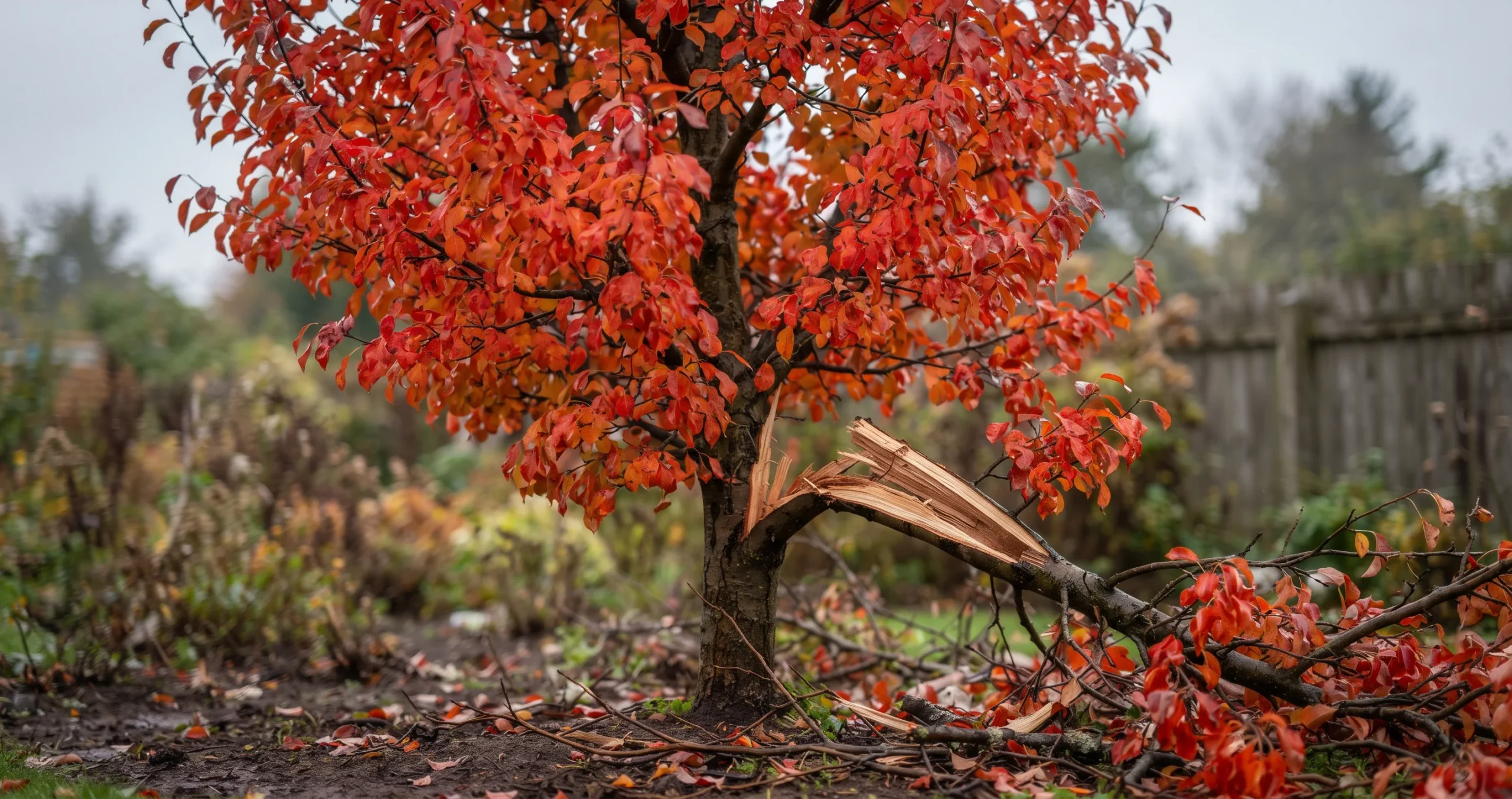
A tree covered in thousands of beautiful white flowers can split almost in half during a single summer thunderstorm. Even more surprisingly, its descendants can escape suburban gardens and transform entire fields into dense, thorny thickets.
Understanding Callery pear problems is important for homeowners who have these ornamental trees growing in their yards.
The Callery pear (Pyrus calleryana), particularly its popular Bradford cultivar, was once celebrated for its rapid growth, attractive spring blossoms, and colorful autumn foliage. Today, it is recognized as an invasive species in many parts of the United States.
From structural weaknesses to aggressive seed dispersal, this ornamental tree presents several challenges. Fortunately, numerous native alternatives offer similar beauty while providing greater ecological benefits.
Table of Contents
- What Is a Callery Pear Tree?
- Callery Pear Problems: Seven Reasons to Avoid Planting This Tree
- The Science Behind Bradford Pear Branch Splitting
- How Callery Pear Trees Become Invasive
- How to Identify Callery Pear Trees
- Why Callery Pear Trees Threaten Native Ecosystems
- What to Do if You Have a Bradford Pear Tree
- Seven Native Trees to Plant Instead of Bradford Pear
- In Your Own Yard: Creating a Wildlife-Friendly Landscape
- Frequently Asked Questions
What Is a Callery Pear Tree?
The Callery pear is a deciduous flowering tree native to parts of eastern Asia. It belongs to the rose family, Rosaceae, which also includes apples, cherries, plums, and cultivated pears.
The species was originally introduced to the United States during the early twentieth century, partly because of its potential usefulness in pear breeding and resistance to fire blight.
It later became widely planted as an ornamental landscape tree.
The Difference Between Callery Pear and Bradford Pear
Although these names are frequently used interchangeably, they describe slightly different things.
Callery pear is the species, while Bradford is a cultivated variety of that species.
Other ornamental Callery pear cultivars include:
- Cleveland Select.
- Aristocrat.
- Chanticleer.
- Redspire.
- Capital.
Although some cultivars were developed to improve branch structure, they can still contribute to invasive seed production through cross-pollination.
Why Bradford Pears Became So Popular
Bradford pears offered several characteristics that appealed to urban planners, landscapers, and homeowners.
They grew rapidly, tolerated challenging urban soils, produced abundant white flowers in spring, and developed attractive reddish-purple foliage in fall.
Unfortunately, their long-term structural and ecological problems became increasingly apparent as planted trees matured.
Callery Pear Problems: Seven Reasons to Avoid Planting This Tree
Despite its attractive seasonal appearance, the Callery pear has several significant disadvantages.
1. Weak Branch Structure
Bradford pears frequently develop multiple large branches with narrow attachment angles. These weak unions can split under heavy loads.
2. Vulnerability to Storm Damage
Strong winds, heavy snow, and ice accumulation can place considerable stress on their branches, sometimes resulting in major structural failures.
3. Unpleasant Flower Fragrance
Although their white blossoms are visually attractive, many people describe their scent as unpleasant, sometimes resembling decaying fish.
4. Invasive Seed Production
Different Callery pear cultivars can cross-pollinate, producing viable seeds that spread beyond landscaped areas.
5. Thorny Wild Offspring
Seed-grown Callery pears can develop long, sharp thorns, making invasive thickets difficult to navigate and remove.
6. Competition With Native Vegetation
Escaped trees can colonize open fields, roadsides, and woodland edges, competing with native plants for sunlight, water, and space.
7. Long-Term Maintenance Costs
Structural pruning, storm damage cleanup, invasive seedling removal, and eventual tree replacement can create unexpected expenses for property owners.
The Science Behind Bradford Pear Branch Splitting
One of the most recognizable Callery pear problems is the tendency of Bradford pears to lose large branches as they mature.
The explanation lies in the relationship between branch architecture, wood development, and mechanical stress.
Narrow Branch Attachment Angles
Many Bradford pears develop several upright branches that emerge close together from the main trunk.
These branches frequently form narrow, V-shaped junctions.
As they increase in diameter, their growing tissues press against one another, potentially creating structurally weak connections.
The Problem With Included Bark
In a strong branch attachment, overlapping wood tissues help secure the branch to the trunk.
However, when two stems grow closely together at narrow angles, bark can become trapped within the developing union.
This condition is known as included bark.
The trapped bark interrupts the formation of a strong wood connection, making the junction more susceptible to splitting under mechanical pressure.
Rapid Growth Increases Mechanical Stress
Bradford pears can develop large, dense crowns relatively quickly.
As branches become longer and heavier, they exert greater leverage on their attachment points.
During thunderstorms, wind pushes against the foliage and branches, producing additional bending forces.
Snow and ice can further increase the load.
When these forces exceed the strength of a weak branch union, a major limb or competing trunk can suddenly break away.
Why Pruning Cannot Solve Every Problem
Early structural pruning can help improve branch arrangement by encouraging a dominant central trunk and reducing competition between stems.
However, pruning cannot eliminate the invasive reproductive potential of a Callery pear.
Mature trees with extensive structural weaknesses may also require professional assessment rather than routine pruning alone.
Penn State Extension explains that the steep branch angles and weak attachments of Callery pears make them particularly susceptible to damage from high winds and heavy snow. extension.psu.edu
How Callery Pear Trees Become Invasive
Perhaps the most surprising part of the Callery pear’s history is that its widespread invasion was largely unexpected.
The Myth of Sterile Bradford Pears
Bradford pears are generally self-incompatible, meaning they cannot readily produce viable seeds using their own pollen or pollen from genetically identical Bradford trees.
Initially, this characteristic appeared to limit their reproductive potential.
However, as additional genetically distinct Callery pear cultivars became popular, opportunities for successful cross-pollination increased.
The resulting fruits contained viable seeds capable of developing into new trees.
Birds Become Unintentional Seed Dispersers
Callery pear trees produce small, rounded fruits that become attractive to birds and other animals.
Wildlife consumes these fruits and distributes their seeds through droppings, sometimes far from the original tree.
As a result, new seedlings can emerge in places where ornamental pears were never intentionally planted.
Wild Offspring Develop Different Characteristics
Seed-grown Callery pears do not necessarily resemble their cultivated parents.
Many develop irregular growth habits and sharp thorns that can make established populations particularly difficult to manage.
Over time, these escaped trees can form dense colonies in disturbed landscapes. University of Maryland Extension+1
How to Identify Callery Pear Trees
Callery pears have several recognizable characteristics that remain useful throughout the year.
Spring Flowers
Clusters of small white flowers appear in early spring, often before the leaves have fully developed.
Each flower typically contains five rounded petals.
Summer Leaves
The leaves are glossy, dark green, broadly oval, and finely toothed along their edges.
They grow alternately along the branches.
Fall Foliage and Fruit
During autumn, the leaves may develop shades of orange, red, burgundy, and purple.
The small, rounded brownish fruits are often less than half an inch across and may remain visible after leaf drop.
Winter Branch Structure
During winter, the absence of foliage reveals the tree’s branching architecture.
Cultivated Bradford pears frequently display a dense, upright crown, while wild specimens may have irregular branches and prominent thorns.
Why Callery Pear Trees Threaten Native Ecosystems
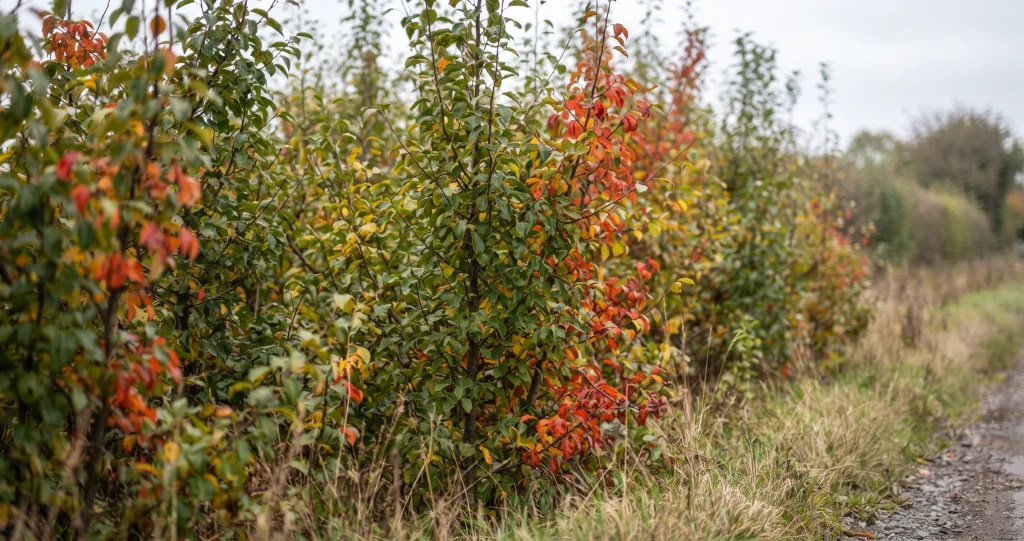
The problems associated with Callery pears extend well beyond individual gardens.
Displacement of Native Plants
Dense stands of invasive pears can occupy spaces that would otherwise support native grasses, wildflowers, shrubs, and young trees.
Reduced Habitat Diversity
Many native insects depend on particular plant species for food and reproduction.
Replacing diverse native vegetation with stands of invasive pears can disrupt these ecological relationships and reduce habitat quality.
Difficult Land Management
Sharp thorns make established populations challenging to remove. Trees can also regenerate from surviving stumps and roots.
Because of these ecological concerns, some states have restricted or prohibited the sale of Callery pears. Regulations vary, so check your state’s invasive species guidelines before purchasing ornamental trees.
What to Do if You Have a Bradford Pear Tree
Finding a Bradford pear on your property does not mean you need to remove it immediately without preparation. However, developing a replacement plan is worthwhile.
Inspect the Tree for Structural Damage
Look for visible cracks, splitting branch junctions, damaged limbs, and competing trunks.
If the tree grows near a building, driveway, or public walkway, arrange an assessment with a certified arborist.
Remove Young Seedlings
Small seedlings can often be pulled from moist soil. Try to remove the entire root system and wear sturdy gloves when working around thorny specimens.
Plan Professional Tree Removal
Mature Callery pears can be difficult and dangerous to remove because of their size and unpredictable branch failures.
Professional removal is generally the safest option.
Prevent Regrowth
Cutting down the tree alone may not eliminate it. Monitor the remaining stump and surrounding area for new shoots.
Penn State Extension recommends follow-up monitoring because Callery pears can repeatedly recolonize managed areas when nearby seed sources remain. extension.psu.edu
Seven Native Trees to Plant Instead of Bradford Pear
Many attractive North American native trees can provide spring blossoms, autumn color, and valuable wildlife habitat.
1. Flowering Dogwood (Cornus florida)
A beautiful ornamental tree with white or pink floral bracts, red fruits, and attractive autumn foliage.
2. Eastern Redbud (Cercis canadensis)
Known for its pinkish-purple spring flowers and distinctive heart-shaped leaves.
3. Downy Serviceberry (Amelanchier arborea)
Produces delicate white spring blossoms, summer fruits, and colorful fall foliage.
4. White Fringetree (Chionanthus virginicus)
Features unusual, fragrant white flowers with narrow, ribbonlike petals.
5. American Plum (Prunus americana)
Offers abundant spring flowers and fruits that attract wildlife. It can develop suckers and form colonies.
6. Green Hawthorn (Crataegus viridis)
An attractive small tree featuring white blossoms and colorful fruits that may persist into winter.
7. Southern Crabapple (Malus angustifolia)
Produces fragrant pinkish-white flowers and small fruits while supporting native wildlife.
| Native tree | Approximate mature height | Main attraction |
|---|---|---|
| Flowering dogwood | 15–30 feet | Showy spring blooms |
| Eastern redbud | 20–30 feet | Pink spring flowers |
| Downy serviceberry | 15–25 feet | Flowers and berries |
| White fringetree | 12–20 feet | Fragrant white flowers |
| American plum | 15–25 feet | Wildlife habitat |
| Green hawthorn | 20–35 feet | Persistent fruits |
| Southern crabapple | 15–30 feet | Fragrant blossoms |
Mature heights vary with growing conditions. Choose a species native to your particular region and suitable for your garden’s soil, sunlight, and available space.
In Your Own Yard: Creating a Wildlife-Friendly Landscape
Replacing an invasive ornamental tree provides an opportunity to rethink the ecological value of your backyard.
Start by assessing the available planting space, soil drainage, sunlight, and proximity to buildings.
If you enjoy Bradford pear’s white spring flowers, consider serviceberry or white fringetree. If autumn foliage is your priority, flowering dogwood may offer an attractive alternative.
Plant your replacement tree during fall or early spring when local conditions are favorable. Keep the root flare at ground level, water regularly during establishment, and apply 2–3 inches of organic mulch without piling it against the trunk.
Complement your new tree with native shrubs, wildflowers, and grasses to create a diverse habitat that supports wildlife throughout the year.
Frequently Asked Questions
1. What is the difference between Bradford pear and Callery pear?
Callery pear is the species Pyrus calleryana, while Bradford is one of its ornamental cultivars. Other cultivars include Cleveland Select and Aristocrat. Different cultivars can contribute to invasive seed production through cross-pollination.
2. Why do Bradford pear trees split so easily?
Bradford pears frequently develop narrow branch attachments and competing upright stems. Included bark can weaken these junctions, increasing the risk of splitting during storms or under heavy loads.
3. What is the best replacement for a Bradford pear tree?
Serviceberry, flowering dogwood, eastern redbud, and white fringetree are excellent alternatives where they are native and suited to local growing conditions. They provide attractive seasonal displays while supporting wildlife.
Conclusion
The spectacular white blossoms of Bradford pears once made them a favorite feature of American neighborhoods. Unfortunately, their structural weaknesses and invasive offspring reveal a more complicated story.
Understanding Callery pear problems helps gardeners make informed decisions about protecting their properties and surrounding ecosystems.
By choosing suitable native alternatives, you can enjoy beautiful spring flowers, colorful autumn foliage, and a garden that provides lasting benefits for wildlife.
A flowering tree should leave behind a legacy of beauty and biodiversity rather than broken branches and invasive thickets.
External Sources
1. Invasives in Your Woodland: Callery Pear
This resource includes distribution maps from 2015 and 2025, illustrating the geographical expansion of Callery pear populations. University of Maryland Extension . Callery Pear Invasion and Distribution