
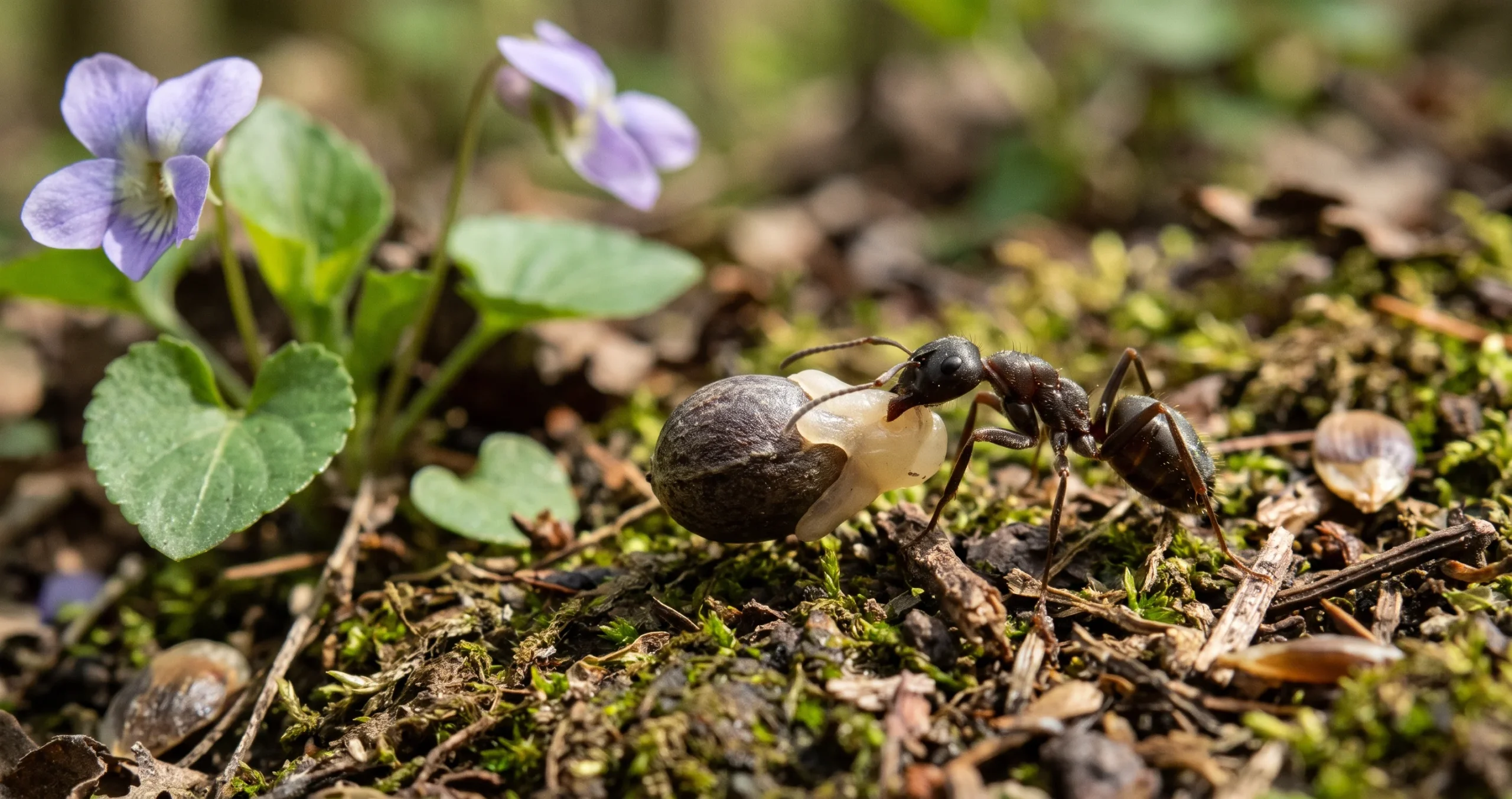
Understanding how ants disperse wildflower seeds reveals a fascinating ecological relationship that helps certain native plants spread across North American forests. This natural process, called myrmecochory, involves ants collecting seeds with nutrient-rich attachments known as elaiosomes.
When ants discover these seeds, they may carry them into underground nests, remove the edible attachments, and discard the intact seeds in new locations. Under suitable conditions, some of these seeds germinate and develop into new plants.
Scientists studying how ants disperse wildflower seeds have documented this relationship in woodland plants such as trilliums, bloodroot, and certain native violets. Ant-mediated seed dispersal can influence plant distribution, woodland biodiversity, and forest regeneration.
This guide explains how myrmecochory works, why certain wildflowers attract ants, and how gardeners can support native plants and beneficial soil organisms.
Table of Contents
- How Ants Help Wildflowers Spread
- What Is Myrmecochory?
- Why Certain Wildflower Seeds Attract Ants
- What Are Elaiosomes?
- Why Ants Collect These Seeds
- How Ants Transport Seeds Underground
- What Happens to Seeds Inside an Ant Nest?
- How Discarded Seeds Can Germinate
- North American Wildflowers That Rely on Ants
- Wild Violets
- Trilliums
- Bloodroot
- Other Woodland Wildflowers
- Why Ant Seed Dispersal Matters for Forest Ecosystems
- How Gardeners Can Support Ants and Native Wildflowers
- Frequently Asked Questions
- Conclusion
How Ants Help Wildflowers Spread
Seed dispersal allows plants to move their offspring away from the parent plant.
Different plant species use different strategies.
Some produce lightweight seeds carried by wind, while others rely on birds, mammals, or flowing water.
Certain woodland wildflowers use ants.
These plants produce seeds that attract specific ant species, encouraging the insects to carry them away from their original location.
The ants are primarily interested in the nutrient-rich structures attached to the seeds rather than the seeds themselves.
Once the attractive material has been removed, the seeds may be left in a new location.
This movement can reduce the concentration of seeds directly beneath the parent plant.
It may also influence competition, exposure to seed predators, and opportunities for establishment.
However, dispersal does not automatically guarantee successful germination.
A seed must remain viable and encounter suitable environmental conditions before it can develop into a seedling.
What Is Myrmecochory?
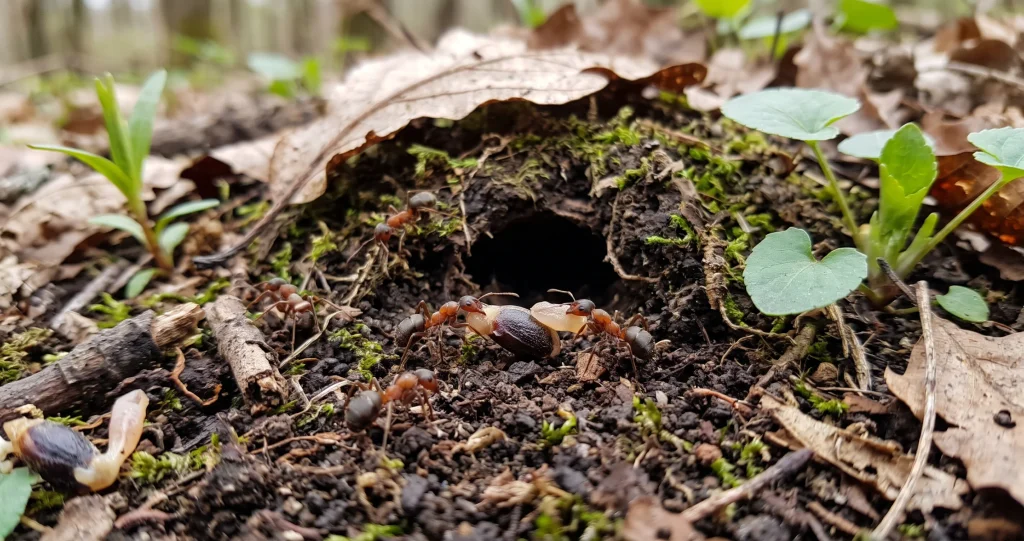
Myrmecochory is the scientific term for seed dispersal by ants.
The word comes from Greek roots associated with ants and movement or dispersal.
It describes an ecological interaction in which ants transport seeds, often because the seeds carry attractive food structures.
Myrmecochory occurs in many regions of the world, including temperate forests of eastern North America.
It is particularly associated with certain herbaceous woodland plants.
The relationship can provide benefits to both organisms.
Ants obtain nutrients from seed attachments, while plants gain an opportunity for their seeds to be moved away from the parent plant.
However, the interaction is not always equally beneficial.
Some ants remove the elaiosome without transporting the seed very far.
Other ants may carry seeds to locations where germination is unlikely.
The outcome depends on the behavior of the ant species and the ecological conditions surrounding the plant.
Why Certain Wildflower Seeds Attract Ants
The attraction between ants and certain wildflower seeds is largely associated with specialized seed structures.
What Are Elaiosomes?
Elaiosomes are fleshy, nutrient-containing attachments found on the seeds of certain plant species.
They often contain lipids and other compounds that can make them attractive to ants.
The precise chemical composition varies between plant species.
Elaiosomes are separate from the embryo and the main seed tissues needed for germination.
This distinction is important because ants can remove the attachment without necessarily damaging the seed itself.
The structure acts as a food reward that encourages seed transport.
Not every wildflower seed has an elaiosome.
This adaptation occurs in particular plant lineages and is especially familiar among some woodland herbs.
Why Ants Collect These Seeds
Ants search their surroundings for food resources that can support colony activities.
Certain species respond to the chemical and nutritional characteristics of elaiosomes.
When a worker ant encounters an attractive seed, it may grasp the seed and carry it toward the nest.
The reward is the edible attachment.
Once ants remove it, the remaining seed may be discarded.
This behavior creates an opportunity for the plant to disperse its offspring without producing wings, fleshy fruits, or other dispersal structures.
However, ant responses vary.
Some species are effective seed carriers, while others may ignore elaiosome-bearing seeds or remove the attachment at the collection site.
How Ants Transport Seeds Underground
The transportation process begins when a foraging ant encounters a suitable seed.
If the seed is attractive and manageable in size, the ant may carry it toward the colony.
Some seeds are transported along the soil surface before entering underground nest passages.
Others may be moved into shallow nest chambers.
The distance traveled depends on ant species, seed size, terrain, and nest location.
In many temperate woodland systems, ant-mediated seed dispersal occurs over relatively short distances compared with wind dispersal or transport by large animals.
Nevertheless, even short-distance movement can influence plant distribution.
A seed transported away from dense vegetation may encounter different light, moisture, and soil conditions.
Some ants may also move seeds more than once.
For example, a seed discarded by one colony could potentially be encountered by another animal.
These secondary movements add complexity to the dispersal process.
However, the final location of a seed is not always predictable.
What Happens to Seeds Inside an Ant Nest?
After an ant carries an elaiosome-bearing seed into its nest, colony members may remove the edible attachment.
The elaiosome can be consumed by workers or used as food within the colony.
The seed itself is often left intact.
Once the attachment has been removed, ants may transport the seed away from active feeding or brood areas.
Some seeds are deposited in nest refuse chambers.
Others are discarded near nest entrances or in surrounding soil.
These locations may differ from the original seed-release site in several important ways.
Ant nests can alter soil structure through excavation and movement of mineral particles.
Some nest areas may contain different concentrations of organic matter or nutrients.
However, these conditions are not universally favorable for plant growth.
The ecological effects of ant nests vary among species, habitats, and soil types.
A seed deposited in an ant nest may germinate successfully, remain dormant, be eaten by another organism, or fail to establish.
How Discarded Seeds Can Germinate
Seed dispersal and seed germination are separate stages in a plant’s life cycle.
Once ants discard a seed, its future depends on environmental conditions and biological characteristics.
Suitable Soil Conditions
Many woodland wildflowers grow in soils containing organic matter and a natural layer of decomposing leaves.
However, their exact requirements vary.
Some prefer moist, well-drained soils, while others tolerate drier woodland conditions.
Seasonal Temperature Changes
Certain native woodland plants require periods of cold, warm, or alternating seasonal temperatures before their seeds can germinate.
These dormancy requirements help coordinate germination with suitable growing conditions.
For example, some trillium species have complex seed dormancy patterns and may take considerable time to produce visible seedlings.
Seed Viability
Seeds must remain alive and undamaged to germinate.
Although ants often remove elaiosomes without destroying the seed, other organisms may consume or damage it.
Fungal infections, unsuitable moisture, and unfavorable temperatures can also reduce germination success.
Seedling Establishment
Even after germination, young plants must survive competition, herbivory, and environmental stress.
Consequently, ant transport increases dispersal opportunities but does not guarantee successful plant establishment.
North American Wildflowers That Rely on Ants
Several familiar North American woodland wildflowers participate in ant-mediated seed dispersal.
Wild Violets
Certain native violets (Viola species) produce seeds with elaiosomes that attract ants.
These plants often grow in woodland edges, shaded gardens, and forest understories.
Some violets also use mechanical seed dispersal, releasing seeds from their capsules before ants potentially transport them farther.
This combination of mechanisms can help distribute seeds around suitable habitats.
However, dispersal strategies differ among violet species.
Trilliums
Trilliums (Trillium species) are iconic spring wildflowers of North American forests.
Many species produce seeds with attractive elaiosomes.
Ants can transport these seeds away from the parent plant, contributing to local dispersal.
Trilliums are generally slow-growing perennials, and seedling establishment can take several years.
Their long life cycles make habitat stability particularly important.
Gardeners should obtain trilliums from reputable nurseries that propagate plants rather than removing them from wild populations.
Bloodroot
Bloodroot (Sanguinaria canadensis) is a native woodland perennial known for its white spring flowers and distinctive lobed leaves.
Its seeds possess elaiosomes that attract certain ants.
After ants transport the seeds and remove the edible attachments, the remaining seeds may be discarded.
Under suitable conditions, some can germinate and contribute to the spread of bloodroot colonies.
Bloodroot contains biologically active compounds and should not be treated as an edible garden plant.
Other Woodland Wildflowers
Additional North American plants associated with ant-mediated seed dispersal include certain species of:
- Wild ginger (Asarum species)
- Dutchman’s breeches (Dicentra cucullaria)
- Squirrel corn (Dicentra canadensis)
- Hepatica (Hepatica species)
- Spring beauty (Claytonia species)
The presence and importance of elaiosome-based dispersal vary among species.
Why Ant Seed Dispersal Matters for Forest Ecosystems
The relationship between ants and wildflowers contributes to several ecological processes.
Plant Distribution
Ants move seeds away from parent plants, influencing where new individuals may establish.
This movement can affect the local distribution of woodland vegetation.
Forest Biodiversity
Woodland wildflowers contribute to forest biodiversity by providing seasonal flowers, vegetation cover, and resources for insects.
Ant-mediated seed dispersal can support the persistence and local spread of some of these plant populations.
Soil Interactions
Ants influence soil through excavation, nest construction, and organic material movement.
These activities can alter small-scale soil conditions.
However, the effects differ between ant species and habitats.
Ecological Relationships
Myrmecochory illustrates how interactions between organisms can influence plant reproduction and community structure.
Changes in ant populations may therefore affect seed dispersal for certain plants.
Research suggests that habitat disturbance and changes in ant communities can influence these relationships.
However, the consequences are context-dependent and should not be generalized to every forest ecosystem.
How Gardeners Can Support Ants and Native Wildflowers
Home gardeners can create conditions that support native woodland plants and the insects associated with them.
Plant Regionally Native Wildflowers
Choose native plants suited to local soil, moisture, and light conditions.
For shaded gardens, consider appropriate woodland species such as native violets, bloodroot, or trilliums.
Purchase nursery-propagated plants from reputable suppliers.
Maintain Natural Leaf Litter
A moderate layer of fallen leaves can provide habitat for soil organisms and help conserve moisture.
Leaf litter also contributes organic matter as it decomposes.
Avoid burying delicate plant crowns beneath excessively thick material.
Reduce Unnecessary Soil Disturbance
Frequent digging and soil disruption can damage established plants and underground insect nests.
Maintain relatively stable woodland planting areas where practical.
Use Targeted Pest Management
Ants perform diverse ecological roles, but not every ant species is beneficial in every setting.
Some invasive ants can disrupt native insect communities.
Avoid broad insecticide applications when there is no identified pest problem.
When intervention is necessary, use targeted methods appropriate to the species and situation.
Provide Diverse Habitat
Combine native groundcovers, woodland flowers, shrubs, and suitable organic mulch to create varied habitat.
For additional information, see Beneficial Garden Insects and Their Ecological Roles.
A broader approach to habitat gardening is covered in How to Create a Wildlife-Friendly Garden.
These practices can support ecological diversity while allowing natural seed-dispersal interactions to occur.
Frequently Asked Questions
1. How do ants disperse wildflower seeds?
Certain ants collect seeds with nutrient-rich attachments called elaiosomes. They transport the seeds toward their nests, remove or consume the attachments, and may discard the intact seeds in new locations.
2. What is myrmecochory?
Myrmecochory is seed dispersal by ants. It commonly involves plants producing seeds with edible attachments that attract particular ant species.
3. Do all ants help spread wildflower seeds?
No. Seed-dispersal behavior varies among ant species. Some ants actively transport elaiosome-bearing seeds, while others ignore them, consume the attachments without moving the seeds, or interact with seeds differently.
4. Which North American wildflowers use ants for seed dispersal?
Documented examples include certain native violets, trilliums, bloodroot, and several other woodland herbs. The importance of ant dispersal differs among plant species and habitats.
5. Do seeds grow better after ants bury them?
Sometimes. Ants may move seeds into locations with favorable conditions, but this is not guaranteed. Germination and seedling survival depend on soil, moisture, temperature, seed viability, and other environmental factors.
Conclusion
Understanding how ants disperse wildflower seeds reveals an important relationship between insects and native woodland plants.
Through myrmecochory, certain ants collect seeds with nutrient-rich elaiosomes, transport them toward their nests, and discard the remaining seeds after removing the edible attachments.
This behavior can influence plant distribution and contribute to forest biodiversity.
However, the outcome depends on the species involved and the conditions where seeds are deposited.
Not every ant participates in this process, and not every transported seed becomes a mature plant.
By protecting native woodland vegetation, maintaining suitable soil habitats, and reducing unnecessary disturbance, gardeners can support the ecological relationships that help sustain healthy forest and garden ecosystems.
External Sources
- USDA Forest Service — Field Experiments on Ant-Mediated Seed Dispersal (2018)
Published in Ecological Entomology, this study investigates the ecological relationship between seed-dispersing ants and woodland plants.
Read the Peer-Reviewed Study USFS Research & Development