
A small stone picked up from a garden path can contain clues to a geological story millions of years old.
At first glance, two stones may look almost identical. Both might be gray, smooth, and slightly shiny. Yet one could contain quartz, while the other holds feldspar, mica, or calcite. Their appearance may be similar, but their physical properties reveal important differences.
Learning to recognize common minerals is like discovering a hidden language written into the Earth. With a few simple observations and household tools, you can begin identifying the materials that make up rocks, soils, mountains, and even the gravel beneath your feet.
You do not need an expensive laboratory or advanced geology training. Many minerals can be distinguished by examining their hardness, streak, luster, cleavage, and other visible characteristics.
In this guide, we will explore eight familiar minerals, explain the science behind their identifying features, and discover how to investigate geological specimens safely in your own backyard.
Table of Contents
- What Makes a Mineral Different From a Rock?
- The Science Behind Identifying Common Minerals
- Eight Common Minerals and Their Identifying Features
- Simple Tools for Identifying Minerals
- In Your Own Yard: Start a Mineral Investigation
- Common Mistakes When Identifying Minerals
- Frequently Asked Questions About Minerals
- Conclusion
What Makes a Mineral Different From a Rock?
A mineral is a naturally occurring solid with a characteristic chemical composition and an ordered internal atomic structure. In conventional geology, minerals generally form through inorganic processes.
A rock, by contrast, is a naturally occurring aggregate that may contain one or several minerals, along with other materials.
Granite, for example, commonly contains quartz, feldspar, and mica. Each mineral contributes different colors, textures, and physical properties.
A single piece of granite may therefore contain several identifiable minerals.
This distinction matters because mineral identification focuses on the properties of individual components rather than the appearance of the entire rock.
Why Minerals Matter in Nature
Minerals are essential building blocks of Earth’s crust.
As rocks weather, some minerals break down and release elements that influence soil chemistry and plant growth.
Other minerals resist weathering and remain as sand or sediment.
Quartz is especially resistant to many weathering processes, which helps explain its abundance in numerous sandy environments.
Minerals also influence drainage, soil texture, and the long-term development of landscapes.
Understanding them offers a new perspective on gardening, geology, and the natural world.
The Science Behind Identifying Common Minerals
Minerals can look remarkably different depending on impurities, crystal size, and environmental conditions.
That is why geologists rarely identify a specimen using color alone.
Instead, they combine several physical tests to narrow down the possibilities.
Hardness: How Easily a Mineral Scratches
Hardness measures a mineral’s resistance to scratching.
Geologists commonly use the Mohs hardness scale, which ranks ten reference minerals from talc at 1 to diamond at 10.
The scale is ordinal, not proportional. A mineral rated 8 is not necessarily twice as hard as one rated 4.
Simple objects can help estimate hardness.
A fingernail has a hardness of approximately 2.5, while ordinary glass is often around 5.5.
A mineral that scratches glass may be harder than the glass surface, although the result should be checked carefully.
Always distinguish a true scratch from a removable streak of powder.
Streak: The Color of Mineral Powder
Streak is the color of a mineral in powdered form.
It is commonly tested by rubbing a specimen across an unglazed porcelain streak plate.
A mineral’s external color may vary, while its streak can be more consistent.
Hematite provides a classic example. Although specimens may appear metallic gray or reddish brown, their streak is typically reddish brown.
Some hard minerals cannot be tested effectively on an ordinary porcelain plate because they scratch the plate instead of leaving powder.
Luster: How a Surface Reflects Light
Luster describes how a mineral reflects light.
Metallic minerals may resemble polished metal, while nonmetallic minerals can appear glassy, pearly, silky, or dull.
Quartz often has a glassy luster.
Mica may display a pearly shine along its cleavage surfaces.
Luster is useful, but weathering and surface damage can change how a specimen looks.
Cleavage and Fracture: How Minerals Break
The internal arrangement of atoms influences how a mineral breaks.
Some minerals split along flat planes called cleavage surfaces.
Others break irregularly, producing fracture surfaces.
Mica separates into thin sheets because of its layered crystal structure.
Quartz lacks prominent cleavage and commonly breaks with curved, shell-like surfaces known as conchoidal fracture.
These differences can be more reliable than color when identifying a mineral.
Why Several Tests Work Better Together
No single property identifies every mineral.
A transparent specimen could be quartz, calcite, gypsum, or another material.
Combining hardness, cleavage, streak, and luster provides a much stronger basis for identification.
Even then, some specimens require specialized tests or professional examination.
Eight Common Minerals and Their Identifying Features
The following minerals are widespread in many geological environments, although their local abundance varies considerably.
1. Quartz: The Mineral That Often Scratches Glass
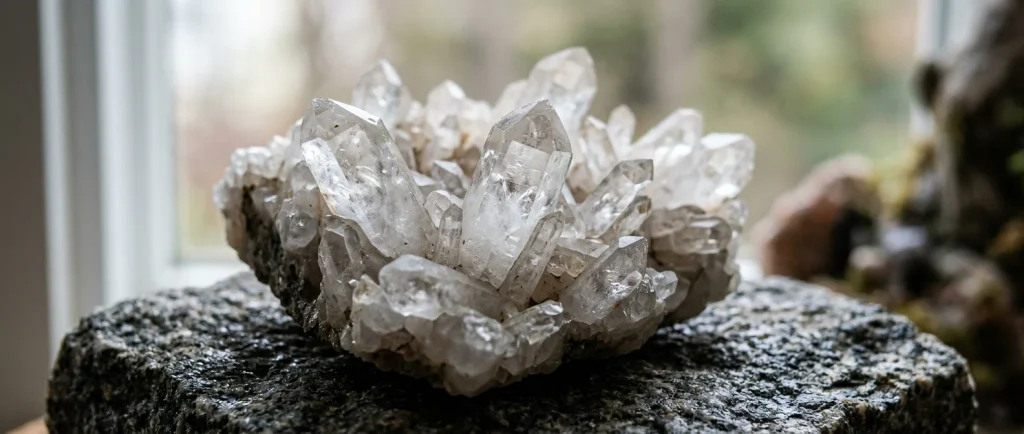
Quartz is one of the most familiar minerals in Earth’s crust.
It appears in many colors, including clear, white, smoky gray, purple, and pink.
Its chemical composition is silicon dioxide.
Quartz has a Mohs hardness of 7, making it harder than ordinary window glass.
Simple identification test: On a suitable loose specimen, carefully check whether a fresh quartz surface scratches an expendable piece of glass. Confirm that the mark is a genuine scratch rather than transferred powder.
Quartz also commonly displays glassy luster and conchoidal fracture.
Unlike calcite or feldspar, it does not show prominent cleavage.
In gardens, quartz may occur in gravel, sand, and landscaping stones.
2. Feldspar: The Mineral With Flat Cleavage Surfaces
Feldspar is a large group of rock-forming minerals rather than a single chemical species.
Feldspars are major components of many igneous rocks, including granite.
Their colors range from white and pink to gray and greenish shades.
Most common feldspars have a hardness of approximately 6.
Simple identification test: Look for two distinct cleavage directions that meet at or near right angles.
These flat surfaces can distinguish feldspar from quartz, which typically breaks irregularly.
Some feldspar varieties also show fine parallel lines on cleavage surfaces.
Feldspar minerals are important sources of elements that can become available during long-term rock weathering.
3. Mica: The Mineral That Splits Into Thin Sheets
Mica is a group of sheet silicate minerals known for their layered structure.
Two familiar varieties are muscovite, often pale or silvery, and biotite, commonly dark brown or black.
Mica frequently appears as sparkling flakes in granite and metamorphic rocks.
Simple identification test: Examine a loose mica flake and observe whether its natural layers separate into thin, flexible sheets.
This excellent cleavage is one of mica’s most recognizable characteristics.
Mica is relatively soft, although hardness varies among species and testing directions.
Its reflective surfaces can make ordinary rocks sparkle in sunlight.
4. Calcite: The Mineral That Reacts With Acid
Calcite is a calcium carbonate mineral found in limestone, marble, and many sedimentary environments.
It may be white, transparent, yellowish, or various other colors.
Calcite has a Mohs hardness of 3.
Simple identification test: A small drop of dilute household vinegar may produce weak bubbling on freshly powdered calcite.
The reaction occurs because acid interacts with calcium carbonate and releases carbon dioxide gas.
Household vinegar is weaker than the dilute hydrochloric acid commonly used by geologists, so visible bubbling may be subtle.
Calcite also displays cleavage in three directions that do not meet at right angles.
Use only a tiny amount of vinegar on a suitable expendable specimen, and never mix cleaning chemicals.
5. Gypsum: The Mineral a Fingernail Can Scratch
Gypsum is a relatively soft mineral composed of hydrated calcium sulfate.
It forms in several geological environments, including areas where mineral-rich water evaporates.
Gypsum may appear white, transparent, gray, or slightly colored.
Its Mohs hardness is 2.
Simple identification test: A fingernail can usually scratch a fresh gypsum surface.
This makes gypsum noticeably softer than quartz and feldspar.
Some gypsum varieties form transparent crystals, while others occur in fine-grained masses.
Selenite and satin spar are familiar forms of gypsum.
Avoid scratching polished, decorative, or valuable specimens.
6. Halite: The Mineral With Cubic Cleavage
Halite is naturally occurring sodium chloride, the same chemical compound found in ordinary table salt.
It forms in evaporite deposits where salty water becomes concentrated and minerals crystallize.
Halite crystals often have a cubic shape.
Its hardness is approximately 2 to 2.5.
Simple identification test: Examine the specimen for three cleavage directions meeting at right angles, producing cube-like fragments.
Halite is also highly soluble in water compared with many common rock-forming minerals.
Do not taste unknown minerals. Specimens may contain contaminants or be misidentified.
A visual examination of crystal shape and cleavage is a safer starting point.
7. Hematite: The Mineral With a Reddish Streak
Hematite is an iron oxide mineral found in numerous geological settings.
It may appear metallic gray, black, reddish brown, or earthy red.
Its hardness varies with the specimen, commonly falling around 5 to 6.5.
Simple identification test: Rub a small, suitable specimen across an unglazed porcelain streak plate.
Hematite typically produces a reddish-brown streak.
This is particularly useful when identifying metallic-looking specimens that resemble other iron minerals.
Hematite contributes to the red coloration of many rocks and soils.
Its presence can provide clues about iron-bearing materials and geological processes.
8. Magnetite: The Mineral Attracted to Magnets
Magnetite is another iron oxide mineral, but it differs chemically and physically from hematite.
It commonly appears black with a metallic or submetallic luster.
Magnetite has a Mohs hardness of approximately 5.5 to 6.5.
Simple identification test: Bring a small magnet close to the specimen and check for attraction.
Magnetite is strongly magnetic compared with most common minerals.
However, magnetism alone does not prove that a specimen is magnetite.
Some rocks contain magnetic mineral grains, and other iron-bearing materials may also respond to magnets.
A black streak and other physical properties can provide additional evidence.
Simple Tools for Identifying Minerals
A basic mineral identification kit can be assembled from inexpensive household materials.
Useful items include a magnifying glass, a small magnet, an unglazed porcelain streak plate, a flashlight, and a notebook.
A fingernail and an expendable glass sample can provide rough hardness comparisons.
A small bottle of household vinegar may be useful for checking suitable carbonate specimens.
For safety, wear eye protection when handling sharp fragments. Avoid creating dust, breaking unknown specimens, or using strong acids.
Never taste unidentified minerals, and wash your hands after handling collected rocks.
For children, visual observations and magnet tests are generally better starting points than scratching or chemical testing.
In Your Own Yard: Start a Mineral Investigation
Your garden may contain more geological variety than you expect.
Decorative gravel, natural stones, exposed soil, and landscaping materials can provide opportunities to observe different minerals.
Examine Garden Gravel
Choose a few loose stones from an area where collecting is permitted.
Look for differences in color, texture, sparkle, and crystal shape.
A pale grain with glassy luster might be quartz.
A shiny flake that separates into sheets could be mica.
Remember that many gravel pieces are rocks containing multiple minerals.
Observe Soil and Sand
Spread a small amount of clean, dry garden sand on a white surface.
Use a magnifying glass to inspect individual grains.
Some may be transparent or milky quartz, while others may contain feldspar or fragments of rock.
Color alone is not enough for identification, but the exercise reveals the variety hidden in ordinary soil.
Avoid inhaling dust or grinding samples.
Create a Backyard Mineral Journal
Record where each specimen was found, its appearance, and the results of any safe tests.
Include sketches or photographs.
Compare several observations before suggesting an identification.
If a specimen remains uncertain, label it as unidentified rather than forcing a conclusion.
This simple habit encourages careful observation and scientific thinking.
Common Mistakes When Identifying Minerals
The most frequent mistake is relying entirely on color.
Many minerals occur in several colors, while unrelated minerals may look similar.
Another mistake is confusing a mineral with a rock.
A granite pebble, for example, contains several minerals and should not be identified as quartz simply because some grains are glassy.
Surface weathering can also mislead observers.
A dull exterior may conceal a shiny interior, and mineral coatings can disguise the original material.
Finally, simple tests have limitations.
A magnet may detect iron-bearing grains without identifying the entire specimen. A weak vinegar reaction may be difficult to observe, and hardness estimates depend on proper technique.
Accurate identification comes from combining evidence.
Frequently Asked Questions About Minerals
1. What is the easiest mineral for beginners to identify?
Mica is often one of the easiest because of its distinctive ability to split into thin sheets. Magnetite can also be recognizable through magnetic attraction, while gypsum is notable for its low hardness. However, several properties should be checked before confirming an identification.
2. Can common minerals be identified without special equipment?
Many minerals can be tentatively identified using a magnifying glass, magnet, streak plate, and simple hardness comparisons. Some specimens require laboratory analysis, particularly when minerals have similar physical properties or occur as very small grains.
3. Are minerals found in garden soil?
Yes. Garden soil commonly contains mineral particles produced through the weathering of rocks. Depending on local geology, these may include quartz, feldspar, mica, clay minerals, and various iron-bearing minerals. Their proportions vary by region and soil type.
Conclusion
That small stone resting beside your garden path may be far more interesting than it first appears.
Its hardness, luster, cleavage, and other properties offer clues about the minerals it contains and the geological processes that formed it.
Learning to identify common minerals transforms an ordinary walk into a small scientific investigation.
A sparkling grain of quartz, a flexible sheet of mica, or a magnetic fragment of magnetite can reveal something about the Earth beneath your feet.
And sometimes, the most fascinating discoveries begin with nothing more than picking up a stone and looking closely.
External Sources
1. U.S. Geological Survey (USGS) – Minerals: Explains the differences between rocks and minerals, their physical properties, and the characteristics of common minerals such as quartz, feldspar, mica, and calcite. Source: USGS – Minerals
2. U.S. Geological Survey (USGS) – Mineral Gemstones: Describes the Mohs hardness scale and explains how scratch resistance helps distinguish minerals, including gypsum, calcite, feldspar, and quartz. Source: USGS – Mineral Gemstones
3. U.S. Geological Survey (USGS) – Mineral Identification: Provides scientific information about identifying minerals through their physical characteristics and laboratory examination. Source: USGS – Mineral Identification
4. Minerals Education Coalition – Calcite: Describes calcite’s chemical composition, hardness, appearance, and geological occurrence, supporting its identification and distinguishing characteristics. Source: Minerals Education Coalition – Calcite