
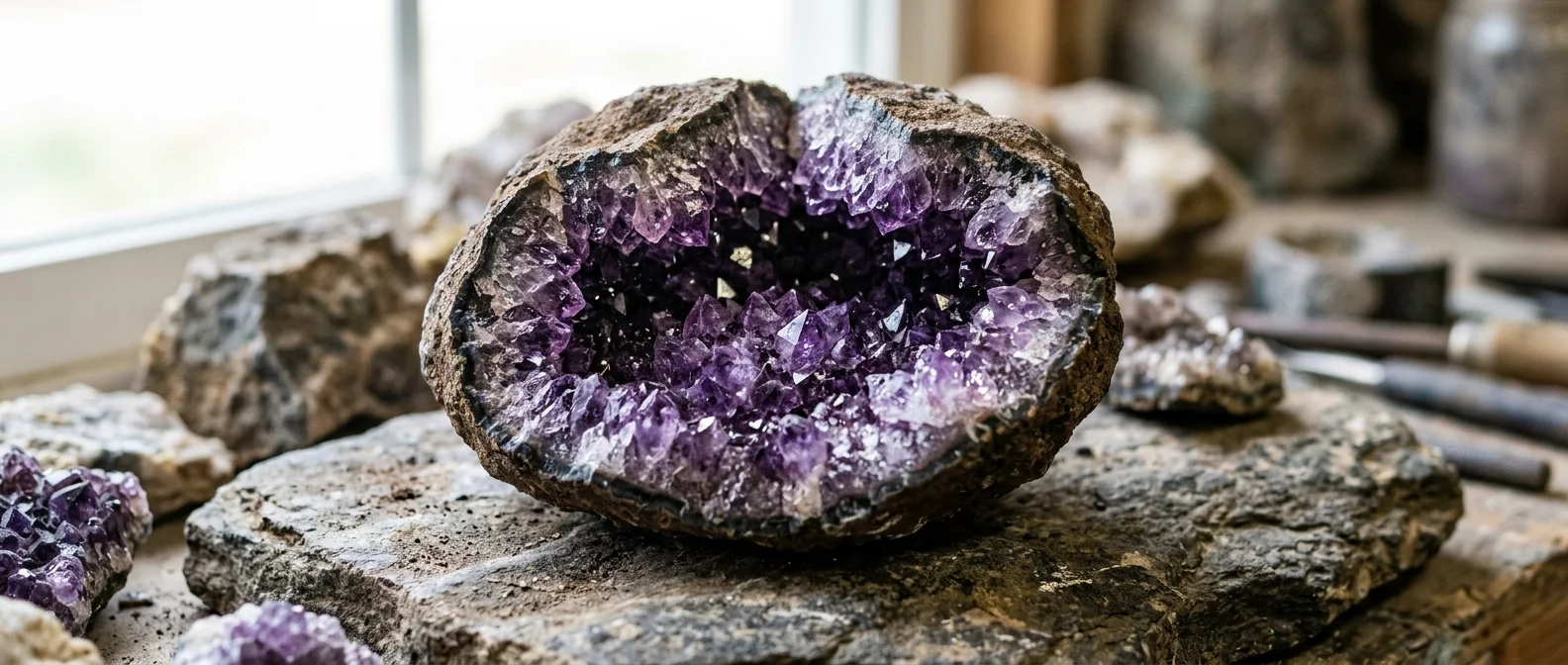
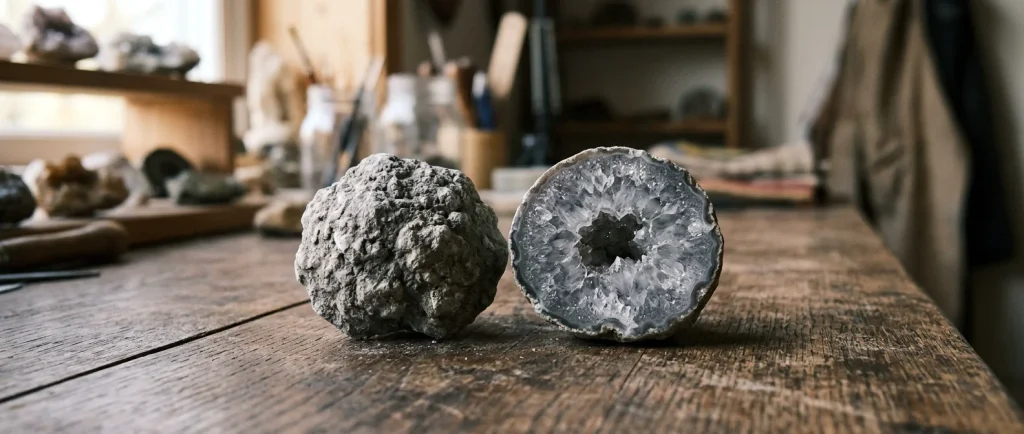
From the outside, a geode might resemble a rough, rounded stone. Its surface can be gray, brown, or covered with weathered mineral deposits. Nothing about its appearance necessarily reveals the beautiful structures waiting within.
Yet inside some geodes, delicate quartz crystals point toward an empty center. Others contain purple amethyst, translucent chalcedony, or colorful bands of minerals deposited over immense periods.
Understanding how geodes form reveals one of geology’s most fascinating processes: the transformation of an empty space inside a rock into a natural crystal chamber.
These remarkable formations are created through interactions between water, dissolved minerals, surrounding rock, and changing geological conditions.
The process can take thousands to millions of years, depending on the geological environment.
And the most surprising part is that many geodes begin not as solid stones, but as cavities waiting to be filled.
Table of Contents
- What Is a Geode?
- How Geodes Form: The Science Behind Crystal Growth
- Where Do Geodes Form?
- Why Geodes Have Different Colors and Crystals
- How Long Does It Take for a Geode to Form?
- Geodes, Agates, and Ordinary Rocks
- In Your Own Yard: Exploring Geodes Safely
- Common Misconceptions About Geodes
- Frequently Asked Questions About Geodes
- Conclusion
What Is a Geode?
A geode is a geological formation containing a cavity lined with mineral deposits or crystals.
Many geodes are roughly rounded, although their shapes can vary considerably.
The exterior is often made of a relatively durable mineral-rich layer that protects the interior as the surrounding rock weathers away.
Inside, the cavity may contain quartz, calcite, chalcedony, or other minerals.
Some geodes are almost completely hollow, while others are partly filled with crystals or layered mineral deposits.
A few become nearly solid as mineral growth continues.
Why Geodes Look Ordinary on the Outside
The outer surface of a geode may be rough, dull, and covered with weathered material.
This protective exterior can conceal the crystals inside.
In some cases, the surrounding rock erodes more quickly than the mineralized cavity, allowing the geode to remain as a separate rounded stone.
That is why geodes can sometimes be found loose in sediment, creek beds, or exposed geological formations.
Their unremarkable appearance makes the discovery of a crystal-filled interior especially surprising.
How Geodes Form: The Science Behind Crystal Growth
Geodes do not appear overnight.
Their formation usually involves several stages, beginning with an opening inside a rock and continuing as mineral-rich water moves through the surrounding material.
Although the details vary between geological settings, the general process follows a recognizable sequence.
1. An Empty Cavity Develops Inside Rock
The first requirement for many geodes is a hollow space.
In volcanic environments, cavities can form when gas bubbles become trapped in cooling lava.
As the lava solidifies, some bubbles leave behind rounded openings called vesicles.
These spaces may later become sites of mineral deposition.
In sedimentary rocks, cavities can develop through different processes.
Some form when shells, fossils, or other materials dissolve or decay, leaving openings in the surrounding rock.
Others develop when groundwater dissolves portions of limestone or other soluble materials.
Not every cavity becomes a geode.
The opening must remain accessible to mineral-bearing fluids under conditions that allow mineral deposition.
2. Mineral-Rich Water Enters the Cavity
Water plays a central role in many geode-forming environments.
As groundwater or other geological fluids move through rock, they can dissolve small amounts of minerals.
The dissolved substances may include silica, calcium, and other chemical components.
These fluids travel through fractures, pores, and interconnected openings.
When mineral-bearing water reaches a cavity, changes in temperature, pressure, evaporation, or chemical conditions may cause dissolved substances to precipitate.
Precipitation, in this geological context, means that dissolved material becomes solid.
The newly formed minerals begin coating the cavity walls.
Over time, repeated episodes of fluid movement and mineral deposition can create multiple layers.
3. The First Mineral Layers Form
Early mineral deposits often create a lining around the cavity.
Silica-rich fluids may produce chalcedony, a fine-grained form of quartz.
Chalcedony can form smooth, compact layers that follow the shape of the opening.
Some geodes develop several bands of different colors or textures.
These bands can reflect changes in fluid chemistry, mineral impurities, or deposition conditions.
The layers may be thin or thick, depending on the environment and duration of mineral deposition.
In some formations, the lining helps create a stable surface on which larger crystals can develop.
4. Crystals Begin Growing Inward
As suitable minerals continue to precipitate, crystals may grow from the cavity walls toward the center.
Quartz is one of the most familiar minerals found inside geodes.
Its crystals can develop recognizable pointed shapes when enough open space is available.
Crystal growth occurs as atoms or chemical building blocks become incorporated into an ordered mineral structure.
The shape of the growing crystal reflects its internal atomic arrangement and the surrounding growth conditions.
Unlike the formation of a solid mineral mass, growth into an open cavity allows individual crystal faces to develop.
This is why many geodes contain pointed crystals extending inward from the walls.
However, not every geode develops large crystals.
Some contain only fine-grained mineral layers, while others become densely filled.
5. Geological Conditions Change Over Time
Crystal growth does not necessarily occur continuously.
Water movement may slow, stop, or change direction.
The chemistry of the available fluids can also change.
Different minerals may precipitate during separate episodes.
For example, silica-rich fluids can produce quartz or chalcedony, while other chemical conditions may favor calcite.
Some geodes record multiple stages of mineral growth.
Their internal layers preserve evidence of changing geological conditions.
The final appearance depends on the cavity’s original shape, the minerals available, and the history of fluid movement.
6. Weathering Eventually Reveals the Geode
Once the cavity becomes lined with minerals, the surrounding rock may remain buried for a very long time.
Later, erosion can expose the formation.
Rain, flowing water, temperature changes, and other weathering processes gradually break down the surrounding material.
If the mineralized geode resists weathering better than its host rock, it may eventually separate from the formation.
The result is a rounded stone that can survive transport by streams or become exposed on the ground.
Only when the geode breaks naturally or is carefully opened does its interior become visible.
Where Do Geodes Form?
Geodes occur in several geological environments.
Their distribution depends on the types of rocks present and the geological processes that affected them.
Volcanic Rock Formations
Some geodes develop in cavities left by gas bubbles in volcanic rocks.
Mineral-rich fluids later enter these openings and deposit crystals.
Basalt and other volcanic rocks can contain mineral-filled cavities.
When such cavities become completely filled, the resulting formations are commonly described as amygdules rather than hollow geodes.
Sedimentary Rock Formations
Geodes also occur in sedimentary rocks, particularly certain limestone and dolostone formations.
In these environments, cavities may develop through dissolution or the alteration of earlier materials.
Mineral-bearing groundwater can subsequently deposit crystals inside the openings.
Some well-known geode deposits in the American Midwest occur in sedimentary formations.
Geodes in the United States
Geodes can be found in several parts of the United States, although collecting opportunities vary by location.
Iowa is particularly well known for geodes, including those associated with the Keokuk region.
Illinois, Missouri, Indiana, Kentucky, and other states also contain geological formations where geodes occur.
The presence of geodes in a region does not mean they can be found everywhere.
Local geology, erosion, and access to suitable collecting sites determine where discoveries are possible.
Why Geodes Have Different Colors and Crystals
One of the most exciting aspects of geodes is their variety.
Two geodes from the same general region may contain noticeably different minerals.
Clear and White Quartz
Quartz crystals are often colorless, translucent, or milky white.
Their appearance depends on factors such as internal inclusions, crystal structure, and microscopic imperfections.
Clear quartz can create bright, glass-like reflections inside a geode.
Purple Amethyst
Amethyst is a purple variety of quartz.
Its color is associated with iron-related defects in the crystal structure and the effects of natural irradiation during geological history.
Amethyst geodes are particularly admired for their vivid purple crystal interiors.
However, not all quartz geodes contain amethyst.
Calcite Crystals
Calcite may form pale, yellowish, orange, or other colored crystals.
Its crystal shapes differ from those of quartz because calcite has a different internal structure.
Calcite can sometimes develop after earlier minerals have already lined a cavity.
Colorful Mineral Bands
Some geodes display layers of chalcedony or agate.
Their colors may result from mineral impurities and other geological processes.
Natural colors can vary widely, but unusually bright commercial specimens are sometimes artificially dyed.
A vivid blue or pink geode should not automatically be assumed to have formed with that color naturally.
How Long Does It Take for a Geode to Form?
There is no universal timetable for geode formation.
The process depends on fluid chemistry, temperature, mineral availability, and the frequency of water movement.
Some mineral deposition can occur relatively quickly under favorable conditions.
Other stages may take place over extremely long geological periods.
A geode may experience several separate episodes of mineral growth, with long intervals between them.
The age of the surrounding rock also does not necessarily reveal when every crystal formed.
The cavity may have developed first, followed by mineral deposition much later.
For this reason, scientists examine geological context and mineral relationships when investigating the history of a geode.
The important lesson is that a geode often records a sequence of events rather than one uninterrupted period of crystal growth.
Geodes, Agates, and Ordinary Rocks
Geodes and agates are sometimes confused because both can contain beautiful silica deposits.
A geode is primarily identified by its cavity and mineral-lined interior.
Agate is a variety of chalcedony commonly recognized by its distinctive banding.
Some geodes contain agate layers.
Others contain quartz, calcite, or combinations of minerals.
An agate nodule may be completely solid, while a geode may retain an open crystal chamber.
An ordinary rock, meanwhile, may contain many minerals without having a cavity.
These categories can overlap, but they describe different geological characteristics.
In Your Own Yard: Exploring Geodes Safely
You do not need to travel to a remote mountain to begin exploring geology.
A backyard or neighborhood landscape can provide opportunities to observe rocks and mineral textures.
Examine Landscaping Stones
Start by looking at loose stones in garden gravel or decorative rock beds.
Notice differences in shape, surface texture, and mineral patterns.
A rounded stone with a rough exterior might resemble a geode, but appearance alone cannot confirm its identity.
Many ordinary rocks have similar shapes.
Explore Local Geological Information
Check geological maps and educational resources for your region.
State geological surveys can help identify the rock formations found near your home.
They may also provide information about known geode-bearing deposits.
Understanding local geology is usually more useful than randomly searching for rounded stones.
Visit Permitted Collecting Areas
If you live near a known geode locality, look for designated collecting sites or organized educational excursions.
Always obtain permission before collecting on private land.
Public lands may have restrictions on rock collecting, and rules differ between agencies and locations.
Avoid protected areas and never remove specimens where collecting is prohibited.
Open Geodes With Proper Equipment
If you obtain a geode from a legitimate source, opening it can reveal its interior.
However, striking rocks with a hammer can send sharp fragments flying.
A purpose-built geode cracker or professional cutting service may provide better control.
Wear suitable eye protection and follow equipment instructions.
Children should participate only with appropriate adult supervision.
Avoid grinding or dry-cutting unknown rocks, since mineral dust may contain respirable crystalline silica.
For beginners, purchasing a safely prepared geode half is often the simplest option.
Common Misconceptions About Geodes
One common misconception is that every round rock contains crystals.
In reality, many rounded stones are ordinary rocks shaped by erosion.
Another misconception is that geodes always contain purple amethyst.
Quartz, calcite, chalcedony, and other minerals are also common in geode interiors.
Some people also imagine that crystals grow from the center outward.
In many geodes, mineral deposition begins along the cavity walls, with crystals growing inward.
Finally, geodes are sometimes described as forming through a single process.
Their geological histories can be much more complicated, involving multiple stages of cavity formation, fluid movement, mineral deposition, and erosion.
Frequently Asked Questions About Geodes
1. Can geodes form in any type of rock?
Geodes can develop in several rock types, particularly certain volcanic and sedimentary formations. However, suitable cavities and mineral-bearing fluids are necessary, so geodes do not form equally in every geological environment.
2. Are all geodes hollow inside?
No. Some geodes contain large open cavities lined with crystals, while others are partly filled with mineral deposits. Continued mineral growth can sometimes fill most or nearly all of the original opening.
3. Can you tell whether a rock is a geode without breaking it?
Sometimes, shape, surface texture, weight, and geological context provide clues. However, these observations are not definitive. Imaging methods or carefully opening the specimen may be needed to confirm its internal structure.
Conclusion
That ordinary-looking stone resting on the ground may contain a remarkable geological history.
What began as a cavity inside volcanic or sedimentary rock could eventually become a chamber lined with sparkling crystals.
Understanding how geodes form reveals the patient work of groundwater, dissolved minerals, crystal growth, and geological change.
Each layer can preserve clues about the conditions that existed when it formed.
And the next time you see a rough, rounded rock, remember the surprising possibility that inspired our journey: sometimes, the most extraordinary beauty is hidden where nobody thinks to look.
External Sources
1. U.S. Geological Survey (USGS) – Celestine-Bearing Geodes from Wayne and Emery Counties, Southeastern Utah: Genesis and Mineralogy. A scientific study explaining geode formation, mineral deposition, and crystal growth in sedimentary rocks. Source: USGS Research Study
2. Geology.com – Geodes: The Rocks with a Crystal Surprise Inside: Explains how geodes develop in volcanic and sedimentary rocks through cavities, mineral-rich water, and crystal formation. Source: Geode Formation Guide
3. U.S. Geological Survey (USGS) – Geode Formation and Crystal Growth: Describes how mineral deposits grow inward from cavity walls, gradually forming crystal-lined interiors. Source: USGS Geological Report
4. Geology.com – Crystal Habits and Forms of Minerals and Gems: Explains how crystals develop different shapes and how minerals grow inside geological cavities. Source: Crystal Formation Guide
5. U.S. Geological Survey (USGS) – The Mineral Industry of Iowa: Documents Iowa’s mineral resources, including geodes and crystals occurring in sedimentary formations. Source: USGS Iowa Mineral Resources