
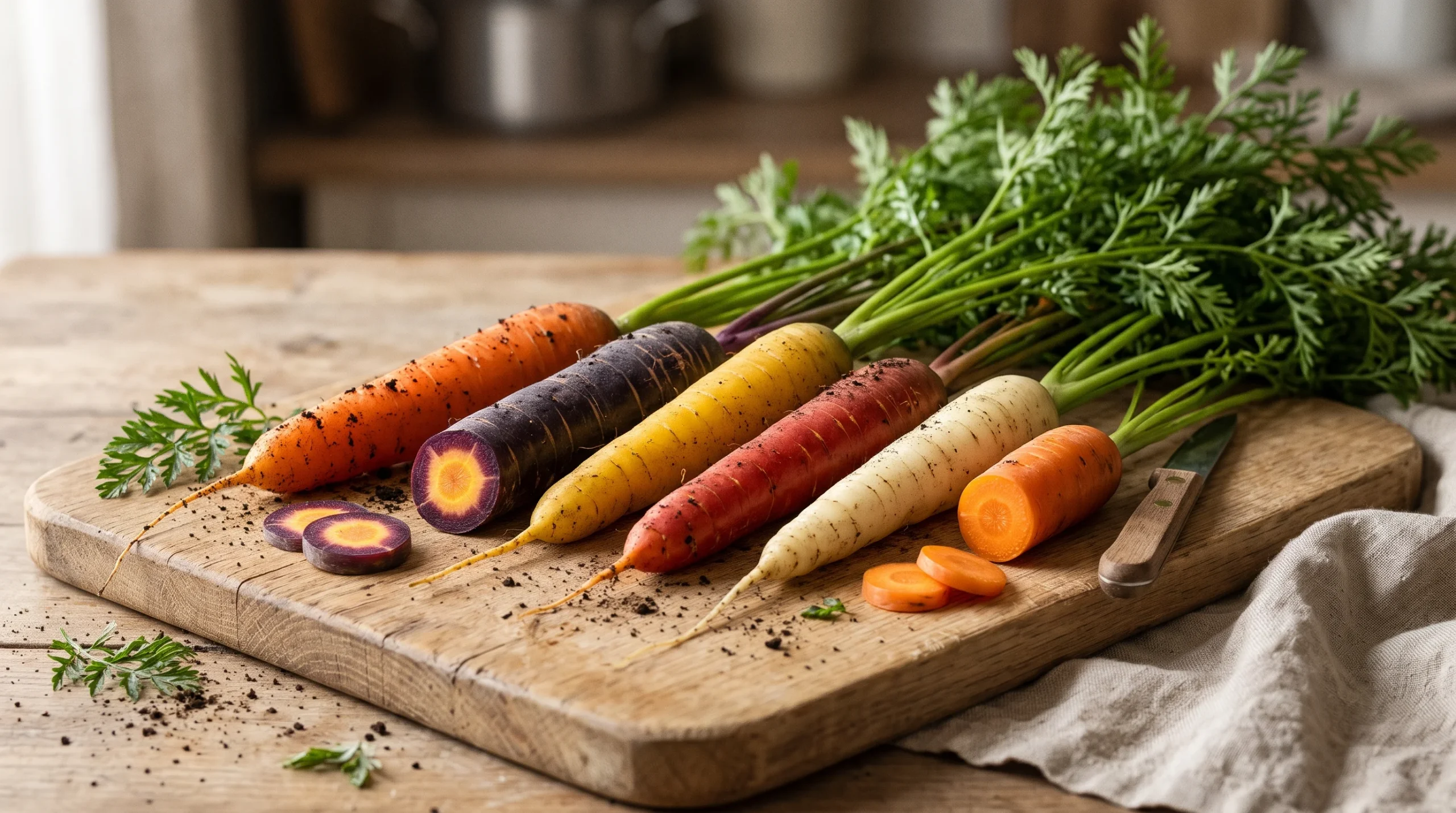
Five freshly harvested carrots rest on a rustic wooden cutting board. One glows bright orange, another is deep purple, a third shines golden yellow, a fourth is crimson red, and the last is creamy white. Their leafy tops still carry traces of garden soil, but their striking colors make them look like an artist’s collection rather than an ordinary vegetable harvest.
The surprising explanation lies inside their cells.
Different carrot colors result largely from naturally occurring plant pigments, including carotenoids and anthocyanins. Each pigment contributes particular shades, while the carrot’s genetic makeup influences where and how much of these compounds accumulate.
Although orange carrots dominate modern grocery stores, they represent only part of a much older and more colorful agricultural history.
From ancient cultivation to modern plant breeding, the rainbow of carrots reveals a fascinating connection between genetics, food science, and home gardening.
Table of Contents
- Why Carrots Come in Different Colors
- Orange Carrots and Their Carotenoid Pigments
- Purple Carrots and Anthocyanins
- Yellow Carrots and Lutein
- Red Carrots and Lycopene
- White Carrots and Low Pigment Levels
- Why Some Carrots Have Two Colors Inside
- Were Carrots Always Orange?
- Do Different Carrot Colors Taste Different?
- How to Grow Colorful Carrots
- Carrot Colors and Pigments at a Glance
- Frequently Asked Questions
Why Carrots Come in Different Colors
The cultivated carrot, Daucus carota subsp. sativus, belongs to the parsley family, Apiaceae.
Its familiar edible portion is an enlarged storage taproot. During growth, the plant stores carbohydrates and other compounds in this root.
The color of the storage root depends primarily on genetics.
The role of plant pigments
Two important pigment groups explain much of the variation among cultivated carrots.
Carotenoids are responsible for many yellow, orange, and red shades.
Anthocyanins produce purple, violet, and sometimes nearly black appearances.
Different carrot varieties possess genetic differences that influence pigment production, accumulation, and distribution.
Environmental conditions can affect pigment concentrations, but they generally do not override a cultivar’s inherited color characteristics.
A purple carrot remains genetically predisposed to produce its characteristic pigments, even when grown beside an orange variety.
This diversity makes carrots an accessible example of how plant genetics shape the appearance of everyday foods.
Orange Carrots and Their Carotenoid Pigments
Orange carrots owe their familiar appearance primarily to carotenoid pigments.
Two especially important compounds are beta-carotene and alpha-carotene.
These pigments accumulate in specialized structures within plant cells.
Why beta-carotene matters
Beta-carotene absorbs certain wavelengths of visible light, contributing to the orange appearance of carrot tissue.
It also functions as a provitamin A carotenoid.
This means the human body can convert some dietary beta-carotene into vitamin A, which supports normal vision and other essential physiological functions.
Alpha-carotene can also contribute to vitamin A intake.
However, nutrient concentrations vary among carrot cultivars, and absorption depends on food preparation and the overall diet.
How orange carrots became common
Orange-rooted cultivars became especially prominent through European cultivation and selection.
Over time, growers favored varieties with desirable root color, shape, flavor, and agricultural performance.
Modern orange carrots are the result of generations of plant selection rather than a single documented invention.
Their popularity reflects both their visual appeal and their suitability for widespread production.
Purple Carrots and Anthocyanins
Purple carrots can range from reddish violet to such a deep purple that their surfaces appear almost black.
Their distinctive appearance comes primarily from anthocyanins.
These water-soluble pigments also contribute to the colors of blueberries, red cabbage, and many flowers.
Where purple pigments accumulate
In carrots, anthocyanins may accumulate in the outer root tissues, inner tissues, or both.
Some purple varieties have intensely colored surfaces but reveal bright orange or yellow centers when sliced.
Others contain purple pigmentation throughout much of the root.
The exact pattern depends on the cultivar’s genetics.
Purple does not automatically mean healthier
Anthocyanins are widely studied plant compounds, but their presence alone does not establish that every purple carrot is nutritionally superior to every orange, yellow, or red variety.
Nutritional composition depends on numerous factors, including cultivar, growing conditions, storage, and preparation.
Purple carrots are valuable for their diversity, appearance, and distinctive pigment composition without requiring exaggerated health claims.
Yellow Carrots and Lutein
Yellow carrots display shades ranging from pale lemon to rich golden yellow.
Their coloration is associated with carotenoids known as xanthophylls, particularly lutein.
Understanding lutein
Lutein is a yellow carotenoid found in many plants.
It differs chemically from beta-carotene and does not serve as a vitamin A precursor.
In yellow carrots, the balance of lutein and other carotenoids contributes to the final root color.
Why yellow carrots look different
Orange carrots typically accumulate substantial amounts of orange carotenoids.
Yellow varieties generally have a different pigment profile, with yellow carotenoids playing a more prominent role.
However, no carrot color is determined by one compound in every cultivar.
Yellow carrots may contain several carotenoids in varying concentrations.
Their golden appearance illustrates how differences in pigment composition can produce visually distinct vegetables within the same species.
Red Carrots and Lycopene
Red carrots contain carotenoid pigments that create reddish-orange to deep red roots.
One especially important pigment is lycopene.
Lycopene is also responsible for much of the red coloration in ripe tomatoes.
How lycopene creates red coloration
Lycopene belongs to the carotenoid family, but its chemical structure differs from beta-carotene.
These structural differences affect how the pigment absorbs visible light.
When lycopene accumulates in carrot tissues, it can contribute to a distinctly red appearance.
The role of genetics
Red carrot varieties possess inherited characteristics that influence carotenoid production and accumulation.
Their color does not come from absorbing red substances from garden soil.
Although environmental conditions can influence plant growth and pigment levels, the ability to produce a red storage root is primarily genetic.
Red carrots demonstrate how changes in carotenoid composition can transform the appearance of a familiar crop.
White Carrots and Low Pigment Levels
White carrots are cultivated carrots that accumulate relatively little of the pigments responsible for strongly colored roots.
Their appearance ranges from ivory to creamy white.
Why the roots appear pale
Compared with strongly pigmented varieties, white carrots generally contain low concentrations of visible carotenoid and anthocyanin pigments in their storage roots.
Without substantial orange, yellow, red, or purple pigmentation, the underlying root tissue appears pale.
Are white carrots nutritious?
White carrots still contain water, carbohydrates, dietary fiber, and other naturally occurring nutrients.
They may provide less provitamin A carotenoid than typical orange carrots, but that does not make them nutritionally worthless.
Their composition depends on the particular cultivar and growing conditions.
White carrots also contribute visual diversity to vegetable gardens and mixed harvests.
They should not be confused with parsnips, which are a separate crop species.
Why Some Carrots Have Two Colors Inside
One of the most surprising features of colorful carrots becomes visible when a root is sliced.
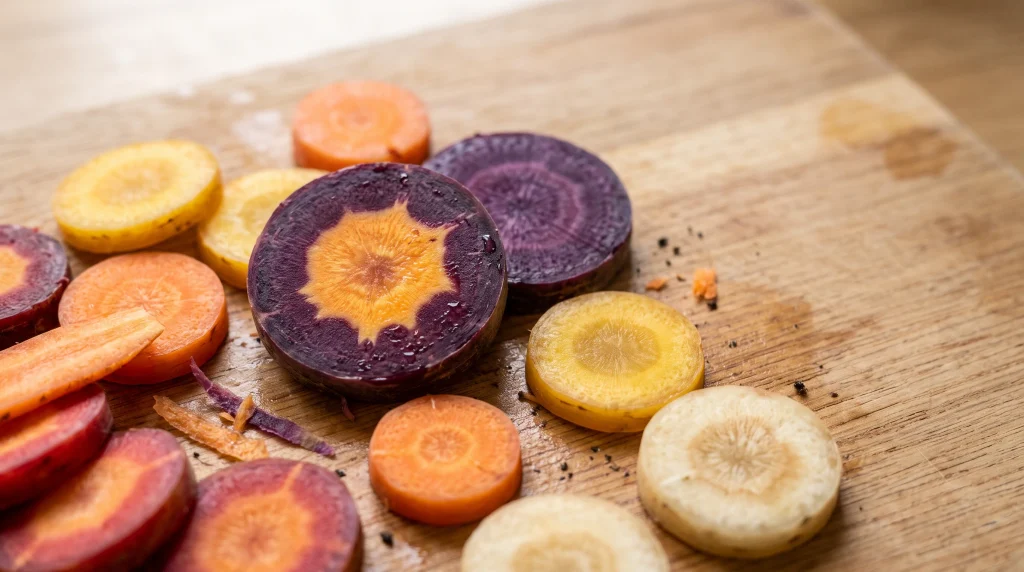
A carrot with dark purple skin may contain a bright orange or yellow interior.
Other varieties display rings, contrasting centers, or more uniformly colored flesh.
Different tissues, different pigments
Carrot roots contain several anatomical regions.
The outer phloem-associated storage tissue and the inner xylem-associated core can differ in pigment accumulation.
In some purple cultivars, anthocyanins are concentrated in outer tissues while carotenoids remain prominent toward the center.
This creates striking contrasts between the surface and interior.
Genetics determines the pattern
Pigment-related genes can be expressed differently across root tissues.
As a result, two carrots with similar purple exteriors may reveal very different patterns when cut.
These differences are inherited characteristics of particular varieties.
They also make colorful carrots especially interesting for botanical observation and culinary presentation.
Were Carrots Always Orange?
The history of cultivated carrots is more colorful than their modern supermarket appearance suggests.
Historical and genetic research indicates that early cultivated carrots included purple and yellow forms.
Carrot domestication is commonly associated with regions of Central and Western Asia.
Early cultivated carrots
The ancestors of modern carrots were selected over many generations for enlarged edible roots.
Early cultivated forms differed from the familiar orange varieties commonly sold today.
Purple and yellow carrots were important parts of this history.
The rise of orange varieties
Orange-rooted carrots became increasingly prominent in Europe during the early modern period.
Dutch horticulture played an important role in their development and spread.
However, the popular story that orange carrots were invented solely to honor a Dutch royal family oversimplifies the historical evidence.
Carrot domestication involved gradual selection, movement of cultivated varieties, and changing agricultural preferences.
Modern plant breeding continues this process by developing varieties with different colors, shapes, textures, and growing characteristics.
Do Different Carrot Colors Taste Different?
Different colored carrots can have noticeable flavor differences, but color alone is not a reliable predictor of taste.
Carrot flavor develops through interactions among sugars, aromatic compounds, texture, and growing conditions.
Sweetness and bitterness
Carrots contain naturally occurring sugars, including sucrose, glucose, and fructose.
Their concentrations vary with cultivar and maturity.
Aromatic compounds, including certain terpenes, also contribute to the characteristic carrot flavor.
Depending on their concentrations, these compounds may create earthy, herbal, or slightly bitter notes.
Why variety matters more than color
Two orange carrot cultivars can taste noticeably different.
Similarly, one purple carrot may taste sweeter than another purple variety grown under different conditions.
Root age, water availability, temperature, and storage practices can also affect eating quality.
Cooking changes flavor
Roasting concentrates flavors as moisture is lost and cooking reactions develop.
Boiling and steaming soften carrot tissues and alter their sensory characteristics.
For a colorful harvest, tasting several varieties raw and cooked is a practical way to appreciate their differences.
How to Grow Colorful Carrots
Growing colorful carrots follows the same basic principles as cultivating conventional orange varieties.
The most important starting point is choosing seeds from cultivars that produce the desired root colors.
Choose suitable varieties
Look for clearly labeled purple, yellow, red, white, or mixed-color carrot seeds.
Read the seed packet for expected root length, maturity period, and recommended growing season.
Short-rooted varieties may be useful in shallower growing beds.
Prepare loose soil
Carrots develop best in loose, well-drained soil that allows roots to expand.
Compacted soil, stones, and hard layers can interfere with root development.
Prepare the growing area by removing large stones and loosening compacted sections.
Avoid excessive nitrogen fertilization, which can encourage leafy growth at the expense of desirable root development.
Sow seeds directly
Carrots are generally direct-seeded because transplanting can disturb their developing taproots.
Sow according to the seed packet’s depth and spacing recommendations.
Keep the upper soil layer consistently moist during germination.
Carrot seeds can germinate slowly, particularly when soil conditions are unfavorable.
Thin seedlings carefully
Crowded seedlings compete for light, water, and root space.
Thin plants to the spacing recommended for the selected cultivar.
Adequate spacing helps roots develop their intended shape and size.
Control weeds and maintain moisture
Young carrot seedlings compete poorly with vigorous weeds.
Remove weeds carefully to avoid disturbing developing roots.
Maintain reasonably even soil moisture throughout growth.
Severe moisture fluctuations can contribute to root cracking and irregular development.
Harvest at suitable maturity
Harvest timing depends on the cultivar and growing conditions.
Check the expected maturity information on the seed packet.
Carrots harvested too early may be small, while overly mature roots can develop less desirable textures.
Store carrots properly
Remove leafy tops before extended storage to reduce moisture loss from the roots.
Store sound, unwashed or appropriately cleaned carrots under cool, humid conditions suitable for fresh produce.
Keep them away from ethylene-producing fruits when possible, since ethylene exposure can contribute to bitter flavor development.
Most importantly, remember that soil amendments cannot reliably turn an orange carrot into a purple carrot. The inherited genetics of the variety determine its basic color potential.
Carrot Colors and Pigments at a Glance
| Carrot color | Main associated pigment | Typical visual characteristics | Important scientific note |
|---|---|---|---|
| Orange | Beta-carotene and alpha-carotene | Bright orange to deep orange | Contains provitamin A carotenoids |
| Purple | Anthocyanins | Violet, deep purple, or nearly black | Pigment distribution varies among root tissues |
| Yellow | Lutein and other yellow carotenoids | Pale yellow to golden | Carotenoid profiles differ among cultivars |
| Red | Lycopene and other carotenoids | Reddish-orange to deep red | Red coloration is genetically influenced |
| White | Low levels of strongly colored pigments | Ivory to creamy white | Still contains fiber and other nutrients |
The table summarizes common pigment associations rather than exclusive chemical compositions.
Individual carrot cultivars may contain multiple pigments, even when one color dominates their appearance.
Frequently Asked Questions
Why are some carrots purple?
Purple carrots accumulate anthocyanin pigments in their storage roots. Their genetic makeup determines how much pigment develops and whether it appears throughout the root or mainly in outer tissues.
Are purple carrots naturally occurring?
Yes. Purple-rooted carrots are part of the historical diversity of cultivated carrots. Their coloration comes from naturally produced plant pigments rather than artificial coloring.
Do yellow carrots taste different from orange carrots?
They can, but flavor depends on cultivar, sugar content, aromatic compounds, maturity, and growing conditions. Yellow coloration alone does not guarantee a particular flavor.
Can soil change a carrot’s color?
Soil conditions can influence plant growth and pigment concentrations, but the fundamental color of a carrot variety is primarily genetic. Soil amendments cannot reliably change an orange cultivar into a purple one.
Which carrot colors are easiest to grow?
Growing difficulty depends more on the selected cultivar and local conditions than on root color. Choose varieties suited to your climate, soil, and growing season.
Conclusion
A harvest of orange, purple, yellow, red, and white carrots reveals the remarkable diversity hidden within an everyday vegetable.
These different carrot colors arise primarily from inherited differences in pigment production, including carotenoids and anthocyanins.
Their history also reflects centuries of cultivation, selection, and adaptation.
Although color can provide clues about pigment composition, it does not determine every aspect of flavor or nutritional value.
For home gardeners, growing several carrot varieties offers an opportunity to explore plant genetics firsthand while enjoying a visually striking harvest.
The next time colorful carrots appear on a cutting board, their rainbow of shades can serve as a reminder of the fascinating biology behind ordinary garden crops.
Internal Sources
- Carrots Sweeter After Frost: Why Cold Weather Changes Their Flavor
- 14 Vegetables to Grow in 5-Gallon Buckets
External Sources
- Curaba et al. (2023) — Population Genomics Identifies Genetic Signatures of Carrot Domestication and Improvement and Uncovers the Origin of High-Carotenoid Orange Carrots.
Published in Nature Plants, this study analyzed 630 carrot accessions. It provides genetic evidence about carrot domestication and the selection of orange roots rich in alpha-carotene and beta-carotene. Read the full scientific paper - Butler (2019) — Purple Is the New Orange: Anthocyanin Regulation Coming Together in Carrot.
Published in Plant Physiology, this article discusses the genetic regulation of anthocyanin accumulation and why purple pigmentation differs among carrot tissues. Read the scientific article - Ellison et al. (2018) — Carotenoid Presence Is Associated with the Or Gene in Domesticated Carrot.
Published in Genetics, this research examines genetic variation associated with carotenoid accumulation in carrot roots and helps explain differences among orange, yellow, and white cultivars. Read the research paper - University of Minnesota Extension — Growing Carrots and Parsnips in Home Gardens.
Provides practical guidance on soil preparation, direct seeding, germination, thinning, watering, harvesting, and storage. This reference supports the article’s home-gardening instructions. Read the university gardening guide