
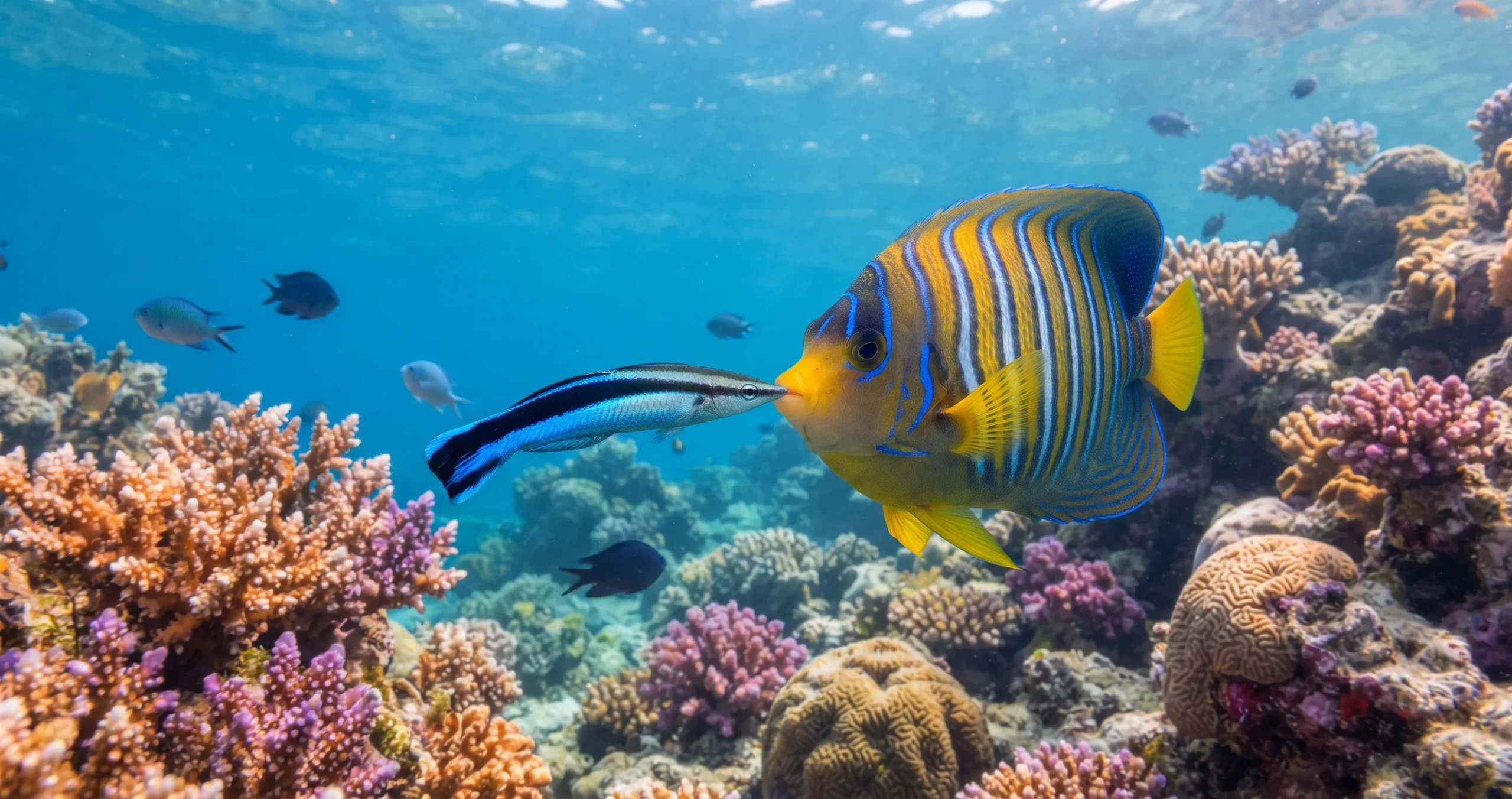
Coral reefs are home to some of nature’s most fascinating partnerships. Among the most remarkable is the relationship between tiny cleaner wrasses and the much larger fish that visit them for cleaning.
A cleaner wrasse cleaning station is a designated area of a reef where fish gather to have external parasites and other material removed from their bodies. The cleaner receives food, while its visitors benefit from parasite removal.
However, this underwater partnership is more complicated than it first appears. Cooperation, competition, communication, and even behaviors that scientists describe as cheating all influence these remarkable interactions.
Understanding cleaner wrasses reveals why even the smallest reef inhabitants can have a surprisingly important ecological role.
Table of Contents
- What Are Cleaner Wrasses?
- How Does a Cleaner Wrasse Cleaning Station Work?
- What Do Cleaner Wrasses Eat?
- How Client Fish Behave During Cleaning
- Cooperation and Mutualism on Coral Reefs
- Why Cleaner Wrasses Sometimes Cheat
- How Client Fish Respond to Cheating
- Why Cleaner Wrasses Matter to Reef Ecosystems
- Where to See Cleaner Wrasses in the Wild
- Cleaner Wrasses and Aquarium Keeping
- Frequently Asked Questions
What Are Cleaner Wrasses?
Cleaner wrasses are small marine fish belonging to the wrasse family, Labridae. Several species in the genus Labroides are particularly well known for removing external parasites from other reef fish.
The bluestreak cleaner wrasse (Labroides dimidiatus) is one of the best-studied examples. It inhabits tropical marine environments across the Indo-Pacific region, where it regularly interacts with a wide variety of other fish.
Adults typically grow to about four inches in length, although individual sizes vary. Their slender bodies feature a distinctive dark stripe extending along the sides, accompanied by lighter and blue-colored markings.
Despite their relatively small size, cleaner wrasses regularly approach fish much larger than themselves, including species that could potentially eat them.
Their specialized appearance and behavior help visiting fish recognize their cleaning role.
How Does a Cleaner Wrasse Cleaning Station Work?
A cleaner wrasse cleaning station is not a physical structure built by fish. Instead, it is a recognizable location within a reef where cleaning interactions regularly occur.
These locations may be situated near coral formations, rocky outcrops, crevices, or sheltered areas that visiting fish can easily approach.
Individual cleaner wrasses establish familiar territories and attract potential clients through distinctive swimming movements.
Advertising the cleaning service
Cleaner wrasses often perform a recognizable bobbing or dancing movement. Their contrasting body markings and characteristic swimming patterns help advertise their presence.
Other reef fish can recognize these signals and approach the station when they are receptive to cleaning.
This communication allows different species to participate in an interaction that can benefit both individuals.
Welcoming visiting fish
When a client arrives at a cleaner wrasse cleaning station, it may slow down, remain relatively stationary, or adopt an unusual body position.
The cleaner then approaches and examines different areas of the client’s body, searching for accessible food.
Depending on the client species, this inspection can include the skin, fins, mouth, and areas around the gills.
Completing the cleaning interaction
Once an interaction ends, the client swims away. The cleaner may then approach another visitor or resume its advertising display.
Several fish sometimes gather around the same location, creating the appearance of an underwater waiting area. However, interactions do not necessarily follow a strict first-come, first-served order.
The timing depends on client behavior, competition, and the cleaner’s feeding decisions.
What Do Cleaner Wrasses Eat?
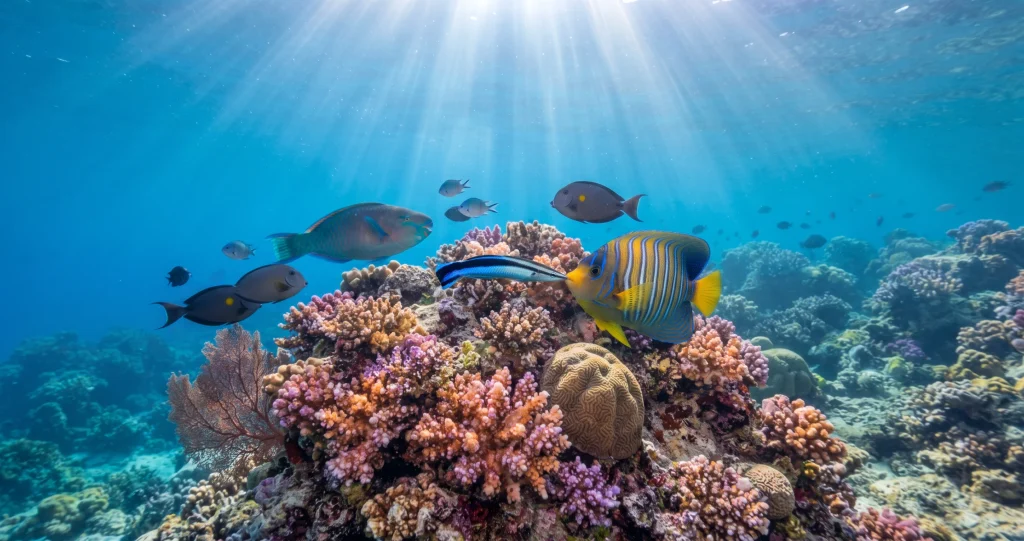
Cleaner wrasses obtain much of their food by examining the surfaces of other marine animals.
Their specialized feeding behavior allows them to exploit resources that many other reef fish cannot access in the same way.
External parasites
External parasites, also called ectoparasites, are an important component of the cleaner wrasse diet.
These include small parasitic crustaceans, particularly gnathiid isopod larvae, which temporarily attach to fish and feed on them.
By consuming these organisms, cleaner wrasses obtain nourishment while potentially reducing the parasite burden of their clients.
Mucus and other organic material
Cleaner wrasses may also consume mucus, loose scales, and other material from the surfaces of their clients.
However, mucus is not simply unwanted debris. It forms an important protective layer on a fish’s body and contributes to its defense against environmental challenges.
Removing healthy mucus may therefore impose costs on the client rather than provide a benefit.
How Client Fish Behave During Cleaning
Fish visiting a cleaner wrasse cleaning station often display behaviors that are noticeably different from their normal swimming activities.
Instead of continually moving around the reef, they may remain almost motionless, allowing the cleaner to approach sensitive areas of their bodies.
Adopting a cleaning posture
Some client fish tilt their bodies, spread their fins, or change their orientation to make particular surfaces more accessible.
Others may open their mouths or gill covers, allowing the cleaner to inspect areas that would otherwise be difficult to reach.
These behaviors vary among species and help coordinate the interaction between cleaner and client.
Temporary changes in coloration
Certain reef fish change their coloration during cleaning interactions.
These changes may help communicate their willingness to participate or make particular areas of their bodies more visible. However, the precise function of color changes varies among species.
Large predators also visit cleaning stations
One of the most surprising aspects of this behavior is that predatory fish, including some groupers, allow small cleaner wrasses to approach them.
Rather than treating the cleaner as ordinary prey, these larger fish may remain still while their bodies are inspected.
This tolerance is remarkable, although cleaning relationships do not guarantee complete protection from predation.
Cooperation and Mutualism on Coral Reefs
The relationship between cleaner wrasses and their clients is a classic example of mutualism, an ecological interaction in which both participants can benefit.
At a cleaner wrasse cleaning station, the cleaner obtains food while the client may experience a reduction in external parasites.
Neither participant needs to understand the interaction in human terms. Natural selection can favor behaviors that improve survival and reproductive opportunities over successive generations.
Benefits for both participants
| Cleaner wrasse | Client fish |
|---|---|
| Access to food | Removal of external parasites |
| Regular feeding opportunities | Inspection of difficult-to-reach areas |
| Repeated interactions with clients | Potential reduction in parasite burden |
| Access to different fish species | Potential improvements in physical condition |
The benefits are not necessarily identical during every encounter. Their value depends on parasite availability, client behavior, and the cleaner’s feeding choices.
Why Cleaner Wrasses Sometimes Cheat
Although cleaning relationships can benefit both participants, they also involve conflicting interests.
Scientists use the term cheating to describe situations in which cleaners obtain a feeding benefit at the expense of their clients.
Eating protective mucus instead of parasites
A cleaner wrasse may consume healthy mucus rather than remove an external parasite.
While this provides food for the cleaner, it can interfere with the client’s protective surface layer. This creates a conflict between the cleaner’s immediate feeding preferences and the benefits expected by visiting fish.
Recognizing an unwanted bite
During observations at a cleaner wrasse cleaning station, researchers sometimes record sudden jolting movements from client fish.
Such reactions can indicate an unpleasant bite, although a visible jolt alone does not identify precisely what the cleaner consumed.
Scientists study these behaviors using controlled experiments and observations of natural reef interactions.
How Client Fish Respond to Cheating
Cleaner wrasses do not have unlimited opportunities to exploit their clients. Visiting fish can respond in ways that influence future cleaning behavior.
Leaving the cleaning station
Fish with access to alternative cleaners may end an unfavorable interaction and visit another location.
For the cleaner, losing a client means losing a potential feeding opportunity. This creates an incentive for behavior that encourages visitors to remain or return.
Chasing the cleaner
Some territorial fish have limited access to alternative cleaning locations. Instead of changing partners, they may chase the cleaner following an unwanted bite.
Physical contact and cooperation
Cleaner wrasses sometimes gently touch clients with their fins.
This behavior, known as tactile stimulation, may help maintain interactions and reduce tension between the participants.
A cleaner wrasse cleaning station therefore represents more than a feeding location. It provides scientists with a natural opportunity to investigate how cooperation can persist despite conflicting interests.
Why Cleaner Wrasses Matter to Reef Ecosystems
The importance of cleaner wrasses extends beyond individual feeding encounters.
Their activities can influence the behavior, distribution, and physical condition of other reef fish.
Supporting reef fish communities
A long-term experiment published in PLOS ONE investigated the consequences of removing cleaner wrasses from small coral reefs for about eight and a half years.
Researchers found differences in fish size, abundance, and species richness between reefs with cleaners and those where cleaners had been removed.
These findings demonstrate that a relatively small fish can influence the composition of surrounding reef communities.
Influencing habitat use
Fish may visit particular areas because cleaning services are available there.
The presence of a cleaner wrasse cleaning station can therefore influence local movement patterns and habitat selection, connecting different parts of a reef through repeated interactions.
Maintaining ecological relationships
Healthy coral reefs depend on complex relationships involving predators, herbivores, parasites, corals, microorganisms, and numerous other organisms.
Cleaner wrasses contribute to this network, but they cannot protect an entire reef from every environmental threat.
Rising ocean temperatures, coral bleaching, pollution, destructive fishing practices, and habitat degradation require broader conservation efforts.
Protecting reef biodiversity means preserving ecological relationships as well as individual species.
Where to See Cleaner Wrasses in the Wild
Bluestreak cleaner wrasses occur throughout extensive portions of the tropical Indo-Pacific. Their natural distribution includes the Red Sea, Indian Ocean, and many western and central Pacific reef systems.
Common regions for observing cleaner wrasses
| Region | Typical habitat |
|---|---|
| Great Barrier Reef, Australia | Coral formations and sheltered reef areas |
| Red Sea | Tropical coral reefs and rocky formations |
| Maldives | Reef slopes and coral lagoons |
| Indonesia | Biodiverse tropical reef systems |
| Philippines | Coastal coral reefs |
| Fiji | Tropical reef environments |
Snorkelers and scuba divers may encounter cleaning stations in these regions, depending on local habitat, species distribution, and environmental conditions.
How to recognize a cleaning station
Look for a small, slender fish repeatedly swimming around a particular coral formation.
Larger fish may approach the same location, pause, and allow the smaller fish to inspect their bodies.
Remaining still at a comfortable distance provides an opportunity to observe these interactions without disturbing them.
Avoid touching coral, chasing fish, feeding wildlife, or attempting to recreate natural cleaning behavior for photographs.
Cleaner Wrasses and Aquarium Keeping
The specialized feeding behavior of cleaner wrasses makes them challenging animals to maintain in home aquariums.
Wild individuals obtain food through frequent interactions with numerous client fish. An ordinary aquarium may not provide sufficient feeding opportunities or appropriate environmental conditions.
Some individuals accept prepared foods, but successful adaptation is not guaranteed. Scientific literature has documented difficulties maintaining this species under home aquarium conditions. PubMed Central (PMC)
Cleaner wrasses should not be purchased as a substitute for appropriate disease prevention, quarantine, water quality management, or veterinary care.
For many aquarium enthusiasts, observing these fish in their natural environment or at professionally managed public aquariums is the more responsible choice.
Frequently Asked Questions
What is a cleaner wrasse cleaning station?
It is a particular location on a coral reef where cleaner wrasses regularly inspect visiting fish and consume external parasites and other material.
What do cleaner wrasses eat?
They primarily obtain food from their clients, including external parasites. They may also consume mucus, scales, and other organic material.
Why do large fish allow cleaner wrasses inside their mouths?
Cleaning interactions can provide access to parasites in difficult-to-reach areas. Some large fish adopt special postures that allow cleaners to inspect their mouths and nearby surfaces.
Do cleaner wrasses ever cheat?
Yes. Researchers describe feeding on healthy client mucus instead of removing parasites as cheating because it benefits the cleaner at a potential cost to the client.
Do predators eat cleaner wrasses?
Predatory fish often tolerate cleaners during cleaning interactions. However, this relationship does not make cleaner wrasses completely immune to predation.
Are cleaner wrasses the only fish that clean other fish?
No. Certain gobies and other fish also perform cleaning services. Some marine shrimp participate in similar relationships.
Can cleaner wrasses cure aquarium fish diseases?
No. Removing some external parasites does not eliminate every parasite, infection, or disease. Appropriate aquarium management and professional veterinary advice remain important.
Why are cleaner wrasses important to coral reefs?
Their activities can influence parasite burdens, fish behavior, growth, and local biodiversity. Research has demonstrated that removing cleaners can alter reef fish communities.
Conclusion
A cleaner wrasse cleaning station provides an extraordinary example of cooperation in the natural world.
Through specialized feeding behavior, recognizable signals, and repeated interactions, these small fish participate in relationships that can benefit many other reef inhabitants.
Their behavior also demonstrates that cooperation does not require the complete absence of conflict. Client fish can respond to unfavorable interactions, helping maintain relationships that offer mutual benefits.
Protecting cleaner wrasses and their coral reef habitats helps preserve the intricate ecological connections that make marine ecosystems so diverse.
External Sources
1. Common Cleanerfish
Explain cleaner wrasse identification, natural distribution, feeding habits, and cleaning station behavior. Australian Museum, https://australian.museum/learn/animals/fishes/common-cleanerfish-labroides-dimidiatus/?utm_source
2. Punishment and Partner Switching Cause Cooperative Behaviour in a Cleaning Mutualism
Provide peer-reviewed scientific evidence explaining cooperation, cheating, client responses, and partner selection during cleaning interactions. Biology Letters — PubMed Central, National Library of Medicine. https://pmc.ncbi.nlm.nih.gov/articles/PMC1626376/?utm_source
3. Long-Term Effects of the Cleaner Fish Labroides dimidiatus on Coral Reef Fish Communities
Demonstrate how the presence or absence of cleaner wrasses can influence reef fish abundance, growth, and species diversity. PLOS ONE — Peer-reviewed scientific research. https://journals.plos.org/plosone/article?id=10.1371%2Fjournal.pone.0021201&utm_source