
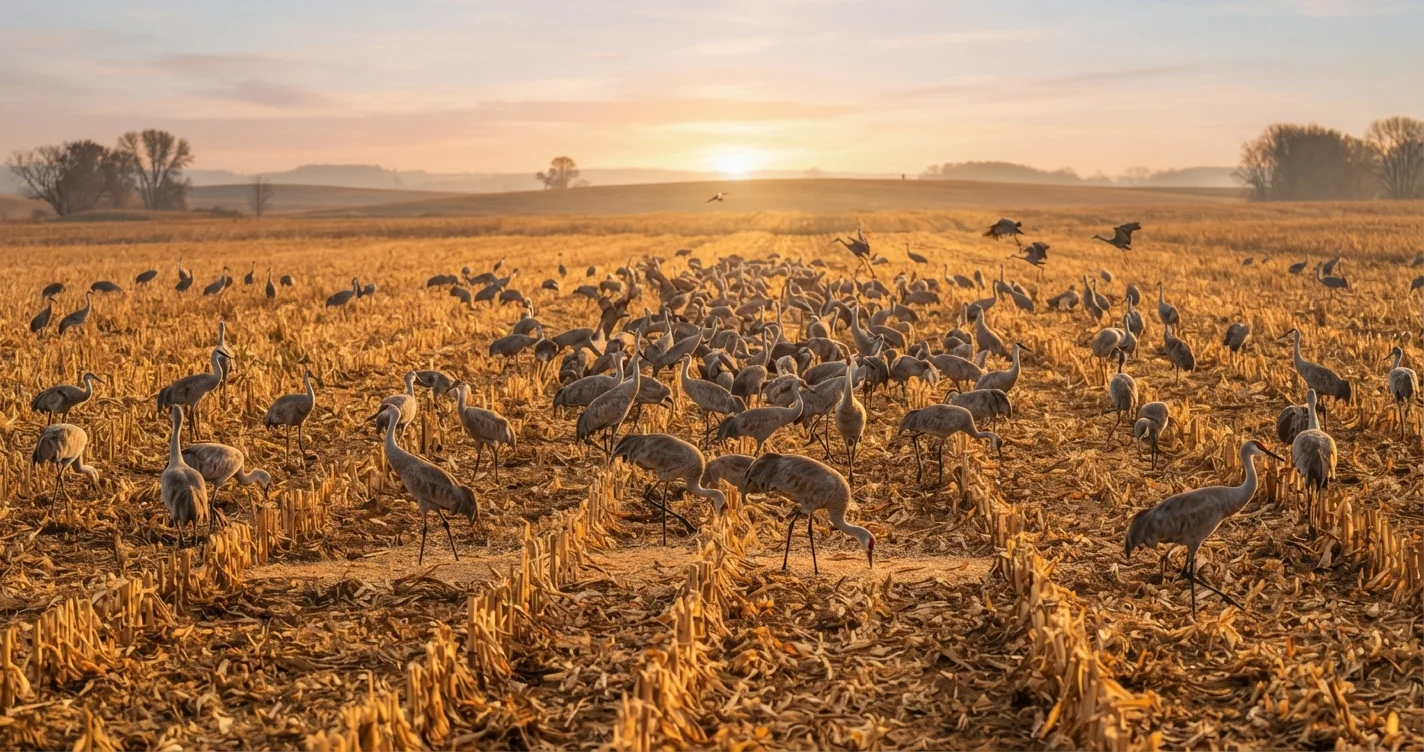
As autumn temperatures drop and harvested fields stretch across the American countryside, one of North America’s most remarkable wildlife migrations begins. The seasonal movement of sandhill cranes brings large flocks of gray, long-legged birds across open skies, agricultural landscapes, and peaceful wetlands.
Understanding the sandhill cranes migration reveals how these extraordinary birds travel, find food, protect their families, and survive changing seasonal conditions.
From their distinctive calls to their impressive evening gatherings, sandhill cranes offer unforgettable opportunities for wildlife observation. Fall is an especially rewarding time to discover their behavior and appreciate the importance of protecting their natural habitats.
Table of Contents
- What Are Sandhill Cranes?
- Understanding Sandhill Cranes Migration in Fall
- Major Sandhill Crane Migration Routes
- Why Sandhill Cranes Feed in Harvested Fields
- Why Sandhill Cranes Roost in Shallow Water
- Family Structure and Social Behavior
- Where to See Sandhill Cranes in Fall
- Best Time of Day to Watch Sandhill Cranes
- Responsible Wildlife Viewing Etiquette
- Sandhill Crane Conservation and Habitat Protection
- Frequently Asked Questions
What Are Sandhill Cranes?
The sandhill crane (Antigone canadensis) is a large, long-legged bird belonging to the crane family, Gruidae. It occurs across much of North America, with some populations also breeding in northeastern Asia.
Adult sandhill cranes are recognizable by their gray plumage, long necks, broad wings, and distinctive red forehead. Younger birds generally have browner feathers and lack the prominent red crown of mature adults.
Depending on their subspecies, sandhill cranes can stand roughly three to four feet tall and have wingspans of about six feet or more.
Their powerful, rolling calls frequently announce their presence before the birds themselves become visible. Unlike herons, which typically retract their necks during flight, cranes fly with their necks extended forward.
Understanding Sandhill Cranes Migration in Fall
The annual southward journey allows migratory sandhill cranes to reach areas where food and suitable resting habitats remain available throughout colder months.
Fall migration generally begins in late summer or early autumn in northern breeding regions. Depending on weather conditions and geographical location, migrating flocks may continue moving south through November and December.
Not every sandhill crane migrates. Some populations, including those in parts of Florida, Mississippi, and Cuba, are generally resident throughout the year.
For migratory populations, the journey involves a series of movements between feeding grounds, wetlands, and traditional resting areas.
What triggers fall migration?
Seasonal changes influence migration timing. Shortening daylight, colder temperatures, changing food availability, and weather conditions all contribute to the movement of migratory birds.
Cranes may remain at productive staging areas for extended periods before continuing south. Favorable winds and suitable weather can help them travel efficiently.
The timing of sandhill cranes migration therefore varies from one region and year to another.
Major Sandhill Crane Migration Routes
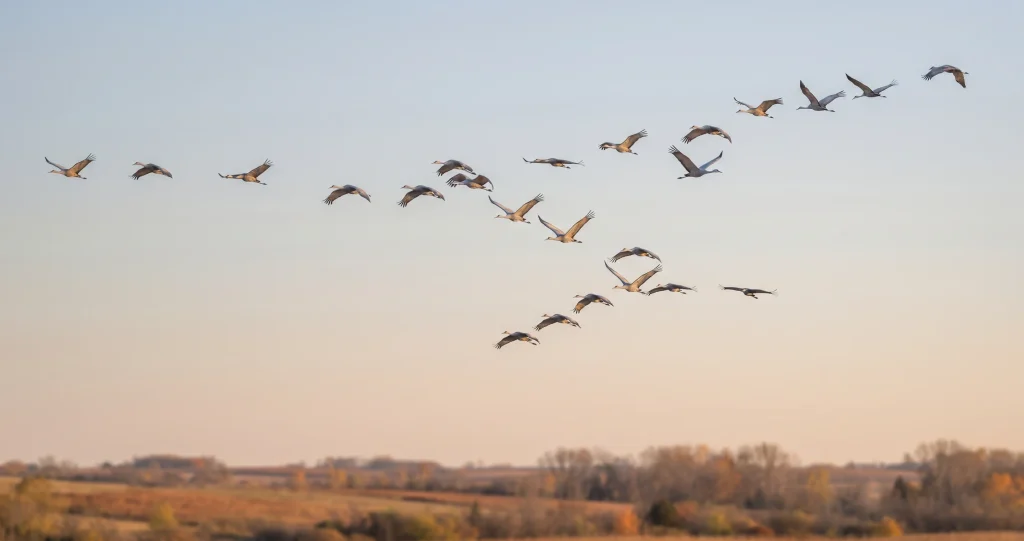
North American sandhill cranes follow several broad migration corridors rather than a single universal route. Their movements reflect the location of their breeding territories, wintering grounds, and suitable habitats along the way.
Central North American route
Many cranes breeding in Alaska, Canada, and northern portions of the continent migrate through the central Great Plains.
Their winter destinations include parts of Texas, New Mexico, and Mexico. Wetlands and agricultural landscapes provide important opportunities to rest and replenish energy reserves.
Although Nebraska’s Platte River is internationally recognized for crane migration, its largest concentrations generally occur during spring rather than fall.
Eastern migration route
Cranes from the Great Lakes region and eastern Canada travel through parts of the Midwest and southeastern United States.
Indiana, Kentucky, Tennessee, and Alabama provide important seasonal habitats. Some eastern cranes continue farther south to Georgia and Florida.
Western migration routes
Western populations travel through portions of the Pacific Northwest, California, the Intermountain West, and the southwestern United States.
California’s Central Valley and wetlands in Arizona and New Mexico provide important seasonal habitats for various crane populations.
These regional differences explain why sandhill cranes migration can be observed across much of the country at different times of autumn.
Why Sandhill Cranes Feed in Harvested Fields
One of the most familiar autumn sights in crane country is a flock searching for food among harvested crops.
Sandhill cranes are omnivorous. Their natural diet includes seeds, plant material, insects, worms, and various small animals.
Agricultural fields become especially useful during migration because harvested crops can leave accessible grain on the ground. Corn, wheat, and other grains may provide concentrated food resources.
Cranes walk slowly across fields, examining the ground and probing the soil with their pointed bills.
Building energy reserves
Migration requires substantial energy, and productive feeding areas allow birds to replenish reserves before continuing their journey.
Access to food near suitable nighttime roosts reduces the need for lengthy daily flights between feeding and resting locations. This relationship between agricultural land and wetlands is an important feature of sandhill cranes migration.
A typical autumn routine
Cranes frequently leave their nighttime roosts around morning, traveling to nearby feeding areas. They may spend much of the day foraging before gathering again toward evening.
Their movements vary according to weather, disturbance, food availability, and local landscape conditions.
Why Sandhill Cranes Roost in Shallow Water
At the end of the day, migrating cranes often gather in shallow wetlands, flooded areas, lakes, and river channels.
These nighttime resting locations are known as roosts. They provide conditions that can help cranes remain relatively secure while resting.
Protection from ground predators
Standing in open water can make it more difficult for terrestrial predators to approach unnoticed.
Movement through water may create splashing sounds or visible disturbances, giving resting cranes an opportunity to detect potential danger.
Open surroundings also provide better visibility than areas surrounded by dense vegetation.
Safety in groups
Large flocks provide more opportunities for individual birds to detect approaching disturbances.
Cranes resting together may benefit from the collective awareness of neighboring birds. However, roosting in water does not eliminate every risk from predators or human activity.
Suitable water depth
Cranes often favor water shallow enough to stand comfortably while maintaining stable footing. Preferred depths vary depending on the location, individual birds, and characteristics of the wetland.
Protecting these quiet nighttime gathering areas is essential to maintaining suitable conditions for sandhill cranes migration.
Family Structure and Social Behavior
Although sandhill cranes can gather in enormous flocks, their individual family relationships remain important throughout migration.
Adult cranes commonly form long-term pair bonds. Both parents participate in raising their young, protecting them from threats and guiding them through their first seasonal journey.
Young cranes learn from their parents
Juvenile sandhill cranes are sometimes called colts. During their first autumn, they generally travel alongside their parents, learning important migration routes, feeding locations, and resting areas.
These family groups often remain together throughout winter and into the following spring.
When watching a large flock, look for smaller groups consisting of two adults accompanied by one or two younger birds.
Communication and crane dancing
Sandhill cranes communicate through calls, body movements, and coordinated displays.
Their famous dancing behavior may include jumping, bowing, spreading their wings, and tossing small pieces of vegetation. Although dancing is associated with courtship, cranes also perform these movements outside the breeding season.
These interactions make sandhill cranes migration particularly interesting for wildlife photographers and birdwatchers.
Where to See Sandhill Cranes in Fall
Several regions across the United States offer excellent opportunities to observe migrating cranes. The best locations usually combine productive agricultural fields with protected wetlands.
1. Jasper-Pulaski Fish and Wildlife Area, Indiana
Northwestern Indiana is one of the most impressive destinations for fall crane watching.
Thousands of cranes gather around Jasper-Pulaski’s wetlands and agricultural fields. The largest gatherings typically occur around late November or early December.
2. Sherburne National Wildlife Refuge, Minnesota
Sherburne National Wildlife Refuge provides important autumn habitat for migrating cranes.
Viewing opportunities generally extend from September into November, with substantial gatherings often occurring around late October.
Visitors can observe cranes traveling between protected wetlands and surrounding feeding areas.
3. Wisconsin and the Great Lakes Region
Wisconsin’s wetlands, river valleys, and agricultural landscapes support migrating sandhill cranes throughout autumn.
The Wisconsin River region is particularly associated with seasonal crane gatherings. Parts of Michigan also offer opportunities to observe cranes preparing for their southward journey.
4. Bosque del Apache National Wildlife Refuge, New Mexico
This southwestern wildlife refuge attracts cranes arriving at their wintering grounds.
Late autumn and winter provide opportunities to observe large gatherings around managed wetlands and agricultural fields.
Early morning departures and evening returns are particularly memorable.
5. San Luis Valley, Colorado
Colorado’s San Luis Valley provides an important stopover along western migration routes.
Cranes use agricultural fields and protected wetlands during their seasonal movements. The Monte Vista and Alamosa national wildlife refuges are notable observation areas.
6. California’s Central Valley
California’s Central Valley supports wintering sandhill cranes arriving from northern breeding regions.
Wetland complexes and agricultural landscapes provide food and resting habitat. Late autumn offers opportunities to observe cranes settling into their winter routines.
Seasonal viewing guide
| Region | Typical viewing period |
|---|---|
| Minnesota | September–November |
| Wisconsin | September–November |
| Indiana | October–December |
| Colorado | September–November |
| New Mexico | November–February |
| California | October–February |
These periods are approximate. Check local wildlife refuge announcements before visiting, since migration timing and habitat conditions change annually.
Best Time of Day to Watch Sandhill Cranes
The most rewarding crane-watching experiences frequently occur around sunrise and sunset.
In the morning, cranes may leave their roosts in groups, calling as they fly toward feeding grounds. During the afternoon, agricultural fields often provide opportunities to observe feeding and social behavior.
Evening brings another impressive spectacle as birds return to their nighttime resting areas.
Soft morning and evening light also provides excellent conditions for wildlife photography without requiring artificial lighting or close approaches.
Responsible Wildlife Viewing Etiquette
Observing sandhill cranes migration should never interfere with the birds’ natural movements or resting routines.
Migrating birds need reliable opportunities to feed and conserve energy. Repeated disturbance can interrupt these activities and force unnecessary flights.
Follow these practical wildlife viewing guidelines:
- Use binoculars, spotting scopes, or telephoto lenses.
- Remain within designated observation areas.
- Avoid approaching feeding or resting cranes.
- Keep noise and sudden movements to a minimum.
- Never feed wild cranes.
- Avoid flying drones near flocks.
- Respect private farmland and wildlife refuge closures.
- Keep dogs away from sensitive wildlife areas.
If cranes repeatedly raise their heads, stop feeding, move away, or display signs of alarm in response to your presence, increase your distance.
Responsible observation allows visitors to enjoy natural behavior while helping preserve the quality of important migration habitats.
Sandhill Crane Conservation and Habitat Protection
Sandhill cranes are relatively widespread compared with many other crane species. However, their overall abundance does not mean that every population is secure.
Some resident populations face significant conservation challenges, including habitat loss and degradation.
The long-term success of sandhill cranes migration depends on suitable breeding grounds, productive stopover habitats, and reliable wintering areas.
Protecting wetlands
Wetlands are essential components of crane habitat. They provide resting areas, natural food resources, and breeding environments.
Drainage, development, altered river flows, and prolonged drought can reduce the availability of these important habitats.
Restoring natural water systems and protecting shallow wetlands can benefit cranes alongside many other wildlife species.
Supporting wildlife-friendly agricultural landscapes
Agricultural fields provide valuable seasonal food resources, but farming and wildlife conservation must coexist responsibly.
Cooperation between landowners, conservation organizations, and wildlife managers can help maintain suitable feeding areas while addressing agricultural conflicts.
Creating wildlife-friendly spaces at home
Although an ordinary backyard is unlikely to provide suitable habitat for large crane flocks, gardeners can still support local biodiversity.
Growing native vegetation, reducing unnecessary pesticide use, preserving natural shelter, and maintaining seasonal food resources can benefit smaller birds and other wildlife.
Small conservation efforts complement the broader protection of natural habitats across the landscape.
Frequently Asked Questions
When does sandhill cranes migration occur in fall?
Fall migration generally occurs between September and November, although some populations begin moving earlier or continue traveling into December.
Timing depends on geographical location, weather, and food availability.
Where do sandhill cranes go for winter?
Migratory populations spend winter in several regions, including California, Arizona, New Mexico, Texas, parts of the southeastern United States, and Mexico.
Different populations follow different routes.
Why do sandhill cranes sleep in water?
Open water provides a resting environment where approaching ground predators may be easier to detect.
Suitable wetlands also allow large groups of cranes to rest together with relatively little disturbance.
Do sandhill cranes migrate together as families?
Yes. Young cranes generally accompany their parents during their first autumn migration.
Individual family groups join larger gatherings while maintaining their social relationships.
Do sandhill cranes migrate at night?
Sandhill cranes commonly migrate during daylight, although they can also travel at night under certain circumstances.
Their daily movements between feeding grounds and roosting areas are particularly noticeable around sunrise and sunset.
Is fall or spring better for watching sandhill cranes?
Both seasons offer excellent viewing opportunities.
Spring is especially famous along Nebraska’s Platte River, while autumn provides impressive gatherings in Indiana, Minnesota, Wisconsin, and other migration regions.
Can I feed migrating sandhill cranes?
Feeding wild cranes is not recommended. Artificial feeding can alter their natural behavior, increase human-wildlife conflicts, and expose them to unnecessary risks.
Observe cranes from appropriate distances and allow them to find their own food.
Are sandhill cranes endangered?
Sandhill cranes as a species are not generally considered endangered. However, certain populations, including the Mississippi sandhill crane, require special conservation protection.
Local conservation status can vary.
Conclusion
The annual sandhill cranes migration is an extraordinary example of seasonal adaptation, family cooperation, and the connection between wildlife and natural landscapes.
From feeding in harvested fields to gathering in shallow wetlands at sunset, these remarkable birds depend on a network of suitable habitats throughout their journey.
Autumn provides excellent opportunities to observe their behavior across many regions of the United States. By following responsible viewing practices and supporting habitat conservation, visitors can appreciate this natural spectacle without disrupting the birds.
Protecting wetlands, agricultural landscapes, and migration corridors helps ensure that future generations can continue enjoying the remarkable sight and sound of sandhill cranes moving across the autumn sky.
External Sources
1. Sandhill Crane – Life History
Explain sandhill crane biology, feeding behavior, family structure, reproduction, and conservation. Cornell Lab of Ornithology
https://www.allaboutbirds.org/guide/Sandhill_Crane/lifehistory
2. Fall Crane Viewing
Identify important autumn migration regions, seasonal staging areas, and wintering locations across the United States. National Audubon Society
https://www.audubon.org/great-plains/news/fall-crane-viewing
3. Sandhill Crane
Provide scientifically grounded information about crane behavior, dietary habits, habitat threats, and conservation initiatives. International Crane Foundation
https://savingcranes.org/species/sandhill-crane/