
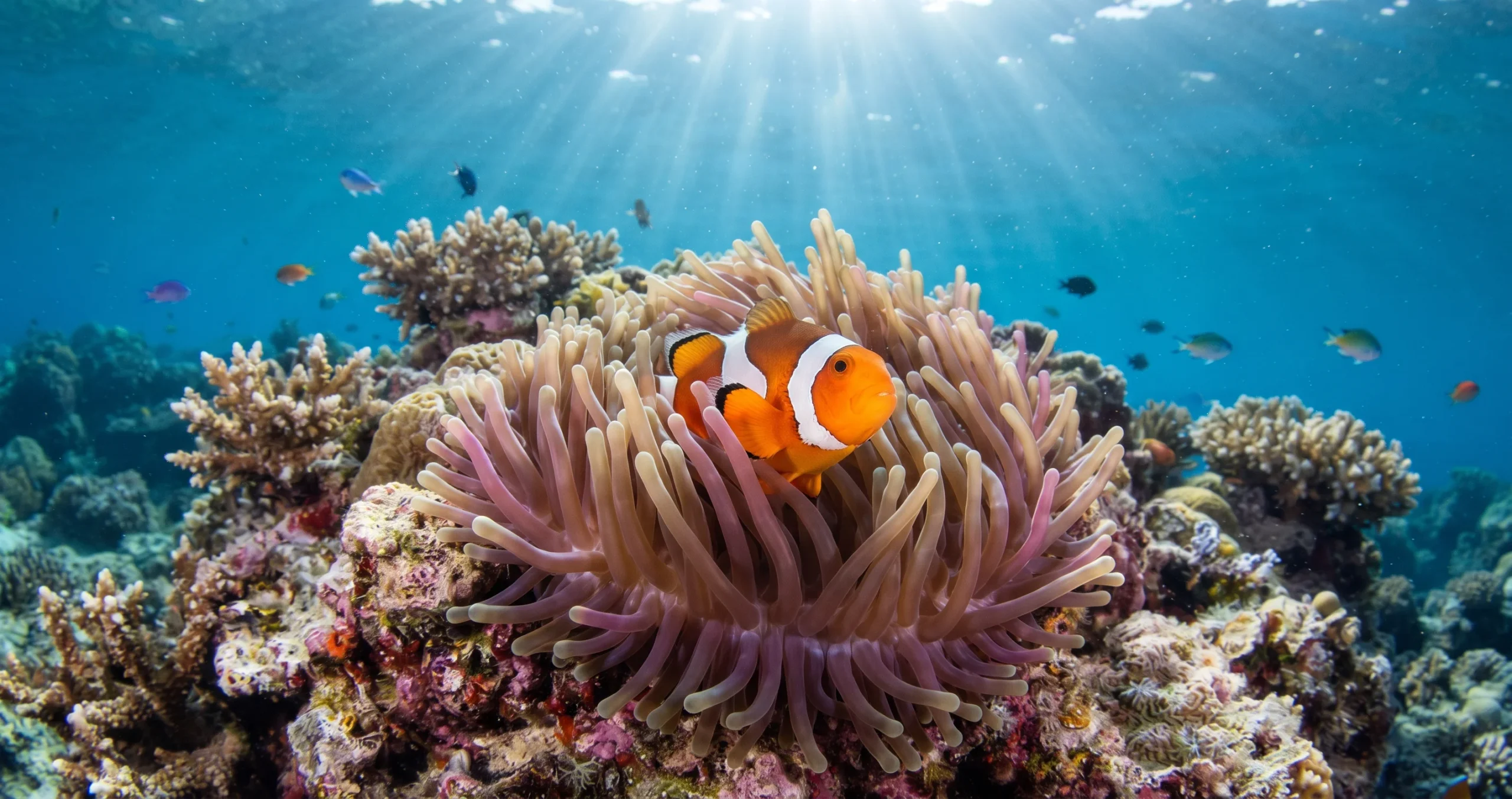
Among the colorful inhabitants of tropical coral reefs, few relationships are as fascinating as the partnership between clownfish and sea anemones. While most small fish avoid the stinging tentacles of anemones, clownfish swim comfortably among them, using these remarkable animals as living shelters.
The clownfish and sea anemone relationship is a classic example of mutualism, a biological partnership in which both organisms can benefit. Clownfish gain protection from predators, while their hosts receive nutrients, improved water circulation, and sometimes protection from other fish.
However, the mechanisms that allow clownfish to avoid harmful stings are more complicated than they might appear.
From protective mucus to unusual social hierarchies and the ability to change sex, clownfish demonstrate how marine animals adapt to life in a highly competitive underwater environment.
Table of Contents
- Understanding the Clownfish and Sea Anemone Relationship
- Why Sea Anemones Sting Other Fish
- How Clownfish Avoid Anemone Stings
- Benefits for Clownfish
- Benefits for Sea Anemones
- Clownfish Social Hierarchy and Sex Change
- Where Clownfish Live in the Wild
- Environmental Threats to Clownfish and Anemones
- Captive-Bred vs. Wild-Caught Clownfish
- Frequently Asked Questions
Understanding the Clownfish and Sea Anemone Relationship
Clownfish, also known as anemonefish, belong to the damselfish family. They are particularly recognizable for their bright coloration, distinctive markings, and close association with sea anemones.
Sea anemones may resemble underwater flowers, but they are animals belonging to the phylum Cnidaria, which also includes corals and jellyfish.
Their tentacles contain specialized stinging cells used to capture prey and defend against potential threats.
Despite this defensive system, clownfish can establish close relationships with certain anemone species. They spend much of their lives swimming among the tentacles, feeding nearby, and defending their small territories.
The clownfish and sea anemone partnership is an example of how different species can develop complementary survival strategies.
What Is Mutualism?
Mutualism describes an ecological relationship in which both participating organisms receive benefits.
In this particular partnership, the fish gains access to a relatively protected habitat, while the anemone may benefit from the fish’s movements, waste products, and defensive behavior.
The precise benefits vary depending on the species involved and their environmental conditions.
Why Sea Anemones Sting Other Fish
Sea anemones possess specialized cells called cnidocytes. These cells contain microscopic structures, known as nematocysts, capable of rapidly discharging tiny threads that may deliver venom.
When suitable prey comes into contact with the tentacles, mechanical and chemical signals can trigger these structures.
The venom helps immobilize small animals, allowing the anemone to move captured prey toward its central mouth.
For many small fish, swimming directly into an anemone’s tentacles would be dangerous.
Clownfish, however, have evolved adaptations that allow them to live among the tentacles of compatible host species.
This unusual ability is one of the most important features of the clownfish and sea anemone relationship.
How Clownfish Avoid Anemone Stings
Scientists have investigated clownfish protection for decades. Although several mechanisms appear to be involved, researchers have not established a single explanation that applies equally to every clownfish and host anemone species.
The Protective Mucus Coat
Like other fish, clownfish possess a layer of mucus covering their skin.
Research suggests that the chemical characteristics of this mucus may help prevent anemone stinging cells from recognizing clownfish as suitable targets.
Rather than simply functioning as a physical shield against venom, the mucus may influence the signals that normally trigger nematocyst discharge.
Some studies suggest that clownfish mucus has distinctive chemical properties that contribute to protection.
However, it would be inaccurate to describe clownfish as completely immune to every sea anemone sting.
Gradual Acclimation to an Anemone
Some clownfish display a gradual introduction behavior when approaching a new host.
They may briefly touch the tentacles, swim away, and repeat the process before spending longer periods among them.
This behavior has led scientists to investigate whether contact with the host modifies the fish’s mucus or contributes to chemical recognition between the two animals.
The importance of acclimation appears to vary among species and host combinations.
What Scientists Still Do Not Fully Understand
Several explanations have been proposed, including naturally protective mucus chemistry, changes associated with host contact, and interactions involving skin microorganisms.
These mechanisms are not necessarily mutually exclusive.
The most accurate explanation is that the clownfish and sea anemone partnership involves specialized biological adaptations, with some details still under scientific investigation.
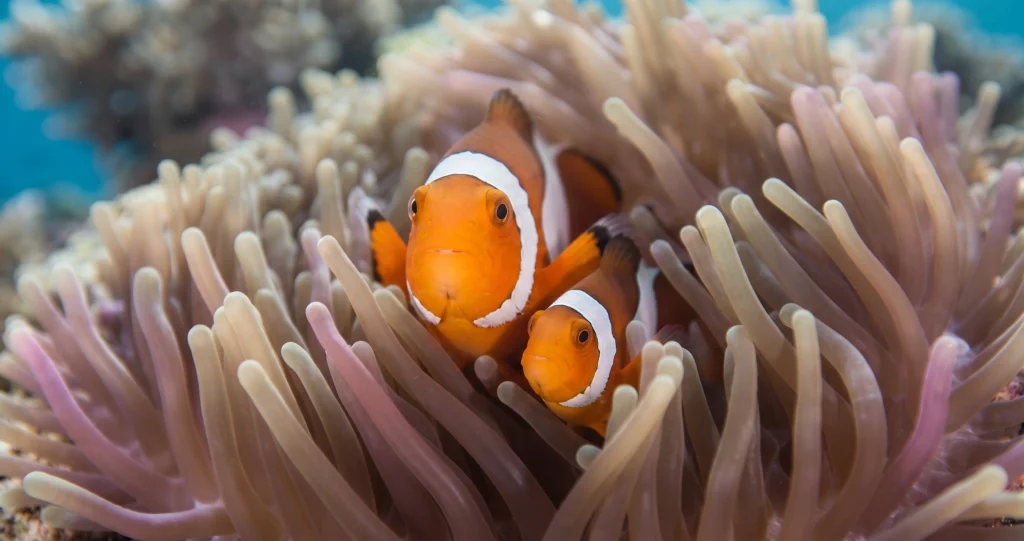
Benefits for Clownfish
Living alongside a sea anemone provides several important advantages for a relatively small reef fish.
Protection From Predators
The most obvious advantage is protection from larger predatory fish.
When threatened, clownfish can quickly retreat among the anemone’s tentacles. Many potential predators avoid approaching these stinging structures, making the surrounding area a relatively secure refuge.
A Permanent Territory
Suitable shelters are valuable resources in crowded reef environments.
An established host provides clownfish with a familiar territory where they can feed, rest, and reproduce.
Competition for suitable anemones can be intense, particularly in areas where healthy hosts are scarce.
A Protected Breeding Site
Clownfish typically deposit their eggs on a suitable hard surface near the base of their host.
The breeding male performs much of the egg care, including fanning the developing embryos with his fins and removing unsuitable eggs.
The nearby anemone provides an additional layer of protection, although it cannot eliminate every threat.
Benefits for Sea Anemones
The clownfish and sea anemone relationship is not simply a fish taking advantage of a convenient shelter.
The host can also benefit from having resident clownfish.
Nutrient Exchange
Clownfish release nitrogen-containing waste products into the surrounding water.
These nutrients can support microscopic photosynthetic algae living within the anemone’s tissues, contributing to the host’s nutrition.
This creates an ecological relationship involving the fish, the anemone, and its microscopic symbiotic algae.
Improved Water Circulation
The swimming movements of clownfish help circulate water around their host’s tentacles.
This movement can improve oxygen availability near the anemone, particularly when surrounding water movement is limited.
Defense Against Predators
Clownfish are often territorial and may chase away fish that approach their host.
This behavior can discourage certain butterflyfish and other animals that feed on anemone tissues.
Research has documented these complementary benefits, although their importance varies among species and environments. GovInfo+1
| Benefits for clownfish | Benefits for sea anemones |
|---|---|
| Protection from predators | Defense against some predators |
| Secure resting habitat | Improved local water circulation |
| Established territory | Nutrients from fish waste |
| Sheltered breeding area | Occasional access to food scraps |
Clownfish Social Hierarchy and Sex Change
One of the most unusual aspects of clownfish biology is their highly organized social structure.
A single host may shelter a small group containing individuals of different sizes and reproductive roles.
The Dominant Female
The largest individual is normally the breeding female.
The second-largest individual is the breeding male, while smaller group members generally remain reproductively inactive.
Body size plays an important role in maintaining this hierarchy.
How Clownfish Change Sex
Clownfish are protandrous sequential hermaphrodites. In simple terms, they can mature reproductively as males and subsequently become females.
If the dominant female disappears or dies, the breeding male can undergo physiological changes and take her place.
A smaller group member can then mature into the new breeding male.
This reproductive flexibility allows an established group to restore its breeding pair without necessarily finding a replacement female from another territory.
Reproduction and Early Development
After the female deposits her eggs and the male fertilizes them, the developing embryos remain attached to the spawning surface.
Once they hatch, the larvae enter a free-swimming stage in the surrounding ocean.
Young clownfish eventually settle into suitable reef habitat, where finding a compatible host becomes especially important.
Where Clownfish Live in the Wild
Clownfish naturally inhabit tropical waters across the Indo-Pacific region.
Their distribution includes parts of the Indian Ocean, Southeast Asia, the western Pacific Ocean, the Red Sea, and northern Australian waters.
They are not native to the Atlantic Ocean or Caribbean Sea.
Coral Reefs and Coastal Habitats
Clownfish occupy environments where suitable host anemones are available.
These include sheltered coral reefs, rocky reef areas, and some shallow coastal habitats.
They feed on small drifting organisms, tiny crustaceans, algae, and other suitable food particles.
Do All Clownfish Use the Same Anemone Species?
No. Some clownfish associate with several different host species, while others have more specialized requirements.
Examples of naturally compatible hosts include the magnificent sea anemone (Heteractis magnifica), the giant carpet anemone (Stichodactyla gigantea), and the bubble-tip anemone (Entacmaea quadricolor), depending on the clownfish species.
A successful clownfish and sea anemone partnership therefore requires more than simply placing any clownfish beside any anemone. PubMed Central (PMC)+1
Environmental Threats to Clownfish and Anemones
Although these animals have evolved remarkable adaptations, their survival remains closely connected to the condition of tropical marine ecosystems.
Ocean Warming and Bleaching
Many host anemones contain microscopic algae that contribute to their nutrition through photosynthesis.
Prolonged heat stress can disrupt this association, causing the anemone to lose algae or their pigments and become noticeably pale.
This process, known as bleaching, can weaken the host and affect the clownfish that depend on it.
Pollution and Habitat Degradation
Coastal development, sediment runoff, nutrient pollution, and destructive fishing practices can damage reef environments.
When suitable hosts disappear, clownfish lose important shelter and breeding opportunities.
Protecting the clownfish and sea anemone relationship requires conserving the broader ecosystem rather than focusing on either animal alone.
Collection for the Aquarium Trade
Removing wild fish and anemones can place additional pressure on local marine populations, particularly where collection practices are poorly managed.
Some destructive capture methods can also harm surrounding marine life.
Responsible sourcing and effective conservation measures are essential for reducing these impacts.
Captive-Bred vs. Wild-Caught Clownfish
Clownfish are among the most recognizable marine aquarium fish, and many commonly kept varieties are successfully bred in captivity.
Choosing responsibly bred individuals can reduce demand for collecting fish from natural reefs.
Advantages of Captive-Bred Clownfish
Captive-bred individuals are often accustomed to aquarium conditions and commercially prepared fish foods.
They are available in both traditional color patterns and selectively bred varieties.
However, captive breeding does not guarantee disease-free or perfectly healthy fish. Responsible suppliers, appropriate quarantine procedures, and suitable aquarium conditions remain important.
Do Aquarium Clownfish Need an Anemone?
Unlike wild individuals, captive clownfish can live successfully without a host anemone when their aquarium provides suitable shelter, nutrition, and stable water conditions.
Sea anemones often require more specialized care, including appropriate lighting, water movement, and reliable marine water chemistry.
Beginners should avoid purchasing an anemone simply because their clownfish appears to need a natural companion.
Understanding the natural clownfish and sea anemone partnership is valuable, but reproducing every feature of a wild reef is not necessary for responsible aquarium care. srac.tamu.edu+1
For another example of how marine fish adapt to their surroundings, explore our article about frogfish camouflage and hunting strategies. While clownfish depend on living shelters, frogfish use their remarkable appearance to blend into reef habitats.
Frequently Asked Questions
Why do clownfish live in sea anemones?
Clownfish gain shelter from predators, access to a stable territory, and a relatively protected location for reproduction.
Why don’t sea anemones sting clownfish?
Their specialized mucus coating appears to play an important protective role. Acclimation and chemical interactions between the two animals may also contribute, although the complete mechanism remains under investigation.
Can a sea anemone live without a clownfish?
Yes. Host anemones can survive without clownfish, although resident fish may provide valuable nutrients, improved water circulation, and protection from certain predators.
Are clownfish born female or male?
Young clownfish are sexually immature. They can mature as males, and a breeding male can subsequently become female when social conditions require it.
Can clownfish live without an anemone in an aquarium?
Yes. Captive clownfish can live without an anemone when provided with appropriate saltwater conditions, nutrition, shelter, and compatible tank inhabitants.
Do clownfish feed their anemones?
Anemones may obtain leftover food particles and nutrients from clownfish waste. However, deliberately feeding the host is not a universal clownfish behavior.
Is the clownfish and sea anemone relationship mutualism?
Yes. Both organisms can receive measurable benefits from their association, making it a well-known example of marine mutualism.
Are sea anemones plants or animals?
Sea anemones are animals related to corals and jellyfish. Their flower-like appearance can be misleading, and many host species contain photosynthetic algae within their tissues.
Conclusion
The clownfish and sea anemone partnership illustrates how cooperation between different species can shape survival in the natural world.
Clownfish gain shelter and reproductive opportunities, while their hosts benefit from nutrient exchange, water circulation, and defensive behavior.
Although scientists continue investigating the precise mechanisms behind protection from anemone stings, the relationship demonstrates how physical adaptations, behavior, and chemical interactions can work together.
For aquarium enthusiasts, choosing responsibly sourced captive-bred clownfish is one practical way to reduce pressure on wild populations.
Ultimately, protecting these remarkable animals means protecting the marine habitats that allow their partnership to flourish.
External Sources
1. Research on Clownfish Skin Mucus (2025)
Peer-reviewed scientific research examining chemical recognition, mucus composition, and the complex mechanisms protecting clownfish from anemone stings. Scientific Reports. Read the complete scientific study
2. Clown Anemonefish
University-based information covering clownfish biology, natural distribution, reproduction, social hierarchy, and anemone associations. Florida Museum of Natural History. Read the Florida Museum species profile
3. Clownfish
Authoritative educational information about clownfish habitat, mutualism, feeding behavior, conservation, and captive breeding. Monterey Bay Aquarium. Read the Monterey Bay Aquarium resource.