
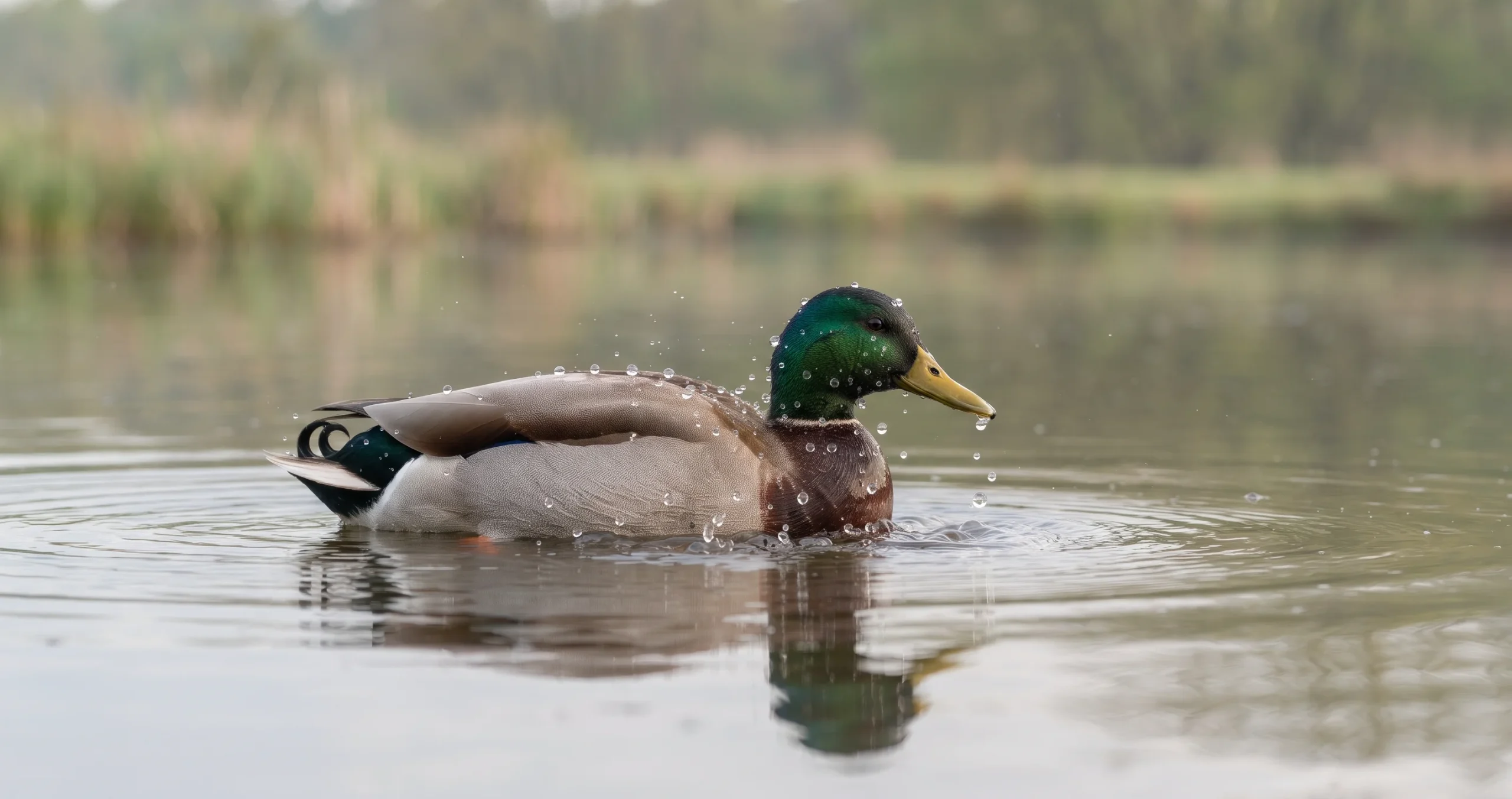
A duck can swim across a pond on a cold winter morning, emerge from the water, and shake droplets from its feathers without becoming completely soaked. This remarkable ability is the result of specialized feather structures, natural oils, and regular maintenance.
What makes bird feathers waterproof is not simply a coating of oil. Their microscopic architecture, overlapping arrangement, and insulating layers work together to resist water penetration and protect the bird’s body.
From backyard songbirds to diving ducks and penguins, different species have developed feather adaptations suited to their environments.
Understanding how these natural protective systems work reveals why healthy plumage is essential for flight, insulation, temperature regulation, and survival.
Table of Contents
- What Makes Bird Feathers Waterproof?
- Understanding the Structure of a Bird Feather
- How Feather Barbs Work Like a Zipper
- Down Feathers and Natural Insulation
- What Is the Preen Gland?
- How Preening Keeps Feathers Healthy
- Which Birds Depend Most on Preen Oil?
- Why Waterbirds Stay Dry While Swimming
- What a Wet or Ragged Bird May Indicate
- When to Contact a Wildlife Rehabilitator
- How to Support Healthy Birds in Your Garden
- Frequently Asked Questions
What Makes Bird Feathers Waterproof?
Bird feathers resist water through a combination of physical structure, feather arrangement, surface properties, and maintenance behavior.
Although preen oil contributes to feather condition in many species, it is not the only reason water droplets roll off a bird’s back.
The feathers covering a bird’s body overlap in a pattern that resembles roof shingles. This arrangement helps direct water away from the skin while protecting the softer insulating feathers underneath.
At a microscopic level, many feathers contain tightly connected structures that form a continuous surface.
Together, these adaptations help limit water penetration and maintain a protective layer of air close to the body.
However, not all birds possess the same degree of water resistance. Their feather characteristics reflect their habitats, lifestyles, and evolutionary adaptations.
Understanding the Structure of a Bird Feather
Feathers are lightweight structures composed primarily of keratin, a structural protein also found in bird claws and bills.
Although feathers may appear simple from a distance, their detailed architecture is surprisingly complex.
The Shaft
The shaft forms the central supporting structure of a typical contour or flight feather.
Its lower portion, known as the calamus or quill, anchors the feather within a follicle in the skin. The upper portion, called the rachis, supports the feather’s branching structures.
The shaft provides strength while allowing the feather to remain relatively lightweight and flexible.
The Barbs
Barbs are the slender branches extending outward from the central shaft.
Arranged closely together, they form the broad surface of the feather, known as the vane.
Their shape, spacing, and arrangement influence how the feather interacts with air and water.
The Barbules
Barbules are much smaller branches extending from individual barbs.
In many contour and flight feathers, specialized barbules possess microscopic hooks that connect with neighboring structures.
These connections help create a smooth, cohesive feather surface capable of resisting water penetration.
| Feather structure | Primary function |
|---|---|
| Calamus | Anchors the feather in the skin |
| Rachis | Supports the feather’s structure |
| Barbs | Form the main feather surface |
| Barbules | Connect neighboring barbs |
| Hooklets | Help maintain a continuous vane |
| Down feathers | Trap insulating air |
How Feather Barbs Work Like a Zipper
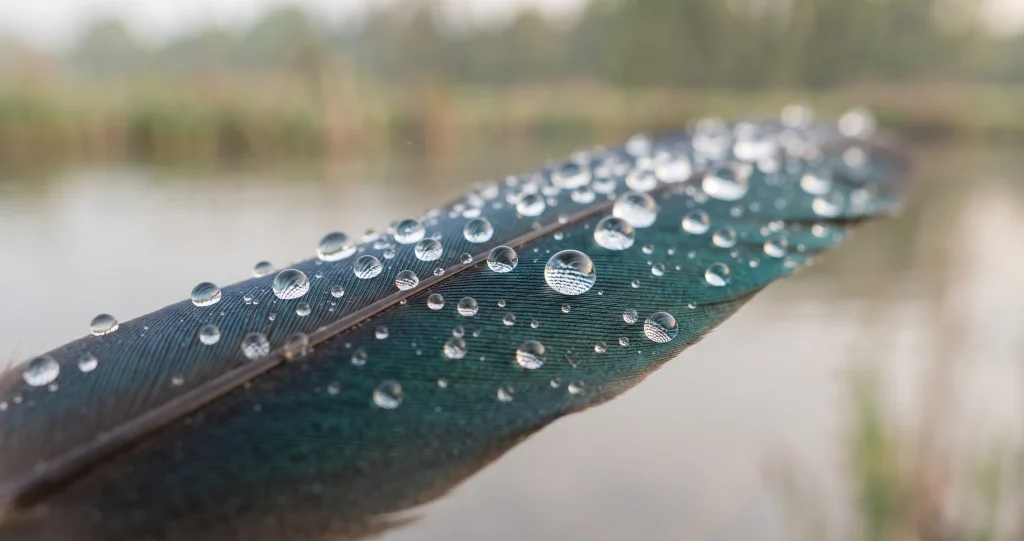
One of the most fascinating aspects of what makes bird feathers waterproof is the way their microscopic structures connect.
The hooklets on certain barbules attach to neighboring barbules, creating an interlocking network.
This arrangement works somewhat like a miniature zipper, joining individual feather branches into a continuous surface.
Repairing Separated Feather Barbs
During everyday activities, feather barbs can become separated by contact with branches, movement, bathing, or other physical disturbances.
When a bird draws a feather through its bill during preening, it can reconnect many of these separated structures.
This behavior helps restore the feather’s smooth surface without requiring the bird to grow a replacement.
However, preening cannot repair every type of damage. Broken shafts and severely worn feathers generally need to be replaced during molting.
Why a Smooth Feather Surface Matters
A well-maintained feather surface helps reduce gaps through which water can penetrate.
It also contributes to efficient airflow across flight feathers, allowing birds to maintain their aerodynamic performance.
The same microscopic architecture therefore supports several essential functions, including flight and protection from environmental moisture.
Down Feathers and Natural Insulation
Beneath the visible outer plumage, many birds possess soft, fluffy down feathers.
Unlike the tightly interlocking structures of many contour feathers, down has loosely arranged branches that create numerous small air spaces.
These spaces trap air close to the bird’s body.
How Down Keeps Birds Warm
Trapped air reduces the rate at which body heat escapes into the surrounding environment.
This natural insulation is particularly valuable during cold weather, when maintaining body temperature requires additional energy.
Birds may fluff their feathers to increase the insulating air layer around their bodies.
Why Keeping Down Dry Is Important
When insulating feathers become thoroughly wet, their fluffy structures can collapse and lose much of their ability to trap air.
As a result, the bird may lose body heat more rapidly.
The water-resistant outer plumage helps protect these delicate insulating layers.
This relationship between outer feathers and down is especially important for waterbirds that regularly encounter cold water.
What Is the Preen Gland?
Many birds possess a specialized gland called the uropygial gland, commonly known as the preen gland or oil gland.
It is located near the base of the tail, typically on the upper surface of the body.
The gland produces a secretion containing various compounds, including waxes and other lipids. Birds collect this secretion with their bills and distribute it throughout their plumage.
Does Preen Oil Make Bird Feathers Waterproof?
Preen oil contributes to feather maintenance and can influence the way feathers interact with moisture.
However, the idea that oil alone makes feathers waterproof is an oversimplification. The physical arrangement of feather branches and the overlapping outer plumage are also fundamental to water resistance.
The chemical composition and function of preen gland secretions vary among species.
Some birds lack a functional preen gland altogether but still maintain protective plumage through other adaptations.
How Preening Keeps Feathers Healthy
Preening is a routine grooming behavior performed by birds throughout their lives.
Using their bills, birds carefully work through their feathers, maintaining their arrangement and removing unwanted material.
A bird may spend considerable time preening after bathing, swimming, feeding, or resting.
The Main Functions of Preening
Regular preening helps birds:
- Reconnect separated feather barbules.
- Remove dirt and loose material.
- Distribute natural preen gland secretions.
- Maintain the arrangement of overlapping feathers.
- Remove some external parasites.
- Preserve feather condition for flight and insulation.
Preening is particularly important because mature feathers are no longer living tissues that can heal themselves like skin.
Although birds can restore separated feather structures through grooming, severely damaged feathers must eventually be replaced.
Which Birds Depend Most on Preen Oil?
Waterbirds frequently encounter conditions that make feather maintenance particularly important.
Ducks, geese, swans, and many seabirds regularly distribute preen gland secretions throughout their plumage.
However, it is difficult to rank species according to their dependence on oil alone because feather structure, density, and grooming behavior also contribute to water resistance.
| Bird group | Feather adaptations |
|---|---|
| Ducks | Water-resistant outer plumage and insulating down |
| Geese | Dense plumage and regular preening |
| Swans | Overlapping contour feathers and thick insulation |
| Penguins | Dense, tightly overlapping feathers adapted to swimming |
| Cormorants | Partially wettable outer plumage suited to diving |
| Songbirds | Protective contour feathers suited to terrestrial habitats |
Some parrots lack a preen gland and instead possess specialized powder-producing feathers that contribute to plumage maintenance.
These differences demonstrate that birds have evolved several ways of maintaining healthy feathers.
Why Waterbirds Stay Dry While Swimming
Ducks and other waterfowl spend substantial portions of their lives swimming, feeding, and resting on water.
Their ability to resist soaking depends on multiple protective adaptations working together.
Overlapping Outer Feathers
The outer plumage forms a layered covering that helps direct water away from sensitive inner feathers.
The microscopic structure of individual feathers further limits the movement of water into the plumage.
A healthy duck can therefore swim while maintaining a relatively dry insulating layer near its skin.
Trapped Air and Buoyancy
Air trapped between feathers provides insulation and contributes to buoyancy.
For ducks, this helps reduce heat loss while supporting their floating behavior.
Diving birds have different requirements because excessive buoyancy can make underwater movement more difficult.
Why Cormorants Spread Their Wings
Unlike many ducks, cormorants have outer plumage that allows a greater degree of water penetration.
This partial wettability may reduce buoyancy and make underwater foraging easier, although it can also increase heat loss.
After diving, cormorants are frequently observed standing with their wings extended, a behavior commonly associated with feather drying.
Their example illustrates why making bird feathers waterproof to the greatest possible degree is not necessarily advantageous for every species.
What a Wet or Ragged Bird May Indicate
A wet-looking bird is not automatically sick or injured.
Birds regularly bathe, fly through rain, and expose their feathers to water. Temporary changes in plumage appearance are entirely normal.
However, a bird that remains unusually soaked or appears unable to maintain its feathers may require closer attention.
Possible Causes of Poor Feather Condition
Persistent feather deterioration can be associated with several problems:
- Physical injuries that interfere with preening.
- Exposure to petroleum, grease, or other contaminants.
- Illness or severe weakness.
- External parasites.
- Damaged or excessively worn feathers.
- Nutritional problems.
Normal molting can also make birds appear temporarily uneven or untidy.
Appearance alone is therefore insufficient to diagnose a health problem.
Why Petroleum Oil Is Dangerous
Natural preen gland secretions should not be confused with petroleum products.
Petroleum contamination can cause feathers to clump together, disrupting their protective arrangement and reducing insulation.
Affected birds may lose body heat and ingest harmful substances while attempting to clean themselves.
Even relatively small areas of contamination can be serious, especially for birds that spend much of their time in water.
When to Contact a Wildlife Rehabilitator
If you encounter a bird that appears unusually wet, observe its behavior from a safe distance before deciding whether intervention is necessary.
A healthy bird that has recently bathed will typically resume normal movement, grooming, or feeding.
Professional assistance may be necessary if the bird shows persistent shivering, visible injuries, difficulty standing, an inability to fly, or apparent petroleum contamination.
Contact a licensed wildlife rehabilitator before attempting to capture the bird. Do not apply household oils, detergents, or other cleaning products to its feathers, and do not force it to eat or drink.
How to Support Healthy Birds in Your Garden
Gardeners can help wild birds maintain healthy plumage by providing suitable habitat, clean water, and natural food sources.
These resources become particularly valuable during periods of cold weather and limited food availability.
Provide Clean Bathing Water
A shallow birdbath with a textured surface allows birds to bathe and drink safely.
Replace the water regularly, clean the container, and avoid adding chemicals, fragrances, or oils.
During winter, provide unfrozen water whenever practical.
Maintain Natural Shelter
Evergreen shrubs, dense hedges, and mature trees provide sheltered resting places during heavy rain, snowfall, and strong winds.
Planting a variety of native vegetation can also support natural food sources and provide protection from harsh weather.
Keep Feeders Clean
Regularly remove wet seeds, accumulated waste, and spoiled food from bird feeders.
Clean feeding areas reduce opportunities for disease transmission and help maintain a healthier environment for visiting birds.
Frequently Asked Questions
Are all bird feathers waterproof?
No. Water resistance varies among species and feather types. Outer contour feathers generally provide greater protection against moisture than fluffy down feathers.
Does preen oil repel water?
Preen oil helps maintain feather condition and contributes to water resistance. However, scientific research indicates that feather architecture itself plays a major role, and the precise contribution of oil remains an active area of study.
Why do birds bathe if their feathers repel water?
Bathing helps remove dirt and other unwanted material. Birds typically preen afterward to restore their feather arrangement.
Can birds get completely soaked?
Yes. Prolonged exposure to heavy rain, damaged feathers, or contamination can allow water to penetrate the protective plumage.
Do penguins have waterproof feathers?
Penguins possess dense, water-resistant plumage adapted to swimming. Their feathers help protect their bodies and retain insulating air, although they are not completely impermeable under every condition.
Why do birds fluff their feathers in winter?
Fluffing increases the amount of insulating air trapped within the plumage, helping reduce body heat loss.
Do cormorants have a preen gland?
Yes. Cormorants possess a functional preen gland despite having partially wettable plumage. Their distinctive feather architecture contributes to their diving adaptations.
Conclusion
The adaptations that make bird feathers waterproof demonstrate how microscopic structures can influence an animal’s survival.
Interlocking barbs and barbules create protective feather surfaces, overlapping plumage helps shed moisture, and down traps insulating air close to the body.
Preen oil and regular grooming help maintain these structures, although water resistance depends on much more than a natural oil coating.
For gardeners and wildlife enthusiasts, understanding feather biology provides a deeper appreciation of the birds visiting ponds, feeders, and backyard habitats.
Providing clean water, natural shelter, and suitable food sources can help support these remarkable animals throughout the year.
The next time a duck shakes water from its back or a songbird carefully preens its wings, remember the extraordinary microscopic engineering that makes these everyday behaviors possible.
External Sources
1. Everything You Need to Know About Feathers
Comprehensive educational resource covering feather anatomy, barbules, keratin, preening, insulation, and feather development. Cornell Lab of Ornithology. https://academy.allaboutbirds.org/feathers-article/?utm_source.
2. Water Off a Duck’s Back
Scientific explanation of preen oil, feather water resistance, and experimental research on waterfowl plumage. British Ornithologists’ Union. https://bou.org.uk/blog-montgomerie-preening-oil/?utm_source