
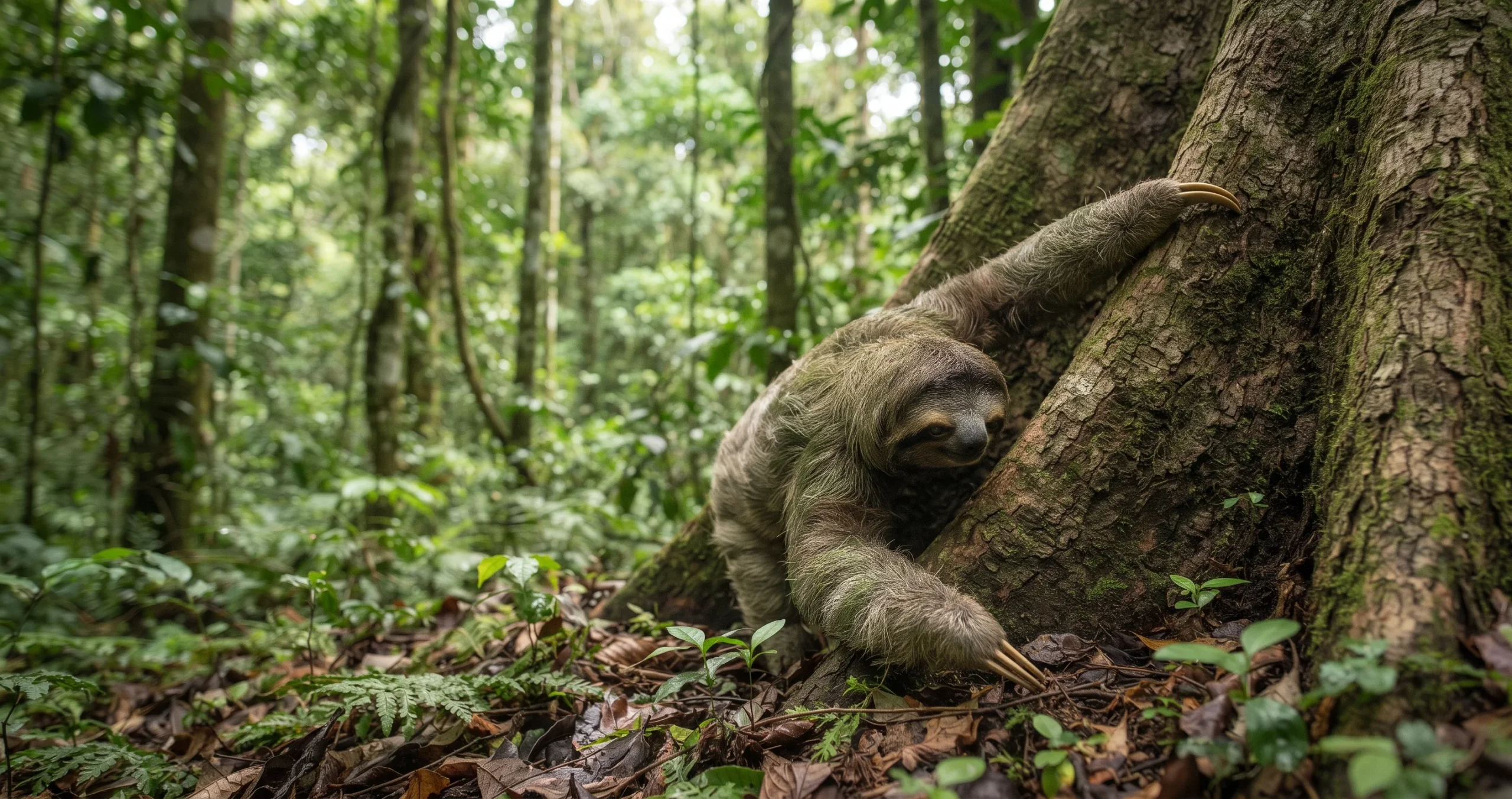
High in a tropical rainforest, a three-toed sloth spends much of its life hanging from branches, slowly feeding on leaves and resting among the canopy. Yet, roughly once a week, it may descend to the forest floor for an activity that seems surprisingly ordinary: defecating.
The mystery of why sloths come down to the ground has fascinated biologists for decades. Descending takes energy, exposes the animal to danger, and interrupts a lifestyle remarkably well suited to life in trees.
Scientists have proposed several explanations, including a fascinating relationship between sloths, moths, and algae living in their fur. But the evidence is more complicated than the popular story suggests.
Understanding this behavior reveals how even a seemingly simple bathroom trip can raise difficult questions about evolution, ecology, and survival.
Table of Contents
- Life in the Canopy: How Three-Toed Sloths Survive
- Why Sloths Come Down to the Ground About Once a Week
- The Surprising Dangers of a Ground-Level Bathroom Trip
- The Sloth Moth and Algae Hypothesis
- What Scientific Evidence Supports the Hypothesis?
- Other Explanations for Sloth Ground Visits
- Why Scientists Are Still Debating the Mystery
- Three-Toed vs. Two-Toed Sloths
- Sloths, Habitat Loss, and Conservation
- Common Myths About Sloths
Life in the Canopy: How Three-Toed Sloths Survive
Built for Hanging, Not Running
Three-toed sloths belong to the genus Bradypus and inhabit tropical forests in Central and South America.
Their long limbs, curved claws, and specialized anatomy make them exceptionally capable of suspending themselves beneath branches. They can rest, feed, and move through the canopy while hanging upside down.
Their claws function like sturdy hooks, allowing them to maintain a grip with relatively little muscular effort. This arrangement is particularly useful for an animal that spends so much time suspended above the ground.
On land, however, their body proportions become a disadvantage. Rather than walking upright like most mammals, they move awkwardly using their limbs and claws.
This difference helps explain why leaving the trees is such a consequential decision.
A Leaf-Based Diet and Slow Metabolism
Three-toed sloths primarily consume leaves, supplemented by other plant material depending on the species and habitat.
Leaves can be difficult to digest, and their nutritional value varies widely. Sloths compensate with a specialized digestive system and an unusually low metabolic rate for mammals of their size.
Their large, complex stomachs support microbial fermentation, helping break down fibrous plant material over an extended period.
Digestion can be remarkably slow, and the contents of the digestive tract may represent a substantial portion of a sloth’s body mass.
Moving slowly helps limit energy expenditure. Rather than indicating laziness, this behavior is part of a coordinated strategy for surviving on a relatively low-energy diet.
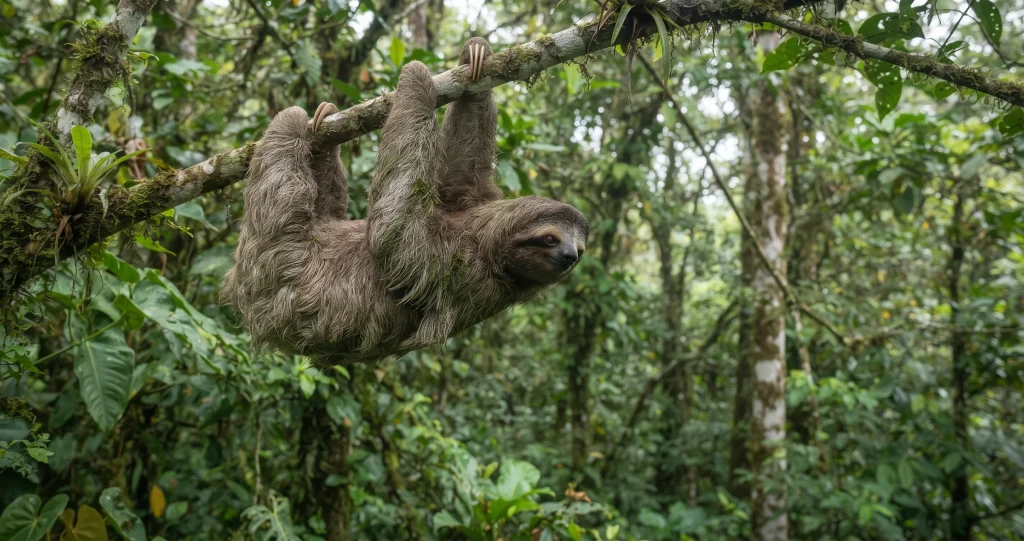
A Life Among Branches
Three-toed sloths typically spend much of their time feeding, resting, and traveling within the canopy.
Their movements can be difficult to detect because they often remain still for long periods, blending into surrounding vegetation.
Their fur may develop a greenish appearance as algae grow among the hairs, adding another unusual feature to their already distinctive appearance.
Despite their tree-dwelling adaptations, many three-toed sloths regularly descend to the ground.
That behavior creates one of the most intriguing questions in sloth biology.
Why Sloths Come Down to the Ground About Once a Week
The most familiar explanation for why sloths come down to the ground is that many three-toed sloths descend to defecate.
Researchers have documented a pattern in which these animals leave the canopy periodically, often around once per week, although the interval varies.
After reaching the ground, a sloth may use its short tail and hindquarters to create a shallow depression, deposit feces, and cover the material with leaves or soil.
It then climbs back into the trees.
This behavior is remarkable because the sloth could theoretically release waste from a branch, as many other arboreal animals do.
Instead, it undertakes a deliberate journey that can involve climbing down a substantial tree trunk and moving across exposed ground.
Why a Weekly Schedule Makes Sense Physiologically
A sloth’s slow digestion and comparatively infrequent elimination are consistent with its energy-conserving lifestyle.
However, the digestive system alone does not explain why the animal must descend.
The distinction matters: infrequent defecation may be understandable from its physiology, while the choice of location remains a separate evolutionary question.
Scientists therefore examine not only how often sloths eliminate waste but also whether descending provides benefits that outweigh the costs.
The Surprising Dangers of a Ground-Level Bathroom Trip
A sloth is far more vulnerable on the forest floor than it is among branches.
Its claws are excellent for gripping vegetation but poorly suited to rapid terrestrial movement.
Exposure to Predators
On the ground, sloths may face predators such as large cats and other carnivores, depending on the region.
Their slow movement makes escape difficult if a predator discovers them.
Researchers have suggested that ground-level defecation can carry substantial predation risk, although exact risk estimates depend on the study and circumstances.
Energy Costs of Climbing
Climbing down and back up requires physical effort.
For an animal that conserves energy so carefully, unnecessary movement would seem disadvantageous.
Even if the energy required for one descent is modest in absolute terms, it must be considered relative to the sloth’s limited daily energy budget.
Habitat Fragmentation Makes Travel Harder
In intact forests, a sloth may travel between neighboring trees using connected branches.
Where roads, buildings, or cleared land interrupt the canopy, it may be forced onto the ground more often.
Such movements are different from routine defecation trips, but they demonstrate how vulnerable sloths can become when forest structure is disrupted.
The Sloth Moth and Algae Hypothesis
One of the most imaginative explanations for why sloths come down to the ground involves an entire miniature ecosystem living in their fur.
Sloth fur can support algae, fungi, insects, and other organisms. Among its best-known residents are moths that have close ecological associations with sloths.
Moths That Depend on Sloth Dung
Certain sloth-associated moths spend their adult lives in the animal’s fur.
When a sloth descends to defecate, female moths can leave the fur and lay eggs in fresh dung. Their larvae develop in this nutrient-rich material.
After emerging as adults, moths may find sloths again, continuing the association.
This provides a plausible reason why ground-level defecation could benefit the moths. But demonstrating a benefit to moths is different from proving that the behavior evolved for their sake.
The Algae Growing in Sloth Fur
Some sloths carry green algae among their hairs, contributing to their distinctive coloration.
Researchers have investigated whether these algae receive nutrients from waste products associated with moths and other organisms living in the fur.
In the proposed relationship, moth activity increases the availability of nitrogen, which encourages algal growth.
The algae might then provide the sloth with an additional nutritional resource.
If every step were established, the relationship would represent a striking example of mutualism: different organisms helping one another survive.
The important qualification is that the full cycle remains a hypothesis, not an accepted explanation for the sloth’s weekly descent.
What Scientific Evidence Supports the Hypothesis?
A widely discussed 2014 study by Jonathan Pauli and colleagues examined the relationships among sloths, moths, nitrogen, and algae.
The researchers reported that three-toed sloths carried more moths, higher inorganic nitrogen concentrations, and greater algal biomass than the two-toed sloths they studied.
They also found associations between moth abundance, nitrogen, and algae, and reported evidence suggesting that sloths could obtain nutrients from algae.
These observations provided a scientific foundation for the proposed relationship.
However, correlation does not establish every step of a biological mechanism.
Why Later Researchers Raised Questions
A comprehensive 2021 review in Biological Reviews examined the organisms living in sloth fur and the evidence for their ecological relationships.
The authors identified important gaps in the proposed moth–algae–sloth mutualism.
In particular, they questioned whether sloths regularly consume algae directly from their fur, whether the algae found in digestive samples necessarily originated there, and whether the nutritional benefits would be large enough to explain risky ground visits.
The review emphasized that the biological functions of many sloth-associated organisms remain poorly understood.
This distinction is central to why sloths come down to the ground: scientists have documented intriguing associations, but the proposed evolutionary explanation has not been conclusively demonstrated.
Other Explanations for Sloth Ground Visits
The moth-and-algae hypothesis is not the only explanation researchers have considered.
Several alternatives focus on the sloth’s relationship with its environment, its predators, or its evolutionary history.
Fertilizing Trees
One proposal suggests that depositing feces near a tree’s base returns nutrients to the soil around a tree that provides food and shelter.
The idea is ecologically appealing, but it has not been established that the resulting benefit to the sloth is substantial enough to explain the behavior.
Nutrients deposited near a tree do not necessarily return directly to the same individual animal.
Reducing Predator Detection
Another suggestion is that depositing or covering feces on the ground could reduce detectable odors near resting areas.
Such behavior might conceivably make it harder for predators to locate a sloth.
Yet this explanation must account for the danger created by descending in the first place. Researchers have not demonstrated that odor reduction provides a sufficient survival advantage.
Chemical Communication
Sloths may use scent-related information in their interactions with other individuals.
Ground-level waste deposits have therefore been proposed as possible sources of chemical information.
However, evidence that this function specifically explains routine defecation descents remains limited.
Obtaining Trace Nutrients
Researchers have also considered whether sloths acquire minerals or other substances when contacting soil or licking material from their claws.
This possibility would connect ground visits with nutritional needs.
It remains uncertain whether such behavior occurs consistently enough to explain the broader pattern.
An Ancestral Behavior That Persisted
A 2021 paper by researcher Julián Monge-Nájera proposed another explanation: ground-level defecation may simply be an inherited behavior that persisted as sloths adapted to life in trees.
Under this hypothesis, natural selection may not have strongly favored eliminating the behavior.
The proposal challenges the assumption that every costly behavior must provide a special present-day advantage.
It is also a hypothesis requiring further testing, rather than a settled answer.
Why Scientists Are Still Debating the Mystery
Scientists distinguish between observing a behavior and identifying the evolutionary forces responsible for it.
We know that many three-toed sloths periodically descend to defecate. We also know that moths, algae, and other organisms inhabit their fur.
What remains uncertain is whether those relationships explain why sloths come down to the ground.
The strongest test would establish not only that moths benefit from the dung but also that sloths receive a meaningful benefit that changes their survival or reproductive success.
Researchers would also need to compare competing explanations across different sloth species, habitats, and populations.
Careful field observations, nutritional studies, and experiments could help separate causes from associations.
Until then, the most accurate conclusion is that the behavior is well documented, while its ultimate evolutionary explanation remains debated.
Three-Toed vs. Two-Toed Sloths
Although their names sound similar, three-toed and two-toed sloths belong to different living lineages.
Three-toed sloths belong to Bradypus, while two-toed sloths belong to Choloepus. The names refer to the number of digits on their forelimbs; both groups have three digits on their hind feet.
Differences in Diet and Behavior
Three-toed sloths generally have more specialized leaf-based diets.
Two-toed sloths can consume a broader variety of plant foods and differ in aspects of their physiology, activity, and movement.
Both are adapted for life in trees, but their ecological strategies are not identical.
Differences in Ground Visits
The familiar roughly weekly defecation pattern is particularly associated with three-toed sloths.
Two-toed sloths may also descend to the ground, but their elimination habits and frequency of descent can differ.
The original moth-and-algae study compared these groups and found differences in the organisms living in their fur.
Those differences are interesting, but they do not establish that all sloths descend for the same reason.
Sloths, Habitat Loss, and Conservation
Understanding why sloths come down to the ground is more than a scientific curiosity.
It also highlights the importance of connected forest habitat.
The Importance of Canopy Connections
Sloths rely on trees for feeding, resting, and traveling.
When forests are fragmented by roads, agriculture, or development, the gaps between trees may force animals to travel across exposed ground.
These crossings can increase encounters with vehicles, domestic animals, and other hazards.
Maintaining connected forest corridors helps sloths move between feeding areas without unnecessary terrestrial journeys.
Different Species Face Different Threats
Sloths do not all share the same conservation status.
Some species occupy relatively broad geographic ranges, while others have extremely restricted distributions.
The pygmy three-toed sloth, for example, is confined to a small island habitat in Panama and faces particular conservation concerns.
Habitat protection must therefore consider the needs of individual species rather than treating all sloths as one conservation category.
Responsible Wildlife Observation
Sloths are wild animals, even when they appear calm or approachable.
Tourists should avoid handling them, removing them from trees for photographs, or supporting attractions that encourage direct contact.
Wildlife observation is most responsible when animals can continue their natural behavior without interference.
For readers interested in the wider relationship between wildlife and healthy ecosystems, a related article about habitat conservation or rainforest biodiversity would provide useful additional context.
Common Myths About Sloths
Myth: Sloths Are Lazy
Sloths move slowly because their physiology and diet favor energy conservation.
Their low-energy lifestyle is an adaptation, not a personality trait.
Myth: Sloths Cannot Swim
Sloths can swim.
Their movements in water differ from their awkward locomotion on land, and swimming can help them cross waterways in suitable circumstances.
Myth: Sloths Come Down Only to Defecate
Defecation is a familiar reason for ground visits, particularly among three-toed sloths.
However, sloths may also descend while moving between disconnected trees or responding to environmental conditions.
Myth: Sloths Eat Algae From Their Fur Every Week
The idea that sloths regularly consume fur algae as a nutritional supplement remains disputed.
Some research has suggested a possible nutritional connection, but later reviews have questioned the strength of the supporting evidence.
It should not be presented as an established weekly feeding ritual.
Frequently Asked Questions
How often do three-toed sloths come down from trees?
Many three-toed sloths descend to defecate roughly once per week. The interval varies, and it should not be treated as an exact schedule followed by every individual.
Why don’t sloths simply defecate from branches?
Scientists have proposed several explanations, including ecological relationships with moths, chemical communication, and inherited behavior. No single explanation has been conclusively established.
Do sloth moths live permanently in their fur?
Adult sloth-associated moths spend much of their lives in sloth fur, but their reproductive cycle involves dung, where their larvae develop.
Does algae help camouflage sloths?
Green algae can alter the appearance of sloth fur and may contribute to camouflage. The extent of that advantage and its ecological importance remain subjects of research.
Are sloths endangered?
Conservation status varies by species. Some sloths face severe threats from habitat loss and restricted ranges, while others remain more widespread.
Conclusion
The question of why sloths come down to the ground begins with an unusual observation: an animal exceptionally adapted to life in trees repeatedly leaves that safety to defecate.
The proposed relationship among sloths, moths, and algae offers a fascinating possible explanation, supported by some ecological observations but challenged by later research.
Other hypotheses suggest benefits involving nutrients, communication, or predator avoidance. Still another proposes that ground-level defecation may be an inherited behavior that never disappeared.
For now, the mystery remains open.
What scientists do agree on is the importance of the rainforest canopy to sloth survival. Protecting connected forests gives these remarkable mammals the best opportunity to continue their extraordinary lives above the ground.
Internal Sources
1. Why Sloths Are Slow on Purpose: The Survival Logic Behind Their Metabolism
Help readers understand how sloths’ slow metabolism, leaf-based diet, and energy conservation relate to their unusual weekly trips to the forest floor.
Green Garden, Why Sloths Are Slow on Purpose.
2. Why a Sloth’s Fur Is Basically Its Own Tiny Ecosystem
Explain the fascinating relationship between sloths, moths, algae, fungi, and other organisms living in their fur, while highlighting the scientific debate about mutualism.
Green Garden, Why a Sloth’s Fur Is Basically Its Own Tiny Ecosystem.
External Sources
1. Why Are Sloths So Slow?
Explains how sloths’ low-energy diet and slow metabolism relate to their unusual behavior, including their roughly weekly descent to defecate. Smithsonian National Zoo Read Smithsonian’s sloth facts
2. Antibiotic-Producing Bacteria in Sloth Fur (2022)
Researchers discovered bacteria in sloth fur capable of producing substances that inhibit certain other microbes. This expands the article’s discussion beyond moths and algae, although it does not explain why sloths descend. Read the microbiome research