
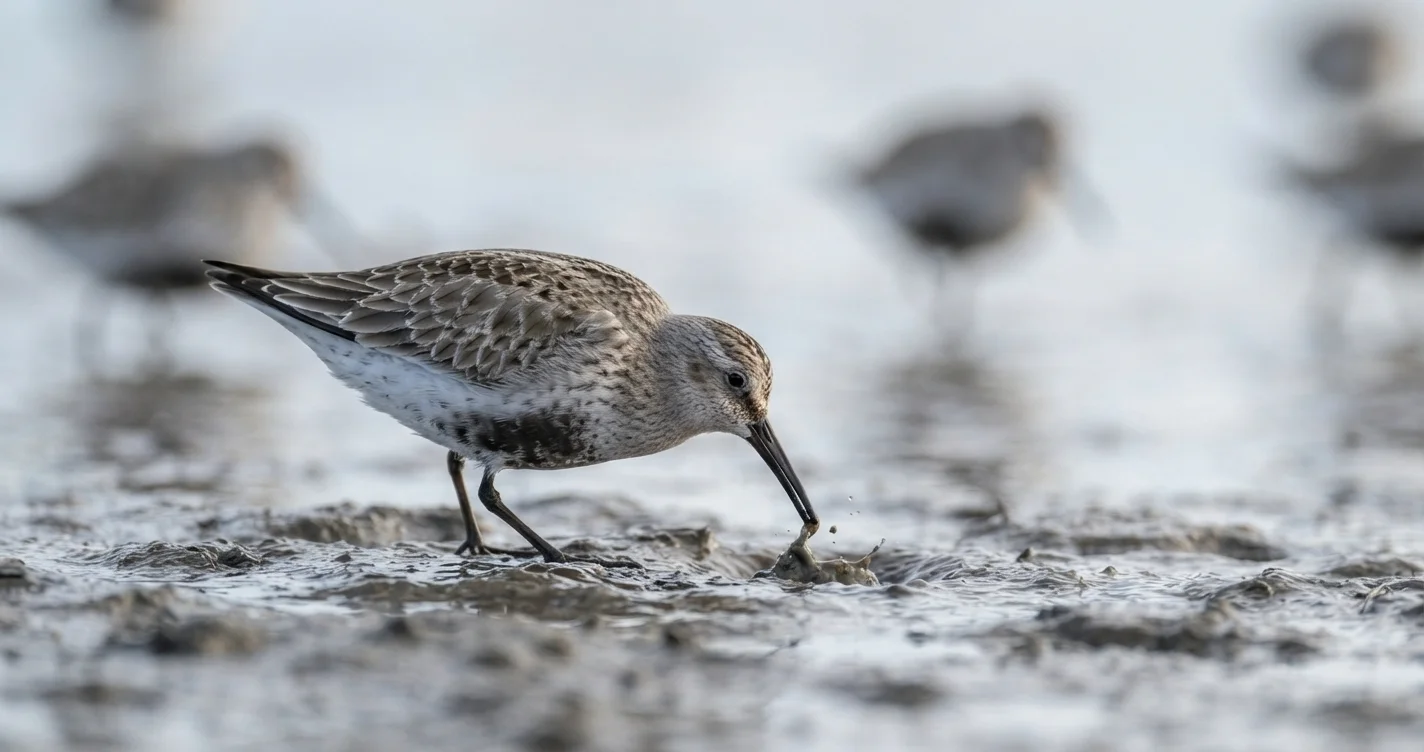
A muddy field in the middle of winter may look like one of the least inviting places for wildlife. Yet beneath its waterlogged surface lies a hidden supply of food that attracts flocks of remarkably adaptable shorebirds.
The dunlin (Calidris alpina) is a small migratory sandpiper that spends much of the winter searching for tiny invertebrates in mudflats, estuaries, coastal wetlands, and flooded agricultural fields.
Equipped with a sensitive, slightly curved bill, this bird can locate prey buried beneath the mud, even when its food is completely invisible.
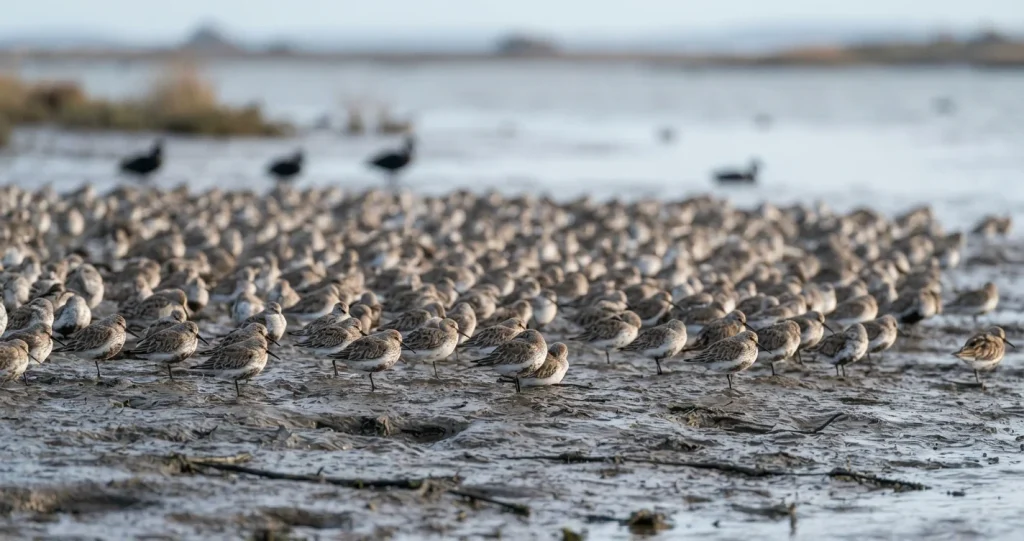
During winter, dunlins also gather in impressive flocks, sometimes transforming quiet wetlands into spectacular displays of synchronized flight.
Understanding their feeding habits reveals why muddy landscapes are among the most valuable winter habitats for migratory birds.
Table of Contents
- What Is a Dunlin?
- How to Identify Dunlins in Winter
- Where Dunlins Spend the Winter
- Dunlin Feeding Behavior: The Hidden Science Beneath the Mud
- Why Flooded Fields Attract Dunlins
- What Dunlins Eat During Winter
- Why Dunlins Gather in Large Winter Flocks
- The Ecological Importance of Mudflats and Wetlands
- In Your Own Yard: Supporting Shorebirds and Wetland Wildlife
- Frequently Asked Questions
What Is a Dunlin?
The dunlin is a small shorebird belonging to the sandpiper family, Scolopacidae.
It has a remarkably broad geographical distribution, breeding across Arctic and subarctic regions of North America, Europe, and Asia.
As temperatures fall, many populations migrate toward coastal environments and other wetlands where food remains accessible throughout winter.
In the United States, dunlins are familiar seasonal visitors along the Atlantic, Pacific, and Gulf coasts.
A Shorebird With Two Different Appearances
During the breeding season, dunlins develop reddish-brown upperparts and a distinctive black belly patch.
Winter brings a dramatic transformation.
Their colorful breeding feathers are replaced by grayish-brown upperparts and pale underparts, allowing them to blend into muddy shorelines and subdued winter landscapes.
This seasonal change can make identification challenging for inexperienced birdwatchers.
A Bird Adapted to Wet Landscapes
The dunlin’s compact body, moderately short legs, and sensitive bill are particularly well suited to feeding in shallow water and soft sediment.
Unlike birds that depend on visible seeds or insects, dunlins can exploit food resources hidden beneath the surface.
How to Identify Dunlins in Winter
Winter dunlins may initially resemble several other small sandpipers. However, a combination of physical characteristics and feeding behavior can help distinguish them.
Five Distinctive Identification Features
- Grayish-brown upperparts during winter.
- Pale belly and lightly streaked breast.
- Black legs.
- Moderately long, dark bill with a downward curve near its tip.
- Compact body measuring approximately 6–9 inches in length.
Their slightly curved bills are particularly useful identification features, although bill length varies among individuals and populations.
Watch Their Feeding Movements
Dunlins often walk rapidly across exposed mud, repeatedly inserting their bills into the sediment.
Their movements can appear almost mechanical as they alternate between short steps and rapid probing.
Identification During Flight
When a flock takes flight, look for narrow white wing stripes and a dark central area on the rump and tail, bordered by lighter feathers.
Large groups sometimes turn almost simultaneously, creating alternating flashes of dark upperparts and pale underparts.
Dunlins vs. Other Small Shorebirds
| Feature | Dunlin | Sanderling | Western sandpiper |
|---|---|---|---|
| Winter plumage | Grayish-brown | Very pale gray | Gray |
| Bill | Moderately long and curved | Short and relatively straight | Slightly curved |
| Legs | Black | Black | Black |
| Feeding habitat | Mudflats and flooded fields | Sandy beaches | Mudflats and shallow wetlands |
| Typical behavior | Frequent probing | Following retreating waves | Pecking and probing |
Because these species sometimes share habitats, identification is most reliable when several characteristics are considered together.
Where Dunlins Spend the Winter
Dunlins migrate considerable distances between their northern breeding territories and winter feeding grounds.
Their distribution during the colder months depends largely on suitable wetland habitat and accessible food.
Atlantic and Gulf Coast Habitats
Along the eastern United States, dunlins frequently occupy tidal mudflats, salt marshes, estuaries, and protected coastal bays.
Suitable habitats extend along much of the Atlantic Coast and into the Gulf of Mexico.
Pacific Coast Habitats
Pacific Coast populations often winter in productive estuaries, coastal wetlands, and agricultural landscapes.
Washington’s Puget Sound region, California’s coastal bays, and seasonally flooded areas of the Central Valley can provide important feeding opportunities.
Inland and Agricultural Wetlands
Although dunlins are commonly associated with coastal environments, they also use certain inland wetlands and flooded agricultural fields.
These alternative habitats can become especially valuable when tidal mudflats are submerged or when agricultural management creates suitable shallow-water feeding areas.
Dunlin Feeding Behavior: The Hidden Science Beneath the Mud
One of the most remarkable things about dunlins is their ability to find food without necessarily seeing it.
While a robin might watch for movement before capturing an earthworm, a dunlin can use its bill as a sensitive exploratory tool.
A Bill That Works Like a Sensory Probe
The tip of a dunlin’s bill is sensitive to touch, allowing the bird to detect small organisms concealed within wet sediment.
Surprisingly, according to the Cornell Lab of Ornithology, most of its feeding probes penetrate less than a quarter of an inch into the mud.
Even this shallow layer can contain an extraordinary abundance of microscopic and small marine organisms. All About Birds
The Remarkable Sewing-Machine Technique
When feeding intensively, dunlins sometimes insert their bills into the mud several times per second.
This rapid, repetitive movement resembles the action of a sewing machine.
By combining shallow probing with visual searches, the birds can exploit different types of prey without traveling great distances between feeding attempts.
Feeding in Complete Darkness
Dunlins do not depend entirely on daylight to find food.
Their tactile feeding abilities allow them to continue searching for invertebrates at night.
This adaptation is particularly valuable during winter, when daylight hours are shorter and low tides may occur after sunset. Audubon Field Guide
Why Tides Determine Feeding Schedules
As the tide retreats, previously submerged sediment becomes accessible.
Marine worms, tiny crustaceans, and mollusks provide feeding opportunities until the incoming tide covers the mud again.
During high tide, dunlins may move toward beaches, inland wetlands, or nearby agricultural fields.
Their daily routines are therefore influenced by the movements of the ocean as well as the availability of daylight.
Why Flooded Fields Attract Dunlins
A waterlogged agricultural field might represent a temporary inconvenience for farmers. For wintering shorebirds, however, suitable flooded ground can become a valuable feeding habitat.
Rain Makes Hidden Food Accessible
Winter rainfall softens soil and creates shallow pools across low-lying landscapes.
These conditions can make earthworms, insect larvae, and other small invertebrates easier for shorebirds to capture.
Dunlins often favor exposed mud and very shallow water rather than deeply flooded areas.
Agricultural Fields Supplement Coastal Food Sources
A 2013 study published in The Condor examined wintering dunlins at two estuaries in northern Puget Sound, Washington.
Using stable isotope analysis, researchers estimated that agricultural uplands supplied approximately 62% of the birds’ dietary nutrients overall during the study.
The contribution from agricultural habitats also increased later in winter.
Although these findings are specific to the study region, they demonstrate how important nearby farmland can be to some coastal shorebird populations. OUP Academic
Water Depth Makes a Difference
A deep pond may attract diving ducks, but dunlins require feeding areas where their relatively short legs allow them to walk comfortably.
Gradually sloping shorelines, shallow pools, and patches of exposed sediment tend to provide more suitable conditions.
What Dunlins Eat During Winter
Despite their small size, dunlins consume a surprisingly varied diet.
Their food choices depend on the habitat they occupy and the prey available at different times of the year.
| Food source | Common habitat |
|---|---|
| Marine worms | Tidal mudflats |
| Small clams | Estuaries and coastal sediments |
| Amphipods | Coastal wetlands |
| Earthworms | Moist agricultural fields |
| Midge larvae | Shallow freshwater wetlands |
| Small snails | Mudflats and marshes |
| Aquatic insects | Flooded fields and ponds |
An Important Source of Winter Energy
Small invertebrates provide nutrients that help shorebirds meet the energetic demands of cold weather.
However, each individual prey item may offer relatively little nourishment.
Consequently, dunlins often spend substantial periods searching for food, particularly when weather conditions increase their energy requirements.
Why Dunlins Gather in Large Winter Flocks
One of the most spectacular sights associated with dunlins is the sudden movement of hundreds or even thousands of birds across a winter sky.
Protection Through Collective Movement
Peregrine falcons and merlins are among the predators that may hunt wintering shorebirds.
Remaining in large groups may improve predator detection and make it more difficult for a hunting bird to isolate an individual.
When threatened, dunlins can form tightly coordinated aerial formations.
Finding Productive Feeding Areas
Flocking may also help individuals locate suitable feeding grounds by observing the movements of neighboring birds.
As tides and weather conditions change, entire groups may relocate between feeding and resting habitats.
In northern Puget Sound, historical surveys recorded gatherings exceeding 30,000 dunlins at several major bays. Audubon
Resting Between Feeding Periods
Feeding is only part of a dunlin’s winter routine.
When tidal flats become submerged, birds also need relatively undisturbed places to rest and conserve energy.
Protected beaches, islands, and suitable agricultural fields can provide these temporary refuges.
The Ecological Importance of Mudflats and Wetlands
Mudflats may appear empty, but they are among the most biologically fascinating coastal habitats.
Their sediments contain complex communities of organisms that sustain numerous species of migratory birds.
A Hidden Food Web
Bacteria, microscopic algae, marine worms, mollusks, and crustaceans form interconnected food webs within coastal sediments.
Dunlins are part of this system, transferring energy from small sediment-dwelling organisms into the wider ecosystem.
The Importance of Connected Habitats
Protecting coastal mudflats alone may not always satisfy the needs of wintering shorebirds.
Nearby freshwater wetlands, wet pastures, and suitable agricultural fields can provide complementary feeding and resting opportunities.
Maintaining these habitat connections allows birds to respond to changing environmental conditions.
Threats to Wintering Shorebirds
Wetland drainage, coastal development, pollution, human disturbance, and rising sea levels can reduce the availability of suitable feeding grounds.
The loss of shallow wetlands is particularly concerning for species that depend on accessible sediment rather than deep water.
In Your Own Yard: Supporting Shorebirds and Wetland Wildlife
Although dunlins rarely visit ordinary backyard gardens, homeowners can still contribute to the health of the aquatic environments these birds depend on.
Create a Rain Garden
A rain garden helps collect and slow stormwater runoff while supporting native plants and insects.
Where suitable, planted depressions can reduce the movement of sediment and pollutants into nearby waterways.
Choose native plants adapted to local rainfall patterns and soil conditions.
Preserve Existing Natural Wetlands
If your property contains natural seasonal wetlands, consider preserving their existing ecological functions.
Consult local conservation authorities before draining, excavating, or modifying these areas.
Reduce Excess Fertilizer and Pesticides
Chemicals applied to gardens can move into nearby streams, rivers, and coastal environments.
Careful fertilizer use and integrated pest management can help reduce unnecessary impacts on aquatic food webs.
Plan a Winter Dunlin-Watching Trip
Visit a coastal wildlife refuge, estuary, public wetland reserve, or permitted viewing area between November and March.
Check local tide tables before visiting. Falling tides often expose new feeding grounds, while rising tides may concentrate birds closer to suitable high-tide resting areas.
Bring binoculars or a spotting scope, remain on designated trails, and keep a comfortable distance from feeding flocks.
With patience, you may witness hundreds of dunlins probing the mud before rising together into the winter sky.
Frequently Asked Questions
1. Why do dunlins feed in flooded fields during winter?
Flooded fields can provide accessible earthworms, insect larvae, and other small invertebrates. These habitats may supplement coastal feeding grounds, particularly when high tides cover mudflats.
2. Can dunlins find food at night?
Yes. Dunlins have sensitive bill tips that help them detect concealed prey through touch. This adaptation allows them to exploit feeding opportunities after dark.
3. Why do dunlins lose their black belly patch in winter?
Dunlins undergo seasonal feather replacement. Their distinctive breeding plumage is replaced by more subdued grayish-brown and white winter feathers, which blend into many nonbreeding habitats.
Conclusion
The next time you pass a muddy field or an exposed coastal flat, remember that an entire ecosystem may be thriving just beneath its surface.
The dunlin reveals how specialized feeding techniques, seasonal migration, and flexible habitat choices allow small birds to survive challenging winter conditions.
Its ability to discover hidden food transforms seemingly barren landscapes into valuable feeding grounds.
Sometimes, the most extraordinary examples of nature’s resilience are found in the places we are most likely to overlook.
External Sources
1. Dunlins Find Food Less Than a Quarter-Inch Beneath the Mud
Despite having relatively long bills, dunlins generally use very shallow feeding probes. Their sensitive bill tips also allow them to locate prey after dark, Cornell Lab of Ornithology. https://www.allaboutbirds.org/guide/Dunlin/lifehistory.
2. Thousands of Dunlins Leave When Mudflats Freeze
Winter bird surveys in Puget Sound documented thousands of dunlins leaving an area after ice covered their feeding grounds and returning when conditions improved, Washington Department of Fish and Wildlife. https://wdfw.wa.gov/sites/default/files/publications/02202/wdfw02202.pdf.