
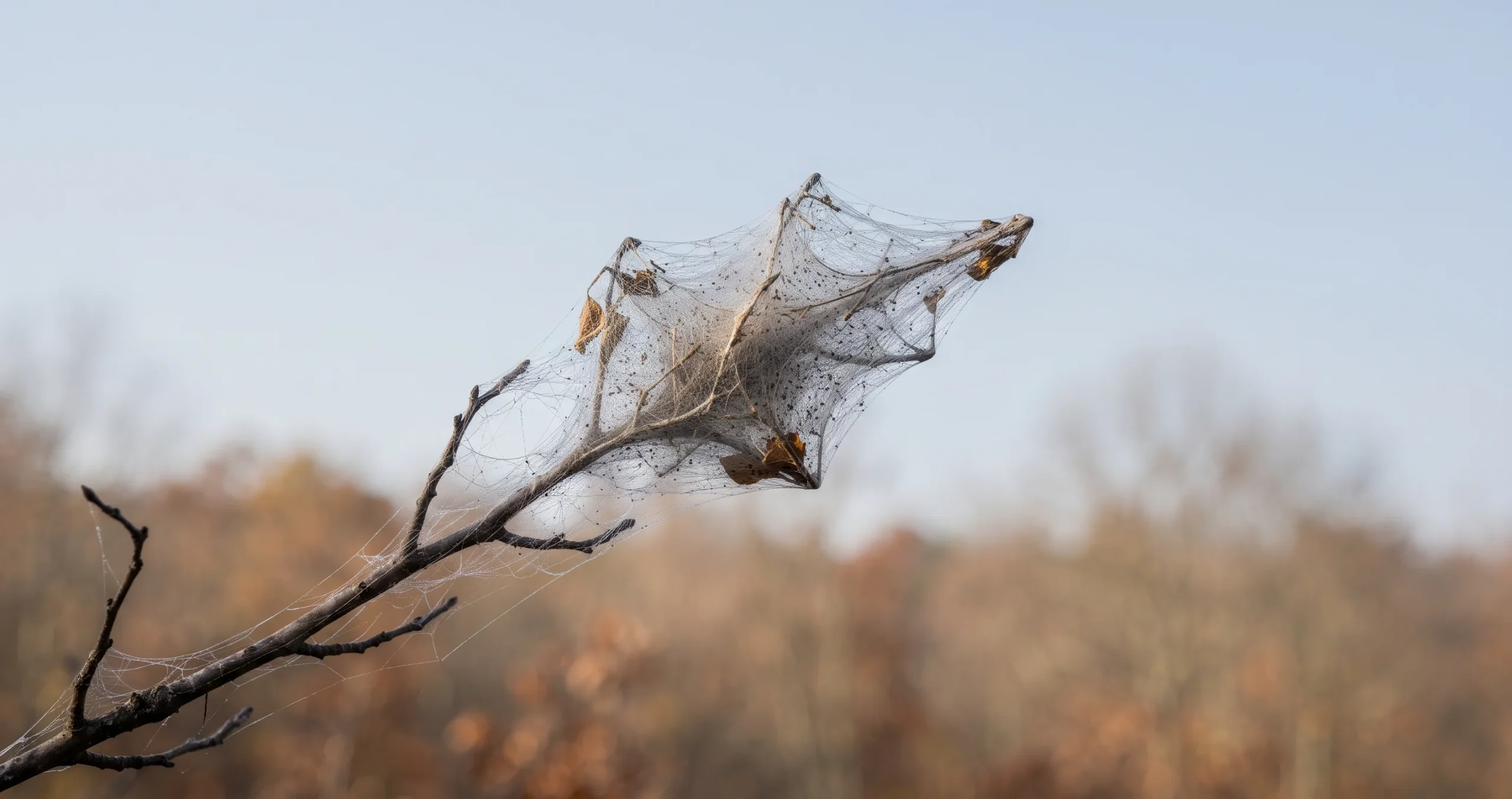
Imagine walking through your backyard in late summer and discovering what looks like a giant spiderweb wrapped around the end of a tree branch. Inside the silky structure, dozens of tiny caterpillars move among brown leaves and dark specks.
It looks alarming. The branch appears trapped, the leaves are disappearing, and the web seems to grow larger every day.
But the fall webworm (Hyphantria cunea) has a surprising secret: although its nests can look destructive, the damage is often more cosmetic than dangerous to a healthy, established tree.
These native North American moth caterpillars create communal silk shelters while feeding on leaves. Their activity can make trees look ragged, especially during late summer and early fall.
Understanding their life cycle, feeding habits, and natural enemies helps gardeners decide when to intervene and when to let nature take its course.
In many cases, the most effective response is simply to recognize what’s happening.
Table of Contents
- What Are Fall Webworm Nests?
- Fall Webworm: The Science Behind the Silky Nests
- How to Identify Fall Webworm Caterpillars
- Which Trees Do Fall Webworms Attack?
- Are Fall Webworm Nests Harmful to Trees?
- Fall Webworm vs. Eastern Tent Caterpillar
- The Fall Webworm Life Cycle
- Natural Predators and Ecological Benefits
- How to Manage Fall Webworm Nests Safely
- Common Mistakes When Treating Webworm Infestations
- In Your Own Yard: A Practical Tree Protection Plan
- Frequently Asked Questions
What Are Fall Webworm Nests?
Fall webworm nests are communal silk structures produced by the caterpillars of the fall webworm moth.
Unlike spiders, these insects do not spin webs to capture prey. Their silk shelters protect groups of feeding caterpillars and enclose the leaves they consume.
The nests usually appear near the ends of branches.
As the caterpillars grow, they extend the web to include additional foliage.
Why the Webs Look So Dramatic
A single nest may surround numerous leaves and small twigs.
Inside, caterpillars feed while their waste, shed skins, and damaged foliage accumulate.
This mixture can make the structure appear dirty or diseased.
Large nests are especially noticeable after surrounding leaves begin changing color.
When Fall Webworm Nests Appear
In much of the United States, fall webworm activity becomes noticeable during summer and early fall.
Timing varies with latitude, climate, and the number of generations produced each year.
Northern populations often have fewer generations than populations in warmer southern regions.
Despite the name, fall webworms can appear well before autumn.
Why Some Trees Have Multiple Nests
Female moths lay clusters of eggs on host plants.
When several egg masses occur on the same tree, multiple groups of caterpillars may develop.
Heavy infestations can produce numerous webs across the canopy.
However, the presence of several nests does not automatically mean the tree will suffer lasting damage.
Fall Webworm: The Science Behind the Silky Nests
The silk produced by fall webworm caterpillars is central to their survival.
Rather than feeding individually across exposed branches, young caterpillars often remain together within a shared structure.
This behavior creates a protected feeding environment.
How Caterpillars Produce Silk
Like many moth larvae, fall webworm caterpillars have specialized silk-producing glands.
Silk proteins are released through a structure called the spinneret, located near the mouthparts.
As the material emerges, it forms fine threads.
The caterpillars use these threads to build and expand their communal shelter.
Why They Build Webs Around Leaves
Fall webworms feed on foliage enclosed within the nest.
The web helps keep the group together and creates a physical barrier between the caterpillars and parts of the outside environment.
It may reduce exposure to some predators and weather conditions.
However, the web is not completely protective.
Parasitoid wasps, predatory insects, and other natural enemies can still attack fall webworms.
How the Nest Expands
Young caterpillars initially feed together on a limited number of leaves.
As they grow and consume more foliage, they extend the web over additional leaves.
The shelter can become considerably larger during the larval stage.
Older caterpillars may eventually disperse from the nest before pupating.
Why the Web Contains Brown Leaves
Leaves inside the nest gradually become damaged as caterpillars consume their tissues.
Some leaves turn brown, dry out, or become skeletonized.
Frass, the technical term for insect droppings, also accumulates inside.
This creates the characteristic appearance of a large, messy web filled with dead foliage.
Why Timing Matters for Tree Health
The timing of defoliation strongly influences its consequences.
Trees normally produce much of their seasonal energy through photosynthesis during spring and summer.
When fall webworms remove leaves late in the growing season, many established deciduous trees have already accumulated substantial energy reserves.
That helps explain why late-season feeding often causes less serious damage than comparable defoliation earlier in the year.
However, repeated severe defoliation, drought, disease, and other stresses can increase the risk of long-term problems.
How to Identify Fall Webworm Caterpillars
Correct identification is important because several other insects produce silk structures on trees.
Caterpillar Appearance
Fall webworm caterpillars are often pale yellowish or greenish, with dark spots and long hairs.
Color varies among populations and developmental stages.
Some individuals appear darker, while others have pale bodies with contrasting markings.
The hairs give them a fuzzy appearance.
Adult Moths
Adult fall webworm moths are generally white.
Some have dark spots on their wings, while others appear almost entirely white.
Their appearance varies geographically and among individuals.
Adult moths do not create the large silk nests. The caterpillars are responsible.
The Most Reliable Identification Clue
The location and structure of the web are especially useful.
Fall webworms typically enclose leaves near branch tips and feed within the expanding nest.
This differs from several other web-producing caterpillars that construct shelters in branch forks or use silk in different ways.
Which Trees Do Fall Webworms Attack?
Fall webworms are generalist feeders.
They can use a remarkably wide range of deciduous trees and shrubs.
Common Host Trees
Frequently reported hosts include:
- Hickory and walnut
- Pecan
- Sweetgum
- Persimmon
- Mulberry
- Cherry
- Elm
- Willow
Host preferences vary by region.
Some tree species may experience frequent infestations in one area but relatively little activity elsewhere.
Why Deciduous Trees Are Common Targets
Fall webworms primarily consume the leaves of broadleaf trees.
Their feeding habits are closely associated with the seasonal growth and decline of deciduous foliage.
Evergreen conifers are not typical hosts.
Do They Prefer Weak Trees?
Not necessarily.
Fall webworms can infest healthy trees as well as stressed ones.
The presence of nests alone is not evidence that a tree is diseased.
However, a tree already weakened by drought, root damage, or disease may be less able to tolerate extensive foliage loss.
Are Fall Webworm Nests Harmful to Trees?
For many mature, healthy deciduous trees, fall webworm feeding is primarily an aesthetic problem.
The webs may be unattractive, but they often do not cause permanent damage.
Why Healthy Trees Usually Recover
Deciduous trees naturally lose their leaves each autumn.
When fall webworms feed relatively late in the growing season, trees may already have stored much of the energy needed for dormancy and spring growth.
In many cases, affected trees produce normal foliage the following year.
When Damage Becomes More Serious
Young trees have smaller crowns and fewer stored resources than mature trees.
Extensive defoliation can therefore be more consequential.
Repeated infestations, prolonged drought, poor soil conditions, and other stresses may also increase vulnerability.
Can Fall Webworms Kill a Tree?
Death from a single typical late-season infestation is uncommon in otherwise healthy, established trees.
However, severe or repeated defoliation can contribute to decline when combined with other problems.
The overall condition of the tree matters more than the dramatic appearance of the web alone.
Does the Web Damage the Bark?
Fall webworms primarily damage foliage.
Their silk does not normally injure bark or girdle branches.
Brown leaves trapped inside a web may make a branch look dead even when the underlying wood remains healthy.
Fall Webworm vs. Eastern Tent Caterpillar
Fall webworms are frequently confused with eastern tent caterpillars (Malacosoma americanum).
Both produce silk structures, but their habits differ.
| Feature | Fall webworm | Eastern tent caterpillar |
|---|---|---|
| Typical season | Summer to fall | Spring |
| Web location | Around leaves at branch tips | In forks of branches |
| Feeding behavior | Feeds largely within the web | Leaves the tent to feed |
| Common hosts | Many deciduous trees | Especially cherry and apple relatives |
| Nest appearance | Expanding web enclosing foliage | More compact tent in a branch junction |
The most useful distinction is simple: fall webworms surround the leaves they eat, while eastern tent caterpillars generally leave their tent to feed.
This difference helps homeowners identify the insects without handling them.
The Fall Webworm Life Cycle
Understanding the insect’s development helps explain why nests appear suddenly and then seem to disappear.
Eggs and Newly Hatched Caterpillars
Female moths deposit egg masses on the undersides of host leaves.
After hatching, young caterpillars begin feeding and producing silk.
Their first shelters may be small enough to escape notice.
Growing Caterpillars and Expanding Webs
As larvae develop, they consume more foliage and enlarge their communal nest.
This is the stage when homeowners most often discover the infestation.
The caterpillars pass through several molts before reaching maturity.
Pupation and Overwintering
Mature caterpillars eventually leave their webs and seek protected places to pupate.
Pupae may be found in leaf litter, soil debris, or sheltered crevices.
In regions with cold winters, fall webworms generally overwinter as pupae.
Adult moths emerge when seasonal conditions become suitable.
The number of generations varies geographically, which explains why southern states may experience a longer period of activity.
Natural Predators and Ecological Benefits
Although fall webworms can damage leaves, they are also part of the natural food web.
Birds That Eat Caterpillars
Some insect-eating birds consume fall webworm caterpillars.
Birds may also feed on moths and other developmental stages when accessible.
The silk shelter can complicate access, but it does not make the insects completely safe from predators.
Parasitoid Wasps and Flies
Certain parasitoid wasps and flies develop in or on caterpillar hosts.
Their offspring eventually kill the host insect.
These natural enemies can contribute to regulating fall webworm populations.
Why Biodiversity Matters
Gardens with varied vegetation may support a wider range of insect predators and parasitoids.
Native flowering plants, shrubs, and trees can provide resources for beneficial insects.
Avoiding unnecessary broad-spectrum insecticide applications helps preserve these ecological relationships.
How to Manage Fall Webworm Nests Safely
Most established trees do not require treatment for a small number of late-season nests.
When management is justified, the simplest methods are often sufficient.
Remove Small, Accessible Nests
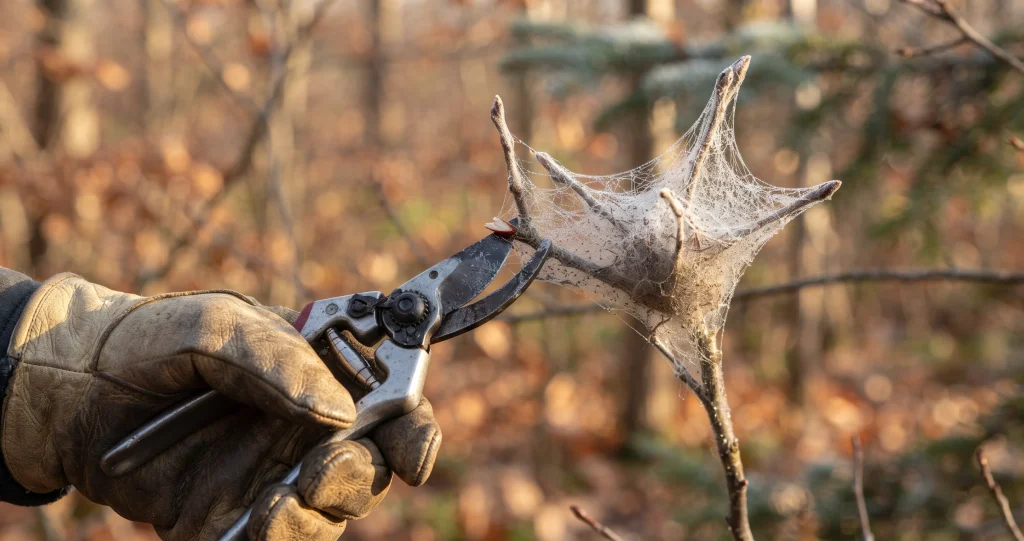
On small trees, early nests can sometimes be removed by pruning a lightly infested branch tip.
Use clean pruning tools and avoid removing large amounts of healthy wood.
Dispose of infested material according to local guidance.
Do not climb trees or attempt to reach branches near electrical lines.
Open Webs to Natural Predators
For low, accessible nests, carefully opening the silk with a long tool may expose caterpillars to predators.
Results vary, and this approach is less useful after the caterpillars have completed feeding.
Avoid damaging branches in the process.
Consider Biological Controls When Necessary
Products containing appropriate strains of Bacillus thuringiensis subsp. kurstaki (Bt) can control certain young caterpillars when applied correctly.
However, silk shelters can make thorough treatment difficult.
Bt products can also affect non-target butterfly and moth caterpillars.
Use only products labeled for the pest and application site, follow all label instructions, and reserve treatment for situations where it is genuinely warranted.
Avoid Burning the Webs
Burning nests while they remain on trees is unsafe.
Flames can damage living bark and branches, injure people, and create fire hazards.
Chemical treatments and physical removal should also never be attempted near power lines.
Common Mistakes When Treating Webworm Infestations
A dramatic-looking nest can encourage unnecessary intervention.
Treating Every Web as an Emergency
A few late-season nests on a large, healthy tree usually do not justify aggressive treatment.
Assess the amount of foliage lost and the tree’s overall health before acting.
Spraying Empty Nests
By late fall, many caterpillars may already have left their shelters.
Spraying an abandoned web provides little benefit.
Removing Too Many Branches
Heavy pruning can create more stress than the caterpillars themselves.
If removing a nest requires sacrificing major branches, leaving it alone may be preferable.
Using Broad-Spectrum Insecticides
Unnecessary insecticide applications may harm beneficial insects and other organisms.
Targeted management and observation are often better choices.
In Your Own Yard: A Practical Tree Protection Plan
A fall webworm nest provides an opportunity to observe a fascinating insect while protecting your trees.
Begin With Identification
Look at the web’s location.
If it surrounds leaves at the outer ends of branches during summer or fall, fall webworms are a likely explanation.
Check for feeding caterpillars before deciding on treatment.
Evaluate the Tree’s Condition
A mature tree with a few nests and otherwise healthy foliage is usually at low risk.
A recently planted tree with substantial defoliation deserves closer attention.
Consider drought, previous pest damage, and other stresses.
Support Healthy Growth
Water trees appropriately during extended dry periods.
Protect the root zone from soil compaction and mechanical injury.
Maintain organic mulch where suitable, keeping it away from the trunk.
Healthy growing conditions improve a tree’s ability to tolerate occasional defoliation.
Preserve Natural Enemies
Maintain a diversity of appropriate native plants.
Avoid unnecessary pesticide use.
Allow beneficial predators and parasitoids to contribute to natural population control.
Observe the Seasonal Changes
Photograph a small nest periodically from a safe distance.
Notice how it expands as the caterpillars grow.
Later, the larvae may disappear, leaving behind a web filled with dried leaves.
The experience offers a close look at an insect’s development without disturbing it.
Frequently Asked Questions
1. Should I remove fall webworm nests from my trees?
Usually, removal is unnecessary when a healthy, mature tree has only a few late-season nests. Young, stressed, or heavily defoliated trees may benefit from early, targeted management. Consider the tree’s condition and the extent of feeding before taking action.
2. Do fall webworms bite or sting people?
Fall webworm caterpillars are not considered stinging caterpillars, and they do not normally pose a serious threat to people. However, their hairs may irritate sensitive skin. Avoid unnecessary handling and wash exposed skin if irritation occurs.
3. Will fall webworms return next year?
They may return, especially where suitable host trees are available. However, infestation severity varies with weather, natural enemies, and local populations. A tree with several nests one year will not necessarily experience the same level of feeding the next.
Conclusion
Return to that strange white web hanging from a backyard tree.
At first glance, it resembles something dangerous spreading through the branches. Inside, however, a colony of caterpillars is simply completing an important stage of its life cycle.
The fall webworm can certainly damage foliage, and severe infestations deserve attention. But for many healthy deciduous trees, a few late-season nests are far less threatening than their appearance suggests.
Recognizing the insect, understanding its timing, and evaluating the tree’s overall health can prevent unnecessary pruning and pesticide applications.
Sometimes, the most useful gardening decision is to observe rather than intervene.
And that mysterious web among the autumn leaves becomes something entirely different: a temporary nursery for one of North America’s native moths.
External Sources
1. Clemson Cooperative Extension — Fall Webworm
Clemson Extension reports that fall webworm larvae can regulate temperatures inside their silk nests, with temperatures reported above 122°F (50°C). Their webs are more than simple shelters. Clemson University.
2. Fall Webworm Genomes Yield Insights Into Rapid Adaptation of Invasive Species
Researchers report that fall webworms can feed on more than 600 species of trees and shrubs, and females may lay as many as 900 eggs. Their adaptability helps explain their success outside North America. Nature Ecology & Evolution.
3. The Fall Webworm of North America in Europe (1948)
A historical report published in Nature documented the first European fall webworm moth near Budapest in 1940. By the late 1940s, the insect had spread through large parts of Hungary. This is an unusual reversal of the familiar story of invasive insects arriving in North America. Nature.