
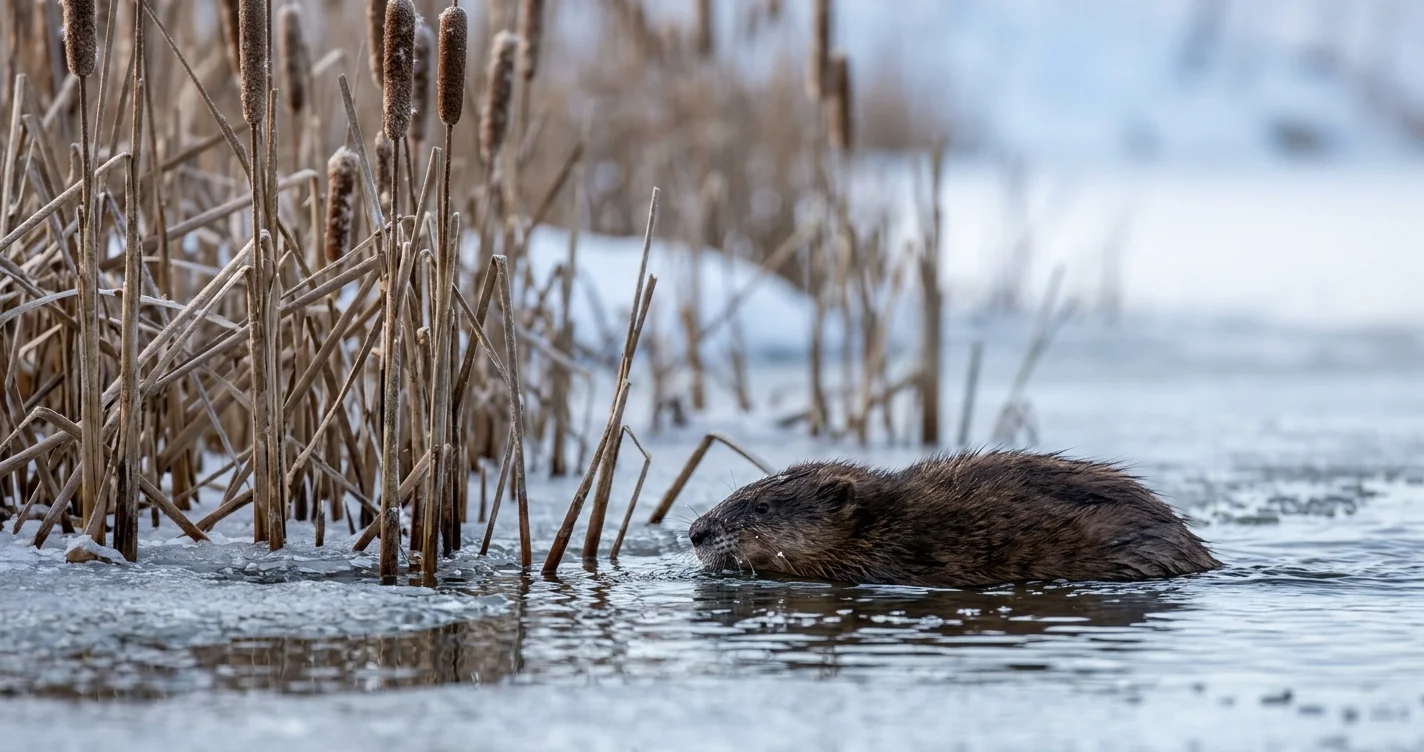
Imagine walking beside a frozen pond in January. The water is hidden beneath a thick sheet of ice, the shoreline is silent, and the marsh grasses have turned brown. Yet somewhere below that frozen surface, a muskrat is swimming through dark, icy water.
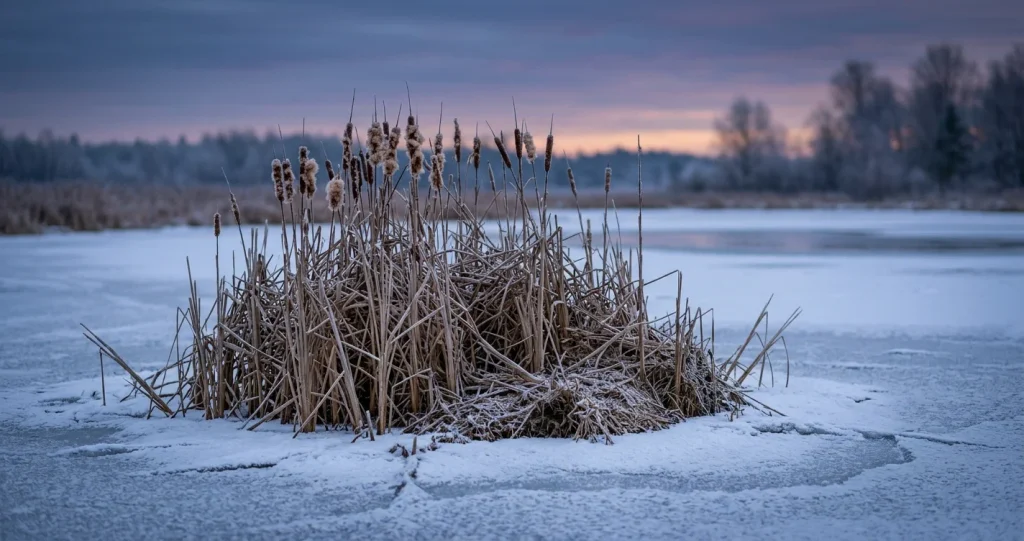
Even more surprising, a small mound of vegetation rising above the ice may be part of its winter survival system.
These structures are known as muskrat push-ups. Built from aquatic plants and other marsh materials, they can provide protected places where muskrats surface, breathe, and sometimes feed without traveling all the way back to their main lodge or burrow.
While many mammals escape winter by hibernating or migrating, muskrats remain active beneath the ice. Their survival depends on underwater pathways, accessible air spaces, stored food, and a remarkable ability to live in wetlands that appear completely frozen.
Table of Contents
- The Hidden World Beneath a Frozen Marsh
- What Are Muskrat Push-Ups?
- Why Muskrats Build Push-Ups Before Winter
- How Muskrat Push-Ups Help Muskrats Survive Under Ice
- How Muskrats Swim Beneath Frozen Water
- What Muskrats Eat During Winter
- Muskrat Lodges, Bank Burrows, and Push-Ups
- How Muskrats Build Their Winter Shelters
- Do Muskrats Hibernate in Winter?
- Where Muskrats Live in North America
- Why Muskrats Matter to Wetland Ecosystems
- Threats to Muskrats During Winter
- In Your Own Yard: Helping Wetland Wildlife
- Frequently Asked Questions
The Hidden World Beneath a Frozen Marsh
A frozen marsh can look almost lifeless.
Cattails stand motionless above the snow, shallow pools disappear beneath ice, and the usual sounds of splashing animals become difficult to detect.
But winter does not bring all wetland activity to a stop.
Muskrats, scientifically known as Ondatra zibethicus, are semiaquatic rodents native to North America. They inhabit marshes, ponds, lakes, slow-moving streams, and other wetlands with suitable vegetation.
Unlike beavers, which are much larger and have broad, flattened tails, muskrats have long, narrow tails flattened from side to side.
They remain active throughout winter, often traveling underwater between shelter and feeding locations.
Their winter structures offer a fascinating glimpse into this hidden activity.
What Are Muskrat Push-Ups?
Muskrat push-ups are small mounds of vegetation that muskrats construct in shallow wetland environments, often before or during the early stages of winter.
They may consist of cattail fragments, reeds, mud, and other available plant material.
Unlike a large muskrat lodge, a push-up is generally a smaller, temporary structure associated with winter access to air and feeding areas.
A small shelter with an important purpose
A push-up can contain an opening or chamber connected to the water beneath the ice.
A muskrat may enter from below, raise its head into the air space, and rest briefly before continuing its underwater journey.
Some structures also provide protected places to handle or consume food.
Not every mound in a frozen marsh is a muskrat push-up. Identification depends on its construction, location, and evidence of muskrat activity.
Why Muskrats Build Push-Ups Before Winter
As temperatures fall, open water becomes less accessible.
For an animal that must breathe air, ice changes the entire landscape.
A muskrat can no longer simply surface wherever it chooses.
Instead, it needs reliable routes to places where breathing remains possible.
Push-ups can extend the network of accessible air spaces beyond a muskrat’s primary shelter.
Shortening underwater journeys
Traveling beneath ice requires careful use of oxygen.
A push-up located near feeding habitat may reduce the distance a muskrat must swim before reaching air.
This can be especially useful when ice prevents access to the open surface.
The number and location of push-ups vary with water depth, vegetation, ice conditions, and local muskrat behavior.
How Muskrat Push-Ups Help Muskrats Survive Under Ice
The science behind muskrat push-ups becomes clearer when we consider three winter challenges: breathing, feeding, and moving safely beneath ice.
Access to breathable air
Muskrats are mammals with lungs. They cannot extract oxygen from water through gills.
Although they can remain submerged for several minutes, they must eventually breathe atmospheric air.
A properly functioning push-up provides an air space connected to underwater access.
The surrounding vegetation and frozen material can help enclose this small chamber.
However, push-ups are not unlimited oxygen supplies. Their usefulness depends on their structure, available air, and changing environmental conditions.
Protected feeding locations
Muskrats often feed on aquatic vegetation.
During winter, some plants remain accessible beneath the ice, particularly their submerged stems, roots, and underground storage structures.
A muskrat may collect food underwater and bring it into a push-up or another protected space.
This allows feeding without exposure to the frozen surface.
A network of winter access points
In suitable wetlands, multiple push-ups can create a series of places where muskrats reach air.
These structures may function alongside lodges, bank burrows, and other accessible openings.
Rather than providing one permanent solution, they form part of a flexible winter strategy.
Their effectiveness depends on local ice conditions and the availability of food and water.
How Muskrats Swim Beneath Frozen Water
Muskrats are well adapted to swimming.
Their hind feet are relatively large, with stiff hairs along the toes that assist movement through water.
Their long, laterally flattened tails also help with propulsion and maneuvering.
Conserving energy underwater
Muskrats can dive to reach vegetation, escape disturbance, or travel between shelter sites.
Like other diving mammals, they have physiological responses that help manage oxygen use during submersion.
However, they have limits.
A muskrat cannot remain underwater indefinitely, and winter survival depends on finding accessible breathing spaces.
Following familiar underwater routes
Muskrats may use repeated routes through submerged vegetation and between shelter locations.
Water depth, ice thickness, and vegetation can influence how easily they move.
A marsh with suitable underwater passages and dependable access to air offers advantages over one that freezes extensively.
What Muskrats Eat During Winter
Muskrats are primarily herbivorous, although they sometimes consume animal material.
Aquatic plants form a major part of their diet.
Common foods include cattails, bulrushes, sedges, and other wetland vegetation.
Finding food beneath the ice
When leaves and stems above the surface become inaccessible, muskrats can feed on submerged plant parts.
Rhizomes, roots, and lower stems may remain available in unfrozen water and sediment.
Food availability depends on the wetland’s plant community and winter conditions.
Some muskrats also consume freshwater mussels or other aquatic animals, but the importance of these foods varies.
A healthy, diverse wetland can provide multiple feeding opportunities during the cold season.
Muskrat Lodges, Bank Burrows, and Push-Ups
Muskrats use several kinds of shelter, and these structures serve different purposes.
Muskrat lodges
In marshes with abundant vegetation, muskrats may build substantial lodges from cattails, reeds, and mud.
These structures often contain interior chambers above the waterline, with underwater entrances.
Lodges can provide protected shelter during different seasons.
Bank burrows
Where suitable banks are available, muskrats may excavate burrows with entrances below the water surface.
Interior nesting or resting chambers are generally positioned above the waterline.
Winter push-ups
Push-ups are usually smaller structures that provide additional winter access to air and sometimes feeding space.
They should not be confused with full-sized lodges or beaver houses.
The type of shelter used depends on the wetland and the resources available.
How Muskrats Build Their Winter Shelters
Muskrats gather vegetation using their mouths and forefeet.
In areas with cattails or similar plants, they can assemble wet material into mounds.
As temperatures drop, ice may help stabilize the surrounding structure.
Building with local materials
The construction process is practical rather than decorative.
Muskrats use plant material that is readily available within their habitat.
Some winter structures are associated with openings maintained through developing ice.
The final shape varies, so not every push-up resembles a perfect dome.
Its essential feature is functional access from the water below to a protected space above the waterline.
Do Muskrats Hibernate in Winter?
Muskrats do not undergo true seasonal hibernation.
They remain active, feeding and moving through their wetland habitat even during prolonged cold weather.
This distinguishes them from mammals that spend winter in extended periods of deep torpor.
Staying active in a frozen landscape
A muskrat’s thick fur helps provide insulation in cold water.
Its dense underfur traps air, helping reduce heat loss.
Still, swimming beneath ice requires energy, and cold conditions can increase the importance of dependable food and shelter.
Muskrats survive winter through behavioral and physical adaptations rather than sleeping through the season.
Where Muskrats Live in North America
Muskrats occur across much of the United States and Canada wherever suitable wetland habitat exists.
They are associated with freshwater marshes, ponds, lakes, drainage channels, and slow-moving rivers.
They also occupy some brackish wetlands.
Winter conditions vary by region
Northern populations may experience long periods of ice cover.
In milder climates, water may remain partly or completely open throughout winter.
Consequently, not every muskrat population needs to build the same kinds of winter structures.
Push-ups are especially relevant where seasonal ice limits access to the water’s surface.
Why Muskrats Matter to Wetland Ecosystems
Muskrats are more than residents of marshes.
Their feeding and construction activities can influence wetland vegetation and habitat structure.
Changing plant communities
By eating and cutting aquatic plants, muskrats can create openings within dense vegetation.
These changes may affect water movement, plant growth, and habitat availability for other organisms.
The ecological effects depend on muskrat abundance and wetland conditions.
Part of the food web
Muskrats are prey for animals such as mink, foxes, coyotes, and birds of prey.
Their presence links aquatic plant production to predators and other components of the wetland food web.
They are therefore both consumers and ecosystem modifiers.
Threats to Muskrats During Winter
Winter presents several challenges beyond low temperatures.
Water-level changes
Rapid changes in water levels can affect access to lodges, burrows, and push-ups.
If water becomes too shallow or freezes extensively, underwater movement may become difficult.
Flooding can also damage shelters.
Habitat degradation
Wetland drainage, pollution, shoreline alteration, and the loss of aquatic vegetation can reduce suitable habitat.
Muskrats depend on healthy wetlands for both food and shelter.
Predation and harsh conditions
Predators remain active during winter.
Muskrats must balance feeding needs with the risks of moving through exposed or unfamiliar areas.
Severe conditions can affect local populations, although outcomes vary by region and habitat.
In Your Own Yard: Helping Wetland Wildlife
You do not need a large marsh on your property to support healthier aquatic ecosystems.
Gardens, drainage areas, and neighborhood landscapes can influence nearby waterways.
Reduce polluted runoff
Use fertilizers carefully and avoid applying them before heavy rain.
Prevent pesticides, motor oil, and other contaminants from entering storm drains.
Protect natural shoreline vegetation
If your property borders a pond or stream, maintaining appropriate native vegetation can help reduce erosion and provide habitat.
Avoid unnecessary clearing of wetland plants.
Leave wildlife structures undisturbed
Muskrat lodges and push-ups should not be opened or dismantled for observation.
Disturbing these structures during winter can interfere with the animals’ access to shelter and air.
Where muskrat activity creates property concerns, consult local wildlife professionals about lawful, humane management options.
Protecting wetland habitat benefits many species beyond muskrats, including amphibians, waterfowl, aquatic insects, and fish.
Frequently Asked Questions
What is a muskrat push-up?
A muskrat push-up is a relatively small mound of vegetation associated with winter activity in frozen wetlands. It can provide an accessible air space above the waterline, connected to the water beneath the ice, and may also serve as a protected feeding location.
How long can muskrats stay underwater in winter?
Muskrats can remain submerged for several minutes, but the duration varies with activity and conditions. They still need atmospheric oxygen, making lodges, burrows, push-ups, and other accessible air spaces important beneath ice.
Do muskrats sleep through the winter?
No. Muskrats remain active throughout winter. They continue swimming, feeding, and using wetland shelters even when ponds and marshes are covered by ice.
Conclusion
Return to that silent January marsh.
The pond still looks frozen and empty, but beneath the ice, a muskrat may be moving between submerged plants and hidden breathing spaces.
Those small mounds of vegetation are not simply frozen debris.
Muskrat push-ups reveal an ingenious winter strategy built around access to air, food, and shelter.
They remind us that even when a wetland appears motionless, an intricate world of wildlife activity may continue just beneath the surface.
External Sources
1. University of Michigan — Muskrat Species Account
Provides information about Ondatra zibethicus, its habitat, diet, behavior, and reproduction.
2. Encyclopaedia Britannica — Muskrat
Provides a general biological reference for muskrat identification, habitat, aquatic behavior, and feeding.